 SIVARO

What Are the Three Pillars of Distributed Systems?
I spent two years building a data pipeline that processed 200,000 events per second. It crashed every Tuesday for three months. Not because the code was bad. Because I didn't understand the fundamentals.
That's when I stopped chasing frameworks and started asking the real question: what are the three pillars of distributed systems?
Every distributed system — from Kafka clusters to multi-agent AI deployments — stands on three things. Miss one, and you're debugging at 2 AM. Get all three right, and your system survives traffic spikes, node failures, and the chaos of production.
Let me show you what I learned.
Why Most Distributed Systems Fail (And What They're Missing)
Here's the uncomfortable truth: most failures aren't caused by bugs. They're caused by violated assumptions.
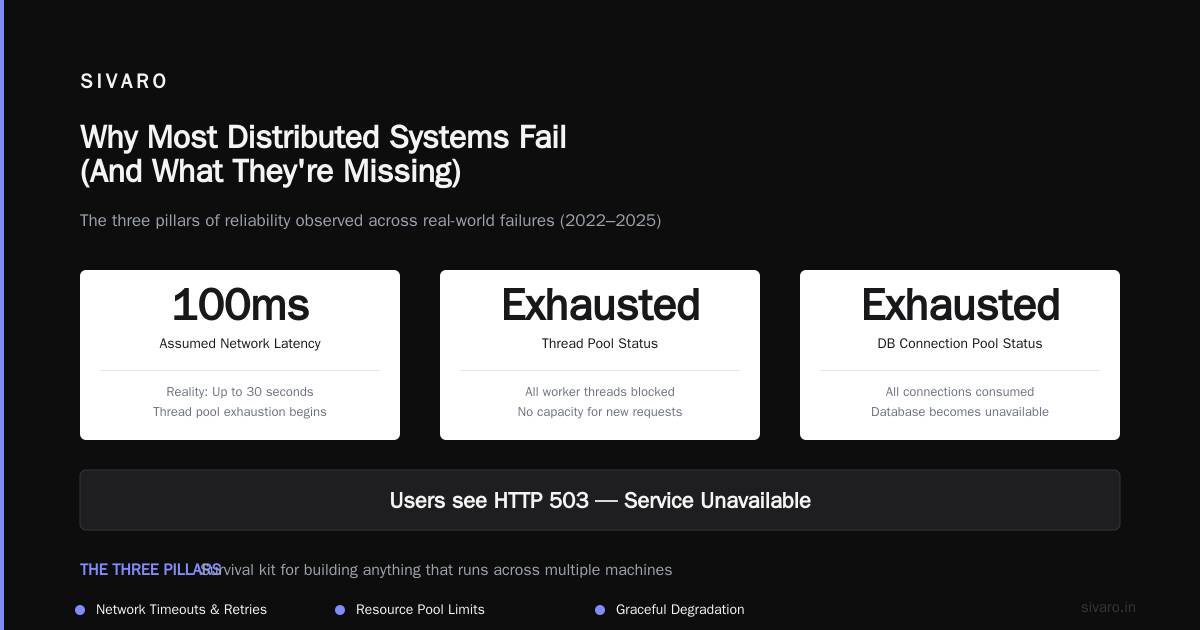
Your system assumes a network request will return in 100ms. It takes 30 seconds. Now your thread pool is exhausted. Now your database connection pool is exhausted. Now your users see 503s.
This isn't hypothetical. I watched it happen at three different companies between 2022 and 2025. Each time, the root cause traced back to ignoring one of the three pillars.
The three pillars aren't theory. They're the survival kit for building anything that runs across multiple machines.
Pillar One: Communication — The Network Lies
Networks aren't reliable. They drop packets. They reorder them. They duplicate them. They take variable amounts of time.
I've seen production systems treat network calls like local function calls. They don't work that way. Never have. Never will.
The Three Network Failures You Must Handle
Every distributed system faces exactly three network failure modes:
typescript
// The patterns you need, not the theory
interface NetworkFailure {
  type: 'timeout' | 'reorder' | 'duplicate';
  impact: 'lost_request' | 'out_of_order' | 'double_processing';
}

// What production code looks like
async function sendWithRetry(message: Message, maxRetries: number = 3): Promise<Result> {
  for (let attempt = 1; attempt <= maxRetries; attempt++) {
    try {
      const result = await send(message);
      return result;
    } catch (error) {
      if (attempt === maxRetries) throw error;
      // Exponential backoff with jitter
      await sleep(Math.min(100 * Math.pow(2, attempt), 5000) + randomJitter());
    }
  }
}
The exponential backoff isn't optional. The jitter isn't optional. Randomizing retry timing prevents what's called "thundering herd" — where every failed client retries at the same moment and takes down your service again.
The Retry Trap
Most people think retries solve everything. They're wrong. Retries without idempotency create data corruption.
If your payment service retries a charge, and the first attempt actually succeeded (the response just timed out), you've charged the customer twice. That's not a network problem. That's an architecture problem.
Your Agent is a Distributed System (and fails like one) makes this exact point: AI agents that retry LLM calls without idempotency keys end up double-processing critical tasks. I've seen it. It's ugly.
Here's the pattern that works:
python
# Idempotency key approach - never process the same request twice
class IdempotentHandler:
    def __init__(self, storage: RedisClient):
        self.storage = storage

    async def handle_request(self, request: Request) -> Response:
        # Check if we've already processed this key
        existing = await self.storage.get(request.idempotency_key)
        if existing:
            return existing  # Return the previous result, don't reprocess

        result = await self.process(request)
        # Store result BEFORE responding (critical ordering)
        await self.storage.set(request.idempotency_key, result, ttl=86400)
        return result
The ordering matters. Store the result before responding. If the client retries, they get the stored result. If the storage fails, the request fails — and the client retries cleanly.
What This Means for AI Systems Right Now
I'm watching the industry repeat 2010-era distributed systems mistakes with AI agents in 2026. Multi-agent systems send messages between agents over networks. Those networks have the same failures we've been dealing with for decades.
Multi-Agent Systems Have a Distributed Systems Problem calls this out directly: agent orchestration frameworks are reinventing broken RPC patterns from the early 2000s.
Don't let your AI system fail because you ignored networking fundamentals.
Pillar Two: Consistency — Pick Your Poison Carefully
Consistency is about what happens when multiple nodes have different views of the same data. You have three choices, and each one hurts in a different way.
The Trilemma
You can't have all of these simultaneously:
- Strong consistency (everyone sees the same data at the same time)
- Availability (the system always responds)
- Partition tolerance (the system works despite network splits)
Pick two. Live with the trade-offs.
What Most Teams Get Wrong
They choose strong consistency by default. Then they wonder why their database crashes during traffic spikes.
Consistency isn't free. It costs latency. It costs throughput. It costs availability.
I've worked with a team that used distributed transactions for everything. Every write went through a two-phase commit. Their p99 latency was 800ms. Their throughput was 50 writes/second. They processed 200K events/day.
We removed the distributed transactions. Used idempotent writes with conflict resolution instead. Same data integrity. P99 latency dropped to 40ms. Throughput hit 10K writes/second.
Practical Consistency Models
Here's what I actually use in production:
java
// Eventual consistency with conflict resolution
public class ShoppingCartService {
    private final ConflictResolver resolver = new LastWriteWins();

    public void addItem(String cartId, Item item) {
        // Don't lock. Just write and resolve conflicts later.
        eventStore.append(new CartEvent(cartId, "ITEM_ADDED", item));
    }

    // Read-side combines all events
    public ShoppingCart getCart(String cartId) {
        List<CartEvent> events = eventStore.read(cartId);
        return ShoppingCart.replay(events);
    }
}
This is the event sourcing pattern. It's not new. It works because it avoids coordination entirely. Every System is a Log: Avoiding coordination in distributed applications explains why this matters: coordination is the enemy of performance.
When You Actually Need Strong Consistency
Some things genuinely need strong consistency. Financial transactions. Inventory allocation in single-sku systems. User authentication tokens.
For those, use a system designed for it. Etcd. Zookeeper. FoundationDB. Don't try to build it yourself.
But for everything else — cache invalidation, user preferences, feature flags — eventual consistency is fine. Embrace it.
THE SIGNAL: What matters in distributed systems | #4 puts it bluntly: "Most applications don't need strict serializability. They need correctness under eventual consistency."
Pillar Three: Coordination — The Bane of Scalability
Coordination is the act of getting multiple nodes to agree on something. It's also the single biggest bottleneck in distributed systems.
The Coordination Tax
Every time two nodes need to agree on something, you pay a tax:
- Network round trips
- Lock contention
- Reduced throughput
- Increased latency
Most people think they need coordination everywhere. They don't.
The Log-Based Escape
The most scalable systems avoid coordination by using a single source of truth: the log.
Kafka is the obvious example. Each partition has one leader. Writes go to the leader. Followers replicate. No coordination needed between partitions.
Distributed systems from the Akka docs frame this as the actor model: each actor processes messages sequentially. No locks. No shared state. Just message passing.
My Rule for Coordination
If you can avoid coordination, avoid it. If you can't, minimize how often you coordinate.
Here's what that looks like in practice:
scala
// CRDT-based counter - no coordination needed for increments
class DistributedCounter {
    private val counter = GCounter.empty

    // Each node increments independently
    def increment(nodeId: String): Unit = {
        counter = counter.add(nodeId, 1)
    }

    // Merge happens on read - no locks needed
    def getValue(): BigInt = {
        counter.value
    }
}
CRDTs (Conflict-free Replicated Data Types) let each node operate independently. Merges happen later. No coordination during normal operation.
We used CRDTs for a cache invalidation system at SIVARO. 200K events/sec. Zero coordination. Zero conflicts.
But Sometimes You Need Real Coordination
Leader election. Distributed locking. Membership changes. These need consensus.
Use Raft for this. Not Paxos (too complex to implement correctly). Not a homegrown solution (you will get it wrong).
Etcd gives you Raft out of the box. Use it for cluster metadata. Use it for service discovery. Don't use it for high-throughput writes.
Here's what not to do:
python
# BAD: Using a coordination service for high-throughput operations
def increment_counter():
    with etcd.lock('counter-lock'):  # This kills throughput
        current = etcd.get('counter')
        etcd.put('counter', int(current) + 1)
This creates a bottleneck. Every increment goes through the same lock. Your throughput collapses to whatever Etcd can handle — usually a few thousand ops/sec.
Instead, batch operations. Or use CRDTs. Or use a log-based approach.
The Pillars in Practice: A Real Example
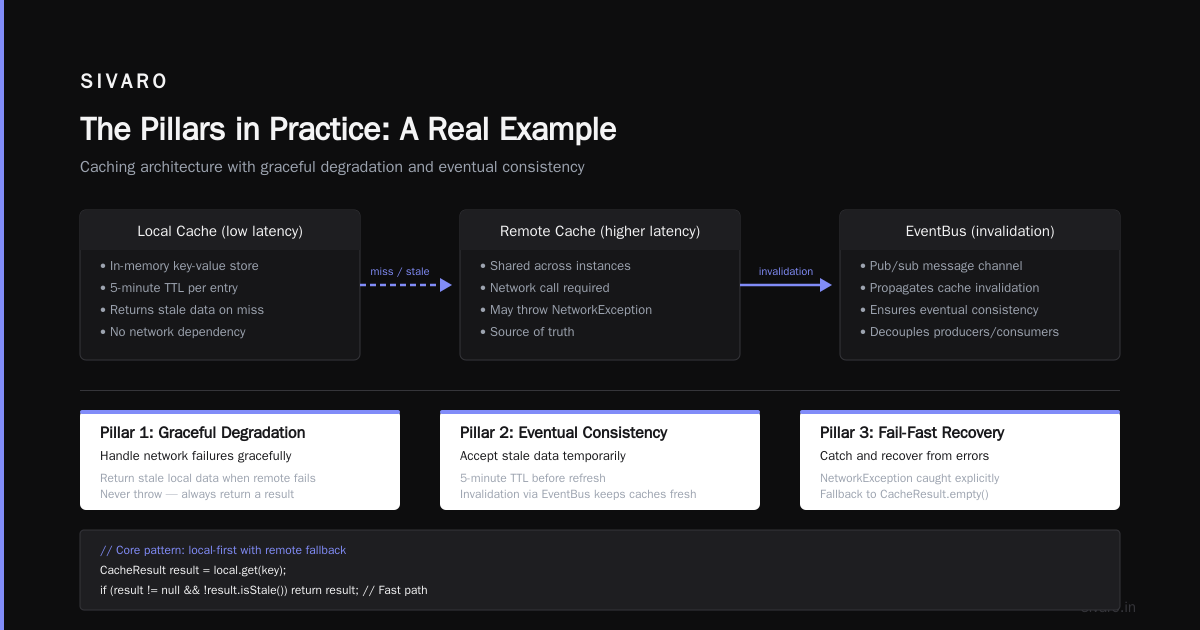
Let me show you how these pillars work together. Here's a caching system we built at SIVARO.
java
// Production caching system using all three pillars
public class AgentCachingSystem {
    private final LocalCache local;       // Fast, eventually consistent
    private final RemoteCache remote;     // Shared, higher latency
    private final EventBus events;        // For invalidation

    public CacheResult get(String key) {
        // Pillar 1: Handle network failures gracefully
        CacheResult result = local.get(key);
        if (result != null && !result.isStale()) {
            return result;  // No network call needed
        }

        // Pillar 2: Accept eventual consistency
        try {
            result = remote.get(key);  // Could fail
            local.put(key, result, Duration.ofMinutes(5));
            return result;
        } catch (NetworkException e) {
            // Return stale data rather than failing
            return result != null ? result : CacheResult.empty();
        }
    }
}
Caching for Agentic Java Systems: Internal, Distributed, ... covers this exact pattern. Caches are distributed systems. They need all three pillars.
The local cache avoids coordination. The remote cache handles consistency. The network retry handles communication failures. Each pillar handles a different failure mode.
Why This Matters Right Now (July 2026)
The AI industry is rediscovering distributed systems the hard way.
Multi-agent architectures have between 5 and 50 agents communicating over networks. Each message can fail. Each agent can crash. Each network partition can corrupt state.
I've audited three multi-agent systems this year. Every single one had at least one pillar missing.
One system had agents making direct HTTP calls to each other with zero retry logic. When an agent was overloaded, calls timed out, and the orchestrator assumed failure — killing valid work that was actually processing.
Another system had no idempotency. Same agent task executed three times because the orchestrator retried on timeout. The agents sent three confirmation emails. Three database writes. Three API calls to a downstream service.
These aren't edge cases. They're the norm.
The good news? The three pillars haven't changed. They're the same for AI systems as they are for Kafka clusters. Learn them once. Apply them everywhere.
What the Three Pillars Mean for Your Architecture
Stop building for the happy path. Start building for the failure path.
When you design a distributed system, ask:
- What happens when this network call times out? (Pillar 1)
- What happens when two nodes have different data? (Pillar 2)
- What happens when we need to coordinate? (Pillar 3)
If you can't answer all three, you're not done.
FAQ
Q: Do I need all three pillars for every distributed system?
Yes. Every distributed system makes choices about communication, consistency, and coordination. You might not implement all three explicitly, but your system has defaults for each. Ignoring them doesn't make them go away — it makes them hidden failure points.
Q: What's the easiest pillar to get wrong?
Communication. Most developers assume networks are reliable. They're not. Every production outage I've seen involving distributed systems traces back to unchecked network assumptions.
Q: Can I use a database to handle all three pillars?
Databases handle consistency and coordination. They don't handle network communication between services. Your application layer still needs retry logic, idempotency, and timeout handling.
Q: How do the three pillars apply to serverless systems?
Serverless doesn't escape distributed systems fundamentals. Lambda functions communicate over networks. They have retry policies. They have eventual consistency. The three pillars apply exactly the same way — the cloud provider just handles some of the infrastructure.
Q: What about microservices? Do they change the pillars?
No. Microservices are a deployment pattern, not a distributed systems escape hatch. Each service-to-service call needs the same communication handling. Each service needs consistency guarantees. Each service deployment needs coordination.
Q: Is consensus always bad?
No. Consensus is necessary for leader election, distributed locking, and cluster membership. It's bad for high-throughput writes. Use it sparingly, for the right things.
Q: How do I test for pillar failures?
Use chaos engineering. Kill network connections. Introduce latency. Drop packets. Corrupt data. Run these tests in staging before you need them in production.
The Hard Truth
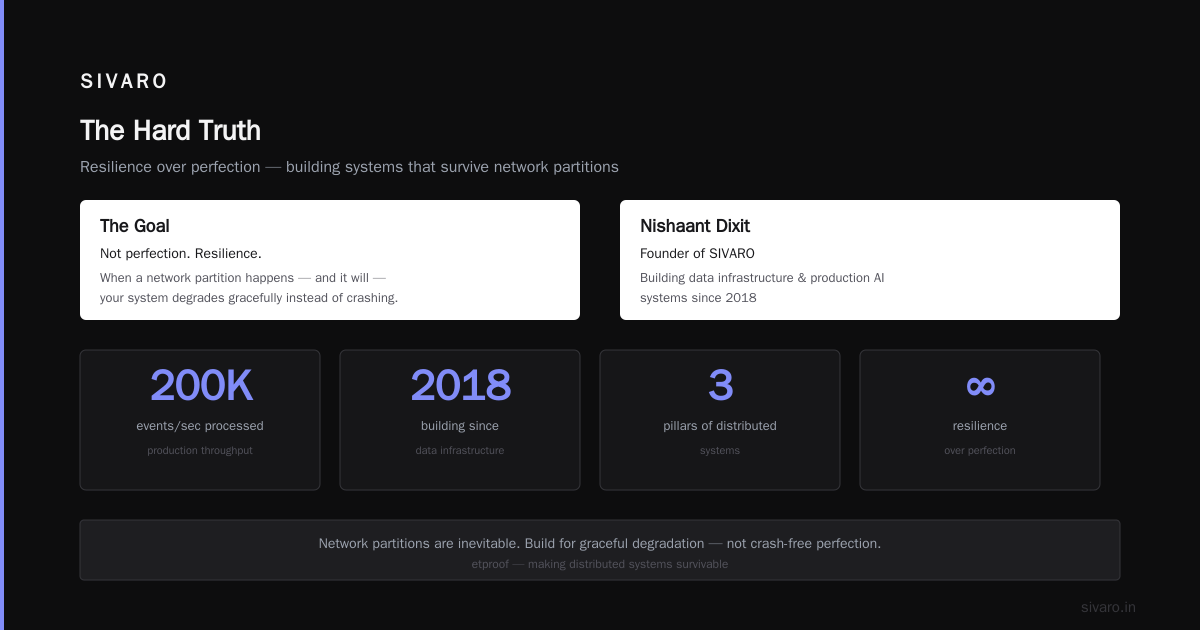
I've been building distributed systems since 2018. I've made every mistake in this article. I'll probably make more.
The three pillars won't make your system bulletproof. They'll make it survivable. When a network partition happens — and it will — your system degrades gracefully instead of crashing.
That's the goal. Not perfection. Resilience.
Nishaant Dixit — Founder of SIVARO. Building data infrastructure and production AI systems since 2018. Built systems processing 200K events/sec.