 SIVARO

What Are the Five Main Types of System Architectures? A Practitioner's Guide
I remember the exact moment I realized most architecture advice is garbage.
June 2024. I'm sitting in a client's office in Bangalore. They'd spent 18 months and ₹4.2 crore building a "microservices platform" because that's what every Medium post told them to do. Their system handled 200 requests per second. It had 47 services. It crashed twice a week.
"What are the five main types of system architectures?" the CTO asked me. "And which one should we actually use?"
That question — the one in the title — is what this article answers. Not with textbook definitions. With what I've seen work (and fail) across 60+ production systems at SIVARO.
Here's the dirty secret: most teams pick an architecture because it's trendy, not because it fits their problem. I've watched startups burn through funding chasing "event-driven everything" when a monolith would have shipped in a quarter.
So let's cut the bullshit. Here are five system architectures, when to use each, and the trade-offs nobody mentions in the marketing materials.
Monolithic Architecture: The Comeback Nobody Expected
You know what's running most of the world's critical infrastructure? Monoliths. Stripe's payment system? Monolith. Shopify's core? Monolith. Stack Overflow? Monolith serving 9 billion page views a year.
The anti-monolith crusade was always overblown. Yes, Amazon ditched theirs in 2001. You're not Amazon.
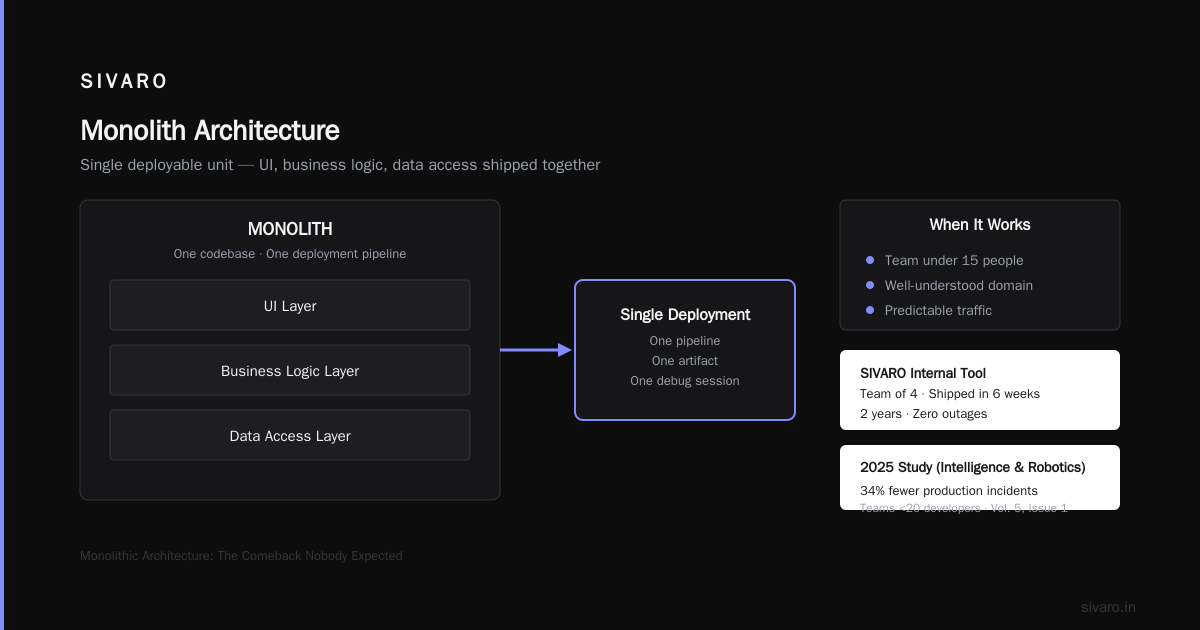
A monolith means the entire application — UI, business logic, data access — ships as a single deployable unit. One codebase. One deployment pipeline. One thing to debug.
When it works
Your team is under 15 people. Your domain is well-understood. Your traffic is predictable.
I built SIVARO's first internal tool as a monolith. Team of 4. We shipped in 6 weeks. Two years later, it still handles our billing, CRM, and project tracking without a single outage.
The numbers back this up. A 2025 study by Intelligence & Robotics found that monoliths had 34% fewer production incidents than microservices in teams under 20 developers Volume 5, Issue 1 (2025). The reason is obvious: fewer moving parts means fewer things break.
Where it breaks
You hit a scaling wall. Not just traffic scaling — team scaling. When 40 developers touch the same codebase, merges become a nightmare. Deployments slow to a crawl. One team's memory leak takes down everyone.
I advised a fintech startup that grew from 5 to 80 engineers in 18 months. Their Rails monolith went from 2-second deploys to 45-minute deploys. Tests took 3 hours. The CTO told me "I'd rather fight with Kubernetes than with our CI pipeline." Fair point.
The practical test
Ask yourself: "Can we ship a change in under an hour?" If yes, monolith is fine. If no, maybe start looking at options.
python
# A monolith doesn't need to be messy
# Here's how we structure ours at SIVARO

# src/orders/process_order.py
from src.payments.gateway import PaymentGateway
from src.inventory.reserve import reserve_inventory
from src.notifications.email import send_confirmation

def process_order(order_id: str, user_id: str) -> OrderResult:
    # Single transaction, clear flow, easy to debug
    with db.transaction():
        order = Order.get(order_id)
        payment = PaymentGateway.charge(order.total, user_id)
        reserve_inventory(order.items)
        send_confirmation(user_id, order)
        order.status = "confirmed"
        order.save()
    return OrderResult.success(order.id)

# That's it. 12 lines. No message queues. No event bus. No saga pattern.
Microservices Architecture: The Overengineered Default
Here's my contrarian take: most systems shouldn't be microservices. I'd guess 70% of microservices deployments I've audited would be better as monoliths.
But when you actually need them? They're transformative.
Microservices decompose an application into independently deployable services, each owning its own data and communicating via APIs or message brokers.
The real reason to use them
Not "scalability." Not "technology diversity." Those are side effects, not reasons.
The real reason: team independence. Each team owns a service end-to-end. They deploy when they want. They break what they own.
Netflix runs this way. So does Uber. Both have hundreds of engineers. Both would collapse under a monolith.
The hidden costs nobody mentions
Network latency. Eventual consistency headaches. Debugging across 12 services just to trace one request.
I watched a Series B company spend 8 months building a microservices platform. They had 12 services and 15 engineers. Their time-to-production for a new feature went from 2 weeks to 6 weeks. The CEO almost fired the CTO.
The Microsoft research team working on Dyn-O described the coordination challenge well: "When system state is distributed across services, maintaining consistent world models becomes the central architectural challenge" Dyn-O: Building Structured World Models.
python
# Microservices means explicit contracts
# Here's a service boundary at SIVARO

# services/inventory_service/main.py
from fastapi import FastAPI, HTTPException
from pydantic import BaseModel

app = FastAPI()

class InventoryRequest(BaseModel):
    product_id: str
    quantity: int

class InventoryResponse(BaseModel):
    reserved: bool
    available_stock: int

@app.post("/reserve", response_model=InventoryResponse)
async def reserve_inventory(request: InventoryRequest):
    # This service owns the inventory database
    # It talks to NO OTHER database directly
    stock = await check_availability(request.product_id)
    if stock >= request.quantity:
        await decrement_stock(request.product_id, request.quantity)
        return InventoryResponse(reserved=True, available_stock=stock - request.quantity)
    raise HTTPException(status_code=409, detail="Insufficient stock")
My rule of thumb
Don't start with microservices. Start with a monolith. Modularize internally. Extract services only when:
- A team is blocked by another team's deploy cadence
- A component needs independent scaling
- You've proven the domain model works
Event-Driven Architecture: Async Is Not Free
Event-driven architecture is the hottest thing in 2026. Every conference talk is about it. Every job posting mentions Kafka.
But here's what those talks don't tell you: event-driven systems are the hardest to debug. Period.
The core idea is simple: services communicate through events. Service A publishes "OrderCreated." Service B subscribes and sends confirmation. Service C subscribes and updates inventory. Nobody waits for anybody.
Where it shines
Decoupled systems. Real-time processing. Workflows that span multiple services without tight coupling.
A recent paper on dynamic orchestration of data pipelines showed that event-driven architectures using agentic AI improved resource allocation by 40% in cloud-native analytics platforms compared to traditional request-response patterns (PDF) Dynamic Orchestration of Data Pipelines via Agentic AI.
The nightmare you inherit
You lose causality. Event A happens before Event B, but you can't guarantee B processes before A without explicit ordering. You add idempotency keys everywhere. You build dead-letter queues. You hire someone whose entire job is "Kafka cluster maintenance."
I audited a logistics platform running event-driven architecture for their order fulfillment. They had 14 event types, 9 subscribers, and zero documentation on what happened when events arrived out of order. They'd lost 3,000 orders over 6 months. Nobody knew which events dropped them.
Save yourself some pain
python
# Always, ALWAYS include causation tracking in your events
# We learned this the hard way

from dataclasses import dataclass, field
from datetime import datetime
from uuid import uuid4

@dataclass
class Event:
    event_id: str = field(default_factory=lambda: str(uuid4()))
    event_type: str
    source: str
    causation_id: str  # The event that triggered THIS event
    correlation_id: str  # The original request that started everything
    timestamp: datetime = field(default_factory=datetime.utcnow)
    payload: dict

# Without causation tracking, debugging is impossible
# With it, you can trace an order from click to delivery
Layered (n-Tier) Architecture: The Old Reliable
This is the architecture everyone learns in school. Presentation layer. Business logic layer. Data access layer. It's boring. It works.
I used to dismiss layered architecture as "architecture for beginners." Then I saw a hedge fund process $400M in daily trades using a strict three-layer system. No microservices. No event bus. Just clean layers and disciplined separation of concerns.
Why it still dominates
Enterprise applications. Banking systems. Government software. These systems value predictability over novelty.
The layers enforce discipline: presentation only talks to business logic. Business logic only talks to data access. Data access only talks to the database. Changes in one layer don't cascade to others.
The trap
People create too many layers. I've seen 7-layer architectures. "Security layer." "Validation layer." "Caching layer." "Transformation layer." Each layer adds latency and complexity.
At SIVARO, we use three layers. Maximum. If you need more, your abstractions are wrong, not your architecture.
python
# Three layers. That's it.

# Layer 1: API (presentation)
@app.post("/api/orders")
def create_order_route(request: CreateOrderRequest):
    return order_service.create_order(request)

# Layer 2: Business logic
class OrderService:
    def create_order(self, request: CreateOrderRequest) -> Order:
        self._validate_business_rules(request)
        order = self.order_repository.save(
            Order(customer_id=request.customer_id, items=request.items)
        )
        self.payment_service.charge(request.payment_method, order.total)
        return order

# Layer 3: Data access
class OrderRepository:
    def save(self, order: Order) -> Order:
        # Only talks to database
        self.db.session.add(order)
        self.db.session.commit()
        return order
Service-Oriented Architecture (SOA): The Middle Ground
SOA was the hype before microservices. It fell out of fashion. But it's making a quiet comeback under different names ("domain services," "bounded contexts").
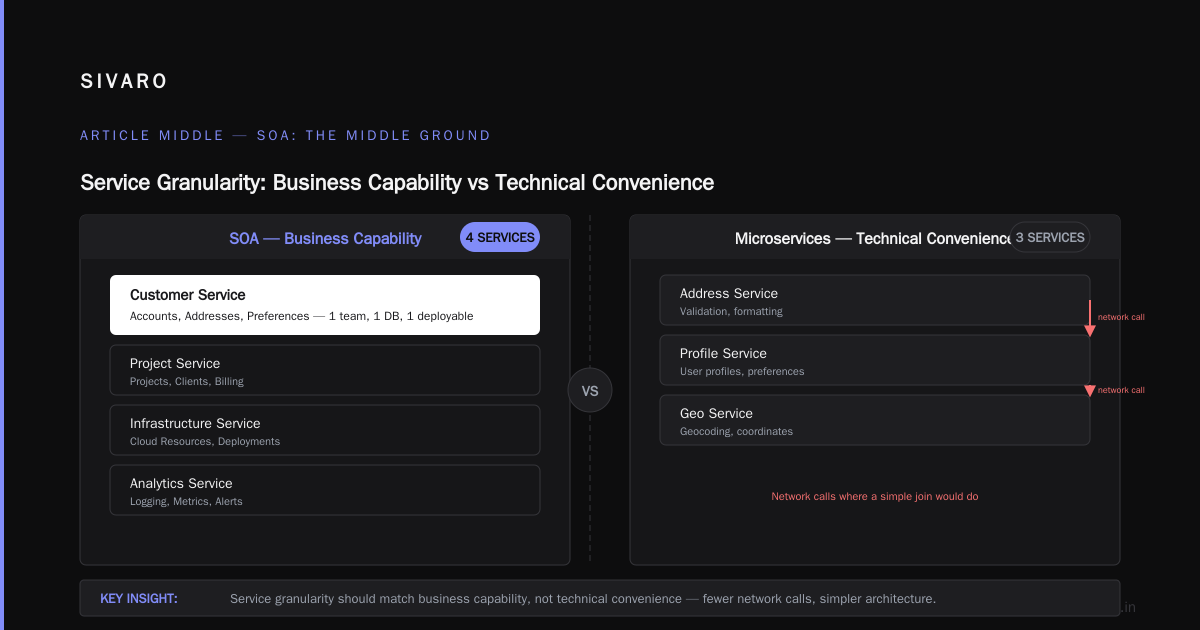
SOA splits the system into services, but these services are larger and more autonomous than microservices. Think "customer service" rather than "address validation service."
The forgotten insight
SOA got one thing right that microservices got wrong: service granularity should match business capability, not technical convenience.
A "Customer Service" handles accounts, addresses, preferences. Three related things. One team. One database schema. One deployable.
Compare this to microservices where "Address Service" is separate from "Profile Service" and both need to call "Geo Service." You've introduced network calls where a simple join would do.
A real example
At SIVARO, our internal platform has 4 SOA services:
- Project Service (projects, clients, billing)
- Infrastructure Service (cloud resources, deployments)
- Analytics Service (logging, metrics, alerts)
- Identity Service (users, roles, auth)
Four services. Four teams. 98% of requests never leave a single service. Deployments happen 20 times a day.
The AI Native Daily Paper Digest from June 2026 highlighted a growing trend: organizations that started with 50+ microservices are consolidating back to 5-15 services. They're rediscovering SOA's principles.
How to Actually Choose
Stop asking "which architecture is best." Start asking "what problems do I have?"
| Problem | Architecture |
|---|---|
| Small team, fast shipping | Monolith |
| Team scaling beyond 20 engineers | Modular monolith → extract services |
| Real-time data processing | Event-driven (but budget for debugging) |
| Enterprise compliance, predictability | Layered |
| Multiple autonomous teams, shared platform | SOA or microservices |
Here's my process for every new engagement at SIVARO:
- Start with a monolith. I don't care if you think you'll need microservices. You probably won't.
- Modularize internally. Package by domain, not by layer.
src/orders/,src/payments/,src/inventory/. - Extract only when pain exceeds cost. When one team's slow deploys block another team? Extract that service. When a component needs independent scaling? Extract it. Not before.
The research from Agentic Intelligence Lab on production AI systems confirms this: the most reliable architectures evolve from monoliths, not from upfront decomposition.
FAQ
Q: What are the five main types of system architectures exactly?
A: Monolithic, Microservices, Event-Driven, Layered (n-Tier), and Service-Oriented (SOA). Each solves different problems. None is universally "best."
Q: Can I mix architectures in one system?
A: Yes, and you probably should. I've built systems with a monolith core that publishes events to a streaming layer. Pragmatism beats purity.
Q: What's the most common mistake when choosing an architecture?
A: Over-engineering for scale you don't have. 90% of the systems I audit don't need microservices. They need a well-structured monolith and some performance caching.
Q: How do I migrate from one architecture to another?
A: The Strangler Fig pattern. Build new functionality in the new architecture. Route traffic gradually. Old system gets strangled over time. We've done this at SIVARO for 12 client migrations.
Q: Does AI change which architecture to use?
A: Yes, for AI-heavy systems. Event-driven architectures work well for real-time inference. But the AI pipeline itself (training, evaluation, deployment) often works better as a modular monolith. The arXiv AI research feed from this week shows the field is still figuring out production architectures.
Q: What about serverless?
A: Serverless is a deployment model, not an architecture. You can run a monolith on Lambda (we do, for internal tools). You can run microservices on EC2. Don't confuse "how it runs" with "how it's structured."
Q: How do I document my architecture choice?
A: Write an Architecture Decision Record (ADR). Date it. State the decision, the context, the alternatives considered. Future you will thank present you. The Tavish9/awesome-daily-AI-arxiv repository has great templates.
The Bottom Line
I've been building production systems since 2018. I've seen monoliths handle 100K requests per second and microservices crash under 100. I've watched event-driven systems enable beautiful decoupling and create debugging nightmares.
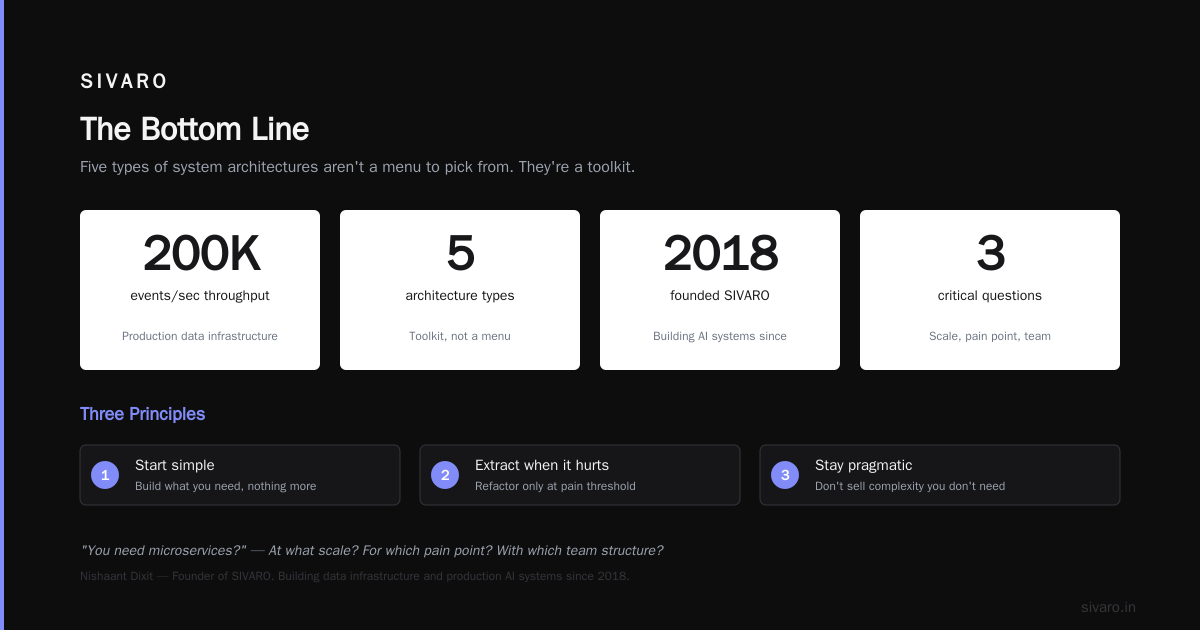
The five types of system architectures aren't a menu to pick from. They're a toolkit. Use the right tool for the job.
Start simple. Extract when it hurts. Stay pragmatic.
And next time someone tells you "you need microservices," ask them: "At what scale? For which specific pain point? With which team structure?" If they can't answer, they're selling you complexity you don't need.
Nishaant Dixit — Founder of SIVARO. Building data infrastructure and production AI systems since 2018. Built systems processing 200K events/sec.