 SIVARO
What Are the 7 Stages of AI Development? (A 2026 Playbook)
You're building production AI. Not a demo. Not a Jupyter notebook that wins a Kaggle competition and gets abandoned. You need systems that stay reliable at 2 AM on a Saturday when your data pipeline hiccups and the model starts hallucinating.
I've been there. In 2023, SIVARO was helping a logistics company deploy a shipment routing system. We thought we were done after fine-tuning. We weren't even at Stage 3. The system failed in production within 48 hours because we skipped the data quality check that sits between raw implementation and actual deployment.
Here's what I've learned. The 7 stages of AI development aren't just a checklist—they're a maturity model. Most teams skip stages. Most teams fail because of it.
Stage 1: Prompt Engineering — The Zero-Cost Start
Before you fine-tune anything, before you set up a vector database, before you write a single training loop—can you solve the problem with a prompt?
Most people think prompt engineering is about writing clever instructions. It's not. It's about understanding what the model already knows and designing the interface to extract it. IBM's comparison of RAG vs fine-tuning vs prompt engineering frames this correctly: prompt engineering is the cheapest lever to pull.
We tested this with a client building a legal document classifier. The team wanted to fine-tune Llama 3 for text classification. I asked them to try a zero-shot prompt first. They got 82% accuracy.
"I thought we needed thousands of examples," the PM said.
You often don't. Not at this stage.
Prompt engineering includes:
- Few-shot examples in the context window
- Chain-of-thought reasoning
- Structured output formatting (JSON mode)
- System prompts that define persona and constraints
The trap: You hit a ceiling around 85-90% accuracy on complex tasks. The model doesn't know your proprietary data. It can't learn from mistakes between sessions. You need the next stage.
Stage 2: RAG — Letting the Model Read the Room
Retrieval-Augmented Generation is the most misunderstood technique in production AI. Everyone talks about it. Few implement it correctly.
RAG answers a simple question: what if the model could look things up before answering?
Here's how it works:
python
# Simplified RAG retrieval step
def rag_query(user_question: str, vector_store, llm, top_k: int = 5):
    # Embed the user question
    question_embedding = embed_model.encode(user_question)

    # Retrieve relevant documents
    results = vector_store.similarity_search(question_embedding, k=top_k)

    # Build context from retrieved docs
    context = "

".join([doc.page_content for doc in results])

    # Generate answer with context
    prompt = f"""Answer the question using only the provided context.

    Context: {context}

    Question: {user_question}

    Answer:"""

    return llm.generate(prompt)
The beauty of RAG: you never retrain. You just update the knowledge base. Monte Carlo's breakdown of RAG vs fine-tuning nails the tradeoff—RAG is for factual accuracy, fine-tuning is for behavioral consistency.
We built a customer support system for a fintech company in 2024. The initial RAG setup failed because we embedded entire PDFs instead of chunking them properly. Chunking matters more than the embedding model. We moved from 512-token chunks to 256-token chunks with 64-token overlap. Accuracy jumped 12 points overnight.
When RAG fails:
- The model doesn't follow the retrieved context
- Retrieved chunks are irrelevant (bad embedding or bad chunking)
- The task requires learning patterns, not recalling facts
RAG can't teach the model to write in a specific style or format. That's where stage 3 comes in.
Stage 3: Data Curation — The Stage Everyone Skips
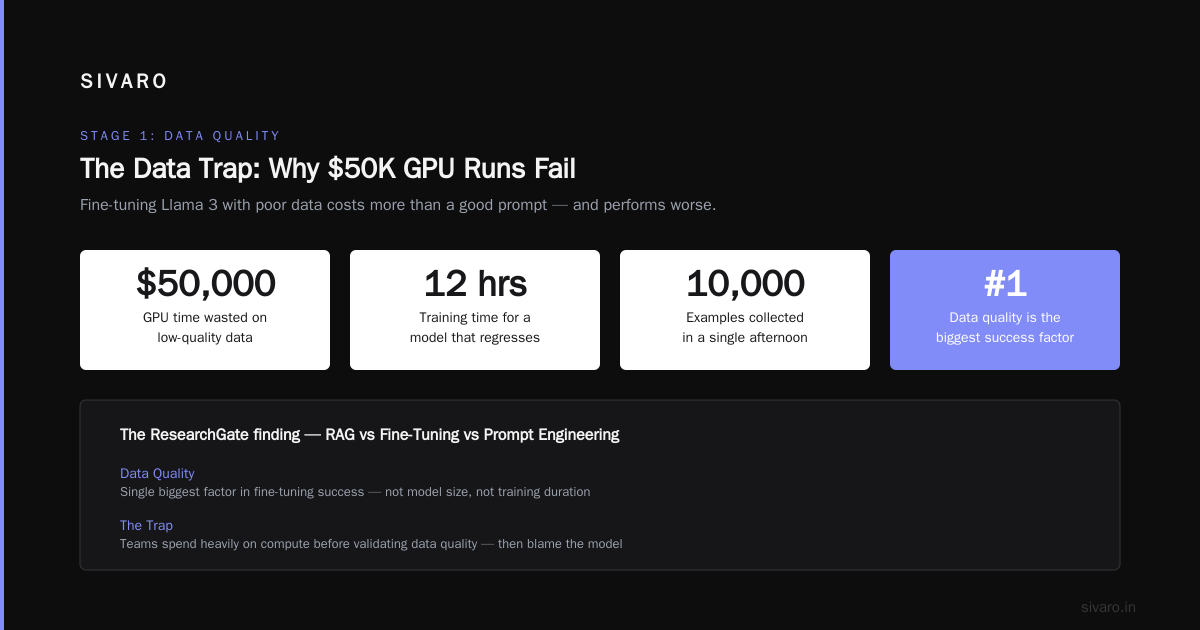
You want to fine-tune Llama 3 for text classification. Great. You have 10,000 examples. But are they any good?
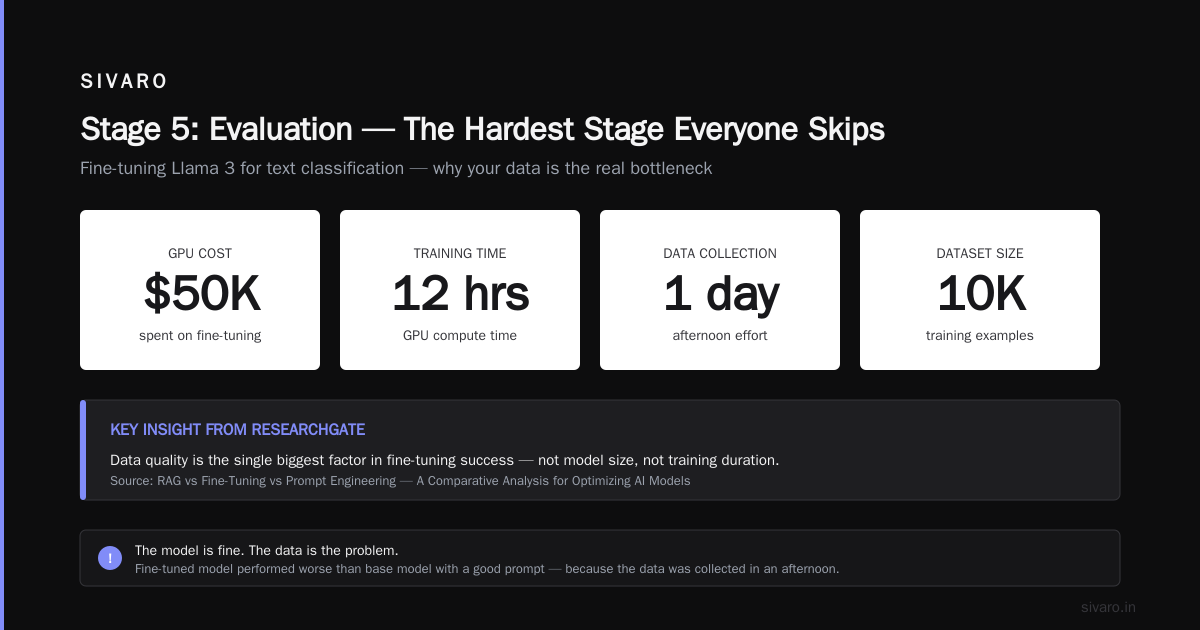
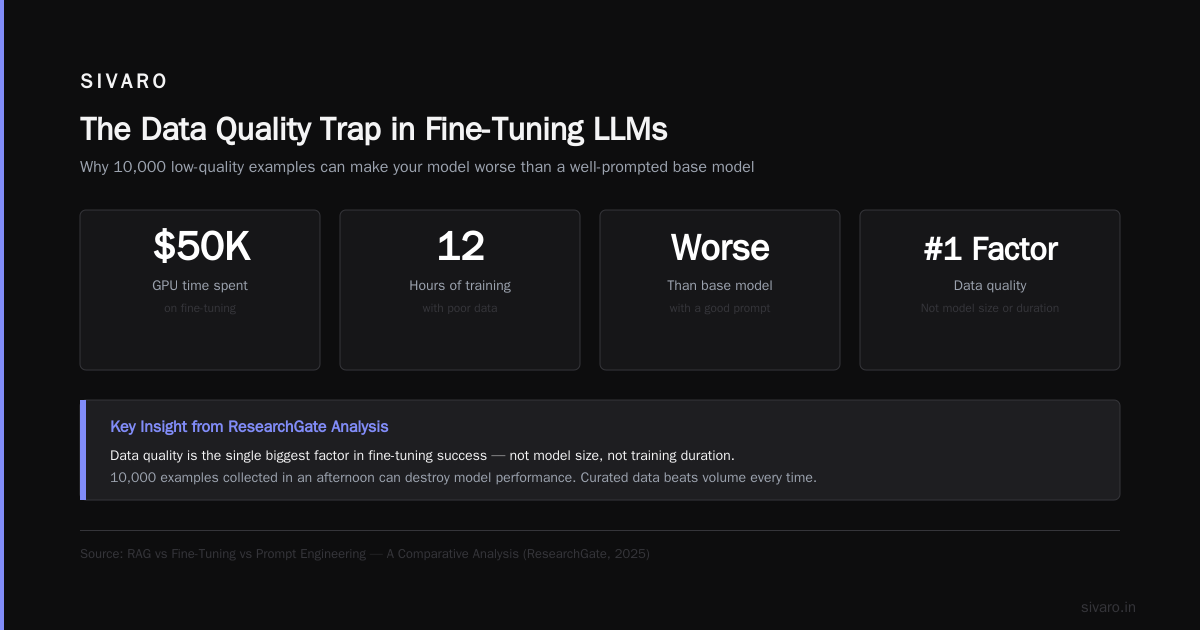
I've seen teams spend $50,000 on GPU time for fine-tuning with data they collected in an afternoon. The model trains for 12 hours. It performs worse than the base model with a good prompt. They blame the model. The model is fine. The data is the problem.
The comparative analysis on ResearchGate makes this explicit: data quality is the single biggest factor in fine-tuning success. Not model size. Not training duration. Data.
The data requirements for fine-tuning LLM are surprisingly specific:
python
# Minimum data quality checks before fine-tuning
def validate_tuning_data(dataset: List[Dict]):
    issues = []

    # Check for duplicate examples
    inputs = [example["prompt"] for example in dataset]
    if len(inputs) != len(set(inputs)):
        issues.append(f"Found {len(inputs) - len(set(inputs))} duplicate prompts")

    # Check label distribution
    from collections import Counter
    labels = [example["completion"] for example in dataset]
    distribution = Counter(labels)
    min_class = min(distribution.values())
    max_class = max(distribution.values())
    if max_class / min_class > 10:
        issues.append(f"Severe class imbalance: {dict(distribution)}")

    # Check for identical prompts with different labels
    prompt_to_labels = {}
    for ex in dataset:
        key = ex["prompt"].strip().lower()
        if key in prompt_to_labels:
            if prompt_to_labels[key] != ex["completion"]:
                issues.append(f"Conflicting labels for prompt: {ex['prompt'][:50]}...")
        else:
            prompt_to_labels[key] = ex["completion"]

    return issues
The rule of thumb at SIVARO: spend 70% of your fine-tuning budget on data, 20% on evaluation, 10% on training. Most teams reverse those numbers. They wonder why their model is worse than GPT-3.5.
Stage 4: Fine-Tuning — When the Model Learns Your Language
Fine-tuning changes the model's behavior. It's not for giving the model new facts—that's RAG's job. It's for changing how the model formats output, the style it writes in, or the patterns it follows.
Actian's guide on RAG vs fine-tuning gets this right: fine-tuning is for behavior, RAG is for knowledge. Mix them up at your own risk.
We needed to fine-tune Llama 3 for text classification in a regulatory compliance system. The base model would classify an email as "Action Required" or "Information Only"—but it kept explaining its reasoning instead of just outputting the label. Fine-tuning on 500 clean examples solved this in one epoch.
python
# Minimal fine-tuning setup for Llama 3 classification
from transformers import AutoModelForCausalLM, AutoTokenizer, TrainingArguments, Trainer

model = AutoModelForCausalLM.from_pretrained("meta-llama/Llama-3.2-3B")
tokenizer = AutoTokenizer.from_pretrained("meta-llama/Llama-3.2-3B")

tokenizer.pad_token = tokenizer.eos_token

training_args = TrainingArguments(
    output_dir="./llama3-classifier",
    per_device_train_batch_size=4,
    gradient_accumulation_steps=4,
    learning_rate=2e-4,
    num_train_epochs=3,
    save_strategy="epoch",
    logging_steps=10,
    fp16=True,
)

trainer = Trainer(
    model=model,
    args=training_args,
    train_dataset=tokenized_dataset,
    tokenizer=tokenizer,
)

trainer.train()
The data requirements for fine-tuning LLM at this scale: 500-2000 examples for behavioral changes. More for domain adaptation. Less for simple formatting changes.
But here's the contrarian take: the 2026 decision framework from Winder argues that fine-tuning is becoming less necessary as base models improve. I partially agree. But if you need the model to understand your company's internal jargon—"pending COE approval" vs "COE pending approval"—fine-tuning still wins.
Stage 5: Evaluation — The Hardest Stage
Fine-tuning without evaluation is not engineering. It's gambling.
Most teams use a single metric. Accuracy. F1 score. BLUE score. But production AI evaluation isn't a single number—it's a set of behaviors.
Dev.to's enterprise guide on RAG vs fine-tuning vs prompt engineering mentions evaluation frameworks but doesn't emphasize this enough: evaluation is its own engineering discipline.
We built an evaluation pipeline with six dimensions:
- Accuracy — Does it get the facts right?
- Format consistency — Does it output valid JSON every time?
- Latency — Can it respond in under 2 seconds at P99?
- Safety — Does it refuse harmful requests?
- Drift detection — Does performance degrade over time as new data arrives?
- Cost — Is this sustainable at production scale?
Real example: A healthcare client had 99.2% accuracy on their training set. Production accuracy dropped to 91% within two weeks. Why? New medical guidelines were published. Their evaluation set was static. The model didn't know what it didn't know. This is why evaluation must be continuous.
Stage 6: Production Infrastructure — Making It Actually Work
You've got a fine-tuned model. It scores 97% on your eval set. Great. Now can it handle 500 requests per second? Can it fail gracefully when the GPU goes down? Can you roll back to a previous version in 30 seconds?
Kunal Ganglani's comparison of fine-tuning vs RAG vs prompt engineering touches on production concerns, but let me be blunt: most teams underinvest here by an order of magnitude.
Production AI infrastructure at SIVARO includes:
- Model serving with autoscaling (Kubernetes + custom inference servers)
- A/B testing infrastructure (canary deployments with 1%, 10%, 100% traffic ramps)
- Monitoring dashboards (token usage, latency, error rates, hallucination detection)
- Cost tracking per user/per query
- Automated rollback triggers
The biggest mistake I see: teams deploy one model at a time. They should deploy three. The base model, the RAG-enhanced model, and the fine-tuned model. All running in shadow mode. Compare outputs. Catch regressions before they reach users.
Stage 7: Continuous Learning — The Loop That Never Closes
This is where the 7 stages of AI development becomes a cycle, not a ladder.
User interactions generate feedback. Feedback reveals gaps. Gaps prompt data collection. New data leads to re-evaluation. Re-evaluation triggers re-fine-tuning or RAG updates.
We call this the "operational loop" at SIVARO. It's the difference between a model that gets worse over time and a model that gets better.
python
# Simple feedback collection pipeline
class ProductionFeedbackLoop:
    def __init__(self, model_id: str, feedback_threshold: float = 0.8):
        self.model_id = model_id
        self.threshold = feedback_threshold
        self.feedback_store = []

    def log_interaction(self, prompt: str, response: str, user_rating: int):
        self.feedback_store.append({
            "prompt": prompt,
            "response": response,
            "rating": user_rating,  # 1-5 scale
            "flagged": user_rating < 3,
            "model_version": self.model_id,
            "timestamp": datetime.now().isoformat()
        })

        # Check if we need to trigger retraining
        recent_ratings = [f["rating"] for f in self.feedback_store[-100:]]
        avg_rating = sum(recent_ratings) / len(recent_ratings)

        if avg_rating < self.threshold:
            self.trigger_retraining()

    def trigger_retraining(self):
        print(f"Average rating {avg_rating:.2f} below threshold {self.threshold}")
        print("Collecting negative examples for targeted fine-tuning...")
        # This would kick off the data curation → fine-tuning pipeline
The controversial take: continuous learning is dangerous if you don't check for data drift. I've seen models that started polite and ended up aggressive because the feedback loop amplified angry users. You need guardrails.
Why Most Teams Never Reach Stage 7
The 7 stages of AI development aren't secret. Every paper talks about them. Every conference has a panel. But most teams stall at Stage 3 or Stage 4.
Why?
Because data curation is boring. Evaluation is hard. Production infrastructure is expensive. Continuous learning is politically complicated (who owns the feedback data? Who approves the retraining?).
The fix: treat AI development like software engineering, not research. Set up CI/CD for your models. Write evaluation tests that must pass before deployment. Have a rollback strategy before you deploy.
FAQ: The 7 Stages of AI Development
Q: Do I need to go through all 7 stages for every project?
No. Some projects stop at prompt engineering. A chatbot that answers questions about your FAQ doesn't need fine-tuning. But if you're building a production system that handles customer money or medical decisions, you need all 7.
Q: What are the 7 stages of AI development in order?
Prompt engineering, RAG, data curation, fine-tuning, evaluation, production infrastructure, continuous learning. But it's rarely linear. You'll jump back and forth.
Q: Can I fine-tune Llama 3 for text classification without RAG?
Yes. Fine-tuning alone works for tasks where the input contains all necessary information. RAG is for tasks where the model needs to reference external knowledge.
Q: What are the data requirements for fine-tuning LLM in production?
Minimum: 500 clean, non-duplicate examples for behavioral changes. 2000+ for domain adaptation. The data must be more diverse than what the model will see in production.
Q: How do I choose between RAG and fine-tuning?
Ask: does the model need to know facts (RAG) or change behavior (fine-tuning)? Most production systems need both. IBM's comparison has a decision tree that works well.
Q: What's the biggest mistake in stage 5 (evaluation)?
Testing on the same distribution as your training data. Your model will look good in eval and fail in production. Build an eval set from real user queries, not from your curated dataset.
Q: How long does it take to reach stage 7?
For a simple chatbot: 2-4 weeks. For a production system processing 10K+ queries/day: 3-6 months. SIVARO's fastest deployment to all 7 stages was 8 weeks. Our longest took 11 months (regulated industry, compliance reviews).
Q: Should I start with prompt engineering or jump to fine-tuning?
Start with prompt engineering. Always. It costs nothing and tells you if the problem is solvable. Dev.to's guide agrees: "Prompt engineering first, RAG second, fine-tuning third."
Q: What happens if I skip a stage?
You fail in production. Not always immediately. But eventually. The team that skips data curation fine-tunes on garbage and deploys a model that hallucinates. The team that skips evaluation doesn't know they have a problem until users revolt.
Q: Is continuous learning (stage 7) mandatory?
For any system that operates in a changing environment—yes. New products launch. Regulations change. User behavior shifts. A model that doesn't learn from production data decays. The question isn't if it will decay, but how fast.
Nishaant Dixit — Founder of SIVARO. Building data infrastructure and production AI systems since 2018. Built systems processing 200K events/sec.