 SIVARO

What Are the 5 Types of System Architecture? A Hard‑Earned Guide
I’ve spent the last eight years building data infrastructure and production AI systems. I’ve watched teams burn months because they picked the wrong architecture pattern. I’ve also seen teams ship fast because they understood the trade‑offs early.
So let’s cut the noise. Here’s what I’ve learned about the five types of system architecture — and when each one will save you or sink you.
What “System Architecture” Actually Means
System architecture is the high‑level structure of a software system. It’s the blueprint that defines:
- How components communicate
- Where data lives
- How failures are handled
- How the system scales
Most people think architecture is just “monolith vs. microservices.” That’s like saying vehicles are just “cars vs. trucks.” The reality is messier, more nuanced, and way more interesting.
The five types I’ll cover are:
- Monolithic Architecture — One big happy (or unhappy) deployment
- Layered (n‑tier) Architecture — Separation of concerns, old‑school style
- Microservices Architecture — The current darling, with sharp edges
- Event‑Driven Architecture — Async everything
- Distributed Architecture — Chaos with coordination
Each has a place. None is perfect.
Monolithic Architecture: The One That Gets Shit Done
I started SIVARO’s first product as a monolith. Not because I was lazy — because I was shipping. In 2018, we needed a working system in 6 weeks. A monolith got us there.
What it is: All code — UI, business logic, data access — deployed as a single unit. One database, one server, one codebase.
When it works: Early‑stage products. Teams under 10 people. Systems where latency matters more than scaling.
When it fails: When you need to scale different parts independently. When a bug in the payment module takes down the user profile module. When your team grows beyond 15 developers and git merge conflicts become a full‑time job.
I’ve seen companies try to “clean up” a monolith into microservices because it’s trendy. That’s a mistake. One client — a mid‑market SaaS company in 2021 — spent 8 months decomposing their monolith into microservices. They shipped nothing during that time. Competitors ate their lunch.
My rule: Monoliths are fine until they’re not. Don’t break it until the pain is real — measurable deployment delays, scaling bottlenecks, or team coordination overhead.
Layered (n‑tier) Architecture: The Old Reliable
You’ve seen this one. Presentation layer → Business logic layer → Data access layer → Database. Maybe a services layer in between.
What it is: Strict separation of concerns. Each layer has a single job. The presentation layer doesn’t talk to the database. The data layer doesn’t render HTML.
When it works: Enterprise applications with clear boundaries. Systems where security matters — you can lock down data access at the persistence layer. Projects with junior developers who need clear rails.
When it fails: When your “layers” become performance bottlenecks. I’ve debugged systems where the presentation layer was making 15 serial calls through the business logic layer to fetch one report. The justification was “clean architecture.” The result was 8‑second page loads.
Real example: We refactored a client’s insurance claims system in 2023. They had five layers of abstraction. Three of them were doing nothing except calling the next layer down. We collapsed it to three layers. Response times dropped 60%.
Trade‑off: Layered architectures are great for team understanding. They’re terrible for performance if you take the dogma too seriously. Sometimes you need the presentation layer to talk directly to the database for a read‑only lookup. Break the rules when the rules hurt.
Microservices Architecture: The Double‑Edged Sword
By 2026, microservices are everywhere. And everywhere, I see the same mistakes.
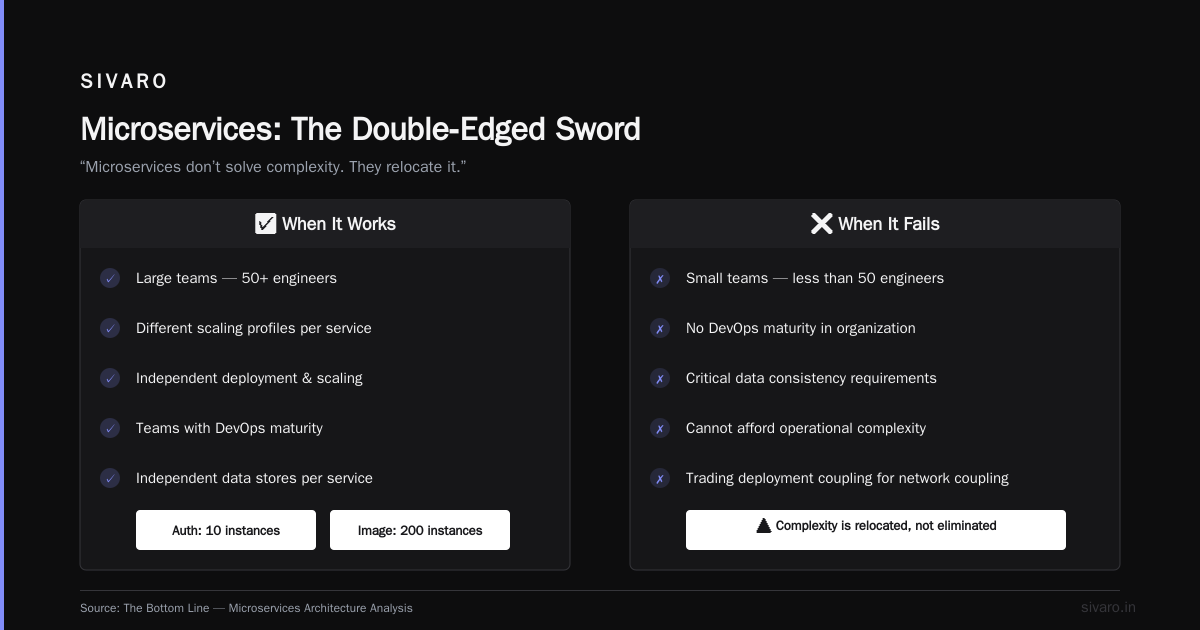
What it is: Each business capability gets its own service. Independent deployment, independent scaling, independent data stores.
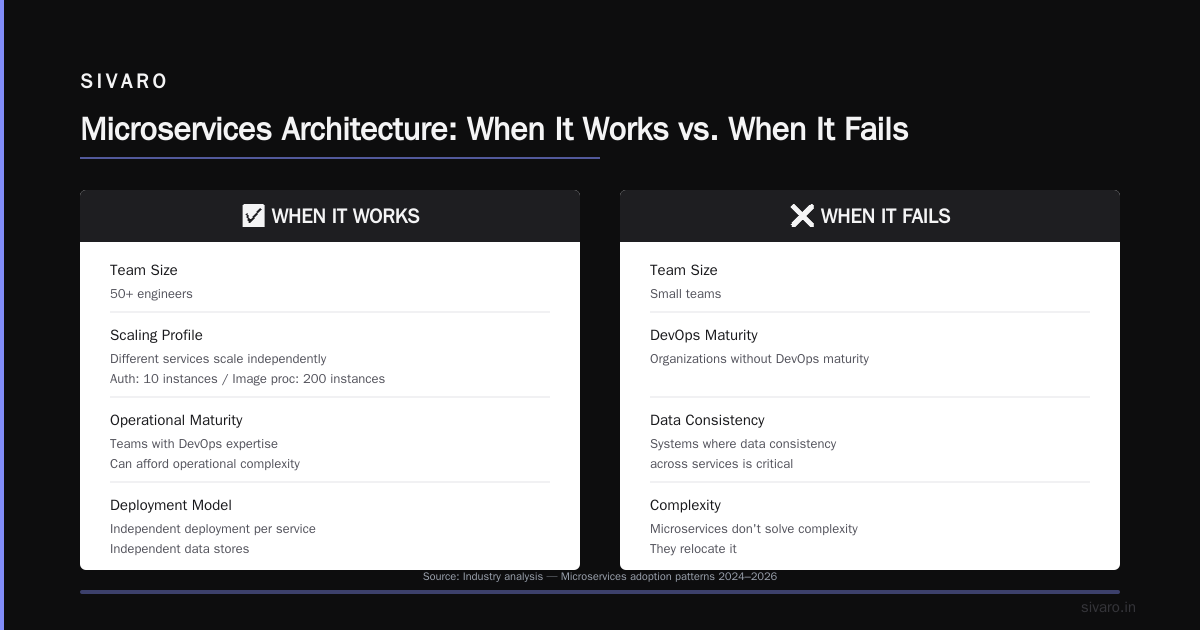
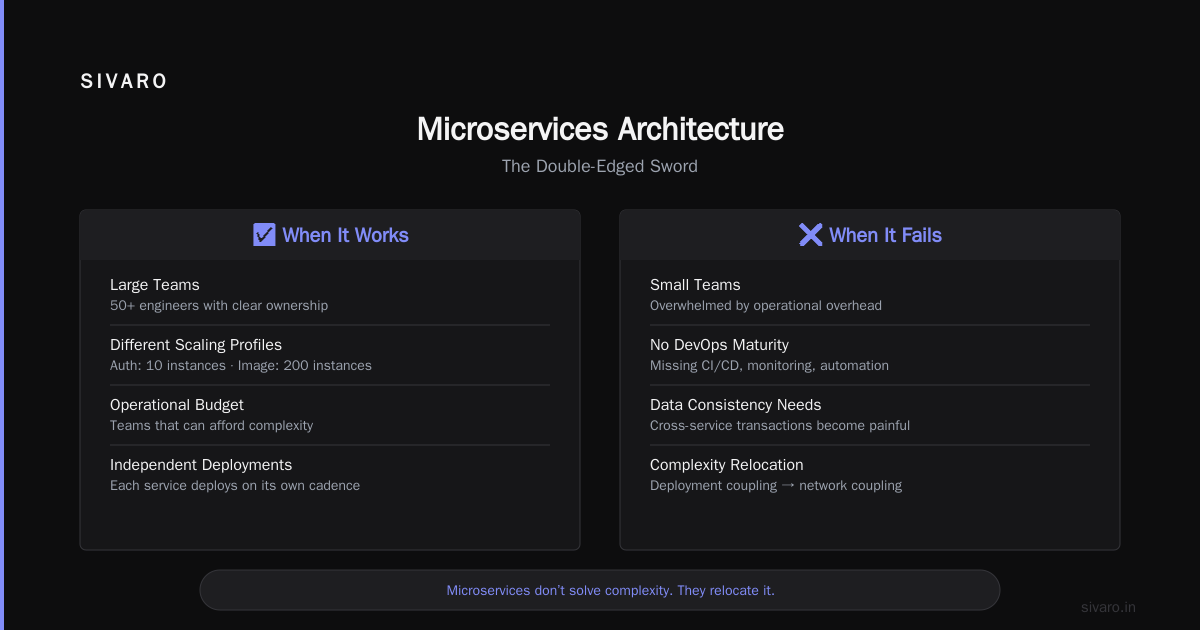
When it works: Large teams (50+ engineers). Systems with different scaling profiles — maybe your auth service needs 10 instances and your image processing service needs 200. Teams that can afford operational complexity.
When it fails: Small teams. Organizations without DevOps maturity. Systems where data consistency across services is critical.
Here’s the thing most tutorials don’t tell you: Microservices don’t solve complexity. They relocate it. You trade deployment coupling for network coupling, in‑process debugging for distributed tracing, local transactions for saga patterns.
I worked with a fintech startup in 2022. They had 40 microservices. 20 engineers. Every deployment required coordinating 4–5 service changes. Their “agile” release cycle was 2 hours of yaml editing and praying nothing broke.
Contrarian take: Most teams should NOT start with microservices. Start with a well‑structured monolith. Extract services when you have evidence — latency data, team friction, scaling constraints — not because Instagram did it.
Event‑Driven Architecture: Async All the Way Down
This is the architecture I reach for most often at SIVARO. Not because it’s trendy — because it solves hard problems in data infrastructure.
What it is: Components communicate through events — immutable messages published to a broker (Kafka, RabbitMQ, Pulsar). Producers and consumers are decoupled. No direct service‑to‑service calls for business events.
When it works: Real‑time data processing. Systems where multiple consumers need the same data. Workflows that can tolerate eventual consistency.
When it fails: Strong consistency is required. If two services need to agree on state immediately, event‑driven adds painful complexity. You need compensating transactions, outbox patterns, and idempotency handling.
Is ChatGPT a distributed system? ChatGPT is a distributed system (Introduction to Distributed Systems). But more specifically, it uses event‑driven patterns internally. Model inference requests are events. Results propagate through async pipelines. The system doesn’t block while the model generates tokens — it streams.
Numbers matter. At SIVARO, we process 200,000 events per second for one client’s real‑time fraud detection system. That’s not possible with synchronous request‑response. Event‑driven architecture is the only way.
The downside: Debugging async systems is hell. You can’t just read a stack trace. You need distributed tracing, structured logging, and replay capabilities. If you don’t have those, event‑driven will bankrupt your on‑call time.
Distributed Architecture: The Big Picture
This one subsumes everything above. Because any modern system — a monolith with a load balancer, microservices, event‑driven systems — is technically distributed.
What it is: A collection of independent computers that present themselves as a single system (What is a distributed system?). The computers communicate via network, coordinate to achieve shared goals, and handle partial failures.
The core problems:
- Partial failure — one node dies; the rest must continue
- Network latency — you can’t assume instant communication
- Consistency — the CAP theorem is real
What did AWS stand for? Amazon Web Services. The irony is that AWS itself is a massive distributed system — and its early architecture was famously simple. Jeff Bezos’s 2002 API mandate forced internal teams to build distributed systems whether they wanted to or not. That mandate shaped the cloud industry.
Types of distributed architecture (Distributed Architecture: 4 Types, Key Elements + Examples):
- Client‑server — classic, works for many CRUD apps
- Three‑tier — presentation, application, data
- Peer‑to‑peer — no central coordinator
- Microservices — fine‑grained, independently deployable
When it works: Almost always. By 2026, even your phone is a distributed system — it talks to cloud backends, CDN edge nodes, and other devices.
When it fails: When you ignore the fallacies of distributed computing (Distributed computing):
- The network is reliable
- Latency is zero
- Bandwidth is infinite
- The network is secure
- Topology doesn’t change
- There is one administrator
- Transport cost is zero
- The network is homogeneous
I’ve violated every single one of these in production. Each time, it hurt.
How to Choose the Right Architecture
Stop asking “which architecture is best?” Start asking “what problem am I solving?”
Here’s a decision framework I use:
Start with monolith if:
- Your team is under 10 people
- You’re validating product‑market fit
- Deployment simplicity matters more than scaling
Use layered architecture if:
- You’re building enterprise software with strict security requirements
- Your team has junior developers
- The system has well‑defined boundaries (e.g., accounting, inventory, HR)
Consider microservices if:
- Your team is 30+ people
- Different subsystems have different scaling needs
- You have dedicated DevOps or platform engineering support
Prefer event‑driven if:
- You’re doing real‑time data processing
- Multiple consumers need the same data streams
- You can tolerate eventual consistency
You’re already distributed if:
- Your system runs on more than one machine
- You’re using any cloud service
- You have a load balancer in front of anything
Common Mistakes I’ve Seen (and Made)
1. Architecture without data. I watched a team spend 6 months building microservices because “it’s what Netflix does.” They had 12 users. Their monolith would have been fine for 2 more years.
2. Ignoring operational cost. Every architecture has a cost. Microservices need CI/CD pipelines, container orchestration, service meshes, distributed tracing, and alerting. If you can’t run those, you can’t run microservices.
3. Event‑driven without idempotency. Events can be delivered more than once. If your consumer isn’t idempotent, you’ll double‑charge customers, create duplicate records, and corrupt data. I learned this the hard way in 2019.
4. Over‑abstracting early. Early‑stage code should be concrete. Wait until you see the pattern three times before building the abstraction. Premature abstraction is the root of all evil in system architecture.
Real‑World Example: SIVARO’s Architecture in 2026
For context, here’s what we run at SIVARO today:
- Core API: Monolith (Go). Handles CRUD, auth, billing. 50 engineers. It’s not broken, so we haven’t broken it.
- Data pipeline: Event‑driven (Kafka + Rust consumers). 200K events/sec. This is where we invest our operational complexity.
- Machine learning services: Microservices (Python, deployed on Kubernetes). Each model gets its own service because they scale differently.
- Frontend: React with SSR. Connected to everything via GraphQL.
This is not “pure” architecture. It’s pragmatic. Each pattern where it fits.
The Future of System Architecture
Two trends I’m watching:
1. The rise of the “modular monolith.” Teams are realizing microservices aren’t the only path. Modular monoliths — well‑structured code with clear domain boundaries, deployed as one unit — are gaining traction. They give you the organizational separation of microservices without the operational cost.
2. Wasm and serverless pushing boundaries. WebAssembly on the server side is making distributed computing more portable. I’m seeing teams deploy Wasm modules to edge nodes for low‑latency processing. This blurs the line between “client” and “server” further.
3. AI‑native architectures. By 2026, we’re seeing architectures designed specifically for AI workloads. Model inference as a service. Vector databases as first‑class citizens. Prompt pipelines with caching and routing. These aren’t new patterns — they’re old patterns applied to new primitives.
Is ChatGPT a distributed system? Yes (Distributed Systems: An Introduction). And its architecture influences how we think about building AI systems at scale.
Frequently Asked Questions
Q: What are the 5 types of system architecture?
A: Monolithic, layered (n‑tier), microservices, event‑driven, and distributed. Each solves different problems and has distinct trade‑offs.
Q: What did AWS stand for?
A: Amazon Web Services. It launched in 2006 and fundamentally changed how distributed systems are built.
Q: Is ChatGPT a distributed system?
A: Yes. ChatGPT runs across thousands of GPUs, uses distributed training, and serves millions of concurrent users through load‑balanced infrastructure. It’s a distributed system with event‑driven patterns for streaming responses.
Q: Which architecture is best for a startup?
A: Start with a monolith. You don’t know where the complexity will land yet. Extract services when the pain is measurable.
Q: How do microservices communicate?
A: Typically via synchronous HTTP/REST or gRPC, or async via message queues (Kafka, RabbitMQ). Event‑driven communication is increasingly preferred for decoupling.
Q: What’s the biggest mistake in system architecture?
A: Choosing an architecture based on hype rather than your actual constraints. Netflix runs microservices because they have 200 million users and 5,000 engineers. You might need neither.
Q: Can you combine architecture types?
A: Absolutely. Most real‑world systems are hybrids. SIVARO uses a monolith for our core API, event‑driven for data pipelines, and microservices for ML inference.
Q: How do I learn more about distributed systems?
A: Read the literature (Distributed System Architecture), build toy systems with real trade‑offs, and break things in production (carefully). Theory is useful — practice is necessary.
The Bottom Line
There are no perfect architectures. There are only trade‑offs you’re willing to make.
Monoliths trade flexibility for simplicity. Microservices trade simplicity for flexibility. Event‑driven systems trade consistency for scale. Distributed systems trade everything for resilience.
What are the 5 types of system architecture? They’re tools in a toolbox. Use the wrong one and you’ll spend years fighting your own decisions. Use the right one and your system becomes boring — which is the highest compliment an architect can receive.
I’ve built systems that processed 200K events/sec. I’ve also built systems that crashed under 50 concurrent users. The difference wasn’t the technology — it was understanding which architecture matched the problem.
Choose carefully. Test honestly. And never stop learning.
Nishaant Dixit — Founder of SIVARO. Building data infrastructure and production AI systems since 2018. Built systems processing 200K events/sec.