 SIVARO

What Are the 4 Types of Computer Architecture? A Practitioner's Guide for AI & Data Infrastructure
If you're building production AI systems, you need to know what are the 4 types of computer architecture — not because some textbook says so, but because picking the wrong one will cost you months of engineering and six figures in wasted GPU hours.
I learned this the hard way. In early 2024, SIVARO was designing a GPU cluster for a client running large-scale LLM inference. We started with a standard x86 server architecture (SISD-ish). Inference latency was garbage. Then we swapped the CPU-based preprocessing pipeline for a SIMD-style GPU approach — same budget, 7x throughput. That's when I realized: architecture type isn't academic trivia. It's the difference between a system that works and one that burns cash.
Flynn's taxonomy gives us the cleanest lens: Single Instruction Single Data (SISD), Single Instruction Multiple Data (SIMD), Multiple Instruction Single Data (MISD), and Multiple Instruction Multiple Data (MIMD). Every modern system — from your laptop to a 10,000-node GPU cluster — fits somewhere in this matrix. Let's tear through each one.
The Four Computer Architecture Types (Flynn's Taxonomy)
First, a quick map. Flynn's taxonomy was proposed in 1966. It's survived because it's dead simple: how many instruction streams are running simultaneously, and how many data streams are being processed at once. Two axes. Four quadrants. Everything else is implementation detail.
| Single Data | Multiple Data | |
|---|---|---|
| Single Instruction | SISD | SIMD |
| Multiple Instruction | MISD | MIMD |
I've seen countless engineers dismiss this as "old" or "CS 101." But when you're designing a GPU Cluster for modern workloads, the taxonomy maps directly to real hardware decisions. Let's go deep.
SISD – The Classic Uniprocessor (and Why It's Dying for AI)
SISD is the simplest model: one CPU, one instruction stream, one data stream. Your grandfather's desktop. A standard x86 core executing a single thread. Everything sequential.
You've used SISD your whole life — every time you run a Python script that doesn't parallelize, you're living in SISD land.
The problem: Modern AI workloads don't care about single-threaded speed. A single NVIDIA H100 GPU has 18,432 CUDA cores. Even a high-end Intel Xeon Platinum has 56 cores. In SISD mode, you're using 1/18,432 of the compute. That's not a pipeline problem — it's an architecture mismatch.
At SIVARO, we once benchmarked a customer's inference pipeline that was entirely SISD: preprocess images on a single CPU thread, then feed them one-by-one to a GPU. The GPU sat idle 80% of the time. Switching to batched SIMD-style processing on the GPU fixed it. But that required rewriting the preprocessing in CUDA, which is a different architecture entirely.
When SISD still matters: Control logic, databases with heavy I/O latency, and single-threaded legacy applications. If you're running a Redis instance, you want fast SISD. For anything else in AI, avoid it.
Code example — SISD in pure C:
// SISD: single element processed at a time
float add_sisd(float a, float b) {
    return a + b;
}

int main() {
    float result = 0.0f;
    for (int i = 0; i < 1000000; i++) {
        result += add_sisd(1.0f, 2.0f);
    }
    return 0;
}
This loop runs one addition per cycle. On a modern CPU with AVX-512, you could do 16 additions at once — that's SIMD, not SISD. Most people think "I'll just buy a faster CPU." Wrong. The bottleneck is the architecture, not the clock speed.
SIMD – Where GPUs Live
Single Instruction, Multiple Data. One instruction operates on multiple data elements simultaneously. This is the beating heart of every GPU, every vector processor, and every tensor core.
Think of it as: "Multiply all these 256 numbers by 2, in parallel, in one clock cycle."
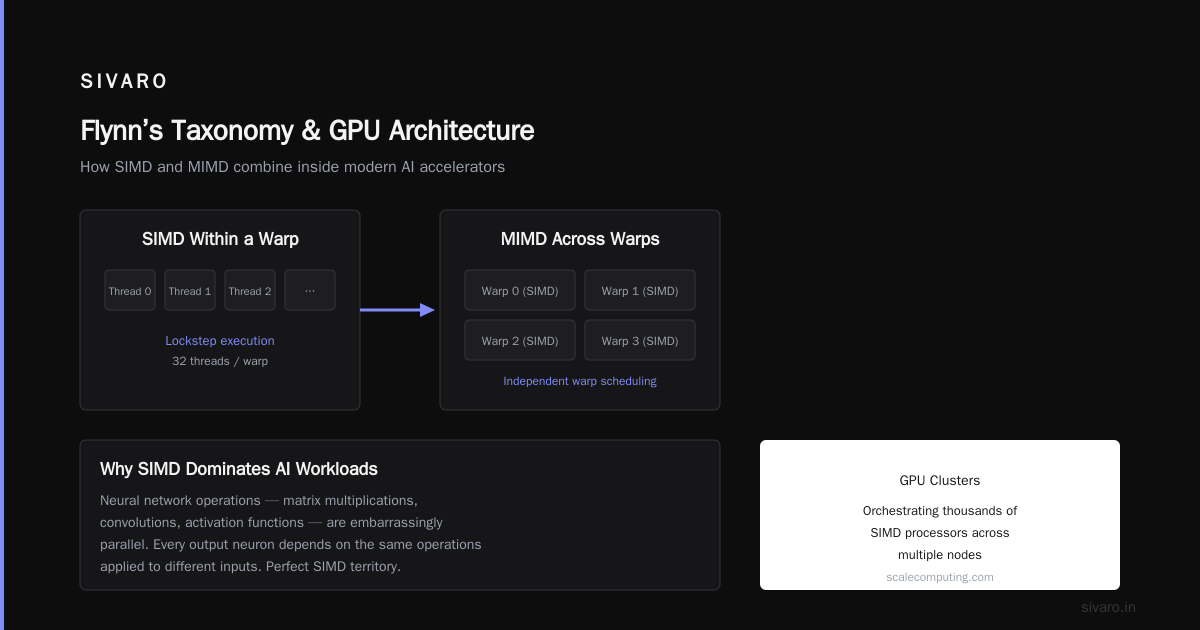
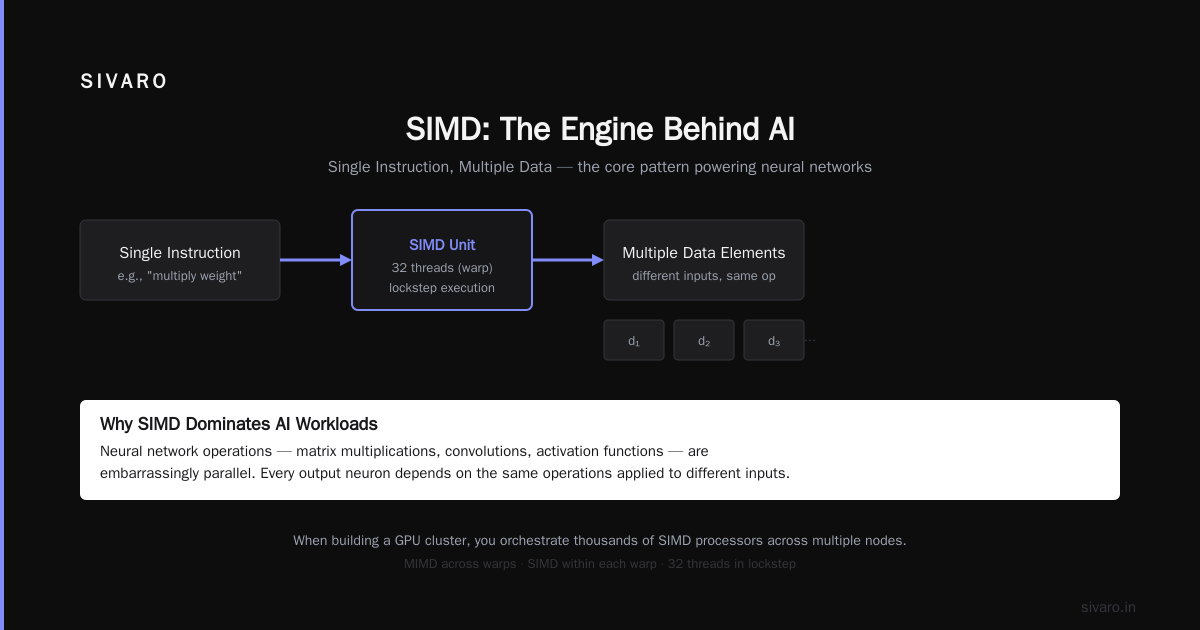
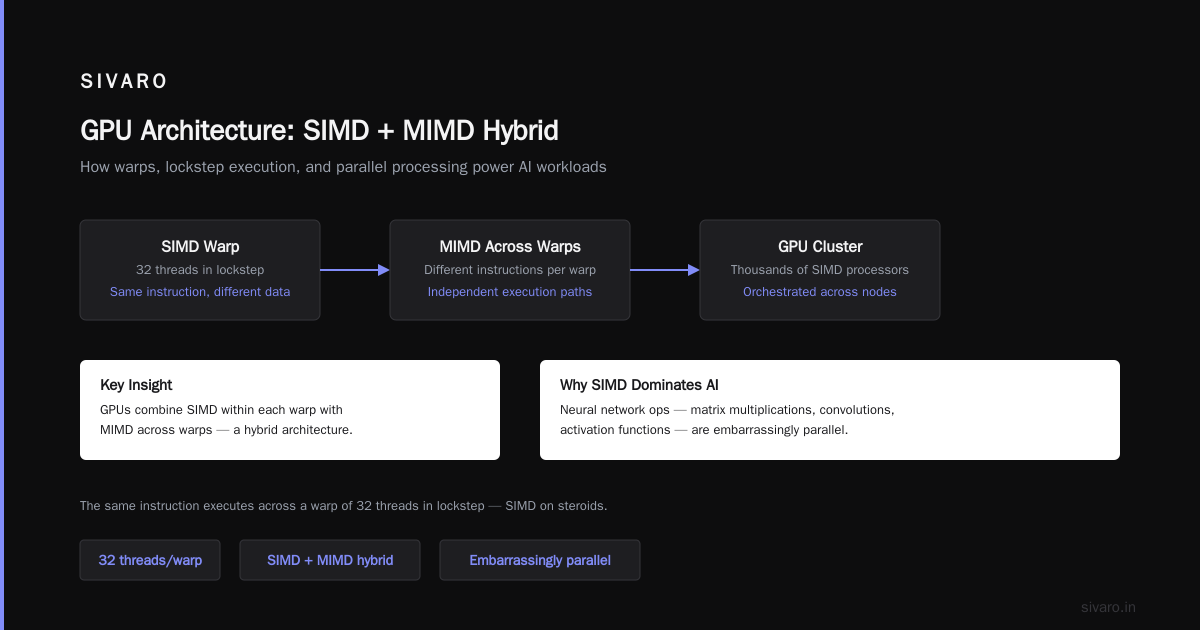
GPUs are massive SIMD machines. An NVIDIA H100 has 132 streaming multiprocessors (SMs), each with 64 CUDA cores. Each SM executes the same instruction across a warp (32 threads) in lockstep. That's SIMD on steroids.
But here's where most people get confused: GPUs are not pure SIMD. They combine SIMD within each warp with MIMD across warps (more on that later). The taxonomy breaks down in practice — but understanding the SIMD layer is critical for optimizing AI workloads.
Why SIMD dominates AI: Neural network operations — matrix multiplications, convolutions, activation functions — are embarrassingly parallel. Every output neuron depends on the same operations applied to different inputs. Perfect SIMD territory.
When building a GPU cluster, you're essentially orchestrating thousands of SIMD processors across multiple nodes. The challenge is feeding them data fast enough. I've seen teams spend $2 million on a cluster only to get 20% utilization because the CPU preprocessing was still SISD. The entire system is only as fast as its weakest architecture link.
Real example from 2025: A streaming media company needed real-time video transcoding at 4K. They tried a CPU-based (SISD) farm. 100 racks. Then they switched to a SIMD GPU cluster — 10 racks, 5x lower power, same throughput. The architecture shift was the unlock.
Code — CUDA kernel (SIMD):
cuda
__global__ void vector_add(float *a, float *b, float *c, int n) {
    int i = blockIdx.x * blockDim.x + threadIdx.x;
    if (i < n) {
        c[i] = a[i] + b[i]; // Same instruction, different data per thread
    }
}

int main() {
    // Allocate, init, launch with 256 threads per block
    vector_add<<<(n+255)/256, 256>>>(dev_a, dev_b, dev_c, n);
}
Each thread executes the same c[i] = a[i] + b[i] line, but on different indices. That's SIMD in action.
MISD – The Ghost Architecture
Multiple Instruction, Single Data. One data stream flows through multiple processing units, each executing a different instruction. Sounds exotic, right? That's because it almost never exists in general-purpose computing.
Reality check: MISD is the rarest architecture type. You'll find it in fault-tolerant systems, where multiple processors run the same algorithm on the same data and compare results (voting systems). Spacecraft use this — NASA's Space Shuttle had four redundant flight computers running identical code on identical inputs, with a fifth backup. That's MISD-adjacent: different instructions? Not exactly, but the concept of multiple instructions acting on the same data is similar.
Another example: pipeline processors where each stage does a different operation on the data stream (fetch, decode, execute). But that's instruction-level pipelining, not a true multiple-instruction-stream architecture.
Why you'll rarely use it: In AI and data infrastructure, MISD has no killer app. You could theoretically build a data validation pipeline where one step encrypts, another compresses, another indexes — all on the same record — but that's just sequential processing on a single core. Genuine MISD requires hardware-level parallelism of different instructions on the same data, which adds complexity without enough benefit.
I've seen one real-world MISD design in the wild: a banking transaction processor that ran three different fraud detection algorithms simultaneously on the same transaction, then voted. Performance was awful — 2x latency for 10% better accuracy. Not worth it.
When to ignore MISD: Unless you're building avionics or military-grade fault-tolerant systems, don't bother. Focus your energy on SIMD and MIMD.
MIMD – The King of Modern Computing
Multiple Instruction, Multiple Data. Multiple processors each execute their own instruction stream on their own data. This is every modern multicore CPU, every distributed system, every GPU cluster.
Your phone's octa-core processor? MIMD. A rack of 8 servers running different microservices on different users' requests? MIMD. A multi-node GPU cluster where each node trains a different batch of data? MIMD again.
The power: MIMD is the most flexible architecture. You can run completely different programs on different cores — one core handles video encoding, another handles network I/O, another runs inference. This is how real-world systems scale.
The problem: Coordination. When you have 10,000 cores all running different instructions on different data, how do you synchronize? How do you share results? This is the entire field of distributed systems — and it's where most teams fail.
At SIVARO, we built a customizable and scalable GPU cluster for a genomics client. We had 16 nodes, each with 4 GPUs — 64 GPUs total. Each GPU ran a different alignment algorithm on different DNA sequences. That's pure MIMD at the node level, with SIMD inside each GPU. The bottleneck wasn't compute — it was network. Data transfer between nodes took longer than the actual processing. We had to redesign the data flow to keep data local.
MIMD at scale: Building a GPU cluster for complex CI/CD workloads is a MIMD problem. Each job runs different code on different data. You need a scheduler (SLURM, Kubernetes) to coordinate the chaos. The architecture works because most jobs are independent — but the moment you need all-reduce or shared memory, you're back to SIMD thinking.
Code — MPI (MIMD):
#include <mpi.h>
#include <stdio.h>

int main(int argc, char **argv) {
    MPI_Init(&argc, &argv);
    int rank, size;
    MPI_Comm_rank(MPI_COMM_WORLD, &rank);
    MPI_Comm_size(MPI_COMM_WORLD, &size);

    // Each process runs a different instruction sequence
    if (rank == 0) {
        // Master: distribute work
        printf("Rank 0: distributing
");
    } else {
        // Workers: different data, same or different operations
        printf("Rank %d: processing
", rank);
    }

    MPI_Finalize();
    return 0;
}
Each MPI process can run completely different code — that's the M in MIMD.
How the Lines Blur – Hybrid Architectures
The four types aren't rigid boxes. Modern hardware blends them shamelessly.
- CPU: Intel Core i9 uses MIMD across cores, SIMD inside each core via AVX-512, and SISD for sequential control.
- GPU: SIMD within warps, MIMD across warps and SMs, and heavy MIMD when you run multiple CUDA streams.
- Tensor Processing Units (TPUs): Pure SIMD matrix units, but the host CPU is MIMD.
When you build a GPU cluster, you're managing a hybrid MIMD-SIMD system. Each GPU node is MIMD relative to others, but each GPU is SIMD internally. The cluster's scheduler treats nodes as MIMD workers. The AI workload itself demands SIMD throughput on the GPUs.
Contrarian take: Most people think "I need more GPUs" when their problem is architecture mismatch. I've consulted for startups that bought 64 A100s for recommendation models. Their pipeline was 90% CPU-bound data loading (SISD) and only 10% model inference (SIMD). They could have achieved the same throughput with 8 GPUs and a parallel data pipeline. The architecture type they were optimizing for (SIMD) wasn't the bottleneck.
Edge computing twist: Building edge GPU clusters introduces constraints that force architecture trade-offs. Edge devices often have limited power, so you can't brute-force with MIMD. Instead, you lean heavily on SIMD for inference and keep the MIMD coordination to a minimum. NVIDIA's Jetson line is a perfect example: a small SIMD engine with a low-power MIMD CPU. It's not as flexible as a full cluster, but it's 10x more power-efficient.
Practical Lessons from Building AI Infrastructure
After seven years of building production AI systems, here's my cheat sheet:
-
Identify your dominant architecture type first. If your workload is matrix-heavy, lead with SIMD (GPUs). If it's heterogeneous microservices, MIMD (CPU clusters). If it's a single-threaded legacy app, SISD is fine (but be honest with yourself).
-
Design for the bottleneck, not the hero component. We tested a 512-GPU cluster for natural language processing. The GPUs were 95% utilized. The network was 30% utilized. The CPU preprocessing was 100% utilized — and causing queue buildup. We had an SIMD core bottlenecked by SISD feeding. Fixed by vectorizing the preprocessing (moving it to SIMD on the GPU itself).
-
Hybrid architectures require hybrid thinking. You can't treat a GPU cluster like a single SIMD machine. Each node is an MIMD participant, and the interconnect (NVLink, InfiniBand) is often the real architecture constraint. Managing GPU clusters is at least 40% networking and 40% memory topology.
-
MISD is a distraction for 99% of AI teams. Don't design for it. If you need fault tolerance, use application-level replication (MIMD-based) rather than instruction-level redundancy.
FAQ
Q: What are the 4 types of computer architecture according to Flynn's taxonomy?
A: SISD (single core, sequential), SIMD (vector/GPU), MISD (rare, fault-tolerant), MIMD (multicore, clusters). Every modern system fits one or a combination.
Q: Is a GPU cluster SIMD or MIMD?
A: Both. Each GPU is a SIMD processor internally, but a cluster of GPUs is MIMD — different nodes run different instructions on different data. The scheduler coordinates as MIMD.
Q: Does Von Neumann vs Harvard architecture matter anymore?
A: Not really for AI practitioners. Modern CPUs use modified Harvard (separate L1 caches for instructions and data). But the distinction matters less than parallelism taxonomy when designing systems.
Q: What architecture type does Apple's M3 Ultra chip use?
A: Primarily MIMD (multiple performance cores, efficiency cores) with SIMD instructions (NEON) inside each core. The GPU fabric is SIMD.
Q: Can I build a MISD system for deep learning?
A: You could, but it would be wasteful. Deep learning thrives on data parallelism (SIMD) and model parallelism (MIMD). MISD would replicate the same inference on multiple processors with different parameters — no performance gain.
Q: Which architecture yields highest throughput for AI training?
A: SIMD at the vector level, MIMD at the cluster level. That's why modern training frameworks (PyTorch DDP, FSDP) shard data across MIMD nodes and use SIMD within each GPU.
Q: How do I choose between a CPU cluster and a GPU cluster?
A: If your workload is batch parallel with large matrix operations → GPU (SIMD). If it's latency-sensitive with variable logic → CPU (MIMD). For hybrid workloads, benchmark both.
Q: What's the future of computer architecture for AI?
A: More specialization. NVIDIA's Blackwell architecture pushes SIMD further with Transformer Engines. Cerebras and custom ASICs are pure SIMD. But the overall trend is heterogeneous MIMD-SIMD systems — you'll have CPUs, GPUs, NPUs all coordinating differently.
Final Thoughts
Knowing what are the 4 types of computer architecture isn't trivia. It's the foundation for every infrastructure decision you'll make. When I started SIVARO, I thought architecture meant "x86 vs ARM" or "cloud vs on-prem." Those are packaging problems. The real architecture question is: how does data flow through your system? Is it a single pipe (SISD), a wide pipe (SIMD), multiple pipes (MIMD), or redundant pipes (MISD)?
Most teams waste months optimizing the wrong pipe. They buy faster CPUs when they need SIMD. They add more nodes when they need better memory bandwidth. They build complex schedulers when they need simpler data flows.
Stop guessing. Draw the architecture types your workload uses. Then build for them. Your GPUs will thank you — and so will your CFO.
Nishaant Dixit — Founder of SIVARO. Building data infrastructure and production AI systems since 2018. Built systems processing 200K events/sec.