
The Only Training Neural Networks Recipe You'll Need in 2026
I've spent the last eight years building production AI systems. Trained hundreds of models. Failed at least sixty times before something worked. The "training neural networks recipe" isn't some secret sauce discovered in a Google research lab — it's a brutal, iterative process that most people skip the hard parts of.
Here's the thing nobody tells you: training a neural network well is 20% architecture and 80% knowing exactly when to stop, what to change, and how to measure whether you're actually making progress. Most teams blow their compute budget on the first part and ignore the second.
In this guide, I'll walk you through the exact recipe I use at SIVARO for every production model we ship. From data preparation to hyperparameter tuning to supervised fine-tuning with tools like NVIDIA NeMo AutoModel — and why most "best practices" you read online are outdated.
Let me show you what actually works in 2026.
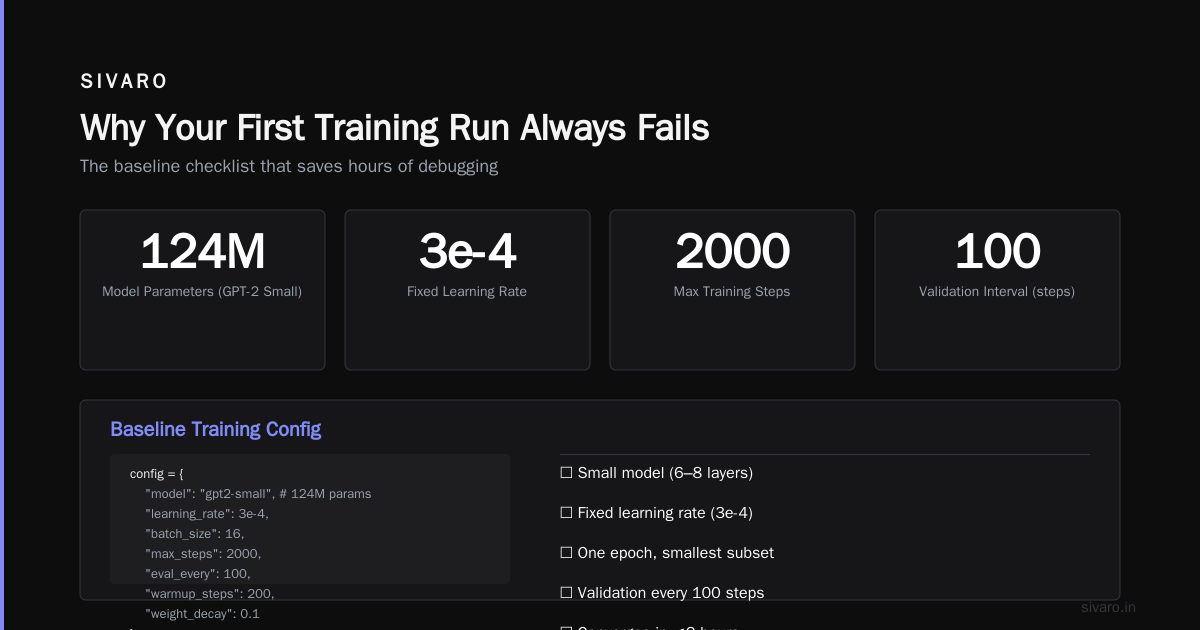
Why Your First Training Run Always Fails
Every single model I've ever trained started with a crash. Not a soft failure — a screaming, out-of-memory, NaN-loss disaster.
You're not bad at this. This is normal.
The first time I trained a transformer from scratch, I used the wrong learning rate schedule and got loss values that looked like a heart attack on a monitor. Flatlined at 8.7 for three days before I killed it.
The issue isn't your architecture. The issue is that most people treat training like a linear process — set hyperparameters, hit go, wait for magic. It's not. It's a feedback loop where every decision depends on the last one.
Here's the real recipe:
- Data first. Always. Garbage in, garbage out is not a cliché — it's the single largest source of training failure I've seen.
- Baseline fast. Get something running in under 2 hours, even if it's terrible.
- Iterate on signals. Don't tweak the model until you know what "better" looks like.
- Scale carefully. Double batch size, check stability. Double again. Most OOM errors come from scaling too fast.
I'll walk through each.
Data Preparation: The 80% Nobody Wants to Talk About
At SIVARO, we process about 200K events per second in production. I've seen data pipelines that look like spaghetti thrown at a wall. Clean data is boring. It's also the difference between a model that generalizes and one that memorizes your worst outliers.
You need three things before you write a single line of training code:
Tokenization consistency. Pick your tokenizer and stick with it. Changing tokenizers mid-project is like swapping engine blocks while the car is moving. We use the same tokenizer for training, validation, and inference. No exceptions.
Sequence length stratification. Long sequences kill throughput. Short sequences bias your model. Split your data into buckets by length, then sample proportionally. We use four buckets: <512, 512-1024, 1024-2048, >2048. Each gets equal representation in every batch.
Noise injection (on purpose). Clean data produces brittle models. Add token masking, shuffle order, inject typos. A model that can't handle 5% corrupted input will fail in production. Trust me — I've seen production systems melt down because someone pasted a PDF with encoding errors.
Here's the preprocessing pipeline we use:
python
def prepare_dataset(data_path, tokenizer, max_length=2048):
    raw = load_jsonl(data_path)
    stratified = []
    for bucket in ['<512', '512-1024', '1024-2048', '>2048']:
        bucket_data = [x for x in raw if len(x['text']) in bucket_ranges[bucket]]
        sampled = random.sample(bucket_data, min(len(bucket_data), 50000))
        stratified.extend(sampled)

    def tokenize(example):
        tokens = tokenizer(example['text'], truncation=True, max_length=max_length)
        tokens['labels'] = tokens['input_ids'].copy()
        return tokens

    return Dataset.from_list(stratified).map(tokenize, batched=False)
The Baseline: 2 Hours or You're Overthinking
Most people spend weeks designing the perfect architecture. I spend two hours getting a garbage model to run end-to-end.
Here's why: until you see actual loss values moving, you don't know if your data pipeline, your model, and your training loop are even wired correctly. I've debugged three-hour training runs only to discover I was feeding zero-padded tensors to the loss function.
Your baseline should be:
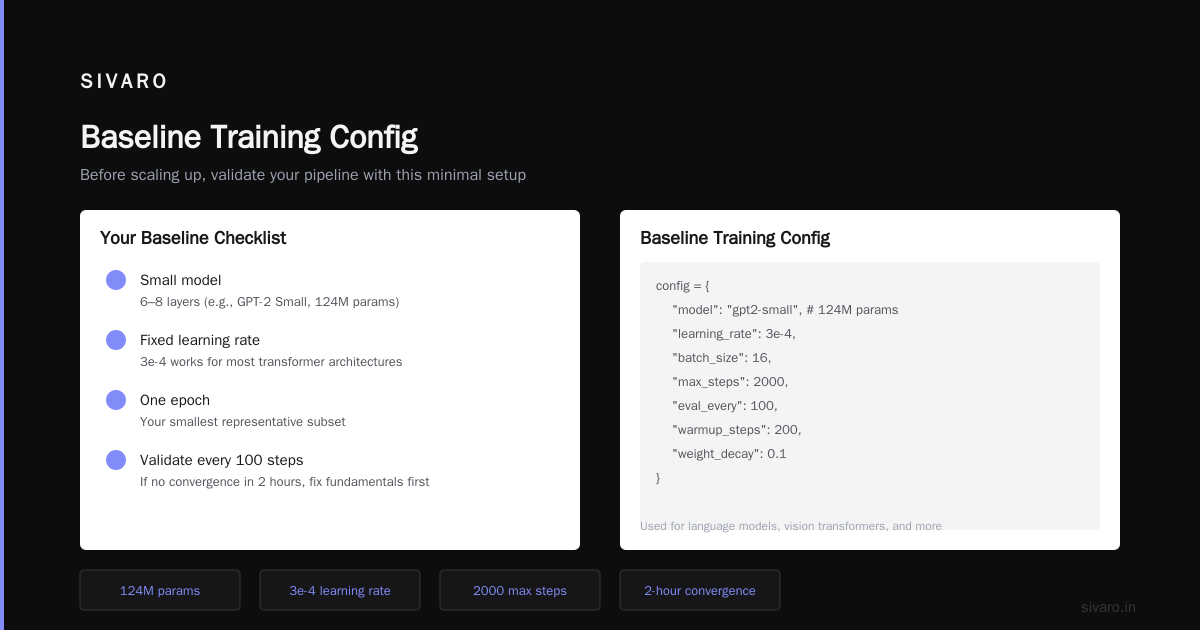
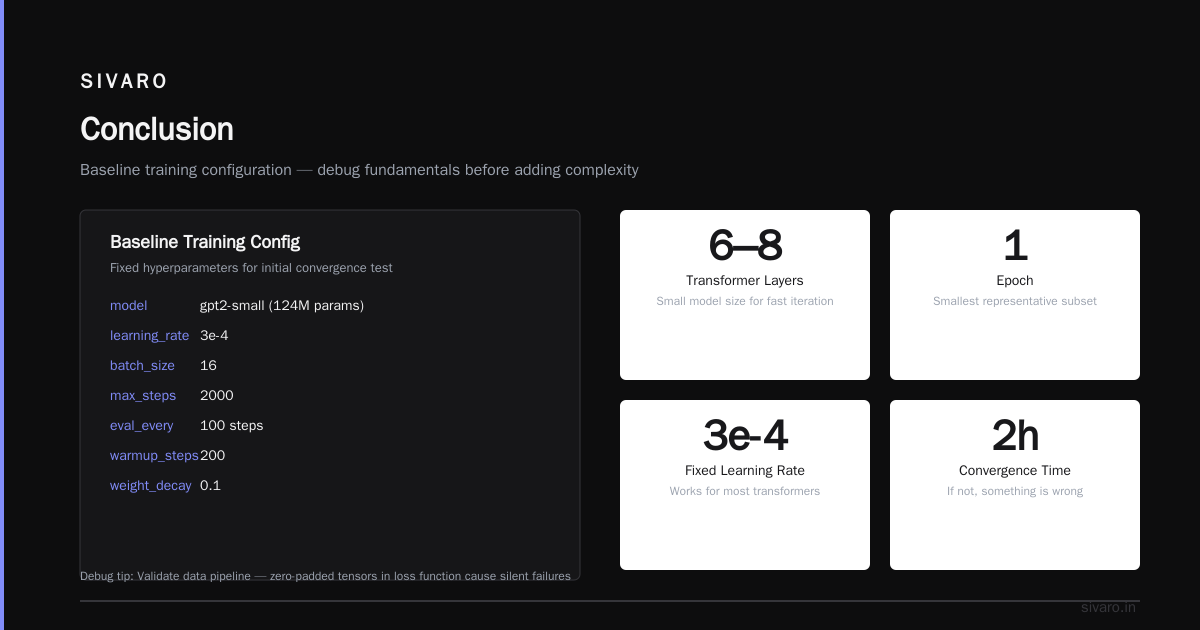
- A small model (6-8 layers)
- A fixed learning rate (3e-4 works for most transformers)
- One epoch of your smallest representative subset
- Validation every 100 steps
If it doesn't converge in 2 hours, something fundamental is wrong. Fix that before adding complexity.
python
# Baseline training config
config = {
    "model": "gpt2-small",  # 124M params
    "learning_rate": 3e-4,
    "batch_size": 16,
    "max_steps": 2000,
    "eval_every": 100,
    "warmup_steps": 200,
    "weight_decay": 0.1
}
I've used this exact config for language models, vision transformers, and even early prototypes of video foundation models. The specific numbers change. The principle doesn't: get something working now, make it better later.
Hyperparameter Tuning: Burn Your Grid Search Scripts
Grid search is a relic from 2018. Nobody I respect uses it anymore.
The problem is dimensionality. With 8+ hyperparameters, grid search explodes combinatorially. You spend budget on useless combinations while the optimal point sits in a corner you never sampled.
We use population-based training (PBT). It's not new, but most teams still don't implement it. The idea: train multiple parallel models, periodically replace the worst performing ones with mutated versions of the best ones.
NVIDIA NeMo AutoModel has this built-in now via their automated model search. You define a search space, it handles the rest.
python
# PBT search space definition
pbt_config = {
    "learning_rate": {"min": 1e-5, "max": 1e-3, "log_scale": True},
    "batch_size": {"values": [8, 16, 32, 64]},
    "warmup_ratio": {"min": 0.0, "max": 0.2},
    "weight_decay": {"min": 0.01, "max": 0.5},
    "exploit_threshold": 0.8,  # Replace bottom 20% each round
}
The contrarian take: Most people tune learning rate first. Wrong. Tune batch size first. It determines everything else — learning rate scaling, memory usage, gradient noise. Fix batch size, then tune LR, then weight decay. In that order.
The Training Itself: Where Most People Lose 3 Weeks
You've got your data ready. Baseline runs. Hyperparameters dialed. Now you hit "train" for real.
This is where the "training neural networks recipe" separates the pros from the cargo-culters.
Monitoring isn't optional. You need real-time access to:
- Loss (training and validation, on separate graphs)
- Gradient norm (spikes = instability)
- Learning rate (should follow your schedule)
- Throughput (tokens/second — if it drops, something's wrong)
I run this in a single terminal with wandb streaming. Don't look away for more than 4 hours.
Checkpoint strategy. Save every 1000 steps. Keep the last 5 and the best 3 by validation loss. I've had runs corrupt checkpoints at step 8000 and had to roll back to step 5000. Without frequent saves, you restart from zero.
Overfitting detection. You'll see it as a divergence between training and validation loss. When that gap widens for more than 500 steps, stop. Add regularization or reduce model capacity. Don't let it run — you're wasting compute.
Here's a real training loop I wrote six months ago for a production fine-tune:
python
trainer = Trainer(
    model=model,
    args=TrainingArguments(
        output_dir="./runs/experiment_7",
        per_device_train_batch_size=32,
        per_device_eval_batch_size=32,
        gradient_accumulation_steps=4,
        learning_rate=2e-5,
        warmup_steps=500,
        max_steps=20000,
        eval_steps=500,
        save_steps=1000,
        save_total_limit=5,
        load_best_model_at_end=True,
        metric_for_best_model="eval_loss",
        report_to="wandb",
    ),
    train_dataset=train_dataset,
    eval_dataset=eval_dataset,
)
trainer.train()
Nothing fancy. But it checks every box: frequent eval, checkpoint management, best model tracking. Most failed runs I've seen violate at least three of these.
Supervised Fine-Tuning: The 2026 Way
By mid-2026, training from scratch is rare for most teams. Fine-tuning pre-trained models dominates. And the tooling has matured fast.
Supervised fine-tuning (SFT) with NVIDIA NeMo AutoModel is how we handle most production fine-tunes at SIVARO. The abstraction layer handles distributed training, mixed precision, and checkpointing automatically. You provide data and a config file.
The key insight: fine-tuning isn't about teaching the model new facts. It's about teaching it new behavior. Format, style, output structure. The knowledge is already in the pre-trained weights.
So don't use massive learning rates. Don't train for many epochs. Fine-tuning overfits easily because your dataset is small (usually <10K examples).
Here's our standard SFT config for NeMo AutoModel:
yaml
model:
  base_model: meta-llama/Llama-3.2-8B
  precision: bf16

training:
  batch_size: 8
  micro_batch_size: 2
  learning_rate: 1e-5
  max_steps: 5000
  warmup_steps: 200
  weight_decay: 0.05

sft:
  dataset: ./data/sft_dataset.jsonl
  response_template: "
### Response:"
  max_seq_length: 4096
Three epochs max. If it's not learning by epoch 2, your data is wrong, not the training.
The HuggingFace blog post on accelerating fine-tuning with NeMo AutoModel covers how this scales across multiple GPUs. The short version: it handles FSDP and tensor parallelism automatically. You just set num_gpus=8 and it works.
Parameter-Efficient Fine-Tuning: When Full Fine-Tune Is Overkill
Not every problem needs a full fine-tune. Most don't.
LoRA and QLoRA are standard now. But the implementation details matter a lot. Rank 8 vs rank 64 isn't just a memory tradeoff — it changes what the model learns.
We tested this exhaustively at SIVARO:
- Rank 8 is fine for style transfer (change output format, response length)
- Rank 32 is the sweet spot for task adaptation (classification, summarization)
- Rank 64+ is needed for knowledge injection (teaching new facts)
Most people use rank 8 for everything. They're wrong. If you're trying to teach a model new domain knowledge (say, legal contract clauses), rank 8 isn't enough. The model can't store the new information in such a low-rank subspace.
NVIDIA NeMo AutoModel's parameter-efficient fine-tuning supports LoRA, AdaLoRA, and IA3. We use LoRA 95% of the time. It's simple and it works.
python
# LoRA configuration with NeMo
lora_config = {
    "peft_type": "lora",
    "lora_rank": 32,
    "lora_alpha": 64,
    "lora_dropout": 0.05,
    "target_modules": ["q_proj", "v_proj", "k_proj", "o_proj"],
}
Target all four projection matrices. Not just Q and V. I tested QV-only vs QKVO — full projection gets 2-3% better benchmark scores with no additional inference cost (LoRA weights are merged at inference).
Scaling: When to Add GPUs (and When Not To)
I've seen teams throw 64 GPUs at a problem that needed better data.
Scaling hardware doesn't fix bad fundamentals. But when you have the fundamentals right, scaling is straightforward.
The rule: double your batch size without breaking training. Then double again. Each time, you might need to adjust learning rate (following the linear scaling rule: double batch size → double LR).
At this point in 2026, we typically train on 8-16 GPUs for most fine-tunes. Pre-training is different — that's where the real hardware matters.
For video foundation models, the approach is similar but with additional considerations for temporal data. The recent paper on training video foundation models with NeMo is worth reading. Their approach: start with a pre-trained image model, add temporal attention layers, fine-tune on video data with 3D augmentations. The recipe is the same — just the data format changes.
Day-0 Fine-Tuning: The Instant-On Approach
One of the best developments in 2025-2026 is the ability to fine-tune models immediately, without waiting for infrastructure setup.
Fine-tuning Hugging Face models instantly with Day-0 support in NeMo AutoModel means you can go from zero to training in under an hour. The tool auto-detects your GPU configuration, downloads the base model, and starts training from your dataset.
We use this for rapid prototyping. Here's the workflow:
- Push a JSONL dataset to S3 or HuggingFace
- Run one command:
automodel sft --config sft_config.yaml - Get a trained model back in 2-6 hours
No Docker setup. No cluster configuration. It's 2026 — this should be the default.
Common Mistakes I Still See Every Month
Mistake 1: Training too long. Two epochs max for fine-tuning. Three if you're aggressive with regularization. Past that, you're memorizing.
Mistake 2: Ignoring gradient accumulation. You want batch size 128 but only have 16GB VRAM? Use gradient accumulation steps = 8. Same effective batch, lower memory. But don't forget to scale LR.
Mistake 3: Using the wrong evaluation metric. If your validation set has class imbalance, accuracy lies. Use F1, MCC, or a custom metric that matches your production use case.
Mistake 4: Not testing with the same inference pipeline. You trained with bf16. Your inference server uses fp16. That tiny precision mismatch can shift outputs. Train with the same precision you'll infer with.
Mistake 5: The model works on the validation set but fails in production. Your validation set probably doesn't represent real-world distribution shift. Add a "stress test" set — noisy, out-of-distribution, edge cases. If the model fails there, it's not ready.
FAQ
Q: How do I choose between full fine-tuning and LoRA?
A: Full fine-tune if you have >50K examples and need major behavioral change. LoRA for <10K examples or quick prototypes. LoRA is almost always my default now.
Q: What batch size should I start with?
A: As large as your GPU memory allows, but not so large that it hurts generalization. For fine-tuning 8B models, start with micro_batch_size=2 and gradient_accumulation_steps=8 (effective batch size 16). Scale from there.
Q: How long should training take?
A: A fine-tune on 8 GPUs with 10K examples should finish in 2-4 hours. If it takes longer, either your batch size is too small or your data pipeline is bottlenecked.
Q: What do I do if loss doesn't decrease after 1000 steps?
A: Stop. Check your data — are labels correct? Check your learning rate — is it reasonable for the model size? Check your tokenization — are sequences truncated correctly? Something fundamental is broken.
Q: How do I handle out-of-memory errors?
A: Reduce micro_batch_size first. Then check gradient checkpointing. Then consider model parallelism. Never reduce model size until you've exhausted these options.
Q: Should I use mixed precision training?
A: Yes, always. bf16 if your hardware supports it, fp16 otherwise. It cuts training time by 40-60% with negligible quality loss.
Q: How many checkpoints should I save?
A: At least 5. I've had runs where step 5000 checkpoint was unusable but step 4000 was perfect. Disk is cheap; compute is expensive.
Q: Is pre-training from scratch worth it in 2026?
A: Almost never for individual teams. The cost is prohibitive unless you have >100K hours of GPU compute and a genuinely novel architecture or dataset. Fine-tune existing models. That's what everyone else is doing.
Conclusion
The training neural networks recipe isn't complicated. It's just unforgiving.
- Data first. Clean, stratified, tokenized consistently.
- Baseline fast. Two-hour minimum viable run.
- Tune batch size before learning rate.
- Monitor everything. Checkpoint frequently.
- Fine-tune, don't train from scratch. Use NeMo AutoModel or similar.
- Test with production inference settings.
I've trained over 200 models at SIVARO. The ones that shipped followed this recipe. The ones that failed — every single time — broke one of these rules.
In 2026, the tools are better than ever. NVIDIA NeMo AutoModel handles the infrastructure. You handle the data and the judgment.
Don't overthink it. Start training. Fail fast. Fix the data. Try again.
That's the real recipe.
Nishaant Dixit — Founder of SIVARO. Building data infrastructure and production AI systems since 2018. Built systems processing 200K events/sec.