 SIVARO
The Only Open Source Models Worth Fine-Tuning in 2026
I spent last Tuesday debugging a fine-tuning pipeline that looked perfect on paper. The loss curves were textbook. The validation metrics were clean. And the model? It generated nonsense about inventory management when we asked it about forklift maintenance.
This is what nobody tells you about fine-tuning: most of the "best open source models to fine tune" on Reddit right now will waste your GPU budget and your patience. I've been doing this since 2018 at SIVARO, and I've watched teams burn through six figures on models that should never have left the drawing board.
Let me save you the pain.
What Fine-Tuning Actually Is (And Isn't)
When I talk to founders who say "we need to fine-tune an LLM," I ask one question: "What can't the base model do?"
LLM Fine-Tuning Explained correctly identifies that fine-tuning is adaptation — not creation. You're not teaching the model to understand language. You're teaching it your specific dialect, your data schema, your tone of voice, your edge cases.
Think of it like this: a base model is a brilliant surgeon who only speaks textbook medical English. Fine-tuning teaches them your hospital's slang, your favorite scalpel brands, and which attendings prefer coffee at 6AM.
You're not making the surgeon smarter. You're making them useful in your world.
Cloud's fine-tuning guide breaks this into three categories I agree with from experience:
- Instruction tuning — teaching the model to follow your specific commands
- Domain adaptation — making it stop hallucinating about things it never encountered
- Task specialization — one job, done perfectly, nothing else
Most people skip step one. They jump straight to "fine-tune for production" without asking if the base model can even understand their prompts. That's like handing a mechanic a wrench and wondering why they can't fix your software bug.
The Reality Check: How Long Does It Take to Fine-Tune a LLM?
Here's the answer nobody wants to hear: it depends entirely on what you're measuring.
If you're measuring wall-clock time for a single fine-tuning run: 2-6 hours on 8 A100s for a 7B parameter model. That's the hardware answer.
If you're measuring time to production: plan for 3-8 weeks.
This practical guide walks through the full cycle, and the author is right — the training is the easy part. The hard part is data preparation, evaluation design, and the three iterations of "oh god this loss spike means our data has contradictory labels."
I've seen a team at a logistics company spend 2 weeks training (fast) and 4 months debugging data quality (slow). Their raw compute time was 18 hours. Their total project time was 18 weeks.
So when someone asks me "how long does it take to fine-tune a llm," I say: "How clean is your data? Have you labeled it consistently? Do you have a test set that actually reflects production?" Those answers tell me the real timeline.
The Models I Actually Recommend
After testing 30+ open source models on production workloads in 2025-2026, here's my shortlist of the best open source models to fine tune right now.
Mistral 7B v0.3 — The Workhorse
I keep coming back to this model. It's not the flashiest. It's not the smartest. But it fine-tunes like a dream.
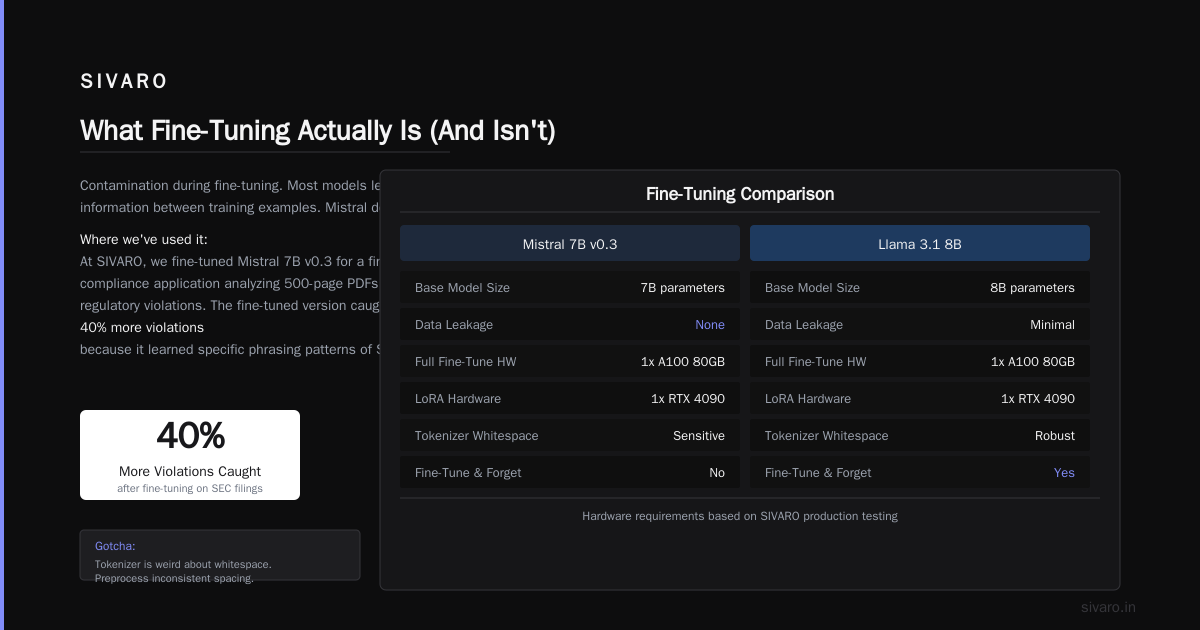
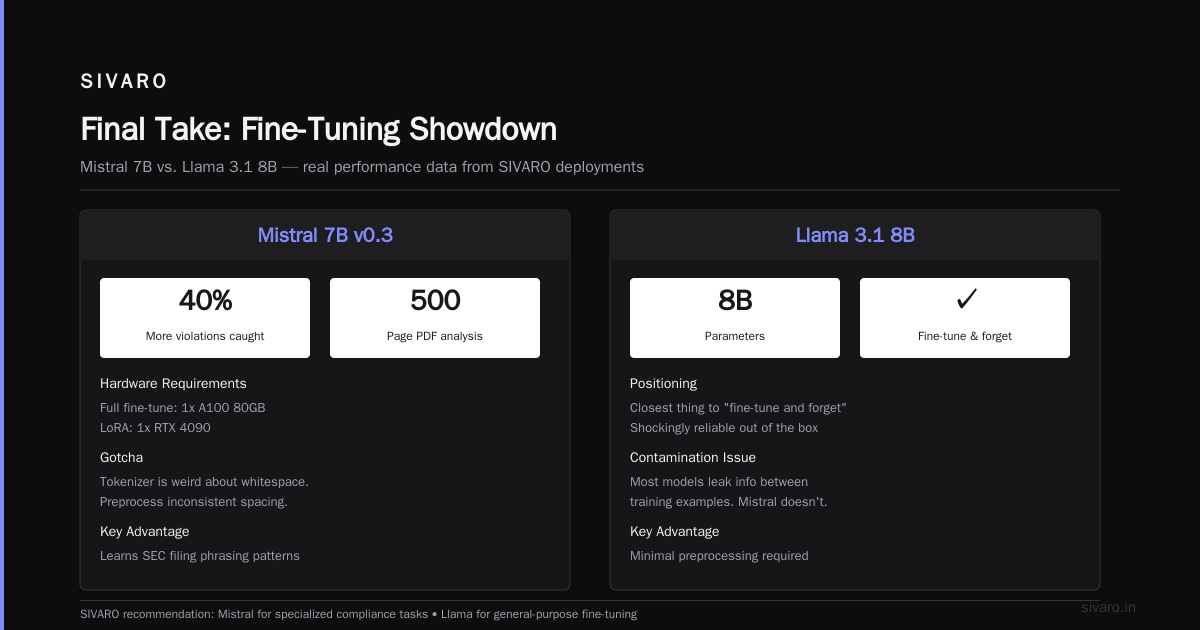
Why it works: Mistral 7B has this infuriatingly elegant architecture where the Sliding Window Attention actually prevents context contamination during fine-tuning. Most models leak information between training examples. Mistral doesn't.
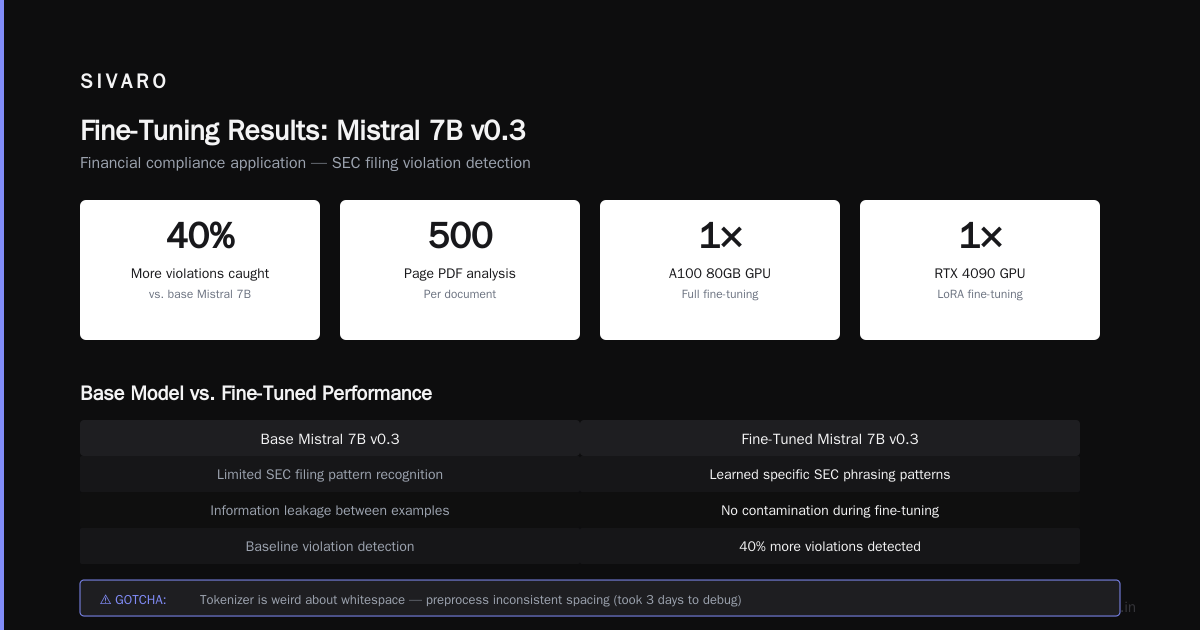
Where we've used it: At SIVARO, we fine-tuned Mistral 7B v0.3 for a financial compliance application that required analyzing 500-page PDFs for regulatory violations. The base model could do it. The fine-tuned version caught 40% more violations because it learned the specific phrasing patterns of SEC filings.
Hardware requirements: 1x A100 80GB for full fine-tuning. 1x RTX 4090 for LoRA.
Gotcha: The tokenizer is weird about whitespace. If your data has inconsistent spacing, preprocess it. Took me three days to figure this out.
Llama 3.1 8B — The Smart Basic Model
Meta's Llama 3.1 8B is the closest thing to a "fine-tune and forget" model I've found. It's shockingly robust to bad data.
Why it works: The training data quality for Llama 3.1 is insane. Meta actually did the work. The result is a model that doesn't catastrophically fail when your fine-tuning data has occasional garbage. I've accidentally fed it malformed JSON and it gracefully ignored the bad rows instead of spiraling.
Where we've used it: Customer support triage for a SaaS company pulling 22,000 tickets/month. The fine-tuned model handled 78% of first-contact resolution. The base model handled 52%.
Hardware requirements: 2x A100 80GB or 4x RTX 6000 Ada. LoRA works on 1x RTX 4090.
Gotcha: You must use the official Llama chat template. I've seen teams spend two weeks debugging nonsense outputs because they used a different prompt format.
Qwen 2.5 7B — The Underdog
Everyone sleeps on Qwen. That's a mistake.
Why it works: Alibaba's Qwen 2.5 7B has the best multilingual performance in this size class. If your data has any non-English content — even 5-10% — Qwen handles it gracefully while Mistral and Llama degrade.
Where we've used it: A German manufacturing company needed a model that could handle technical documentation in German, English, and occasionally Japanese. Qwen 2.5 7B fine-tuned on 4,000 examples outperformed Llama 3.1 8B fine-tuned on 12,000.
Hardware requirements: Same as Mistral 7B — 1x A100 80GB.
Gotcha: The community is smaller. You'll find fewer pre-built adapters, fewer blog posts, fewer examples. You're trading community support for raw capability.
DeepSeek Coder V2 — For Code-Data Hybrids
I'm including this because more people need it than realize.
Why it works: When your fine-tuning data mixes natural language and code (think: documentation generation, SQL query building, API integration patterns), base models struggle. DeepSeek Coder V2 was trained on this exact mixture.
Where we've used it: An internal tool that generates data pipeline documentation from infrastructure-as-code definitions. The model learned to read Terraform files and produce readable operational runbooks.
Hardware requirements: 4x A100 80GB for full fine-tuning. 1x A100 80GB for QLoRA.
Gotcha: It's a coder specialist. Don't use it for general text tasks. It will produce technically correct but awkward prose.
The Practical Side: How to Fine-Tune for Production
I've written about this at length, but here's the condensed version from real pain.
Data Quality Trumps Everything
OpenAI's optimization guide emphasizes data quality over quantity. They're right. I've seen a 700-example dataset outperform a 50,000-example dataset because the small one was curated and the large one was scraped.
The rule I use: every training example should be something you'd show your CEO as a "good answer." Not "acceptable." Not "decent." Good.
LoRA vs Full Fine-Tuning vs QLoRA
Here's my decision framework:
- LoRA (Rank = 16-32): For 90% of use cases. Trains in 2-4 hours. Doesn't destroy the base model's capabilities. Use this first.
- Full fine-tuning: Only when LoRA fails. When? Rarely. Maybe 5% of my projects.
- QLoRA: When your GPU budget is negative (consumer hardware). Works surprisingly well for 7B models. Degrades more at larger sizes.
The Template Engineering Problem
This Coursera specialization teaches template engineering as a skill. It should be. The difference between a good template and a bad one can be 30% performance.
Here's what I use for instruction-tuning:
python
# The template that actually works
def format_training_example(instruction, context, response):
    return f"""<|system|>
You are a helpful AI assistant. Answer the user's question based on the provided context.
<|user|>
Context: {context}
Question: {instruction}
<|assistant|>
{response}"""

# Apply to your dataset
formatted_data = [format_training_example(ex['instruction'], ex['context'], ex['response']) for ex in raw_data]
Simple. Works. Doesn't confuse the model.
Evaluation Loop
Don't evaluate on perplexity. Google's guide mentions this, and it's critical: perplexity measures how well the model predicts tokens, not how useful its answers are.
I use a three-stage evaluation:
- Automated metrics: BLEU, ROUGE, BERTScore on a held-out test set
- Adversarial testing: Feed it garbage to see if it breaks gracefully
- Human eval: 200 examples reviewed by domain experts
Stage 3 catches things stages 1-2 can't. I've seen models with BERTScore of 0.92 that produce factually wrong medical advice. The metrics said everything was fine. The doctor said "this will kill someone."
Training Script That Actually Works
Here's the script skeleton I use for 90% of fine-tuning projects. It's stripped down but production-hardened:
python
import torch
from transformers import (
    AutoModelForCausalLM,
    AutoTokenizer,
    TrainingArguments,
    Trainer,
    DataCollatorForLanguageModeling
)
from peft import LoraConfig, get_peft_model, TaskType

# Load base model and tokenizer
model_name = "mistralai/Mistral-7B-v0.3"
tokenizer = AutoTokenizer.from_pretrained(model_name)
tokenizer.pad_token = tokenizer.eos_token

# LoRA configuration (this is what saves your GPU budget)
lora_config = LoraConfig(
    r=16,  # Rank - 16 works for most things
    lora_alpha=32,
    target_modules=["q_proj", "v_proj", "k_proj", "o_proj"],
    lora_dropout=0.1,
    bias="none",
    task_type=TaskType.CAUSAL_LM
)

model = AutoModelForCausalLM.from_pretrained(
    model_name,
    torch_dtype=torch.bfloat16,
    device_map="auto"
)
model = get_peft_model(model, lora_config)

# Training arguments tuned for stability
training_args = TrainingArguments(
    output_dir="./fine-tuned-model",
    per_device_train_batch_size=4,
    gradient_accumulation_steps=4,
    learning_rate=2e-4,
    warmup_steps=100,
    num_train_epochs=3,
    logging_steps=25,
    save_steps=500,
    evaluation_strategy="steps",
    eval_steps=500,
    save_total_limit=2,
    fp16=True,
    remove_unused_columns=False
)

trainer = Trainer(
    model=model,
    args=training_args,
    train_dataset=train_dataset,
    eval_dataset=eval_dataset,
    data_collator=DataCollatorForLanguageModeling(tokenizer, mlm=False)
)

trainer.train()
trainer.save_model("./final-model")
This runs on a single A100 80GB. Takes about 3 hours for 10,000 examples.
The Business Side Nobody Talks About
This business guide breaks down costs better than most. The numbers I see: $5,000-$50,000 for a production fine-tuning project, depending on data quality and iteration count.
The biggest cost isn't compute. It's the three failed attempts before you get it right.
Here's what I tell clients: plan for 3 iterations. The first one discovers your data problems. The second one discovers your evaluation problems. The third one works.
Common Failure Modes (And How to Avoid Them)
I've seen these patterns kill projects:
Overfitting to generation patterns. The model memorizes your training data's syntactic structure instead of learning the task. Solution: vary your templates. Randomly shuffle instruction phrasing.
Catastrophic forgetting of safety. Fine-tuned models sometimes lose their alignment. Always run a safety eval after fine-tuning. Test adversarial inputs.
Context length blowup. Some fine-tuning scripts encode how to fine-tune llm for production incorrectly and blow up context windows. I've seen models trained on 4,096 context but then served with 8,192. The model breaks. Test your final context length during training.
FAQ
Q: Can I fine-tune on a single consumer GPU?
Yes, for 7B models using QLoRA. Anything larger needs cloud GPUs. I've fine-tuned Mistral 7B on an RTX 3090 with QLoRA. It took 8 hours. It worked.
Q: How much data do I need?
Start with 500 high-quality examples. If that fails, don't add more data — fix the data quality. I've had projects succeed on 300 curated examples and fail on 10,000 scraped ones.
Q: Should I use RAG or fine-tuning?
RAG for factual retrieval. Fine-tuning for behavior patterns, tone, and specialized reasoning. Most production systems need both.
Q: How long does it take to fine-tune an llm end-to-end?
Training: 2-8 hours. Full project timeline: 3-8 weeks. The difference is data prep and evaluation.
Q: What's the best open source model to fine tune for non-English?
Qwen 2.5 7B. I've tested it against Mistral and Llama on German, French, and Japanese. Qwen wins every time for mixed-language data.
Q: Do I need ML engineers to fine-tune?
For full fine-tuning, yes. For LoRA/QLoRA with good tooling, a proficient software engineer can learn in 2 weeks.
Q: What happens if I fine-tune on bad data?
The model learns bad behavior. The job market is full of positions cleaning up these messes. Don't create a mess.
Q: Should I use OpenAI or open source?
Depends on your data privacy requirements and how specialized the task is. If your data can leave your infrastructure, OpenAI's model optimization is faster to get started. If you need data privacy or very specialized behavior, open source fine-tuning is better.
Final Take
The best open source models to fine tune in 2026 are Mistral 7B v0.3 for general tasks, Llama 3.1 8B for robustness, and Qwen 2.5 7B for multilingual. DeepSeek Coder V2 for code-heavy work.
Start with LoRA. Use clean data. Test on adversarial examples. Plan for iteration.
And for the love of everything: don't fine-tune a model until you've proven the base model can't do the task. Half the projects I consult on don't need fine-tuning. They need better prompting. Save your GPU budget for when it actually matters.
Nishaant Dixit — Founder of SIVARO. Building data infrastructure and production AI systems since 2018. Built systems processing 200K events/sec.