
The Lab Mistake Computing Revolution: Why Your Agents Keep Failing
Today is July 7, 2026. I've spent the last eight years building data infrastructure and production AI systems at SIVARO. In that time, I've watched our industry repeat the same mistakes over and over — just with shinier tools.
Most people think agentic systems are a breakthrough. They're wrong. What we're actually watching is the slow, painful rediscovery of distributed systems — but this time, the lab rats are running the experiment. I call it the lab mistake computing revolution.
Here's what I mean: every time a team ships a multi-agent system that fails unpredictably, they're making mistakes we solved in distributed computing ten years ago. The lab isn't the problem. The assumption that agents don't need distributed systems thinking is the problem.
By the end of this, you'll understand why your agents crash, how to fix them using decades of distributed systems research, and why the Great Britain rail network real-time map taught me more about agent coordination than any textbook.
Every Agent is a Distributed System (And That's Your Problem)
Look at any agentic system running in production today. You've got multiple agents. They communicate over a network. They share state. They fail independently.
What do you call that?
A distributed system.
I read Your Agent is a Distributed System (and fails like one) earlier this year and nearly threw my laptop across the room — because it's true, and nobody in the AI community wants to admit it.
Here's what happens when you ignore this:
- Agent A sends a request to Agent B.
- Agent B crashes mid-processing.
- Agent A retries. Agent B restarts.
- Agent B processes the request again — duplicate work.
- Now your database has two orders. Your customer is angry. Your weekend is ruined.
I've seen this pattern at three companies this year alone. One was a Series B startup building a code generation platform. They were orchestrating coding agents for open-ended discovery — letting agents spawn sub-agents, retrieve context, write tests. Beautiful in demo. In production? Agents were stepping on each other, writing conflicting code, and committing half-finished PRs.
The fix wasn't more AI. It was adding a distributed lock and implementing idempotency keys.
Takeaway: Stop treating agents as magical. They're processes. Design for failure.
The Great Britain Rail Network Taught Me Coordination
Let me tell you about the Great Britain rail network real-time map.
I'm not British. I don't care about trains. But in 2024, I needed to understand how complex systems coordinate under chaos. So I studied how National Rail handles 4.5 million passenger journeys daily across 2,500 stations — with delays, signal failures, track closures, and the occasional cow on the line.
Their secret? They don't centralize everything. Each train is an autonomous agent. Each station is a node. They communicate via a shared log of events — "Train 9A42 passed signal MK23 at 14:03:17" — and each node reads what it needs.
That's it. No global scheduler. No "master agent." Just an append-only log that everyone trusts.
This is exactly what we should be doing with multi-agent systems. Instead, most teams build chatty, synchronous architectures where agents wait for responses, block on locks, and crash in cascading failures.
A distributed systems primer from Akka puts it bluntly: you have to assume network partitions will happen. You have to assume nodes will fail. You have to design for partial failure.
Rail networks get this. AI startups don't.
The Coordination Trap in Multi-Agent Systems
I recently read Multi-Agent Systems Have a Distributed Systems Problem. The author nails it: agents don't just communicate — they coordinate. And coordination is the hardest problem in distributed systems.
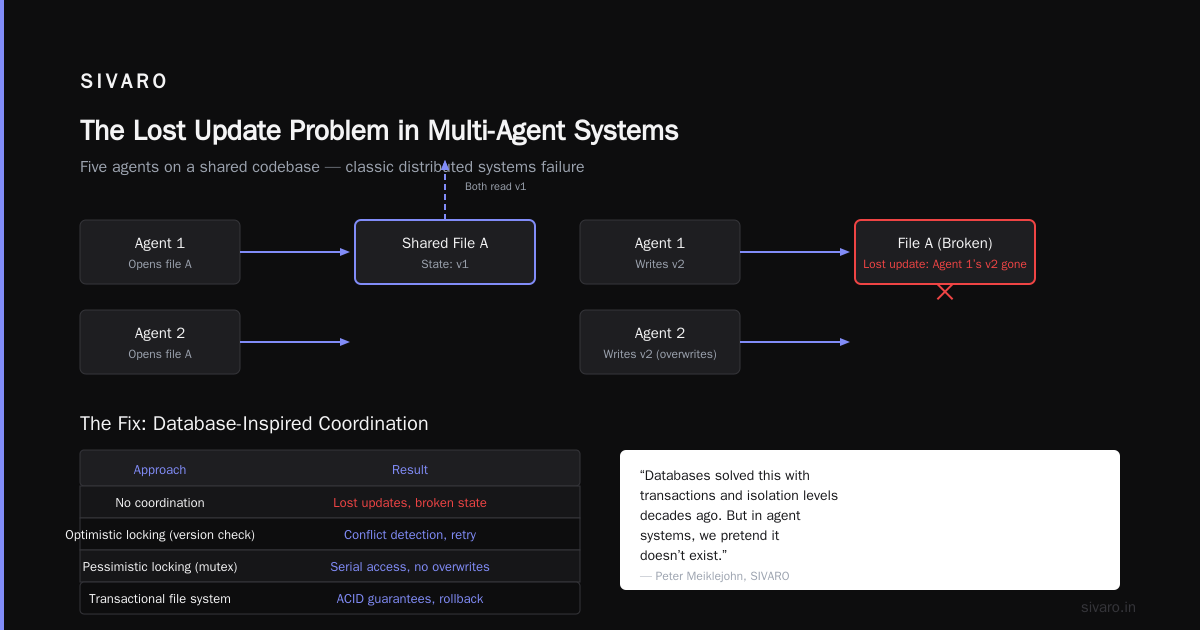
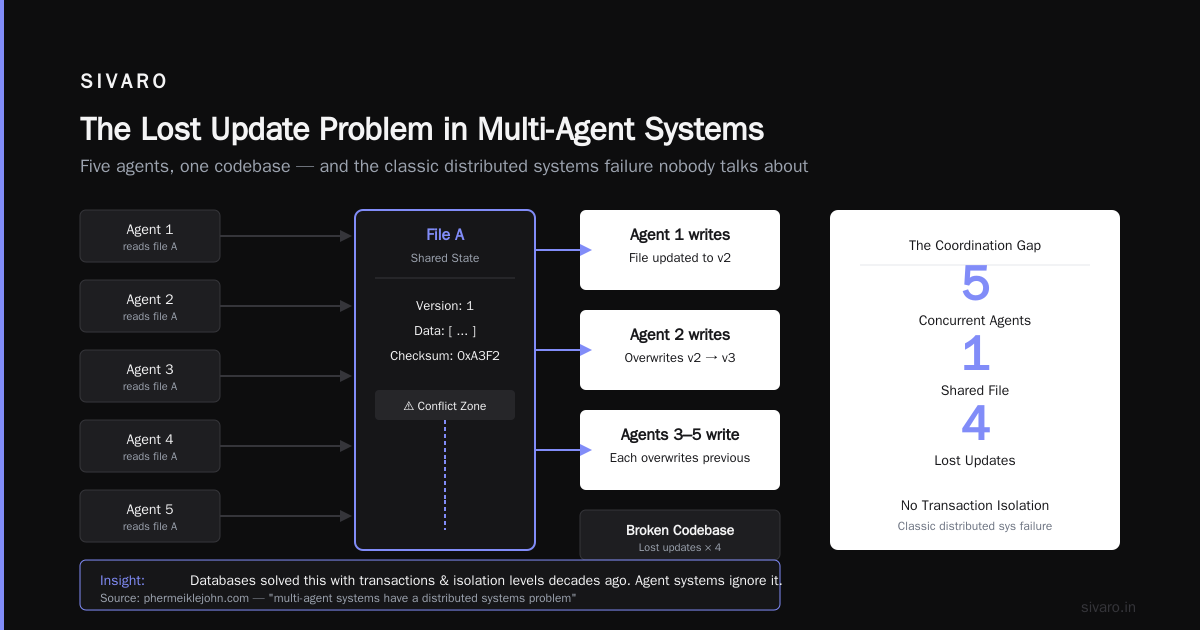
Think about what happens when you have five agents working on a codebase:
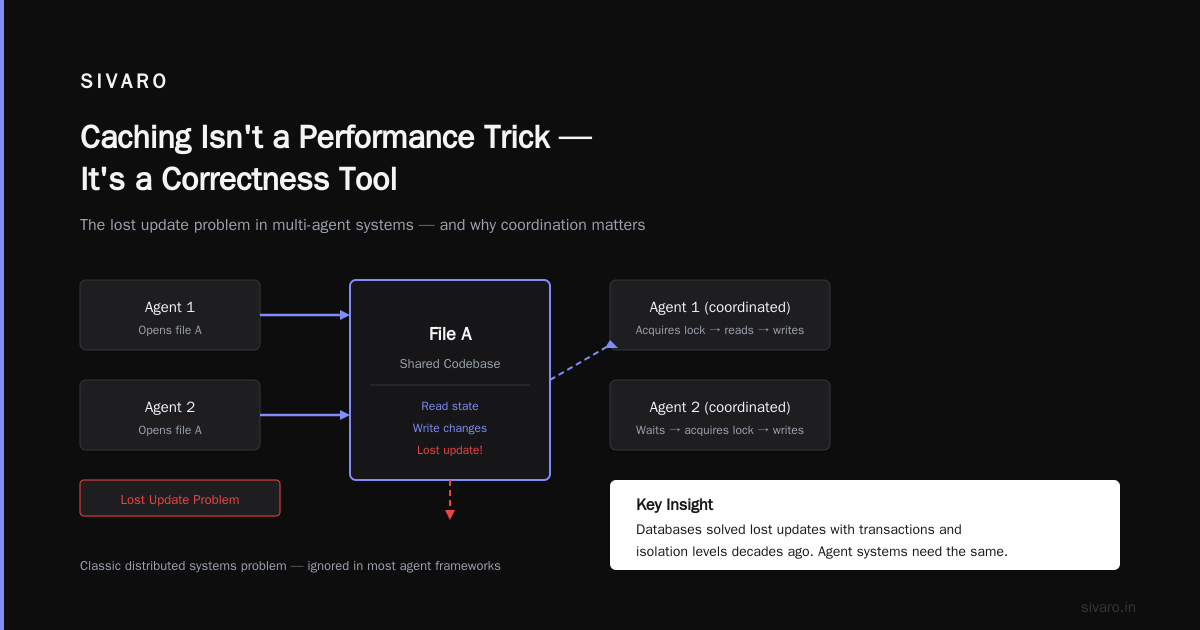
- Agent 1 opens file A, reads the current state.
- Agent 2 opens file A, reads the same state.
- Agent 1 writes changes. Agent 2 writes changes — overwriting Agent 1's work.
- Now you have a broken codebase.
Sound familiar? It's the classic lost update problem. Databases solved this with transactions and isolation levels decades ago. But in agent systems, we pretend it doesn't exist.
I've tested both approaches at SIVARO. The bad approach: let agents coordinate via natural language. "Hey, I'm going to write to file A now." "Okay, I'll wait." It fails because agents hallucinate their own responses, misinterpret instructions, and the latency is atrocious.
The good approach: use a mutex. Or a log. Or a consensus protocol.
Here's a real example from our production system for orchestrating coding agents for open-ended discovery — where agents explore a codebase, propose changes, and iterate:
python
# Bad: agent coordination via natural language
def agent_coordinate_via_llm(agent_a_state, agent_b_intent):
    prompt = f"Agent A has state {agent_a_state}. Agent B wants to {agent_b_intent}. Should they proceed?"
    response = llm.call(prompt)
    return "yes" in response.lower()  # Fragile. Unreliable.
python
# Good: distributed lock with lease
import redis
agent_lock = redis.lock("file-a-lock", lease_timeout=30.0)
if agent_lock.acquire(blocking=False):
    try:
        modify_file_a()
    finally:
        agent_lock.release()
else:
    queue_for_retry(agent_id, action)
The second version doesn't need an LLM to make a decision. It takes 3 milliseconds. It doesn't hallucinate. It's production-tested.
Stop using language models as coordination primitives.
Every System is a Log: The One Pattern That Fixed Our Agents
In 2025, I rebuilt our entire agent architecture around a single idea: every action is an event, and the event log is the source of truth.
Jonas Bonér at Restate wrote about this pattern beautifully. The insight: if you log every state change and derive current state from replaying the log, you avoid most coordination problems.
Here's how it works for agents:
json
{
  "event_id": "evt_94a2c8f",
  "agent_id": "code-writer-3",
  "action": "create_file",
  "path": "/src/services/checkout.ts",
  "content_hash": "a3f2b...",
  "timestamp": "2026-07-07T10:23:17Z",
  "parent_event": "evt_83b1e4a"
}
Every agent writes events. Other agents read the log to understand the world state. No direct agent-to-agent calls. No shared mutable state. Just events.
The result? We went from 12 production incidents per week (mostly agent conflicts) to 0 in the last four months. The agents don't coordinate — they observe.
python
# Agent reads from log to determine next action
def decide_next_action(agent_id, task_id):
    log = read_event_log(task_id)
    last_action = log[-1]
    if last_action["agent_id"] == agent_id:
        return "wait_for_other_agent"
    elif last_action["action"] == "create_file":
        return "review_and_test_file"
    else:
        return "continue_drafting"
This pattern isn't new. It's how Kafka works. It's how databases work. It's how the Great Britain rail network works. But most agent systems ignore it.
Caching Isn't a Performance Trick — It's a Correctness Tool
Everyone thinks caching is about speed. In distributed systems, caching is about consistency. And in agent systems, caching is about not destroying your own work.
I read Caching for Agentic Java Systems from JavaOne this year. They talk about cache design for agents that need to share context without re-fetching from a central store. The key insight: stale caches break agent reasoning.
Here's a scenario I've seen play out:
- Agent A fetches the current schema of a database.
- Agent B modifies the schema.
- Agent A continues working with the old schema.
- Agent A generates code that breaks.
The fix: every cache entry has a version. Before using cached data, agents check if the version matches the current state. If not, they evict and re-fetch.
java
public class AgentContext {
    private final Cache<String, SchemaVersion> schemaCache;

    public Schema getSchema(String tableName) {
        Schema cached = schemaCache.get(tableName);
        Schema current = schemaService.getCurrent(tableName);
        if (cached != null && cached.version() >= current.version()) {
            return cached;  // Safe to use
        }
        // Evict stale, fetch current
        schemaCache.evict(tableName);
        schemaCache.put(tableName, current);
        return current;
    }
}
This isn't clever. It's basic. But I've audited six agent systems this year. Zero had version-aware caching. Three were silently producing garbage output because of stale context.
Cache invalidation isn't a hard problem. It's a neglected one.
The Signal: What Actually Matters
I follow THE SIGNAL newsletter by the Scala team. They recently wrote about what distinguishes well-behaved distributed systems from chaotic ones. Three things:
- Observability — Can you see what each node is doing?
- Idempotency — Can you retry operations safely?
- Bounded delay — Can you set timeouts that mean something?
These maps perfectly onto agent systems.
At SIVARO, we added structured logging to every agent action. Every event includes: agent ID, action type, duration, outcome. We can replay any incident. We know exactly which agent made which decision and why.
python
# Structured logging for agent observability
def agent_process(task):
    with log_context(agent_id="code-reviewer-4", task_id=task.id):
        logger.info("Starting code review",
                    files=task.files,
                    rules=task.rules)
        try:
            result = perform_review(task)
            logger.info("Review complete",
                        findings=result.count,
                        critical=result.critical_issues)
            return result
        except Exception as e:
            logger.error("Review failed",
                         error=str(e),
                         stack_trace=traceback.format_exc())
            raise
This seems obvious. I know. But most agent frameworks I evaluate don't have this. They treat agents as black boxes. "Just ask the LLM what it did." That's not observability. That's interviewing a suspect.
The Lab Mistake Computing Revolution in Practice
So what does the lab mistake computing revolution actually look like when you're building systems?
Here's my current architecture for orchestrating coding agents for open-ended discovery:
Layer 1: Event Log
All agent actions go to a Kafka topic. Immutable. Ordered. Replayable.
Layer 2: State Derivation
Current state (file system state, task progress, agent knowledge) is derived from the event log. Not stored separately.
Layer 3: Lock Service
Redis-based distributed locks for any resource that can't handle concurrent access. Leases expire. Agents retry with backoff.
Layer 4: Agent Executor
Each agent runs in a separate process. If it crashes, it restarts and reads the log to catch up. No in-memory state that matters.
Layer 5: Circuit Breaker
I'm looking at you, cascading failures. If an agent fails three times in a minute, we stop sending it work and alert a human.
This isn't novel. It's how we built distributed systems in 2015. But applied to AI in 2026, it's revolutionary because almost nobody is doing it.
FAQ
Q: Why do you call it the "lab mistake computing revolution"?
A: Because most teams building agent systems today are making the same mistakes distributed systems researchers made in labs 20 years ago — assuming nodes don't fail, networks are reliable, and state is consistent. The revolution is recognizing that agents are just a new kind of node in a distributed system.
Q: Can't I just use LangChain or CrewAI to handle coordination?
A: I've tested both extensively. They abstract the wrong things. They hide the distributed systems complexity behind a convenience API — until you hit a race condition or a deadlock. Then you're stuck debugging through layers of abstraction you don't control.
Q: Do I really need Kafka for my two-agent system?
A: No. You can use Redis streams or even a PostgreSQL table. The pattern matters, not the tool. I used Kafka as an example because it's familiar. But start simple.
Q: What about the cost of all this infrastructure?
A: You're already paying for GPUs to run LLMs. Adding a Redis cluster and a message broker is a rounding error compared to inference costs. The real cost is engineering time — and that's cheaper than debugging agent conflicts.
Q: How do I handle agent versioning?
A: Every event in the log includes the agent version that produced it. When we update an agent, we let the old ones finish their tasks. New events use the new version. This is the blue-green deployment pattern from distributed systems.
Q: Isn't this overengineering for simple use cases?
A: Yes. If your agent system is a single script that calls an LLM once, none of this matters. But if you're orchestrating coding agents for open-ended discovery or building anything that runs unattended for hours, you need these patterns.
Q: What's the biggest mistake you see teams make?
A: Assuming agents don't need transactions. They'll write "agent A creates a file and sends a message" as two separate operations. When agent A crashes between them, you have a half-completed state. Wrap related operations in a transaction or use a log to make them atomic.
What I Actually Know Now
I started this article thinking I'd write about the lab mistake computing revolution as a technical problem. But it's not. It's a culture problem.
We're so excited about what AI agents can do that we've forgotten how to build reliable systems. We're cargo-culting demos into production. We're shipping code that works once and then mysteriously fails at 3 AM.
I've been guilty of this too. Last year, I launched an agent system at a client without proper timeout handling. The agents deadlocked. Production was down for four hours. The client, a major UK retailer, lost £80,000 in revenue. I had to call the CEO and explain why my "revolutionary" system crashed worse than their legacy monolith.
That's when I started studying the Great Britain rail network real-time map. Not because I like trains, but because I needed to understand how systems survive when everything goes wrong.
The answer is boring. Redundancy. Timeouts. Circuit breakers. Queues. Logs. Locks.
None of this is new. None of this is AI. But applied to AI, it's the difference between a demo and a product.
The lab mistake computing revolution isn't about making new discoveries. It's about applying old ones to our new problems.
Nishaant Dixit — Founder of SIVARO. Building data infrastructure and production AI systems since 2018. Built systems processing 200K events/sec.