 SIVARO
The GCP Certification Path for Beginners That Actually Works
I spent three years building data infrastructure before I got my first Google Cloud certification. That was backwards. Here's what I learned.
Most people think cloud certifications are about collecting badges. They're not. A certification path forces you to understand the operational reality of a platform. Without it, you're guessing. With it, you can build systems that don't fall over at 3 AM on a Saturday.
I run SIVARO. We process 200K events per second for production AI systems. We've burned through more cloud credits than I care to admit. And I've watched engineers waste months going down the wrong certification path.
This guide is the one I wish I had in 2021.
Why GCP Over the Other Two?
Let me be direct. AWS has more services. Azure has better enterprise integration. But GCP has something neither of them can match: data infrastructure that doesn't make you want to quit.
I've built the same pipeline on all three platforms. The difference is night and day. GCP's BigQuery alone saves you from managing clusters. AWS requires Redshift provisioning, node management, vacuuming. Microsoft Azure requires Synapse configuration that takes days (AWS vs Azure vs GCP 2026: Same App, 3 Bills | TECHSY).
GCP's secret weapon? It was built by people who actually run global-scale infrastructure. Google runs YouTube, Search, and Maps on it. That DNA shows.
The catch? GCP's pricing model is different. You pay for what you use, not what you reserve. That's great until someone accidentally runs a 10TB query. Which brings us to gcp bigquery pricing per query — it's $5 per TB of data scanned. Sounds cheap until your analyst forgets a WHERE clause.
The Reality Check Before You Start
Here's what nobody tells you about cloud certifications.
Time matters more than talent. The Associate Cloud Engineer exam took me 80 hours of study. I've seen people pass in 40. I've seen people fail after 120. Your mileage varies.
Hands-on beats reading. I don't care how many whitepapers you read. If you haven't created a VPC, deployed a VM, and configured IAM, you'll fail the practical parts. Google's exams test applied knowledge, not memorization.
The cert expires every two years. This isn't a one-and-done deal. Google recertifies. The platform changes fast — Cloud Run today is different from Cloud Run in 2024.
Start with the gcp free tier limits 2025 — and yes, 2025 limits still apply in 2026 because Google hasn't changed them. You get one f1-micro VM per month, 5GB of Cloud Storage, and 1TB of BigQuery querying monthly. That's enough to learn, not enough to break things.
The Exact Path I Recommend
Don't take Google's suggested order. They recommend going broad then deep. I recommend the opposite.
Step 1: Associate Cloud Engineer (ACE)
This is your foundation. No shortcuts.
What you'll learn:
- Managing GCP resources (projects, folders, organizations)
- IAM roles and service accounts (nobody gets this right the first time)
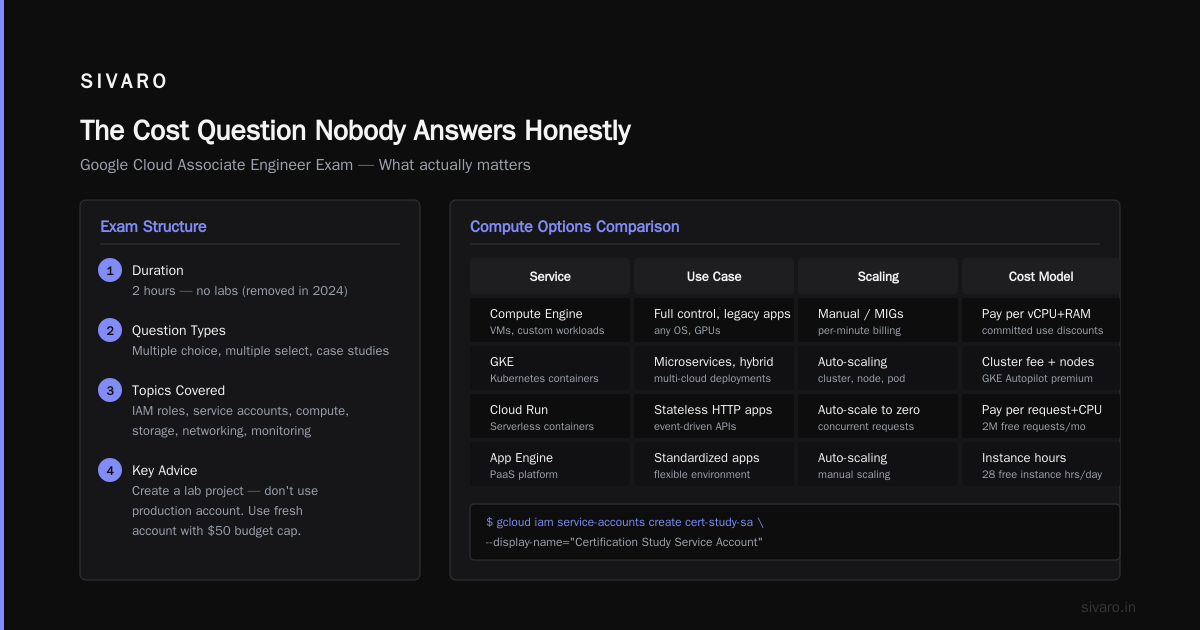
- Compute options (Compute Engine, GKE, Cloud Run, App Engine)
- Storage (Cloud Storage, Filestore, Persistent Disk)
- Networking (VPCs, firewalls, Cloud NAT, Cloud VPN)
- Monitoring (Cloud Monitoring, Logging, Error Reporting)
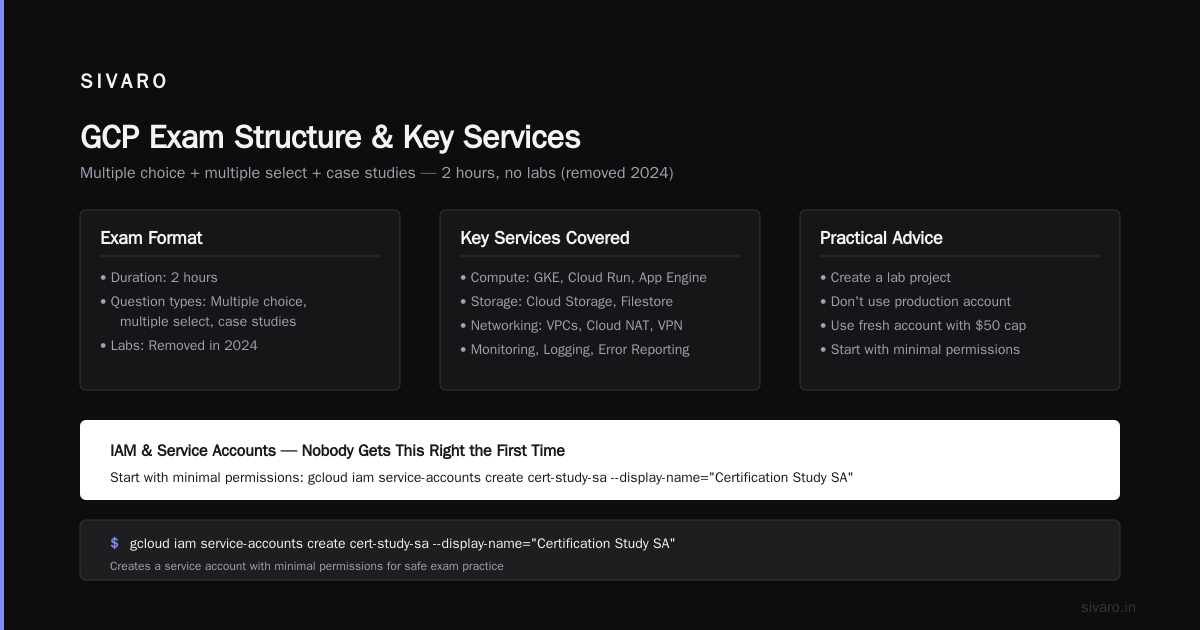
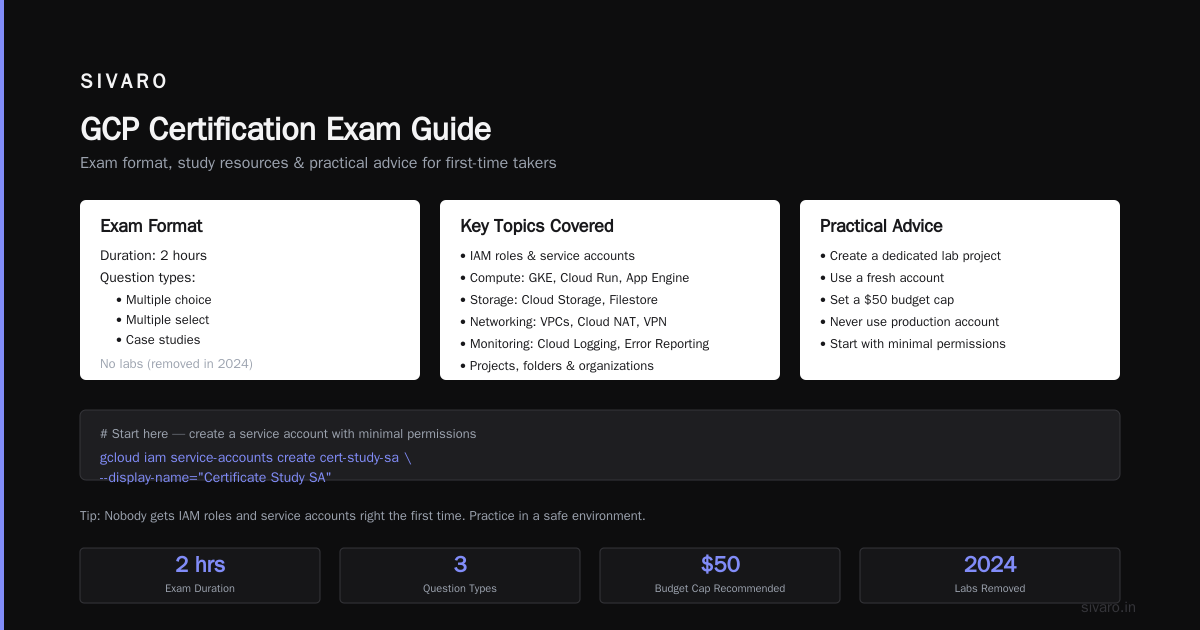
The exam is multiple choice + multiple select + case studies. Two hours. No labs (Google removed them in 2024).
Practical advice: Create a lab project. Don't use your company's production account. I've seen people accidentally delete production databases while studying. Use a fresh account with a $50 budget cap.
# Start here — create a service account with minimal permissions
gcloud iam service-accounts create cert-study-sa     --display-name="Certification Study Service Account"

# Assign only what you need, nothing more
gcloud projects add-iam-policy-binding my-project     --member="serviceAccount:cert-study-sa@my-project.iam.gserviceaccount.com"     --role="roles/compute.admin"
Step 2: Professional Cloud Architect
This is the one employers actually care about.
The Associate cert proves you can operate GCP. The Architect cert proves you can design on it.
What's different:
- Design decisions (regional vs multi-regional, zonal vs regional clusters)
- Business requirements translation (uptime SLAs, disaster recovery, cost optimization)
- Migration planning (lift-and-shift vs re-platforming vs re-architecting)
- Security design (encryption at rest, in transit, CMEK, CSEK)
This exam has case studies. Real ones. Google publishes sample case studies — study them like your job depends on it. Because it might.
Hard truth: I failed this exam the first time. I knew the services but couldn't articulate why I chose one over another. The exam tests reasoning, not recall.
Step 3: Professional Data Engineer
If you're in data or AI — and if you're reading this, you probably are — this is where the money is.
What this covers:
- Building data pipelines (Dataflow, Dataproc, Pub/Sub)
- Data warehousing (BigQuery, including gcp bigquery pricing per query optimization)
- Machine learning (Vertex AI, AutoML, custom training)
- Data governance (Data Catalog, Data Loss Prevention)
This cert changed how I think about data architecture. Before, I thought about compute. Now I think about data flow, cost, and latency simultaneously.
# BigQuery cost optimization — partition your tables
CREATE OR REPLACE TABLE `my-project.my_dataset.events_partitioned`
PARTITION BY DATE(event_timestamp)
CLUSTER BY user_id, event_type
AS
SELECT * FROM `my-project.my_dataset.events_raw`;
# Query only the partitions you need
SELECT user_id, COUNT(*) as event_count
FROM `my-project.my_dataset.events_partitioned`
WHERE DATE(event_timestamp) BETWEEN '2026-06-01' AND '2026-06-30'
GROUP BY user_id;
Why Most People Get Stuck
Three reasons.
Reason 1: Theory without practice. You can't learn GCP by watching videos. I've interviewed candidates with three certs who couldn't create a Cloud Function. Don't be that person.
Reason 2: Skipping the hard stuff. Networking in GCP is not optional. VPC peering, Shared VPC, Cloud NAT, firewall rules — these show up on every exam past Associate level. People skip them because they're boring. Then they fail.
Reason 3: Burning out on the wrong order. Taking Architect before Associate is like running a marathon before learning to walk. Google designed the progression for a reason.
Real Study Resources That Work
Not the list you'll find on Google's certification page. The stuff that actually helped me.
Qwiklabs (now Google Cloud Skills Boost). Do every lab twice. First time following instructions. Second time without looking. If you can't complete it blind, you don't know it.
Practice exams. Use TutorialsDojo or Whizlabs. Google's official sample questions are too easy. Real exam questions have four plausible answers. Practice tests train you to identify the most correct one.
The documentation. Yes, really. Read the GCP documentation for services you're studying. Not the overviews — the how-to guides. They contain the edge cases that appear on exams.
Your own lab. Build something. A web app on Cloud Run with Cloud SQL backend. A data pipeline from Pub/Sub to BigQuery. A multi-tier architecture with Cloud Load Balancing. Break it. Fix it. Learn.
The Cost Question Nobody Answers Honestly
Certifications cost money. Let me be blunt.
The exam fees: $125 for Associate, $200 each for Professional certs. Retakes cost the same.
Study materials: $0 (documentation) to $500 (courses + practice tests + labs).
The gcp free tier limits 2025 give you enough to learn the basics. But I recommend spending $50-100/month on your lab project for 2-3 months. That's cheaper than a retake.
Here's the ROI math. A Professional Cloud Architect certification added $15K-$25K to my annual billing rate. Clients pay for trust. A cert signals you've invested in competence.
What About the Other Certifications?
Google has more, but most people don't need them.
Professional Cloud Developer. Good if you build applications on GCP. Skip if you're doing infrastructure or data.
Professional Cloud Security Engineer. Important if you work in regulated industries. Overkill otherwise — Architect covers enough security for most roles.
Professional Collaboration Engineer. Don't. Unless your entire job is Google Workspace administration.
Professional Machine Learning Engineer. Take this after Data Engineer. The ML cert assumes you understand data pipelines already.
Your 90-Day Plan
Days 1-15: Complete Google Cloud Skills Boost "Cloud Engineering" learning path. Create your lab account. Set budget alerts (trust me on this).
Days 16-30: Focus on IAM, networking, and compute. These are the foundations. Practice creating networks, deploying VMs, setting up load balancers.
Days 31-45: Take practice exams. Identify weak areas. Re-read documentation for services you're missing.
Days 46-60: Deep dive on storage and databases. Cloud Storage, Cloud SQL, BigQuery, Firestore. Understand use cases and trade-offs.
Days 61-75: Full practice exams weekly. Time yourself. The real exam moves fast.
Days 76-90: Review, relax, take the exam. Don't cram the night before. Sleep matters more than one more practice test.
The Hardest Lesson
At first I thought certifications were about proving knowledge. Turns out they're about building mental models.
When I work on a client's infrastructure now, I don't think about exam questions. I think about failure scenarios. What happens when a zone goes down? What happens when a service account key leaks? What happens when someone queries BigQuery without a WHERE clause?
The certification path teaches you to think this way. But only if you engage with it honestly.
FAQ
How long does it take to get GCP certified?
Most people need 2-4 months for Associate Cloud Engineer, 3-6 months for Professional certifications. Your mileage varies based on existing cloud experience and study time.
Can I get a job with just a GCP certification?
No. Certifications complement experience, they don't replace it. A cert without hands-on skill is a red flag in interviews. Build real projects alongside studying.
Which GCP certification is most valuable?
Professional Cloud Architect has the highest demand and salary impact. Professional Data Engineer is close behind, especially for AI and analytics roles.
Do I need to know programming?
For Associate Cloud Engineer? No. For Professional Data Engineer or ML Engineer? Yes. Python and SQL are non-negotiable for data roles.
How hard is the Associate Cloud Engineer exam?
Moderate difficulty if you have 6+ months of GCP hands-on experience. Hard if you've only watched videos. The pass rate is around 60-65%.
Does the gcp free tier limits 2025 apply in 2026?
Yes. Google hasn't changed the free tier limits since 2025. You get one f1-micro VM, 5GB storage, 1TB BigQuery monthly. Enough for learning, not production.
What's the gcp bigquery pricing per query gotcha?
$5 per TB scanned. But scanning is per column, not per row. If you SELECT *, you pay for all columns. If you SELECT specific columns, you pay less. Partitioning and clustering reduce costs dramatically.
Should I take AWS or Azure certifications first?
If your company uses GCP, start here. If you're choosing a platform, evaluate based on your industry. GCP dominates in data and AI. AWS leads overall market share. Azure wins in enterprises already on Microsoft (AWS vs Microsoft Azure vs Google Cloud vs Oracle).
Nishaant Dixit — Founder of SIVARO. Building data infrastructure and production AI systems since 2018. Built systems processing 200K events/sec.