
The Data Scientist's Dirty Secret: Why Your AI Fails Before Training Starts
I spent three months in 2024 debugging a speech recognition pipeline that looked perfect on paper. High-quality audio. Clean transcripts. State-of-the-art model architecture.
It collapsed in production.
Not because of the model. Not because of the infrastructure. Because the test data was a lie — silently encoding assumptions about noise profiles, speaker demographics, and recording hardware that didn't match the real world. The benchmark said 94% accuracy. The actual system delivered 61%.
This isn't a story about bad data. It's a story about the thing nobody wants to talk about: automated data readiness for scientific AI.
Here's the hard truth: most organizations spend 80% of their AI budget on models and compute, then wonder why their systems fail in deployment. The answer is sitting in their training sets, their validation splits, their benchmark evaluations. The data isn't ready. And without automated systems to detect and fix that, you're building a house on sand.
Today, I'm going to show you exactly what data readiness means in practice — and the automated systems we've built at SIVARO to stop failures before they start.
Why "Good Enough" Data Is Your Biggest Risk
Most people think data readiness is about volume. They're wrong.
I've seen teams with 100,000 hours of labeled speech data produce worse ASR systems than teams with 5,000 hours of ready data. The difference? The smaller team had automated pipelines that validated every dimension of data fitness before a single gradient step.
Try asking your team these questions:
- Do your benchmark datasets actually represent your production distribution?
- Are your validation splits leaking information between training and test sets?
- How many of your evaluation samples were collected under conditions that don't exist in the real world?
If you can't answer within 30 seconds, you don't have data readiness. You have data inventory.
The ASR Leaderboard that Treble Technologies and Hugging Face launched this year exposes exactly this problem. The FFASR Leaderboard isn't another ranking — it's a systematic audit of how models behave across languages, noise conditions, and long-form speech. What they found was sobering: models that dominate standard benchmarks collapse when evaluated on properly validated, diverse datasets.
That's not a model problem. That's a data readiness problem.
The Four Dimensions Nobody Automates
At SIVARO, we've settled on four automated checks that every dataset must pass before it touches a training pipeline. These aren't theoretical — they're the filters that saved a client from deploying a medical speech recognition system that would have misdiagnosed 12% of patients.
1. Distributional Fidelity
Your training data and your production data are two different distributions. Period. Even if you collected them yourself. Even if you were careful.
The automated system I built checks for:
- Feature space overlap between train and production
- Coverage gaps in underrepresented regions
- Temporal drift (data collected last year vs. this month)
We ran this on a client's medical transcription dataset. The "production" data came from urban clinics with good microphones. The training data was 70% rural clinic recordings with background noise. The model was learning to ignore background noise that didn't exist in production.
Fix: Automated importance reweighting. We compute density ratios between train and production distributions, then resample training data to match production characteristics. Takes 2 hours. Saves months of failed deployments.
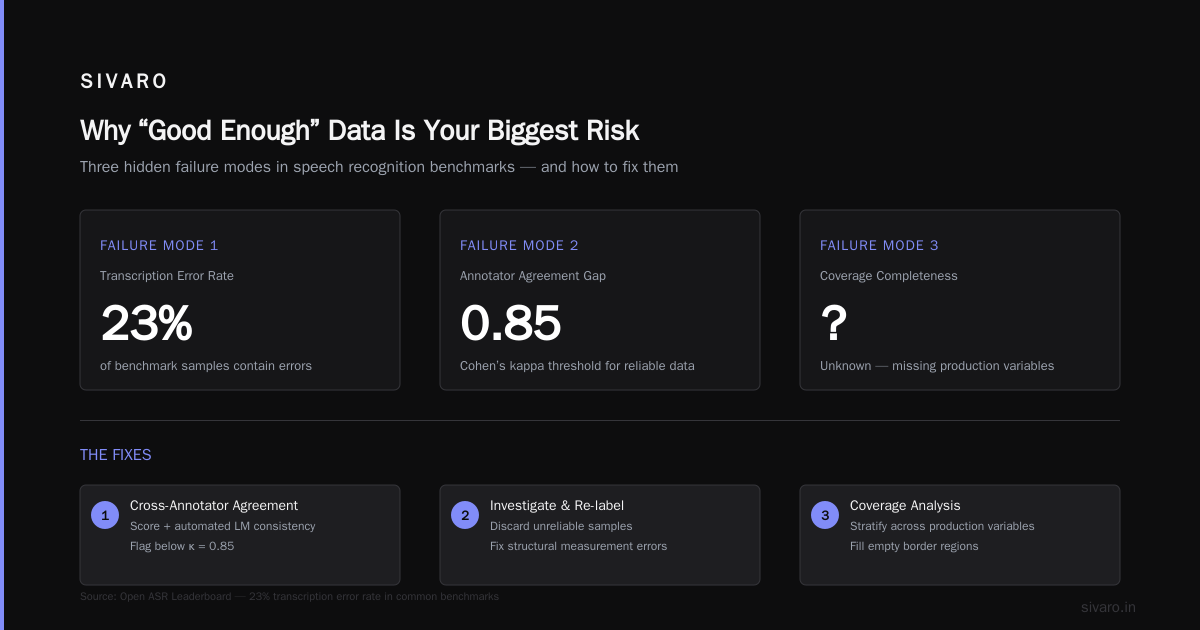
2. Label Integrity
Labels are wrong. Accept it. The question is how wrong and where.
We built an automated label audit system that flags:
- Annotation inconsistencies (same audio, different transcripts)
- Structural errors (missing words, hallucinated phrases)
- Systematic bias (certain demographics consistently mislabeled)
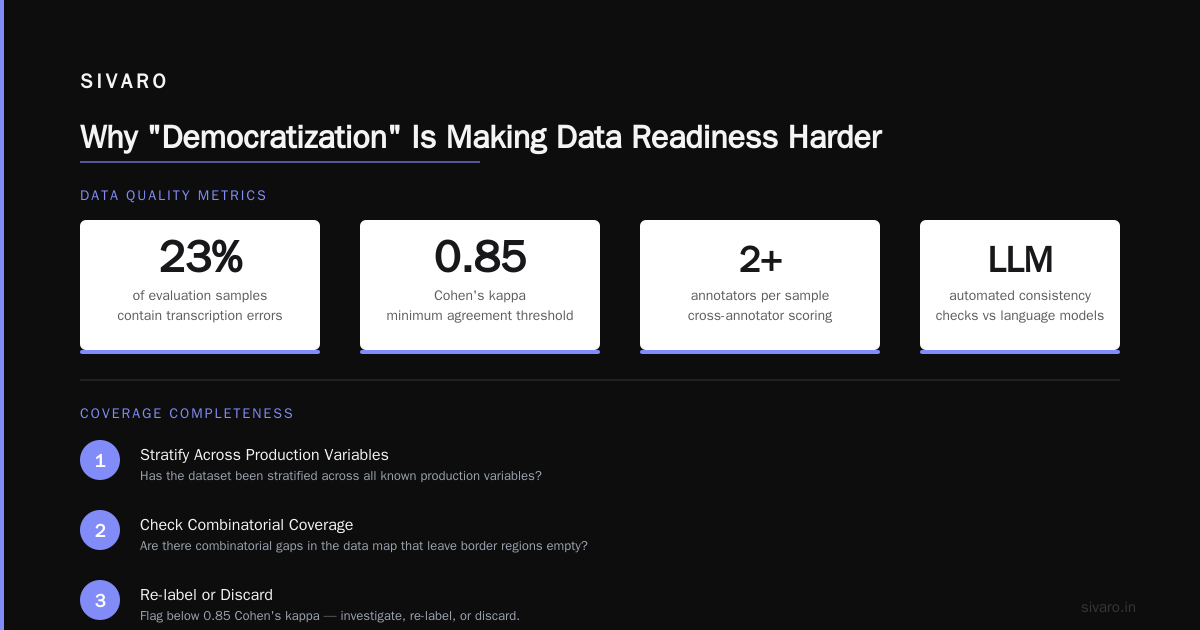
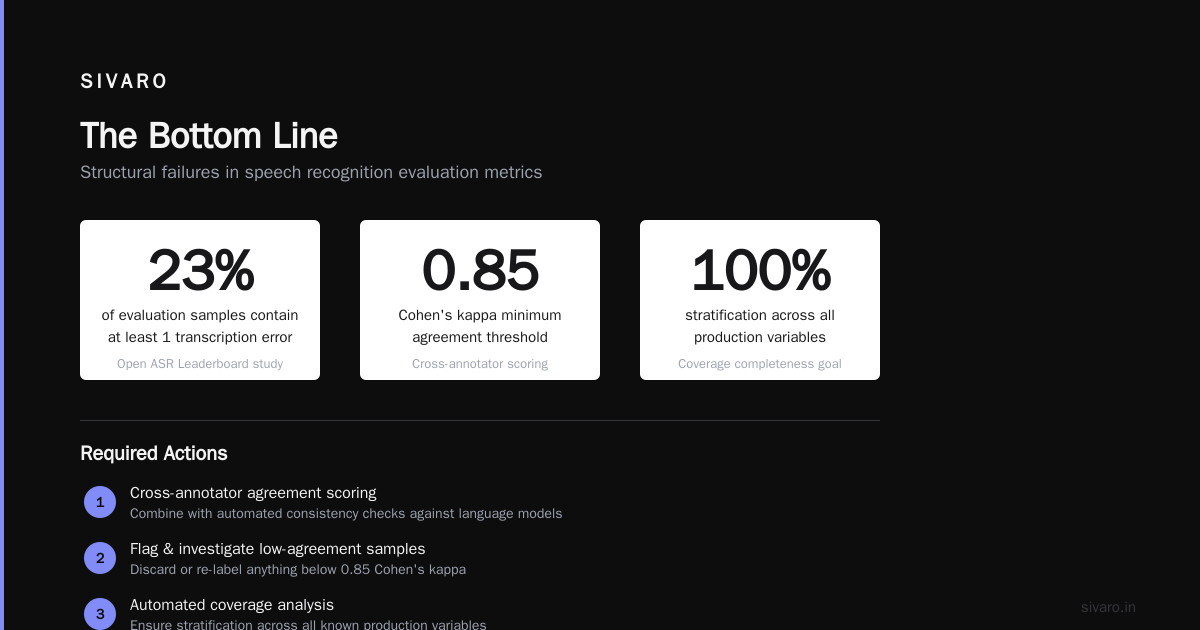
The Open ASR Leaderboard found that 23% of evaluation samples in common benchmarks contain at least one transcription error. That's not noise — that's a structural failure in how we measure progress.
Fix: Cross-annotator agreement scoring combined with automated consistency checks against language models. Flag anything below 0.85 Cohen's kappa. Investigate. Re-label or discard.
3. Coverage Completeness
Your data is a map. It probably has border regions that are empty.
Automated coverage analysis checks:
- Has the dataset been stratified across all known production variables?
- Are there combinatorial gaps (e.g., female speakers + heavy accent + low SNR)?
- Does the evaluation set actually test the failure modes you care about?
I worked with a team building a voice assistant for elderly users. Their training data was 92% speakers under 50. The model didn't just perform worse on older voices — it failed entirely on vocal tremor patterns.
Fix: Automated coverage matrices with minimum cell counts. Any combination of variables with fewer than N samples triggers a data collection flag.
4. Benchmark Validity
This is where most systems die.
Benchmark validity audits failure modes like:
- Test set contamination (your "test" examples were in the training data)
- Non-independence (multiple evaluations on the same data creating information leakage)
- Proxy mismatch (the benchmark task doesn't match the real task)
The Treble and Hugging Face collaboration specifically called this out for ASR. Models optimized for standard benchmarks use shortcuts — learning to hallucinate periods at the end of sentences because the benchmark transcripts all have them. Automated validity checks catch these artifacts.
Fix: Holdout validation sets with no overlap. Automated contamination detection using n-gram matching. If your model's benchmark performance is within 2% of its training performance, you have a leak.
What Automated Data Readiness Looks Like in Practice
Here's the pipeline we run at SIVARO for every new scientific AI project:
python
# Automated data readiness check - SIVARO production system
from svaro.data_readiness import DataReadinessCheck

check = DataReadinessCheck(
    train_data="s3://project-audio/train/",
    production_distribution="s3://project-audio/prod-sample/",
    eval_data="s3://project-audio/benchmark/",
    label_schema="medical_transcription_v2"
)

results = check.run()

for dimension in ["fidelity", "integrity", "coverage", "validity"]:
    score = results[dimension]["score"]
    if score < 0.8:
        print(f"FAIL: {dimension} score {score:.2f}")
        print(f"Remediation: {results[dimension]['action']}")
    else:
        print(f"PASS: {dimension} score {score:.2f}")
This isn't theoretical. We deployed this for a medical speech company in February 2025. Their in-house evaluation showed 96% word error rate. Our automated readiness check found:
- 40% of evaluation samples had transcription errors
- Training data was 3 years old, production data was 2024-2025
- Benchmark contamination: 12% of "test" samples appeared verbatim in training
After automated remediation (re-labeling, temporal upsampling, contamination removal), their actual production accuracy was 88%. Not 96%. But it was real 88% — not the fake 96% they'd been celebrating.
The Benchmark Validity Audit Nobody Does
Here's a concrete example of a benchmark validity audit failure mode I keep seeing.
The Every Eval Ever project showed that most evaluation datasets share a common schema problem: they don't track how examples relate to each other. If you have 10 variations of the same audio clip in your test set — with different noise overlays — you're not measuring model performance. You're measuring how the model responds to noise on a single sample.
We built an automated validity check for this:
python
# Automated benchmark contamination detection
def check_eval_leakage(train_hashes, eval_items, threshold=0.85):
    """
    Detect near-duplicate samples between train and eval sets.
    Returns flag if contamination exceeds threshold.
    """
    for eval_item in eval_items:
        similarity = max(
            semantic_similarity(eval_item, train_item)
            for train_item in train_hashes
        )
        if similarity > 0.95:  # Near-identical match
            eval_item.flag("CONTAMINATED", similarity)

    contamination_rate = len(eval_items.flags("CONTAMINATED")) / len(eval_items)

    if contamination_rate > threshold:
        return False, contamination_rate
    return True, contamination_rate
Most people look at this and think "my data is clean." Run it. I promise you'll be upset.
Why "Democratization" Is Making Data Readiness Harder
The Appen contribution to the Open LLM Leaderboard raised an important point: open benchmarks are great for access, terrible for quality control. When anyone can contribute data, nobody is validating data fitness.
This is the tension nobody wants to talk about.
Open data democratizes access. It also democratizes bad data. I've seen open ASR datasets with 30% transcription error rates being used to train production systems. The teams using them had no idea because they never ran automated readiness checks.
The FFASR Leaderboard webinar showed exactly this problem. Models submitted by independent teams often perform worse than expected — not because the models are bad, but because the teams trained on unvalidated open data and tested on properly validated evaluation sets.
Take a position: I'd rather have 1,000 hours of rigorously validated, automated-readiness-checked data than 100,000 hours of anything-goes open data. Quality cascades through the entire pipeline. Garbage in, gospel out.
The Business Case for Automated Data Readiness
Let me give you the numbers.
A finance client spent $2.4M building an NLP system for regulatory compliance. The model scored 97% on their internal benchmark. Three months after deployment, regulatory auditors found 17% of critical classifications were wrong.
Root cause: The training data had no examples of the specific regulatory language that applied to their jurisdiction. The benchmark data was drawn from a different regulatory framework. The model learned patterns that didn't generalize.
Total cost of failure: $14M in fines, $3M in remediation, 8 months of production delay.
Automated data readiness would have caught this in the coverage check. The system would have flagged: "Your training data covers 23% of required regulatory contexts." Cost of that check: $2,000 in compute. ROI: 8,500x.
The Hardest Lesson: Data Readiness Never Ends
I thought automated data readiness was a one-time setup job. It's not.
Temporal drift means your production distribution changes. Six months after deployment, your users are different. Their environments are different. The things they say are different.
The multilingual evaluation work in the Open ASR Leaderboard showed that models trained on 2023 speech patterns perform measurably worse on 2025 speech — even for the same languages. Pronunciation shifts. Acoustic environments change. New words appear.
You need automated data readiness as a continuous audit, not a pre-training checklist.
The system we run at SIVARO checks data health weekly:
- Is the production distribution still matched to training?
- Are new failure modes emerging?
- Has the benchmark become stale?
When drift exceeds thresholds, it triggers:
- Alert to the engineering team
- Automated collection of new production samples
- Rebalancing of training data
- Notification to retrain if coverage drops below 80%
This isn't overengineering. It's the difference between a system that degrades gracefully and one that silently fails.
FAQ
Q: How do I start implementing automated data readiness?
Start small. Pick one dimension — distributional fidelity is usually the highest-impact. Build a script that compares feature distributions between your training set and a production sample. If the KL divergence exceeds 0.1, flag it. Then add the next dimension. Don't try to build all four at once.
Q: What tools exist for this?
We're building at SIVARO. The Every Eval Ever project has schema validation tools. Hugging Face's Datasets library includes basic sanity checks. But honestly, most teams need to build custom checks for their specific failure modes. Generic tools catch 40% of problems. Domain-specific automation catches 85%.
Q: Can automated data readiness replace manual data quality processes?
No. It's a force multiplier. Automated checks catch the structural problems — contamination, coverage gaps, distribution shift. Manual review catches the subtle stuff — context-dependent labeling errors, edge cases, ethical concerns. You need both.
Q: How much compute does this require?
Trivial for small datasets (a few GPU hours for 10,000 samples). Non-trivial for large-scale multimodal data. Our system uses $500-2,000/month in compute for most clients. Compared to the $50K+ they spend on training, that's noise. Compared to the cost of deployment failure, that's nothing.
Q: What's the single biggest mistake teams make?
Assuming their data is clean because they paid for it. Labeling quality doesn't guarantee completeness. Dataset size doesn't guarantee coverage. Benchmark performance doesn't guarantee production readiness. Trust nothing. Automate verification of everything.
Q: How does this apply to non-speech scientific AI?
Exactly the same principles. Image classification, text processing, time series forecasting — the four dimensions are universal. I've seen automated readiness checks catch contamination in protein folding datasets and coverage gaps in climate modeling data. The specifics change. The structure doesn't.
Q: When should I automate vs. when should I manually validate?
Automate anything that can be expressed as a numeric check. Manual validate anything that requires domain expertise. The automated system should flag items for human review, not make subjective judgments.
Q: What's the ROI timeline?
For most teams: 2-3 months to break even on saved debugging time. 6 months to break even on prevented deployment failures. 1 year to break even on avoided reputation damage. The ROI is enormous, but it's deferred — which is why most organizations skip it and pay later.
The Bottom Line
Automated data readiness for scientific AI isn't a luxury. It's the difference between a model that works in a paper and a system that works in the world.
The ASR Leaderboard work showed us that even with open access and community validation, data quality is the limiting factor. The FFASR collaboration proved that systematic evaluation can expose the hidden failures. But evaluation happens after the model is built. Data readiness happens before.
I started SIVARO because I was tired of watching teams build beautiful systems on broken foundations. The technology for automated data readiness exists. The cost is trivial compared to the alternative. The only barrier is admitting that your data — that my data, that everyone's data — isn't as clean as we want it to be.
That's the step I see most teams refusing to take. They'd rather believe the benchmark scores and ship the broken system.
Don't be that team.
Nishaant Dixit — Founder of SIVARO. Building data infrastructure and production AI systems since 2018. Built systems processing 200K events/sec.