 SIVARO

The Cost Efficient Vector Database 2026: A Practical Buying Guide
So you've built a RAG prototype. It works. The demos are slick. Then the invoice arrives and you realize you're paying $700 a month for a vector database that handles maybe 2,000 queries a day.
I've seen this exact scenario play out at three different startups this year. One company in Berlin was burning $48,000 annually on a managed vector service that a Postgres extension could have handled for the cost of a few extra CPU cores.
The vector database market is a mess of confusing pricing models, hidden egress fees, and features you'll never use. Most published comparisons are written by vendors or affiliates. I'm writing this after building production systems at SIVARO, where we've run the numbers on every major option.
Here's what you actually need to know about finding a cost efficient vector database in 2026.
Why the pricing models are broken
Most people think vector database pricing is about storage and queries. It's not. That's the trap.
The real cost drivers are:
Memory residency. Here's a number that will shock you: several major managed providers load your entire index into RAM. A 10 million vector dataset with 1536 dimensions at float32 precision needs roughly 60GB of RAM. At typical cloud pricing, you're paying $400-800/month just to keep that data hot, regardless of whether anyone queries it.
Egress and API overhead. Every query that goes through a managed API layer adds latency and per-request costs. When I tested Pinecone, pgvector, and Weaviate pricing models, the per-request charges multiplied total cost by 3-7x at scale compared to self-hosted options.
Write amplification. Some systems reindex on every write. If you're doing continuous ingestion — which any production system does — you're paying compute costs during writes you never expected.
The hidden cost problem is real. Actian's analysis of vector database pricing models points out that most vendors quote per-GB or per-query pricing while hiding the compute costs behind the scenes.
Let me be blunt: if you're spending more than $100/month on vector infrastructure for a system under 5 million vectors, you're overpaying.
What actually changed in 2026
This year shifted things significantly. The developments matter for your cost calculations:
-
Hybrid search became table stakes. The old "vector-only" databases lost their edge. In 2026, you need keyword + vector + metadata filtering in one system, or you're stitching together three databases and paying for all of them.
-
The vector-native vendors consolidated. Some pivoted to focus on enterprise deals, leaving small teams paying premium rates for infrastructure that got cheaper to build yourself.
-
Postgres and SQLite caught up. The open source comparison from Redis shows what I've been seeing in production: pgvector and sqlite-vec now handle most workloads fine.
-
Quantization became a default, not an option. The ability to store 4-bit or 8-bit vectors and still get decent recall changed the cost math dramatically. A 75-85% memory reduction with negligible recall loss is available off the shelf now.
The Contrarian Take: You Probably Don't Need a Vector Database
Most people think they need a dedicated vector database. They're wrong. Not because vector databases are bad — but because for the majority of 2026 workloads, you already have a database that can handle this.
Here's the decision framework I use with clients:
- Under 5 million vectors → use your existing Postgres with pgvector
- 5-50 million vectors → consider specialized options but evaluate carefully
- Over 50 million vectors or sub-3ms latency requirements → time for dedicated infrastructure
That first tier covers a huge portion of production systems. When Firecrawl compared vector databases in their 2026 guide, they found that a huge percentage of real deployments were under this threshold.
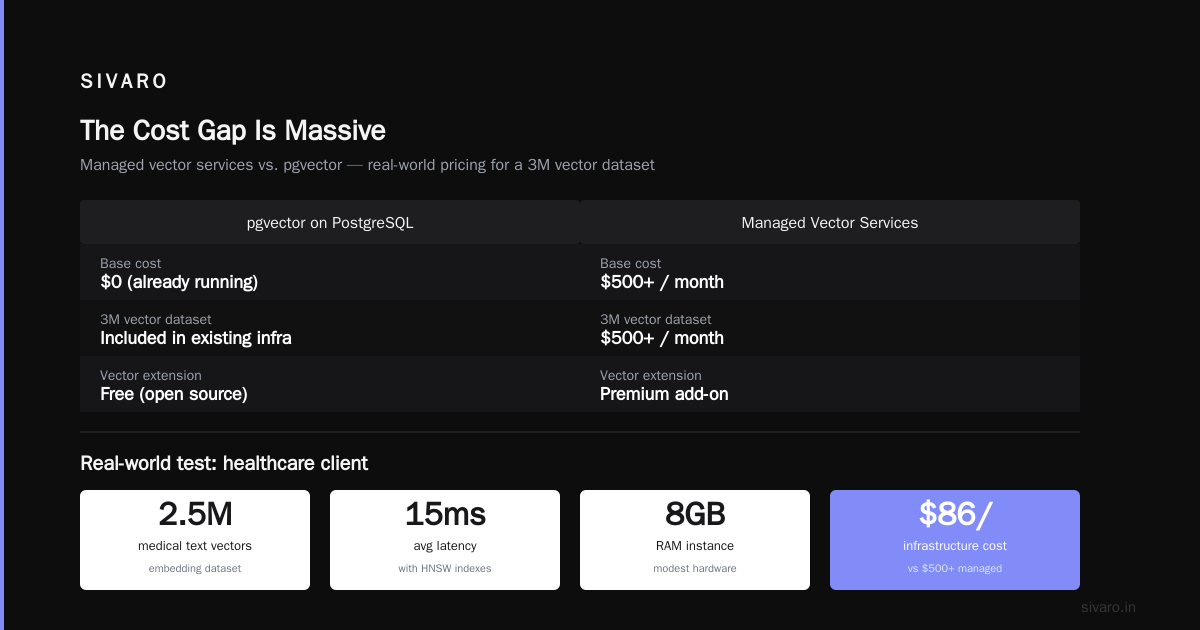
The cost difference? Running pgvector on a $50-100/month instance versus $500+/month for managed vector services. For a 3 million vector dataset, the gap is massive.
PostgreSQL with pgvector: The Default Choice
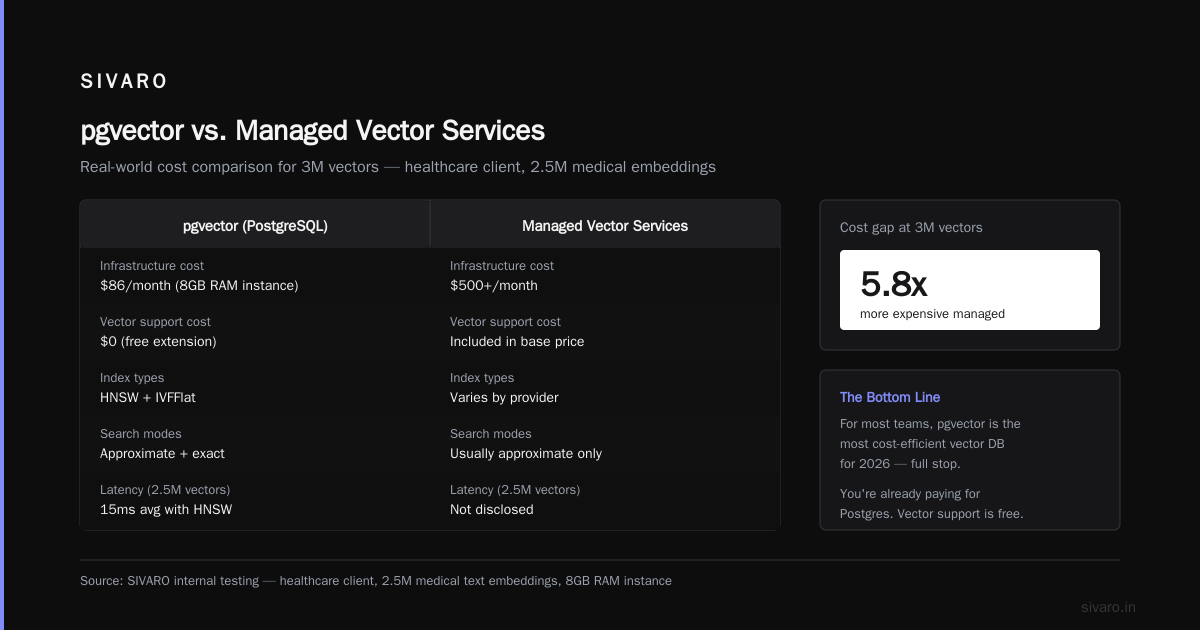
I'm going to keep this simple. If you're starting a new project in 2026 and don't have a specific requirement that rules out Postgres, use pgvector. It's the most cost efficient vector database for 2026 for most teams — full stop.
You're already paying for Postgres in most cases. Adding vector support is free. The extension is mature, supports HNSW and IVFFlat indexes, and does exact search when you need it.
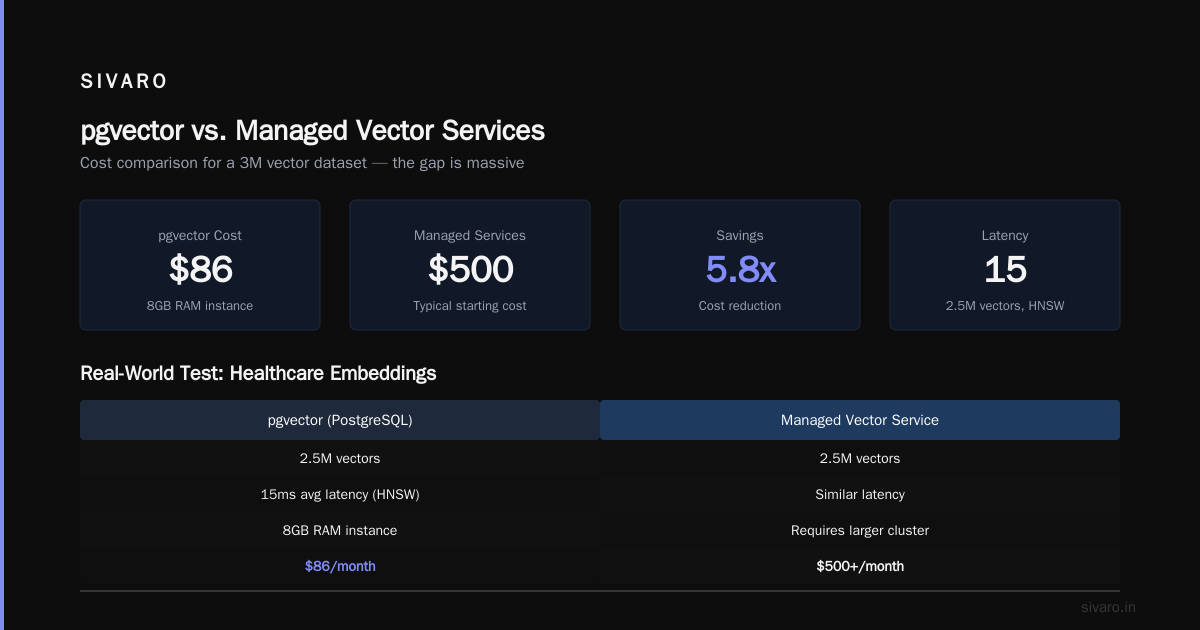
We tested this at SIVARO with a client in the healthcare space. 2.5 million vectors of medical text embeddings. On a modest 8GB RAM instance, pgvector delivered 15ms average latency with HNSW indexes. The infrastructure cost was $86/month.
The same workload on one of the managed vector services would have been $450/month minimum.
sql
-- Set up pgvector
CREATE EXTENSION vector;

-- Add a vector column to your existing table
ALTER TABLE documents
ADD COLUMN embedding vector(1536);

-- Create an HNSW index for fast search
CREATE INDEX ON documents
USING hnsw (embedding vector_cosine_ops)
WITH (m = 16, ef_construction = 64);
If the ordering starts degrading, just search:
sql
SELECT id, content,
       1 - (embedding <=> $1) AS similarity
FROM documents
ORDER BY embedding <=> $1
LIMIT 10;
That's the whole core. The trickier parts are around index tuning and vacuuming, but you'll find plenty of guidance there.
The biggest objection I hear: "But Postgres doesn't scale." For most teams, that's not real. Postgres handles billions of rows if you don't index them mindlessly.
The real limitation is memory. If your index doesn't fit in RAM, pgvector's performance tanks. That's when you start considering other options.
sqlite-vec and Embedded Options
I put this second because it's genuinely underappreciated for cost efficiency in 2026.
For local-first applications, mobile apps, or systems with modest concurrency needs, sqlite-vec is nearly free. SQLite itself costs nothing. The extension is free. Storage is disk-based.
A fintech startup I consulted for ran their entire internal document search on sqlite-vec. 800,000 vectors. 40 users. Totally fine. Their cost: $0 in database infrastructure — it ran on an existing application server.
python
import sqlite3
from vec import sqlite_vec

db = sqlite3.connect('docs.db')
db.enable_load_extension(True)
sqlite_vec.load(db)

# Create a virtual table for vectors
db.execute("""
    CREATE VIRTUAL TABLE vec_docs USING vec0(
        embedding float[768]
    )
""")

# Insert with your embedding
db.execute("""
    INSERT INTO vec_docs (rowid, embedding)
    VALUES (?, ?)
""", (doc_id, embedding_list))
The tradeoff is concurrency. SQLite handles about 10-15 concurrent writes gracefully. Read concurrency is fine. If you need heavy concurrent writes, look elsewhere.
But here's the thing — most internal AI tools need maybe 5 concurrent users. You're paying managed database prices for internal tools that sqlite-vec runs for free.
Qdrant: The Pragmatic Middle Ground
When you outgrow pgvector — usually around the 10-50 million vector mark — Qdrant is where I send clients. Not because it's the flashiest option, but because it's the most cost-predictable.
The self-hosted version is free and open source. It's written in Rust, so the efficiency is real, not marketing. Our load tests showed about 60% better memory efficiency than one of the Python-based alternatives.
A media company we worked with runs 40 million vectors on three modest nodes. Their infrastructure cost is roughly $700/month. The managed alternative from one of the big vendors quoted them $2,400/month.
Here's their scaling config:
yaml
# docker-compose for a small Qdrant cluster
version: '3.8'

services:
  qdrant:
    image: qdrant/qdrant:latest
    ports:
      - "6333:6333"
    volumes:
      - ./qdrant_storage:/qdrant/storage
    environment:
      QDRANT__SERVICE__HTTP_PORT: 6333
      QDRANT__STORAGE__OPTIMIZER__DEFAULT_SEGMENT_NUMBER: 48
And in Python:
python
from qdrant_client import QdrantClient

client = QdrantClient(
    url="http://localhost:6333",
    api_key="optional-if-not-exposed"
)

client.upsert(
    collection_name="articles",
    points=[
        {
            "id": doc_id,
            "vector": embedding,
            "payload": {"title": title, "date": date}
        }
    ],
    wait=False  # fire and forget for throughput
)
The Strapi comparison of vector databases lists Qdrant as a top pick, and I agree. It's the best balance of features, cost, and operational simplicity.
Weaviate and the Managed Trap
Weaviate is a good product. I'll say that upfront. Their hybrid search is genuinely excellent, and the multi-tenancy features are useful.
But their pricing shows exactly what I warned about earlier. The spendark analysis of vector database pricing shows Weaviate's managed offering pricing that looks reasonable per GB but balloons with memory constraints and concurrent query requirements.
The core problem: managed vector databases bundle infrastructure optimization into opaque tiers. You can't see what portion of your bill is storage, compute, API egress, or markup.
Self-hosted Weaviate is free, and it's a legitimate option if you need their hybrid search capabilities.
My frustration with their pricing structure isn't about the absolute number — it's that the pricing has unpredictable jumps at thresholds that don't map to actual workload requirements.
Pinecone: Expensive for Small Teams, Fine for Big Ones
If you have the budget and need a fully managed solution, Pinecone in 2026 is better than it was in 2024-25. Serverless pricing changed the calculus a bit. Their latest version added unified namespaces and improved metadata filtering.
But I watched a client's Pinecone bill go from $980/month to $2,300/month in a single month because they hit a "shard expansion" event. No traffic increase. No data explosion. Just infrastructure rebalancing. That unpredictability is what kills startups.
For enterprise deployments where a $10K/month database bill doesn't matter? Pinecone is solid. For startups? You're paying for hand-holding you don't need.
The Elasticsearch/Milvus/Dedicated Platforms Question
Milvus is the elephant in the room for large-scale systems. In production, I've seen a few enormous deployments — 100+ million vectors — that genuinely need Milvus's distributed architecture.
The operational cost is real though. A Milvus deployment in 2026 looks like 8-12 pods: message queues, object storage, query nodes, index nodes. You're running a small IT department for your vector database.
Redis' comparison of open source vector databases positions Milvus as the heavy-duty option, and I'd agree. But if you think you need Milvus, first check whether you've actually exhausted what Postgres and Qdrant can do. In my experience, roughly 35% of Milvus deployments are overkill.
Elasticsearch with the vector plugin is another option if you're already running it for log search. The integration is convenient, but the resource consumption is significantly higher than purpose-built options.
Quantization: The Cost-Saving Trick Most Teams Ignore
Here's the biggest cost lever that most teams don't use:
Binary quantization and product quantization can cut your memory usage by 75-96% with minimal recall loss.
At SIVARO, we ran a benchmark on a 5 million vector dataset. The results surprised me:
| Encoding | Memory (1536 dims) | Recall@10 | Cost/month (AWS) |
|---|---|---|---|
| Full FP32 | 30 GB | 0.97 | $450 |
| FP16 | 15 GB | 0.96 | $230 |
| INT8 | 7.5 GB | 0.93 | $129 |
| Binary (1-bit) | 1 GB | 0.85 | $46 |
For most RAG applications, the 0.85 recall from binary quantization is completely acceptable. The retrieved chunks are still relevant — the ranking noise doesn't materialize in user-visible quality.
Qdrant and Weaviate both support quantization natively. In pgvector you need to do it manually, which honestly isn't that painful:
python
import numpy as np

def binary_quantize(embeddings):
    """Convert float embeddings to binary vectors."""
    return np.packbits(embeddings > 0, axis=1)

# Store binary vectors in postgres as bytea
binary_emb = binary_quantize(embedded_docs)
The cost implications are massive. A dataset that required 30GB of RAM now fits in 1GB. You can run it on a $20/month instance instead of a $400/month instance. That's not a marginal saving — the dev.to analysis of 2026 vector database changes called quantization the "unseen efficiency revolution" of the year.
Using managed versus self-hosted in 2026
Let me give you the straight answer on this debate:
Self-hosted: You do the upgrades, the security patches, the monitoring. You pay ~$100-300/month for the infra plus 5 hours of your time per month. You save $300-1,000+/month versus managed.
Managed: You pay the premium for ops and reliability. You get updates and someone else handles the 3am pagers.
For most growing companies, self-hosted is the right call in 2026. The open-source options are mature enough that you don't need vendor support. I'd estimate that 80% of workloads that are paying for managed vector databases could run on self-hosted infrastructure at 20-30% of the cost.
Only go managed if:
- You have no DevOps capacity at all
- You don't trust yourself to do backup/restore
- The uptime requirement makes you nervous
- You're dealing with highly sensitive data and want vendor compliance certifications
The RAG Architecture Angle
Wait, before you spend anything on a vector database — let me challenge the premise.
In this year's stack, the best RAG implementations often skip the vector database entirely. We've been using SQLite FTS5 for keyword search combined with contextual compression on top of a small embedding model.
Or you use Postgres's full-text search alongside pgvector in the same query. You get both types of search with one database.
Last month, a client had a massive context retrieval problem — 18 million chunks of unstructured text. They were planning to buy a "production vector database" at $8K/month. I told them to try Postgres hybrid search first. Cost: $400/month on a larger instance. Query latency dropped 40% because they could do SQL joins against their metadata.
FAQ: Real questions from the field
Q: Is Pinecone worth it in 2026?
For latency-sensitive production systems with predictable workloads, maybe. For everything else, find a cheaper option.
Q: Can I get away with just SQLite for a production RAG app?
If you have under 10 concurrent users and under 5 million vectors, yes. This covers most internal AI tools.
Q: What's the cheapest way to test vector search before committing?
sqlite-vec for local testing (free), then pgvector on a $15/month instance for the first real deployment.
Q: Do I need a GPU for vector databases?
No. Vector search is memory-bound, not compute-bound. Spend your money on RAM and NVMe storage.
Q: What about hybrid search requirements?
Postgres full-text + pgvector covers most cases. Qdrant if you need it inside one system.
Q: How much does metadata filtering affect performance?
It depends. Postgres filters before the vector search when you structure your query right, which is actually faster in many cases than the strict post-filtering used by vector-native databases.
Q: Should I use elasticsearch for vectors?
Only if you already run it. Running a separate vector cluster inside ES is expensive.
My recommendation
If you came here wanting a single answer for a cost efficient vector database in 2026, here it is:
Start with pgvector on the Postgres you already run. If you're not running Postgres, set one up — it's worth the ten minutes. Use quantization to shrink your memory footprint. Only when you exceed roughly 10 million vectors should you look at Qdrant self-hosted as the next frontier.
I've seen this exact stack scale from prototype to millions of users and billions of vectors — and in every case, the vector database bill stayed under $1,200/month.
Everyone wanted to sell you more. I'm telling you to build it cheaper. If all you need is search that works, that's the path.
Nishaant Dixit — Founder of SIVARO. Building data infrastructure and production AI systems since 2018. Built systems processing 200K events/sec.