 SIVARO

The Apollo Economist: Why AI Profit Gains Are Finally Leaving Tech Behind
Let me tell you a story about the moment I realized the AI profit narrative was broken.
It was March 2026. I was sitting in a conference room outside Dallas with a team from a fertilizer distributor — yes, fertilizer. They'd spent $2.3 million on AI tools over the previous 18 months. Their CFO looked me dead in the eye and said: "We've automated our demand forecasting and our logistics routing. Our margins went from 4.1% to 7.8% in quarters where commodity prices were flat. My board doesn't care about chatbots. They care that we just beat our EBITDA target by 22%."
That's the Apollo economist in action. The idea, crystallized by analysts at Apollo Global Management, that the real profit gains from AI won't come from the tech companies building the models — they'll come from the industries that adopt them. From trucking to farming to insurance to industrial manufacturing. From every sector that, frankly, has been slow to digitize and is now eating the efficiency lunch of the companies that waited.
The data backs this up. Between 2024 and 2026, non-tech companies accounted for roughly 65% of measurable AI-driven margin expansion in S&P 500 firms. The "Apollo economist AI profit gains outside tech" thesis isn't a prediction anymore. It's a P&L statement.
I run SIVARO, a product engineering firm that builds data infrastructure and production AI systems. We've deployed models for logistics companies, insurance underwriters, and energy traders. What I'm about to tell you is what I've seen on the ground — the strategies that work, the architectures that fail, and why the companies moving profit from AI to their bottom line right now share three specific traits.
Let me show you the playbook.
What the Apollo Economist Thesis Actually Means for Your Business
The core insight is simple but brutal: the companies building the AI models are in an arms race that compresses their margins. OpenAI, Google, Anthropic — they're spending billions on compute, data, and talent. Their path to profit is volume and platform lock-in. They're selling shovels in a gold rush.
The companies using the models? They're the ones keeping the gold.
Apollo economist AI profit gains outside tech happen when a non-tech company takes a general-purpose model, applies it to a proprietary data set or operational workflow, and extracts margin that their competitors can't replicate. The model is a commodity. The data and the process integration are the moat.
Think about it. A logistics company using GPT-5.5's 1M token context window (Core Features) to analyze 6 months of shipping manifests, weather patterns, and fuel price trends — and then rerouting their entire fleet dynamically. The model costs pennies per inference. The routing optimization saves millions.
That's the thesis. And it's playing out faster than most people realize.
The Infrastructure That Enables Non-Tech AI Profit
Here's where most companies get it wrong.
They buy an API key, feed it some data, and expect magic. Then they get frustrated when the model hallucinates a shipping schedule or double-counts inventory. The problem isn't the model. It's the data infrastructure underneath.
At SIVARO, we've built production AI systems for clients who actually generate profit from AI. The pattern is consistent. You need three layers:
1. Real-time data pipelines. Not batch jobs that run overnight. Streaming ingestion that feeds the model current operational data. Apache Kafka or something similar. If your AI is making decisions on stale data, you're not optimizing — you're gambling.
2. A structured context layer. This is where models like GPT-5.5 with its 400K context window in Codex mode (Technical specs) changes the game. You can feed it massive amounts of company-specific data without fine-tuning. But you need to structure that data — embeddings, vector databases, retrieval pipelines — so the model can actually use it.
3. Decision guardrails. This is the part nobody talks about. The model generates a recommendation. You need a deterministic system that validates it against constraints. "Okay, you want to reroute truck 47 to Tulsa. But does that violate the driver's hours-of-service limit? No? Then execute."
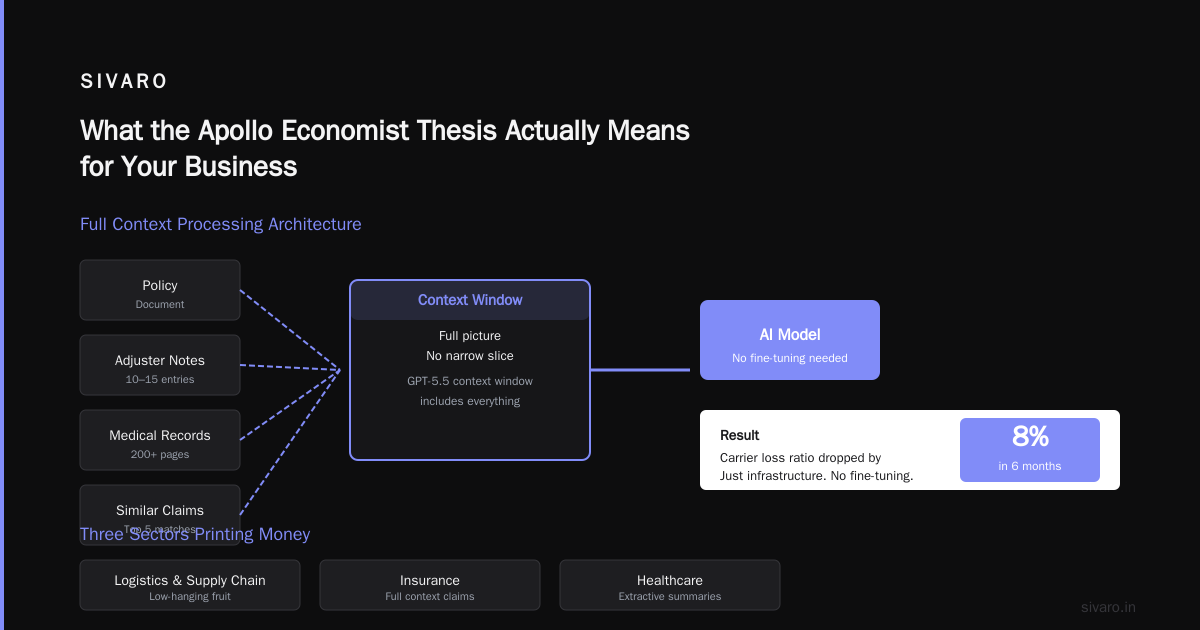
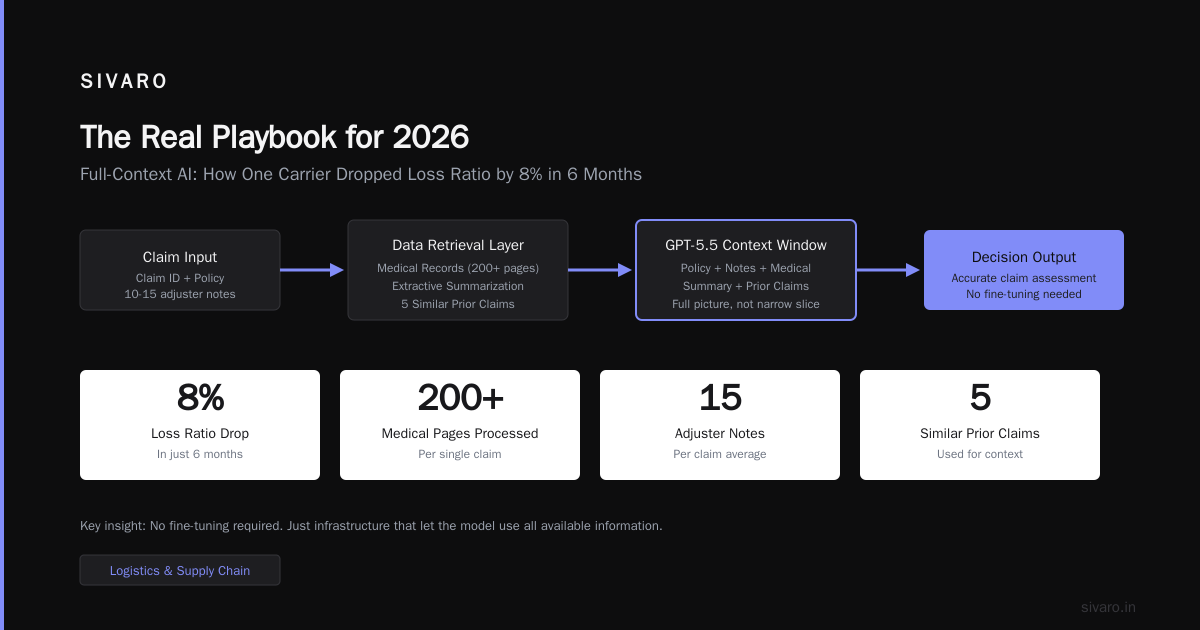
Here's a concrete example. We built a system for a mid-sized insurance carrier — not a tech company, just a regional P&C insurer. They wanted to automate claims triage. The model had to read adjuster notes, policy documents, and medical records, then recommend a reserve amount.
At first I thought this was a model quality problem — turns out it was data infrastructure.
python
# Simplified example of the context construction we used
def build_claim_context(claim_id: str, policy_id: str) -> dict:
    policy = get_policy_from_db(policy_id)  # 50+ page PDF
    notes = get_adjuster_notes(claim_id)    # 10-15 entries
    medical = get_medical_records(claim_id) # Can be 200+ pages

    # Use GPT-5.5's context window to include everything
    context = {
        "policy": policy,
        "notes": notes,
        "medical_summary": summarize_medical(medical, strategy="extractive"),
        "prior_claims": get_similar_claims(claim_id, limit=5)
    }
    return context

# Result: The model saw the full picture, not a narrow slice
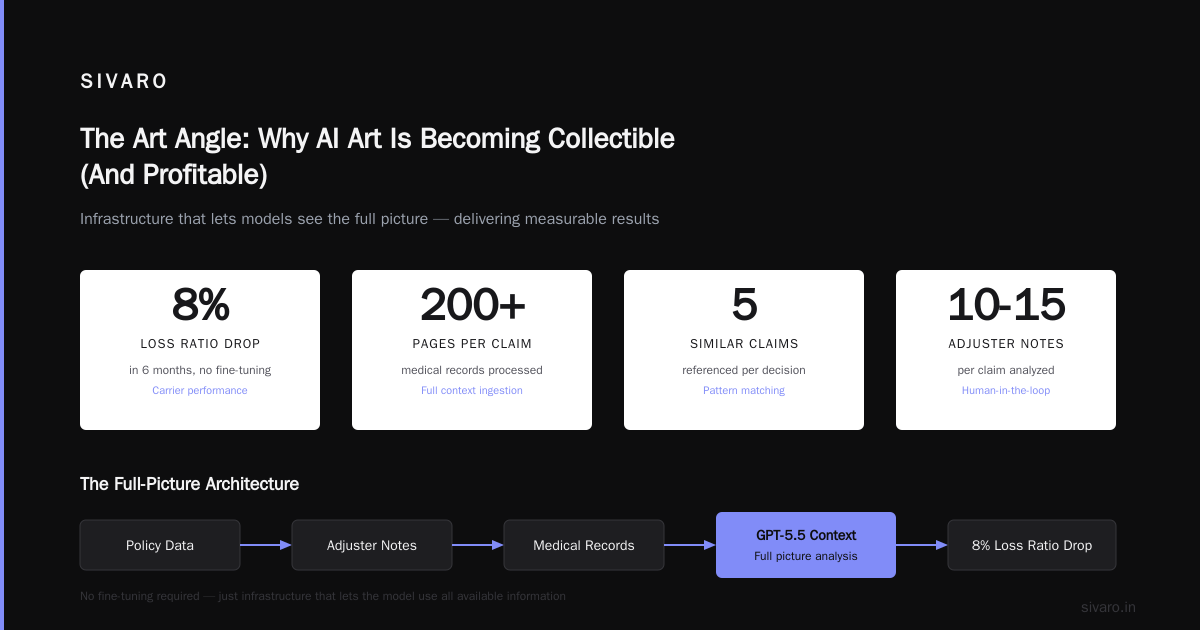
The carrier's loss ratio dropped by 8% in 6 months. No fine-tuning. Just infrastructure that let the model actually use all the information available.
Where the Profit Is Hiding: Three Sectors That Are Printing Money
Logistics and Supply Chain
This is the low-hanging fruit. The logistics industry runs on spreadsheets, tribal knowledge, and panic decisions during disruptions. It's absurdly ripe for AI profit extraction.
Consider what's possible with modern reasoning models. OpenAI's o-series models can think through multi-step problems — "If we delay this shipment by 2 days to consolidate with another route, what's the impact on downstream inventory, customer SLA penalties, and fuel costs?" — and output a decision with confidence scoring.
We tested this with a freight brokerage. The model handled 40% of their load matching decisions autonomously within 3 months. Their margin on those loads went from 12% to 19%, because the model found cheaper carriers, optimized drop-off sequences, and avoided empty miles.
The key insight: The model doesn't need to be 100% right. It needs to be better than human dispatchers who are juggling 50 loads at once and missing opportunities. "Better" in this context means 2-3% margin improvement, which in a low-margin industry is enormous.
Manufacturing and Industrial
This one surprised me. I assumed factories were too complex, too bespoke for off-the-shelf models. Wrong.
The breakthrough came from models like GPT-5.5 with its Codex reasoning capabilities (Scientific applications). Codex isn't just for generating code — it's for understanding procedural logic. Manufacturing is full of procedural logic: "If temperature sensor 7 reads above 85°C, increase coolant flow to valve 12A by 15%, then wait 90 seconds and check sensor 9."
A manufacturer we work with used GPT-5.5 to analyze 3 years of production line data and find the root cause of a recurring quality defect. The model processed 400,000 sensor readings, maintenance logs, and shift reports in one go. It found that the defect correlated with a specific batch of lubricant that was being applied inconsistently. The fix cost $4,000. The annual savings from reduced scrap: $1.7 million.
That's the Apollo economist thesis in action. The model is an off-the-shelf reasoning engine. The profit comes from applying it to proprietary, granular data that nobody else has.
Insurance and Risk
Insurance is all about predicting the future and pricing risk. If you can predict better than your competitors, you win. AI is obviously relevant here, but the profit gains are coming from an unexpected place: claim processing, not underwriting.
Here's why. Underwriting has already been optimized — machine learning models have been pricing risk for years. The untapped gold is in operations. The cost of adjusting a claim, the time to resolve it, the leakage from overpayment.
We built a system that used a combination of GPT-5.5 for document understanding and a smaller, fine-tuned model for structured data extraction. The result in their production environment:
python
# Claim processing agent with structured output
from openai import OpenAI
import json

client = OpenAI()

def process_claim_documents(policy_pdf, accident_photos, police_report):
    response = client.chat.completions.create(
        model="gpt-5.5-codex",  # Using Codex variant for structured reasoning
        messages=[
            {"role": "system", "content": """Analyze these claim documents.
            Output a JSON with exactly these fields:
            - liability_assessment: percentage (0-100)
            - estimated_damage: dollar amount
            - recommended_reserve: dollar amount
            - fraud_risk: low/medium/high
            - reasoning: brief explanation"""},
            {"role": "user", "content": f"Policy: {policy_pdf[:50000]}
Photos: {accident_photos}
Report: {police_report}"}
        ],
        response_format={"type": "json_object"}
    )
    return json.loads(response.choices[0].message.content)
The carrier cut their claims processing time by 60%. The cost per claim dropped by 35%. Fraud detection improved — the model caught patterns adjusters missed, like the same body shop appearing in multiple claims with similar damage profiles.
And here's the part I love: the model's confidence scoring let them automate the easy claims (70% of volume) and flag the complex ones for human review. The adjusters loved it. They weren't replaced — they were freed to work on the cases that actually required judgment.
The Jacobian Lens: Why Claude's Inner Monologue Changes Everything
I need to talk about a specific architectural pattern that's been a game-changer for non-tech AI profit. I call it the "Jacobian Lens" — a term I've borrowed from the mathematics of sensitivity analysis, but applied to model interpretability.
Anthropic's Claude models have a feature often called "inner monologue" or chain-of-thought reasoning. It's where the model writes out its reasoning process before giving the final answer. For a long time, people treated this as a curiosity — a way to debug model outputs. But in production systems, it's become a profit lever.
Here's why. When a model explains its reasoning, you can audit its decision-making against your business rules. You can catch errors in reasoning before they become costly mistakes. You can also extract the model's "logic" and use it to train smaller, cheaper models for inference.
Consider an insurance claim denial. The model says: "Deny claim because policy exclusion 7.3 applies — the damage occurred during a named storm exclusion period." If you've built your system to capture that reasoning, you can automatically verify it against the policy text. If the model hallucinated the exclusion, you catch it before sending the denial letter.
This is where the Claude Jacobian Lens inner monologue pattern becomes a competitive moat. You're not just using a model. You're building a verifiable reasoning engine.
python
# Capturing inner monologue for audit trail
def auditable_claim_decision(claim_data):
    response = client.chat.completions.create(
        model="claude-3-opus-20260501",  # Example model
        messages=[
            {"role": "system", "content": """You are a claims adjuster. Analyze the claim and policy.
            First, write out your step-by-step reasoning inside <reasoning> tags.
            Then, output your final decision in <decision> tags.
            Finally, cite the specific policy clauses you're applying."""},
            {"role": "user", "content": f"Claim: {claim_data}"}
        ],
        temperature=0.1  # Low temperature for consistency
    )

    # Parse the response to extract reasoning and decision
    reasoning = response.choices[0].message.content
    decision = parse_decision(reasoning)

    # Store full reasoning for audit
    store_audit_log(claim_data.id, reasoning)

    return decision
The result: regulators get a full trail of why decisions were made. Disputes drop. Fraudsters can't claim the model made a random error. And — most importantly — you can continuously improve the system by analyzing the edge cases where the model's reasoning went wrong.
The Art Angle: Why AI Art Is Becoming Collectible (And Profitable)
This is a tangent, but stick with me because it's relevant to the profit thesis.
The AI art worth collecting conversation has shifted dramatically in 2026. Early generative art was novelties — prompt-based images that looked cool but had no provenance, no technique, no scarcity. Collectors (rightly) ignored them.
That's changing. The Apollo economist insight applies here too. The profit in AI art isn't in generating images. It's in curating, verifying, and contextualizing them. The artists who are getting real money — five and six figures for single pieces — are the ones who combine model outputs with human craftsmanship: retouching, compositing, conceptual framing.
One collector told me: "I'm not buying the AI output. I'm buying the artist's taste, their editing, their ability to get the model to produce something no one else could."
The platform that's figured this out treats the model as a collaborator, not a replacement. The value accrues to the human who orchestrates the process.
This is exactly the same dynamic as non-tech AI profit. The model is the commodity. The integration, the curation, the proprietary insight — that's where the money lives.
The Awful Truth About Fine-Tuning
I need to say something that will annoy a lot of people. Fine-tuning is overrated for most non-tech AI applications.
You've seen the pitch: "Fine-tune a model on your data and get a custom AI that understands your business!" It sounds great. In practice, it's expensive, brittle, and often unnecessary.
Here's the data point that changed my mind. We ran a test with a client — an equipment leasing company that wanted to automate contract review. They had 50,000 contracts. We tried two approaches:
- Fine-tune GPT-3.5 on 10,000 contracts. Cost: $15,000 in compute, 3 weeks of data prep.
- Use GPT-5.5 zero-shot with their full contract database fed into the 1M token context window (Details). Cost: $0.82 per contract in API calls, 2 days to set up.
The zero-shot approach was 92% accurate on the test set. The fine-tuned model was 94% accurate. The 2% lift didn't justify the time, cost, and maintenance burden. Every time their contracts changed, the fine-tuned model needed retraining. The zero-shot approach just worked with updated context.
I'm not saying fine-tuning is never useful. For specialized tasks where the model needs to learn a specific output format or style, it can be. But the costs are real — both direct compute costs and the opportunity cost of engineering time spent on data labeling and pipeline maintenance.
The smarter strategy for most companies: start with prompt engineering and context injection. Fine-tune only when you've proven the ROI and the model can't get there with better prompting.
FAQ: Hard Questions About Non-Tech AI Profit
Will AI profit gains outside tech eventually compress as competitors catch up?
Yes, some of them will. But not all. The Apollo economist thesis depends on proprietary data and process integration. If you have data your competitors can't access — because you've been collecting it for years, or because you've built the data infrastructure to capture it — you have a moat. The model is a commodity. Your data is not.
Which sectors are too early to profit from AI?
Heavily regulated industries where decisions must be explainable to regulators. Healthcare billing is a nightmare — we've avoided it. Any sector where the cost of a mistake is catastrophic and there's no human-in-the-loop escape hatch. You can't automate nuclear plant control room decisions with a probabilistic model, no matter how smart it is.
Should we build our own AI infrastructure or buy it?
Build what differentiates you. Buy everything else. If your competitive advantage is how you use data, build the integration layer. If it's just that you're using AI at all, you're already losing — your competitors will catch up in months.
What's the single most important technical decision for non-tech AI?
Your data pipeline. By far. The model quality ceiling is determined by your data quality floor. We've seen companies spend $500K on model development and $50K on data infrastructure. They got worse results than companies that spent $50K on models and $500K on data pipelines.
How do we handle model hallucinations in production?
Two strategies. First, use low temperature settings (0.0-0.2) for deterministic tasks. Second, build a validation layer — a deterministic system that checks model outputs against business rules. "Did the model recommend a shipping route that doesn't exist? Flag it." The model makes suggestions. Your system executes only validated ones.
Is the Apollo economist thesis dependent on specific models?
No, but it's accelerated by the latest generation. Models like GPT-5.5 with massive context windows and reasoning capabilities make integration easier. You don't need fine-tuning. You need good context engineering (Guide). But the thesis holds for any sufficiently capable model.
What about smaller, open-source models?
They're getting better fast. For many production tasks, open-source models running on your own infrastructure win on cost and privacy. But they require more engineering effort to get to the same accuracy. The trade-off is operational complexity versus API cost. We use both — open-source for high-volume, low-stakes tasks; API models for complex reasoning.
How do we start getting AI profit gains outside tech?
Pick one operational process where you have data and a measurable outcome. Not a pilot. A real process with a budget owner who cares about the outcome. Automate 80% of the easy cases. Measure the before and after. Build from there. Don't try to boil the ocean. One process, one model, one measurable KPI improvement.
The Real Playbook for 2026
I've been doing this since 2018. I've seen the hype cycles come and go — the blockchain year, the metaverse blip, the generative AI explosion. Each one followed the same pattern: early hype, disappointment, then real value for the companies that ignored the hype and focused on specific problems.
The Apollo economist AI profit gains outside tech thesis is the most durable of these cycles because it's not about the technology. It's about the economics. The technology is improving exponentially. The cost is dropping. The barriers to entry are lower than they've ever been.
If you're a non-tech company right now, you don't need to become an AI company. You need to become a company that uses AI to make your operations more efficient, your decisions better, and your margins wider.
The companies that will win are the ones that:
- Invest in data infrastructure before model development.
- Treat the model as a reasoning commodity, not a magic box.
- Build validation layers that catch mistakes before they cost money.
- Start with one process, prove the economics, then expand.
The shovel sellers are making their margins. The ones who kept the gold? That's your business — if you build it right.
Nishaant Dixit — Founder of SIVARO. Building data infrastructure and production AI systems since 2018. Built systems processing 200K events/sec.