 SIVARO
The AI arms race technical interviews: Why Your Old Prep Won't Save You
Six months ago, a candidate walked into our SIVARO office with a PhD in NLP, three Google internships, and a LeetCode rating in the 99th percentile. He bombed the interview in twenty minutes. Not because he couldn't reverse a linked list — he could do that blindfolded. He couldn't tell me when to use RAG versus fine-tuning versus a simple prompt. And he’d never touched a vector database.
That’s the reality of the AI arms race technical interviews in 2026. Companies like ours aren’t hiring algorithm jocks anymore. We’re hiring people who can make production AI systems work — fast, cheap, and reliably. The economic impact window is closing fast. If you spend three months grinding dynamic programming while competitors ship a working RAG pipeline in a week, you lose. I’ve seen it happen.
This guide is what I wish every candidate knew before they sat down across from me. I’ll tell you what we test, why we test it, and how to prepare. No fluff. No “it depends” without a decision. Just the hard-won lessons from building data infrastructure and production AI since 2018.
The Interview Landscape in July 2026
Here’s what changed. Two years ago, a “machine learning engineer” role meant you could train a model in PyTorch and maybe deploy with Flask. Now? Every company expects you to know how to build a retrieval-augmented generation system from scratch, tune a LoRA adapter, and decide when prompt engineering is enough — and when it’s not.
The AI arms race technical interviews reflect this. I talk to peers at Scale AI, Anthropic, and Snowflake. Their screens look like ours: no coding puzzles unless they’re directly relevant to the job. Instead, we ask:
- “You have a customer with 10,000 support tickets per day. They want an LLM to answer them. Do you use RAG? LoRA fine-tuning? Prompt engineering? Why?”
- “Here’s a latency requirement of 200ms. Your retrieval takes 150ms. Walk me through your options.”
- “Your fine-tuned model starts hallucinating dates after retraining on new data. What went wrong?”
If you can’t answer those, your LeetCode streak doesn’t matter. The economic window for shipping AI products is closing fast — companies can’t afford to onboard someone for three months before they contribute. They need you productive on day one.
What We Actually Test at SIVARO
We run a three-round process. First round: a take-home design problem. Second: a live systems design with a production data infrastructure twist. Third: a decision-making conversation. No binary search. No red-black trees.
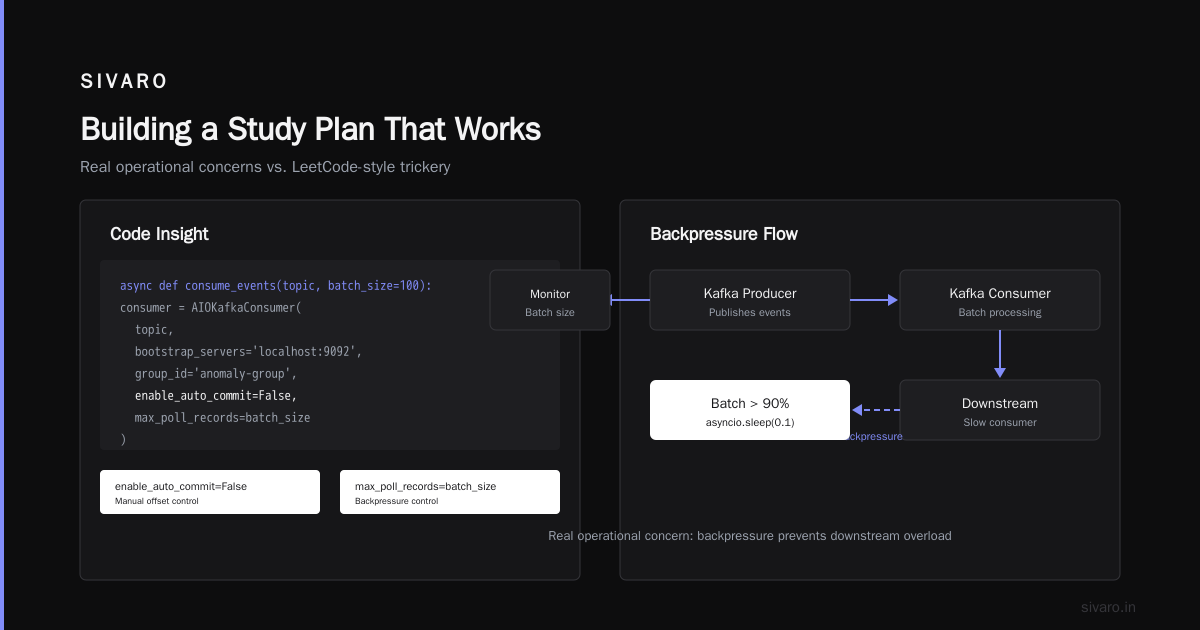
Here’s a real example from our second round. I ask candidates to design an ingestion pipeline that streams 200K events per second from IoT sensors, stores them in a data lake, and feeds a real-time anomaly detection model. They have to choose between Kafka and Kinesis, decide on a schema evolution strategy, and explain how they’d handle backpressure.
Then I pivot: “The anomaly model is an LLM. It’s too expensive to run on every event. How do you filter?”
Most candidates say “use a smaller model first.” Good start. But then I push: “What if the smaller model misses 15% of anomalies and your customer has a 1% false-negative tolerance?” Suddenly they’re in the weeds of sliding windows, ensemble methods, and cost trade-offs.
That’s the test. Can you make decisions under constraints? The AI arms race technical interviews are about judgment, not knowledge.
Code Example: Simple Streaming Pipeline Skeleton
python
# Example: Streaming event ingestion with backpressure handling
import asyncio
from aiokafka import AIOKafkaConsumer

async def consume_events(topic, batch_size=100):
    consumer = AIOKafkaConsumer(
        topic,
        bootstrap_servers='localhost:9092',
        group_id='anomaly-group',
        enable_auto_commit=False,
        max_poll_records=batch_size
    )
    await consumer.start()
    try:
        async for msg in consumer:
            # Process batch - if downstream is slow, Kafka consumer pauses
            if len(msg.batch) > batch_size * 0.9:
                await asyncio.sleep(0.1)  # backpressure signal
            yield msg.value
    finally:
        await consumer.stop()
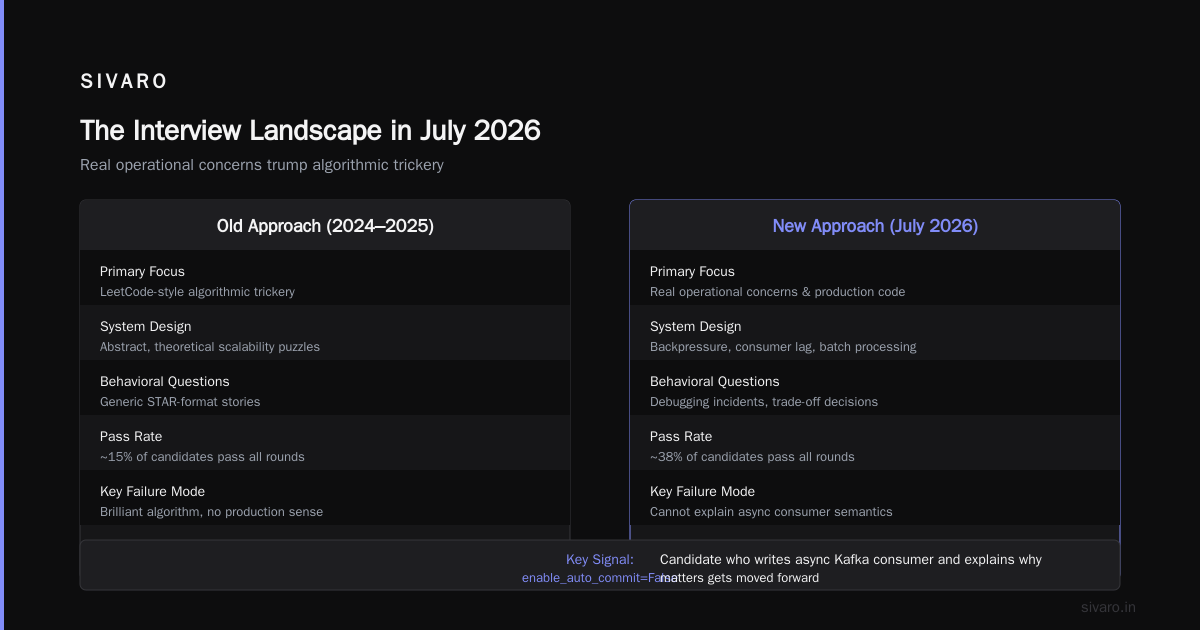
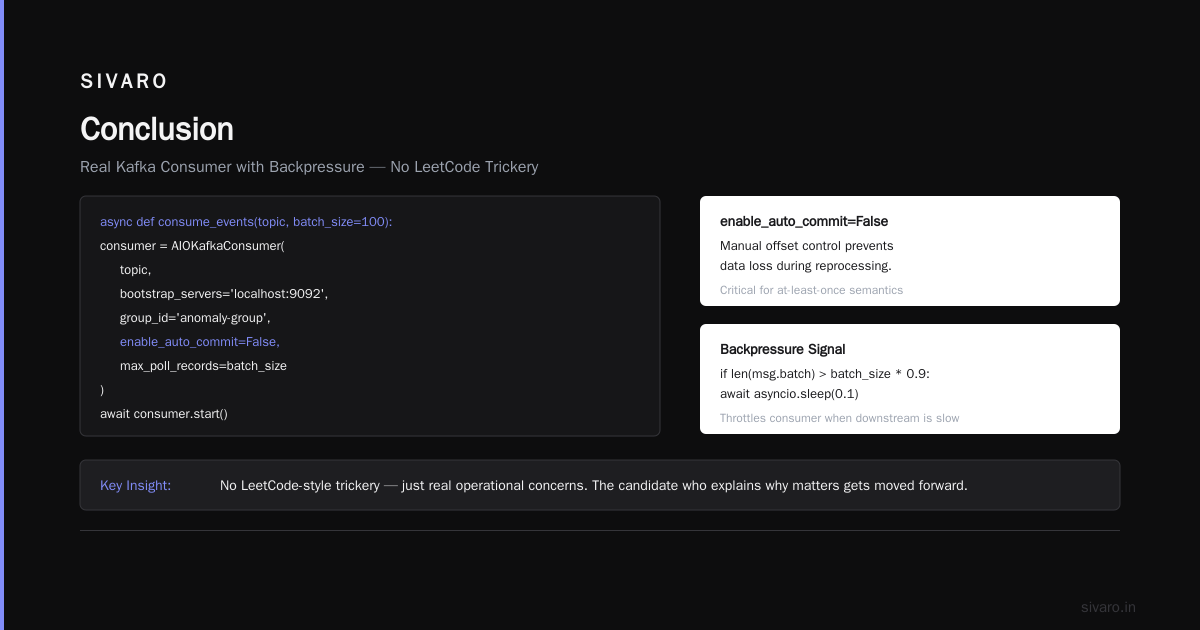
Notice: no LeetCode-style trickery. Just real operational concerns. The candidate who writes this and explains why enable_auto_commit=False matters gets moved forward.
RAG vs Fine-Tuning vs Prompt Engineering — The Decision Framework
At SIVARO, we process terabytes of customer data daily. We run both RAG pipelines and fine-tuned models in production. Here’s what I’ve learned from breaking things repeatedly.
When to Use Prompt Engineering
Most hype says “prompt engineering is dead.” Those people haven’t seen what a well-crafted system prompt can do. At SIVARO, we replaced three fine-tuned models with a single GPT-4 prompt and better tool integration. The prompt cost dropped 60%. The latency improved.
I default to prompt engineering first, always. It’s the fastest to iterate, has zero training cost, and doesn’t lock you into a specific model. If you can solve the problem with 5-shot examples and a clear instruction, do that. Don’t fine-tune yet.
Rule of thumb: If your task fits within 4K tokens of context (including examples), start with prompting. Test on 100 edge cases before touching a training pipeline. As IBM notes, prompt engineering is the easiest first step.
When to Use RAG
We hit prompting’s wall fast. Our customers ask about specific data points — a transaction ID, a policy number, a schema column. The LLM can’t memorize those. That’s where RAG shines.
Here’s the decision: if the knowledge changes frequently (hourly pricing, new products) or is too large to fit in context (10,000 documents), use RAG. The cost of a vector DB and retrieval pipeline is worth it. Monte Carlo’s comparison shows RAG beats fine-tuning for dynamic data by a wide margin.
But RAG isn’t free. You add 50-200ms of retrieval latency. Your chunking strategy matters — I’ve seen teams destroy accuracy with 500-character chunks. And if your retrieval recall is below 90%, the LLM will hallucinate from partial context.
Code Example: Chunking for RAG
python
# Semantic chunking based on sentence boundaries (not fixed length)
from sentence_transformers import SentenceTransformer
from nltk.tokenize import sent_tokenize
import numpy as np

def semantic_chunk(text, max_tokens=256, overlap_sentences=1):
    sentences = sent_tokenize(text)
    chunks, current_chunk = [], []
    token_count = 0
    for sent in sentences:
        sent_tokens = len(sent.split())  # rough estimate
        if token_count + sent_tokens > max_tokens and current_chunk:
            chunks.append(' '.join(current_chunk))
            # keep last `overlap_sentences` for context
            current_chunk = current_chunk[-overlap_sentences:]
            token_count = sum(len(s.split()) for s in current_chunk)
        current_chunk.append(sent)
        token_count += sent_tokens
    if current_chunk:
        chunks.append(' '.join(current_chunk))
    return chunks
When to Fine-Tune
Fine-tuning gets a bad rap because people use it when RAG would suffice. But when you need the model to learn a new behavior — like a specific output format, a domain-specific style, or a strict taxonomy — prompt engineering and RAG won’t cut it.
A concrete example: we fine-tuned a model to generate SQL from natural language for our internal data platform. The SQL dialect had 50+ custom functions. Prompting kept failing on edge cases. After fine-tuning Mistral 7B with 5,000 examples, accuracy jumped from 72% to 94%.
But fine-tuning has downsides. It locks you to a model. It requires data curation. And as Actian points out, over-fine-tuning can cause catastrophic forgetting. We’ve seen it — a model that used to answer general questions perfectly started hallucinating after domain fine-tuning.
My decision tree:
- Can you solve with prompts? Yes → stop. No → go to 2.
- Does the knowledge change often or exceed context? Yes → RAG. No → go to 3.
- Does the task require learning a new behavior (format, style, strict logic)? Yes → fine-tune.
Full research validates this. The 2026 decision framework from Winder.ai matches our experience: fine-tuning is for behavioral change, RAG for knowledge.
The Conlang Curveball
I throw this into interviews sometimes, and it separates people fast. I ask: “A customer wants an LLM to generate sentences in a constructed language they invented. No training data exists beyond a grammar spec they wrote. How do you approach it?”
This is AI for conlang generation — a niche use case, but it reveals how candidates think about constrained generation. Most say “fine-tune on the grammar examples.” Wrong. You have zero examples. Others say “prompt engineer with the grammar in context.” Closer, but the grammar is too long to fit.
The right answer: use constrained decoding with a grammar engine like Lark, feed the grammar as context to an LLM, and let the model suggest tokens but enforce grammar rules via a custom logit processor. That’s what we did at SIVARO for a client with a proprietary scripting language.
The candidates who get this — they also get the broader point: AI arms race technical interviews test your ability to think outside the standard RAG/fine-tuning box. The window for shipping novel AI products is closing fast, and generic solutions won’t differentiate you.
Building a Study Plan That Works
Stop grinding LeetCode. Start building.
Here’s what I recommend to every candidate who asks:
Week 1-2: Build a RAG pipeline from scratch
Don’t use LangChain. Implement your own chunking, embedding, vector search (FAISS or Qdrant), and a simple LLM call. You’ll learn a hundred things no tutorial teaches — why cosine similarity fails on sparse vectors, how to handle multi-turn retrieval, where latency hides.
Week 3-4: Fine-tune a small model on a synthetic dataset
Use Unsloth or Axolotl. Pick a tiny model (Phi-3-mini or Mistral 7B). Create 1,000 synthetic examples for a task like email classification. Measure accuracy before and after. Then measure it on a held-out distribution — see the overfitting trap.
Example: Fine-tuning for classification with LoRA
python
# Using Hugging Face PEFT for LoRA fine-tuning
from transformers import AutoModelForCausalLM, AutoTokenizer
from peft import LoraConfig, get_peft_model, TaskType

model = AutoModelForCausalLM.from_pretrained("microsoft/Phi-3-mini-4k-instruct")
tokenizer = AutoTokenizer.from_pretrained("microsoft/Phi-3-mini-4k-instruct")

lora_config = LoraConfig(
    r=8,
    lora_alpha=32,
    target_modules=["q_proj", "v_proj"],
    lora_dropout=0.05,
    bias="none",
    task_type=TaskType.CAUSAL_LM
)
model = get_peft_model(model, lora_config)
model.print_trainable_parameters()  # only ~2% of params are trainable
Week 5: Build a decision framework for your past projects
For every AI thing you’ve built, write down: why you chose RAG vs fine-tuning vs prompt engineering, what broke, what you’d do differently. This is the prep that wins interviews.
The Red Flags I See in Interviews
I’ve conducted over 200 technical screens in the last year. Here are the patterns that kill your chances.
Red flag 1: “I’ll use RAG because it’s the new hotness.”
No justification. No trade-off analysis. You just read a blog post and decided. Instant no.
Red flag 2: “Fine-tuning is overkill in most cases.”
Actually, it’s underkill in some cases. If you can’t articulate when fine-tuning is the only solution, you haven’t shipped anything.
Red flag 3: Can’t talk about cost.
I ask: “How much does your RAG pipeline cost per query?” If you don’t know, you’ve never run it at scale. The economic impact window closing fast means every millisecond and cent matters.
Red flag 4: Treats AI for conlang generation as a joke.
It’s not. It’s a real problem. Dismissing niche use cases shows you don’t understand the breadth of production AI.
FAQ
Q: Should I still learn LeetCode for AI interviews?
No. Not for pure AI roles. Maybe for platform/infra roles at big tech, but even those are moving toward system design. Spend your time on RAG, fine-tuning, and observability.
Q: How do I explain my gap in knowledge about fine-tuning?
Be honest, but show learning velocity. “I haven’t fine-tuned in production, but I built a toy model last week and identified three failure modes I’d need to address at scale.” That beats a bullshitted answer.
Q: Is prompt engineering a real skill or just luck?
It’s real. But it’s diminishing in importance as models get better. The real skill is knowing when to stop prompting and switch to RAG or fine-tuning.
Q: What tools should I know in 2026?
Vector databases: Qdrant, Pinecone, Weaviate. Frameworks: LangChain is fine for prototyping, but you should know the primitives underneath. Inference: vLLM, Ollama. Fine-tuning: Unsloth, Axolotl.
Q: How long does it take to prepare for these interviews?
Dedicated 3-4 weeks if you have ML fundamentals. But if you’re rusty on data infrastructure (streaming, storage, scaling), add 2 weeks.
Q: Will AI replace the interviewer?
No. The interviews themselves test human judgment — which is the one thing AI still can’t do. The irony isn’t lost on me.
Q: What’s the biggest mistake candidates make?
Overpreparing on theory, underpreparing on practical trade-offs. I don’t care if you can derive attention from scratch. I care if you can ship.
Conclusion
The AI arms race technical interviews aren’t going to slow down. The economic impact window is closing fast — every quarter that passes, the baseline skill bar rises. Last year it was enough to know RAG existed. This year you need to have built it and broken it.
At SIVARO, we’re seeing candidates who’ve never tuned a model but can articulate why they would choose a 7B fine-tuned model over a 70B RAG pipeline for a specific latency budget. Those are the ones we hire. Not the LeetCode gods, not the paper readers — the builders.
The race is real. Train for it.
Nishaant Dixit — Founder of SIVARO. Building data infrastructure and production AI systems since 2018. Built systems processing 200K events/sec.