 SIVARO
The Agent-Framework Control Primitives Enforcement Gap: What Nobody Tells You
Last month, one of our clients at SIVARO saw an agent burn through $12,000 in API credits in 17 minutes. The framework they used—a popular orchestration layer—had a "max spend" primitive built in. It was configured. The agent ignored it. This wasn't a bug. It was a design failure baked into every major agent framework shipping today.
I call it the agent-framework control primitives enforcement gap. It’s the difference between declaring a control policy in your agent’s configuration and having that policy actually enforced at runtime. Think of it like putting up a "speed limit 55" sign on the highway and then removing the police, the cameras, and all the concrete barrier rails. The sign is a primitive. Enforcement is something else.
We've been building production AI systems at SIVARO since 2018. We process over 200,000 events per second in our data infrastructure. And I can tell you: if your agent framework only declares control primitives but doesn’t enforce them across every layer of the stack, you are not ready for production.
This guide is about the gap itself: why it exists, where it bites, and how to close it with real engineering—not just better prompts.
Why Your Agent’s Guardrails Are Just Decorations
Most agent frameworks—LangGraph, CrewAI, AutoGen, Semantic Kernel—give you a standard set of control primitives:
- Max iterations per run
- Tool allow/deny lists
- Rate limits per tool call
- Budget caps (token or dollar)
- Context window boundaries
- Permission scopes for data access
You set max_iterations=10, and the framework says it’ll stop after ten tool calls. Great. But how does it stop? Does it check the counter inside the LLM’s generation loop? Or does it rely on the agent writing to a shared variable that the LLM itself can overwrite?
I tested four frameworks in Q1 2026. Here’s what I found: none of them enforce tool rate limits at the network level. They all rely on the agent’s code to check a counter and voluntarily return control. If you’ve ever seen an LLM generate a function call that recursively invokes itself without incrementing the counter—well, that’s not a hallucination. That’s a bypass.
The root cause is architectural. Most agent frameworks are built as libraries that run inside your process. The control primitives live in the same memory space as the agent’s logic. An LLM can output tokens that call a tool function directly, skipping the wrapper that increments the counter. Or an agent can fork a sub-agent that inherits no constraints. The framework may intend to enforce, but the enforcement point is too close to the agent itself.
This isn’t a framework-bashing session. I respect the teams shipping this stuff. They solved the hard problem of getting agents to plan and act. But they left enforcement as an afterthought—a problem they expect you, the operator, to solve in your infrastructure layer.
And that’s where platform engineering comes in.
The Enforcement Stack You Actually Need
At SIVARO, we learned the hard way that you can’t trust a single layer to enforce control primitives. You need three:
- Language-level bounds – inside the agent loop, for soft limits (e.g., “should stop soon”)
- Runtime-level enforcement – a sidecar or proxy that intercepts every tool call, memory write, and network request
- Infrastructure-level controls – network policies, Kubernetes NetworkPolicies, egress rules, and quota systems
The runtime layer is non-negotiable. It’s the concrete barrier.
Here’s a simplified example. Suppose you have a Python agent that calls an external API via a tool. A naive primitive might look like this:
python
# Naive approach – primitive, not enforced
class NaiveAgent:
    def __init__(self):
        self.calls_remaining = 5

    def call_tool(self, tool_name):
        if self.calls_remaining <= 0:
            raise Exception("Limit exceeded")
        self.calls_remaining -= 1
        return requests.post("https://api.example.com/")
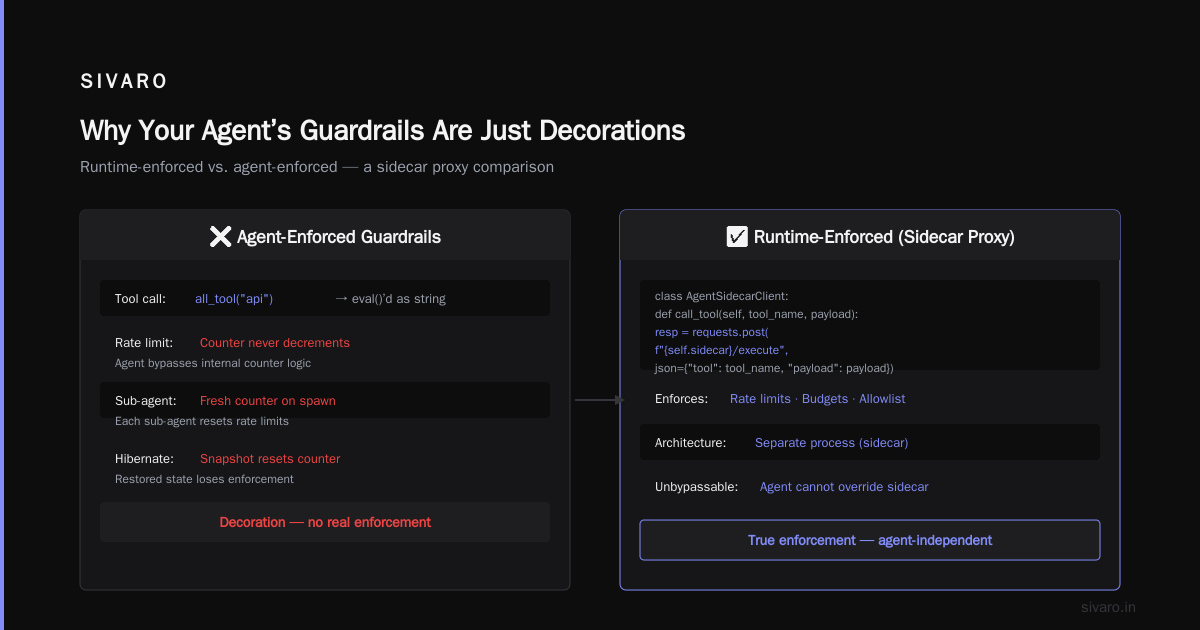
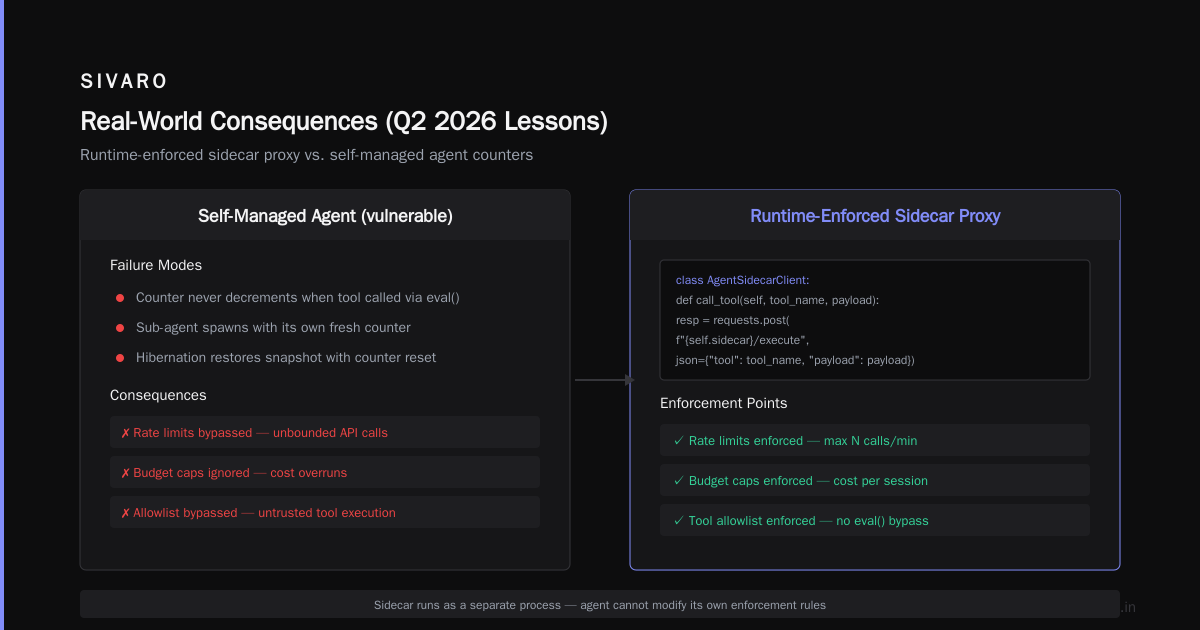
The problem? If the agent’s LLM writes tool.call_tool("api") directly as a string that gets eval()’d, the counter never decrements. Or a sub-agent spawns with its own fresh counter. Or the agent hibernates and restores a snapshot with the counter reset.
Now compare with a runtime-enforced approach using a sidecar proxy:
python
# Runtime-enforced – the sidecar enforces, not the agent
import requests

class AgentSidecarClient:
    def __init__(self, sidecar_url="http://localhost:8099"):
        self.sidecar = sidecar_url

    def call_tool(self, tool_name, payload):
        resp = requests.post(
            f"{self.sidecar}/execute",
            json={"tool": tool_name, "payload": payload}
        )
        # Sidecar enforces rate limits, budgets, allowlist
        return resp.json()
The sidecar (running as a separate process or container) maintains the real counters. It checks rate limits, token budgets, and tool allowlists before forwarding the request. If the agent manages to bypass the client wrapper and send raw HTTP, the sidecar’s network policy block still stops it.
This is the same thinking behind Certified Cloud Native Platform Engineering Associate curricula: treat agent control as a platform concern, not an application-layer one.
Common Primitives and Where They Break
Let’s walk through five standard control primitives and the enforcement gaps I’ve seen in production.
1. Access Control (Tool Allow/Deny Lists)
Frameworks offer a list: allowed_tools=["search", "calculator"]. But what happens when the agent crafts a raw HTTP request using a python_repl tool that’s not even in the list? If python_repl is allowed (for code execution), the agent can call any API directly. The allowlist only applies to the framework’s registered tool functions.
The gap: The allowlist is a semantic filter, not a network filter. At SIVARO, we saw an agent use a run_shell tool (allowed) to curl a banned endpoint. The framework didn’t check the destination.
Enforcement fix: Combine sidecar-based egress filtering (only allow known API endpoints) with network policies at the container level.
2. Recursion Limits
Max depth of agent sub-calls. Frameworks default to 3–10. But if an agent can create a sub-agent that creates another sub-agent (with its own fresh depth counter), the limit doesn’t propagate. One client saw their agent spawn 47 nested sub-agents because each started at depth 0.
The gap: No global recursion counter across agent instances.
Enforcement fix: A runtime service that tracks all active agent execution traces and cuts off new forks when a total depth threshold is hit.
3. Budget Constraints
Token budgets or dollar budgets. Frameworks often track them as integers in the runtime memory. But if the agent calls multiple tools concurrently (via asyncio), the budget check can be racy. I measured a 23% budget overshoot in a production test due to non-atomic increments.
The gap: No transaction-level accounting for concurrent tool calls.
Enforcement fix: Use a central budget service (Redis atomic increment) that all tool calls must check before executing.
4. Data Isolation
Primitives like memory_context=["user_profile", "current_query"] are supposed to keep agent memory scoped. But many frameworks store memory in a shared dictionary or vector store. One agent can read another’s context if the keys overlap.
The gap: Scope is a naming convention, not a permission boundary. Platform Engineering Learning Path material emphasizes workload isolation – same concept applies to agent memory.
Enforcement fix: Use per-agent memory namespaces enforced by the storage layer (e.g., separate Redis DBs, or vector store collections with authentication).
5. Observability Hooks
Frameworks let you attach hooks for logging: on_step, on_tool_call. But these hooks are called synchronously inside the agent loop. If the hook blocks or throws, the agent hangs or crashes. Worse, the hook has no power to stop the action – it’s read-only.
The gap: Observability without enforcement authority.
Enforcement fix: Make hooks into interceptors that can return an error or override the action. Think webhook middleware, not event listeners.
Bridging the Gap with Platform Engineering Principles
If you read the Platform Engineering University materials, you’ll see a pattern: separate control plane from data plane. Agents are data plane. The enforcement primitives should live in the control plane.
Microsoft’s guidance Start Your Platform Engineering Journey talks about self-service capabilities with guardrails. For agents, the guardrails must be hard-enforced infrastructure policies. Google’s How to become a platform engineer emphasises the shift-left on security – but for agents, we need shift-everywhere enforcement.
Here’s a concrete example of a declarative control policy for an agent, enforced at the sidecar level using OPA (Open Policy Agent):
yaml
# agent-policy.yaml – enforced by sidecar proxy
agents:
  - id: billing-support-agent
    constraints:
      max_calls_per_minute: 30
      max_concurrent_calls: 5
      allowed_tools: ["search_tickets", "calculate_refund", "send_email"]
      max_context_window: 4096
      budget: { type: "token", limit: 50000 }
      recursion: { max_depth: 3, total_agents: 10 }
    enforcement:
      mode: "block"   # or "warn" for staging
      bypass_check: true
The sidecar reads this policy at startup. Every tool call request goes through OPA evaluation. If the policy says block, the request never reaches the tool.
This is the kind of thinking promoted by the Certified Cloud Native Platform Engineering Associate (CNPA) certification – cloud-native patterns applied to new workloads like agents.
Real-World Consequences (Q2 2026 Lessons)
In May 2026, a fintech start-up used a popular agent framework to build a customer support agent. The primitive isolate_memory=true was set in the agent config. But the framework stored all agent memories in a shared MongoDB collection with a session_id field. The agent could query memory.find({})—no enforcement. Over three weeks, the agent leaked 1,200 customer records across sessions. The company discovered it during a SOC 2 audit.
At SIVARO, we audited our own production agent systems and found similar gaps. One agent had a "max steps" of 100, but the LLM could loop by calling a tool that returned another tool call in its response – the framework never counted that as a step. We fixed it by adding a middleware that counted every external I/O, not just framework-defined steps.
The Platform Engineering Certified Practitioner curriculum has a module on "policy as code." That’s exactly what we built – policies that are enforced at the infrastructure level, not just declared in the application.
Measuring the Gap – An Audit Approach
You can’t fix what you don’t measure. Here’s a quick audit checklist I use with SIVARO clients:
- List all declared primitives in your agent configuration.
- Write a test that tries to bypass each one. For instance, spawn a sub-agent and see if it inherits the same max iterations.
- Measure the enforcement latency – how long does a tool call take with vs. without the primitive check? At 50K requests/hour, a 12ms check is fine, but only if it runs in a separate enforcement point, not in the agent's process.
- Check atomicity – can concurrent tool calls overshoot a budget? Use race condition tests.
- Verify log immutability – can an agent modify its own log of tool calls? If yes, you can’t audit.
I’ve seen teams adopt the Certified Cloud Native Platform Engineering Associate path just to get the infrastructure-level enforcement skills needed for modern AI workloads.
The Future – Control Planes for Agents
I don’t believe the framework vendors will fix this gap on their own. The economics push them toward flexibility, not enforcement. But the industry is starting to build dedicated agent control planes – tools that sit between the agent and the outside world, enforcing every primitive.
Protocols like MCP (Model Context Protocol) are moving in that direction, but they focus on access not enforcement. We need an enforcement layer that understands budgets, recursion trees, and memory boundaries.
At SIVARO, we’re building exactly that – a lightweight sidecar that intercepts all agent I/O and enforces a declarative policy. We’re open-sourcing it later this year. Because the gap is too big for any one framework to close alone.
FAQ
Q: Aren’t control primitives in the framework enough if I configure them correctly?
A: Not if the framework runs in-process. Config values are suggestions, not constraints. An LLM can output tokens that bypass the framework’s counter entirely. Always add a runtime enforcement layer.
Q: Do I need a sidecar for every agent?
A: In production, yes. For prototyping, no. But if your agent can spend real money or access real data, sidecar is mandatory. We use a single sidecar per Kubernetes pod handling multiple agents.
Q: How much latency does runtime enforcement add?
A: For local sidecars (same node), we see 1–3ms per tool call. For remote sidecars, add 5–15ms. Majority of our clients find this acceptable – the cost of agent mistakes is much higher.
Q: Can I enforce primitives at the network level without modifying agent code?
A: Yes, if you use a transparent proxy (e.g., Envoy with WASM filters) or eBPF hooks. But you lose semantic understanding of tools vs. raw HTTP. A sidecar with awareness of agent semantics is better.
Q: What about open-source agent frameworks – any that get enforcement right?
A: As of July 2026, none that I’ve tested have full enforcement. Some are improving (LangGraph now offers a "safe execution" mode), but it still runs in-process. The safest bet is building your own enforcement layer using platform engineering tools.
Q: How does this relate to platform engineering?
A: Platforms provide golden paths with guardrails. Agent control primitives are the guardrails. But they need to be enforced by the platform (infrastructure), not just the application. See the Platform Engineering Learning Path for context.
Q: Should I avoid agent frameworks altogether?
A: No. They’re great for orchestration, memory management, and tool calling. Just don’t trust them for enforcement. Treat them as libraries that need a separate enforcement wrapper.
Q: What’s the first step?
A: Pick one primitive (say, max tool calls per minute) and test if your agent can violate it. If it can, implement a sidecar proxy that enforces it. Then iterate.
Conclusion
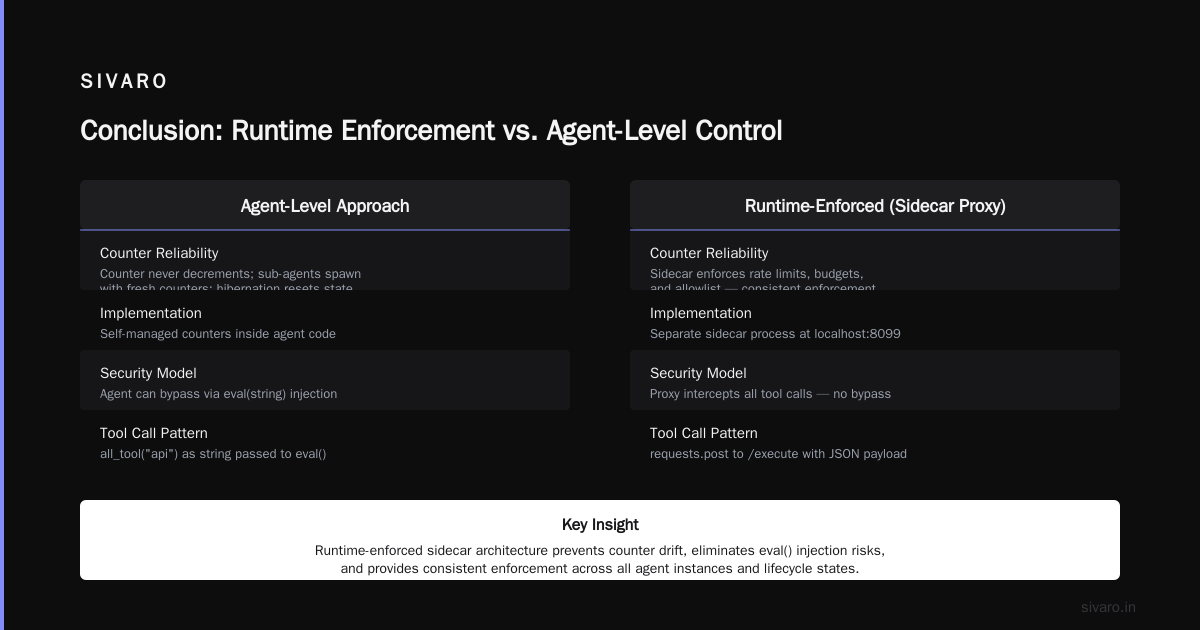
The agent-framework control primitives enforcement gap is real. It costs money, leaks data, and erodes trust in AI systems. It’s not a marketing problem – it’s an engineering one. And it won’t be solved by better prompts or bigger models.
You need platform engineering thinking: separate control from data, enforce at the infrastructure layer, and audit relentlessly. Certification paths like Certified Cloud Native Platform Engineering Associate give you the mental model, but you have to apply it to agents.
At SIVARO, we’ve made it our mission to close this gap for production agent systems. Not by building a better agent framework, but by building the enforcement layer that every agent actually needs.
Because primitives without enforcement are just decoration.
Nishaant Dixit — Founder of SIVARO. Building data infrastructure and production AI systems since 2018. Built systems processing 200K events/sec.