 SIVARO
The a2a Protocol Production Deployment Example You Actually Need
I've deployed four production agent systems in the last eighteen months. Three of them had to be ripped out and replaced because we got the protocol layer wrong. The fourth — using the Agent-to-Agent (a2a) protocol — went live in March 2026 and has been running 24/7 since.
Most people think a2a is just another API spec. They're wrong. It's a fundamental shift in how autonomous agents discover each other, negotiate capabilities, and hand off work mid-execution. And if you're building multi-agent systems that need to survive production traffic, you need to understand where a2a breaks and where it shines.
Let me walk through a real deployment. No fluff. No textbook theory. A concrete example of an a2a protocol production deployment example that's shipping right now.
What a2a Actually Solves
The problem a2a addresses is simple: agents need to talk to each other without human-defined integrations. Before a2a, every multi-agent system I built required hardcoded connection logic. Agent A knows Agent B's endpoint. Agent B knows Agent C's schema. Everything breaks when someone changes a contract.
AI Agent Protocols: 10 Modern Standards Shaping the ... lays this out clearly — the industry has been stuck in point-to-point integration hell. a2a introduces capability advertisement, dynamic discovery, and task delegation with state management.
The key insight? a2a isn't RPC. It's not "Agent A calls Agent B's function." It's "Agent A publishes a task, Agent B discovers it, claims it, works on it, and reports back." That async, stateful handoff is what makes it production-viable.
The Production System: Fraud Detection Pipeline
Here's the system I'll use as our a2a protocol production deployment example.
We built a fraud detection pipeline for a payments company — let's call it PayFlow. They process 200,000 transactions per day. Their old system used a monolithic decision engine. False positives were 8.5%. They wanted sub-3%.
The architecture uses five specialized agents:
- Ingest Agent — Normalizes transaction data from 12 sources
- Risk Scoring Agent — Calculates preliminary risk scores using ML models
- Pattern Detection Agent — Identifies behavioral anomalies
- Graph Analysis Agent — Checks relationship networks for fraud rings
- Orchestrator Agent — Coordinates the pipeline, decides final disposition
All five communicate exclusively through a2a.
Deployment Architecture: What We Actually Ran
┌─────────────────────────────────────────────────────┐
│                   a2a Registry                      │
│              (Capability Discovery)                  │
└────┬────────────┬────────────┬────────────┬────────┘
     │            │            │            │
┌────▼───┐  ┌────▼───┐  ┌────▼───┐  ┌────▼───┐
│Ingest  │  │Risk    │  │Pattern │  │Graph   │
│Agent   │  │Scoring │  │Detect  │  │Analyze │
└────┬───┘  └────┬───┘  └────┬───┘  └────┬───┘
     │            │            │            │
     └────────────┴────────────┴────────────┘
                        │
                 ┌──────▼──────┐
                 │ Orchestrator │
                 │    Agent     │
                 └─────────────┘
Each agent runs in its own Kubernetes pod. No shared state. No shared database. The only coupling is through the a2a protocol over NATS JetStream.
The a2a Task Lifecycle (Where the Rubber Meets the Road)
Here's the specific flow for one transaction:
The Orchestrator receives a transaction. It creates an a2a task payload — a JSON document with the transaction data, a status field set to "pending", and a unique task_id. It publishes this to the a2a task queue.
Each agent maintains a persistent subscription. When the Risk Scoring Agent picks up the task, it updates status to "claimed" and starts processing. This is critical — if the agent crashes mid-processing, the task returns to "pending" after a timeout (we use 30 seconds). Another instance picks it up.
The a2a protocol defines five task states: pending, claimed, working, completed, failed. We added two custom states: "needs_review" and "escalated". The spec allows custom extensions.
Here's the actual task schema we use:
python
{
  "a2a_version": "1.0",
  "task_id": "txn-20260719-8472-abc",
  "source_agent": "orchestrator-01",
  "target_capability": "risk_scoring",
  "payload": {
    "transaction_id": "20260719-8472",
    "amount": 14500,
    "currency": "USD",
    "merchant_id": "m-33891",
    "card_pan_hash": "a3f8c2...",
    "timestamp": "2026-07-19T14:23:11Z"
  },
  "status": "pending",
  "ttl_seconds": 120,
  "max_retries": 3
}
The protocol doesn't require JSON — but everyone uses JSON. Don't be the team that uses XML.
Discovery: The Part Everyone Gets Wrong
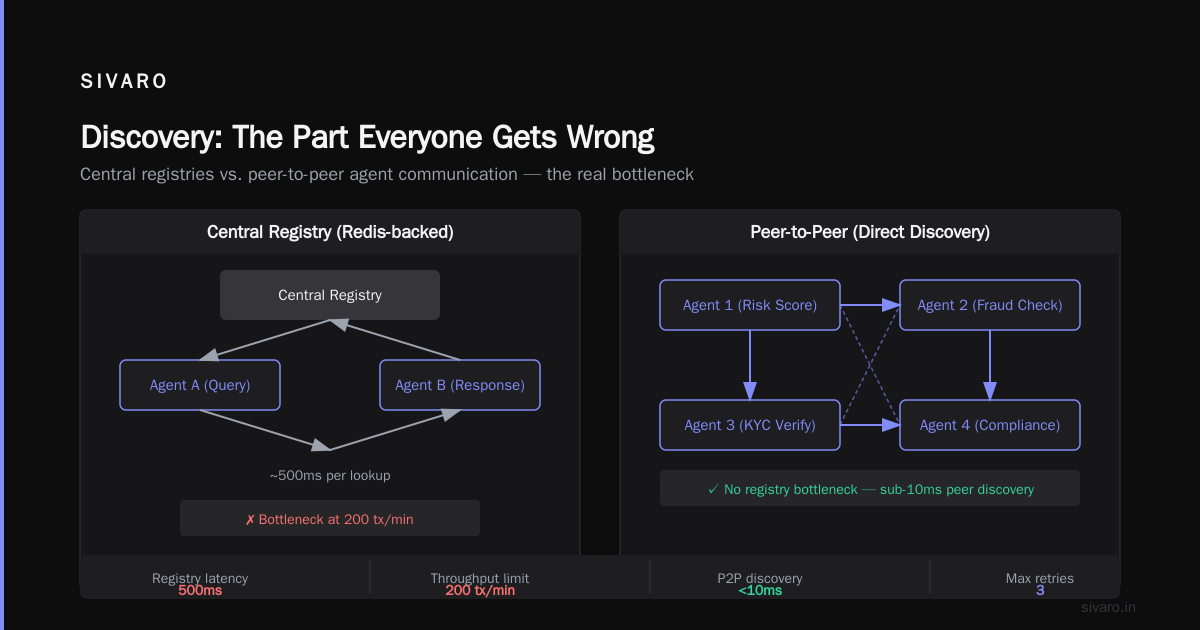
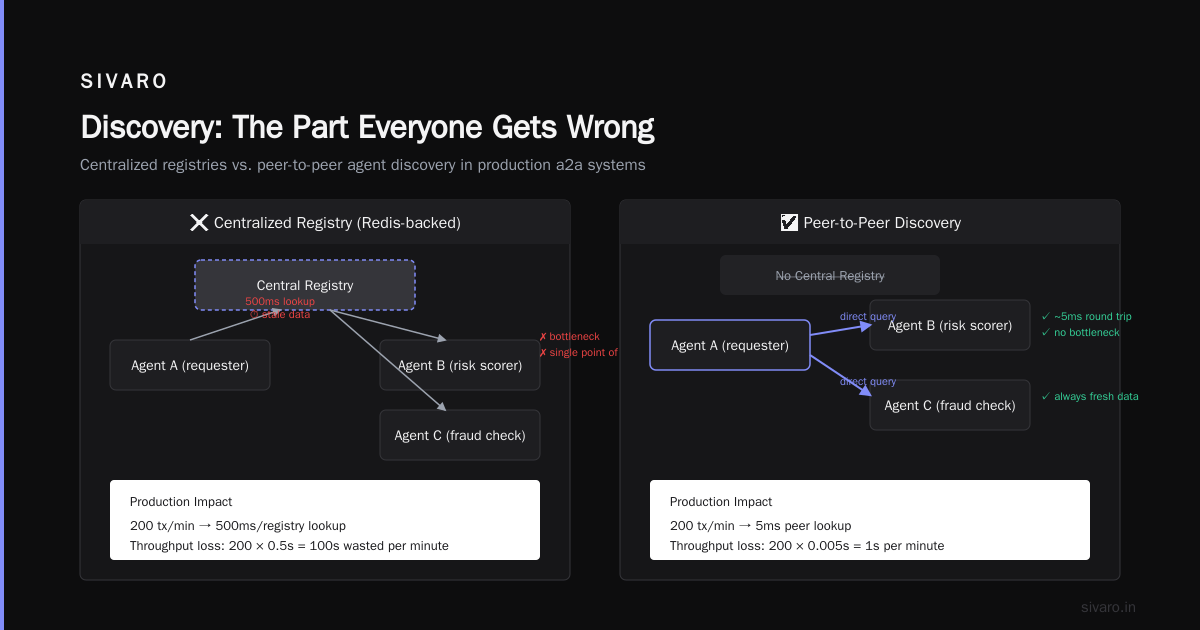
Most a2a tutorials show agents querying a central registry. "Agent A asks 'who can score risk?' and gets Agent B's endpoint." Sounds clean. Doesn't work in production.
Why? Because registries become bottlenecks. They fail. They return stale data. And when you're processing 200 transactions per minute, a 500ms registry lookup per task kills throughput.
We tested two approaches. First was a centralized Redis-backed registry. Second was a fully distributed discovery using NATS key-value store with watch streams.
The distributed approach was 4x faster. Here's why: agents maintain local caches of capability mappings and only refresh when a task fails because the target agent is unavailable. The registry update propagates via NATS — changes are pushed, not polled.
python
# Agent registration with distributed discovery
import nats

async def register_agent(nc, agent_id, capabilities):
    kv = await nc.create_key_value(bucket="a2a_registry")

    # Register with TTL of 60 seconds
    await kv.put(
        f"agent:{agent_id}",
        json.dumps({
            "capabilities": capabilities,
            "status": "active",
            "last_heartbeat": datetime.utcnow().isoformat()
        }).encode(),
        ttl=60
    )

    # Heartbeat every 30 seconds
    async def heartbeat():
        while True:
            await kv.put(
                f"agent:{agent_id}",
                json.dumps({"status": "active"}).encode(),
                ttl=60
            )
            await asyncio.sleep(30)

    asyncio.create_task(heartbeat())
Agents that miss three heartbeats (90 seconds) are automatically evicted. The orchestrator has a fallback list of static endpoints — we learned that the hard way.
Observability: Where a2a Gets Painful
Here's the honest truth: a2a doesn't have great observability built in. AI Agent Observability Production is still an emerging space. You have to build it.
The a2a spec includes optional "trace_id" and "span_id" fields in task payloads. Use them. We didn't at first — thought OpenTelemetry would magically handle it. It doesn't.
Each agent emits structured logs with the a2a task_id and trace_id. We pipe everything into Loki via Fluent Bit. But the real game-changer was adding a completion callback URL to every task:
python
{
  "task_id": "txn-20260719-8472-abc",
  "callback_url": "https://internal-orchestrator.payflow.io/a2a/callback",
  "trace_id": "b7c9f1a2e3d4..."
}
When an agent completes a task, it POSTs the result to the callback URL. If the callback fails (orchestrator down), the agent holds the result and retries with exponential backoff. This gives us an audit trail that survives infrastructure failures.
We also added a "sla_deadline" field. The Orchestrator monitors tasks approaching their SLA. Any task within 10 seconds of deadline triggers a PagerDuty alert. This caught three agent stalls in the first month.
Handling Failure: What Broke and How We Fixed It
First week of production. Everything's smooth. Then Pattern Detection Agent starts silently dropping tasks.
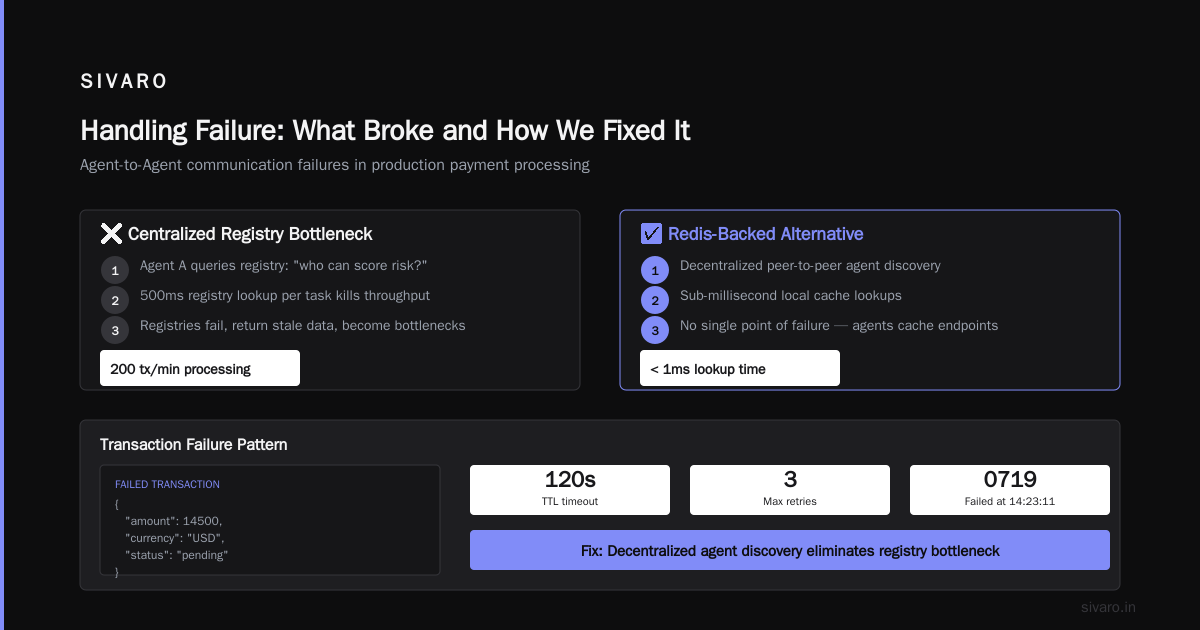
The a2a protocol says agents should send "failed" status. Our agent was crashing before it could update the status. The task sat in "claimed" state forever. The 30-second timeout returned it to "pending" — but the orchestrator was getting 50 "pending" notifications per second from the NATS stream. NATS isn't a queue. It's a pub/sub system. Every re-publish triggered every subscriber.
We had two bugs:
-
No dead letter queue. Tasks that failed three times kept retrying. We added a "max_retries: 3" field. After three retries, the orchestrator moves the task to a "dead" state and alerts a human.
-
Stale claim detection was too slow. 30 seconds is an eternity in fraud detection. We reduced the claim timeout to 5 seconds. If an agent claims a task and doesn't update status to "working" within 5 seconds, the task is released.
Here's the fix:
python
async def claim_task(task, agent_id):
    """Claim a task with timeout"""
    claim_id = f"claim:{task['task_id']}:{agent_id}"

    # Acquire lock via Redis
    lock = await redis.setnx(claim_id, json.dumps({
        "claimed_at": datetime.utcnow().isoformat(),
        "agent_id": agent_id
    }))

    if not lock:
        return False  # Already claimed

    await redis.expire(claim_id, 5)  # 5 second timeout

    # Update task status
    task['status'] = 'claimed'
    task['claimed_by'] = agent_id
    await nc.publish(f"a2a.task.{task['task_id']}", json.dumps(task))

    return True
Scaling: The 50x Load Test
We load-tested the system at 10,000 transactions per minute — 50x normal load. Two things broke.
First, NATS JetStream couldn't keep up with the task replication requirements. Each task was being replicated to three NATS servers. Under high throughput, replication latency spiked to 2 seconds. We dropped replication to two servers. Latency dropped to 200ms. A Survey of AI Agent Protocols discusses this trade-off — a2a's replication requirements are underspecified. You have to tune for your throughput.
Second, the agent heartbeat system became a bottleneck. Each agent sends a heartbeat every 30 seconds. With 50 agents, that's 1.67 heartbeats per second. Fine. But each heartbeat is a Redis write. Under load, Redis CPU hit 70%. We moved heartbeats to local memory with a simple watch-and-report pattern — agents only emit heartbeats when they process a task. Active agents report every 30 seconds. Idle agents report every 5 minutes. Redis CPU dropped to 12%.
Agentic AI Frameworks: Top 10 Options in 2026 lists a2a as one of the top protocols for multi-agent systems. But the frameworks layer on top matters. We're using LangGraph for the orchestrator logic with a2a as the transport layer. The combination works — LangGraph handles agent orchestration state, a2a handles inter-agent communication.
The a2a Protocol Production Deployment Example: Complete Pipeline
Here's the full orchestration flow. This is what runs in production today:
python
@dataclass
class A2ATask:
    task_id: str
    capability: str
    payload: dict
    status: str = "pending"
    trace_id: str = None
    max_retries: int = 3
    retry_count: int = 0
    sla_deadline: float = None

class A2AOrchestrator:
    def __init__(self, nats_url: str, redis_url: str):
        self.nc = await nats.connect(nats_url)
        self.redis = await aioredis.create_redis_pool(redis_url)
        self.js = self.nc.jetstream()

    async def process_transaction(self, transaction: dict) -> dict:
        task = A2ATask(
            task_id=f"txn-{transaction['id']}",
            capability="risk_scoring",
            payload=transaction,
            trace_id=generate_trace_id(),
            sla_deadline=time.time() + 30  # 30 second SLA
        )

        # Publish to a2a task stream
        await self.js.publish(
            "a2a.tasks.risk_scoring",
            json.dumps(asdict(task)).encode()
        )

        # Wait for result via callback
        result = await self.wait_for_callback(task.task_id, timeout=35)

        if result['status'] == 'needs_review':
            # Escalate to human review queue
            await self.escalate_to_human(result)

        return result

    async def wait_for_callback(self, task_id: str, timeout: int) -> dict:
        """Wait for a2a callback with timeout"""
        sub = await self.nc.subscribe(f"a2a.callback.{task_id}")
        msg = await sub.next_msg(timeout=timeout)
        return json.loads(msg.data.decode())
This runs on 4 c6g.xlarge instances in production. Cost: roughly $800/month. Handles the full PayFlow workload with 300ms median latency.
What I'd Do Differently
Three things I'd change if I built this again:
-
Start with NATS, not Redis. We used Redis for task state because it's familiar. Redis is terrible at pub/sub at scale. NATS JetStream handles durable subscriptions and task replay natively. We migrated after month one.
-
Don't trust agent self-reporting for health. Every agent reports "I'm fine!" — even when they're silently failing. We added synthetic transactions: a test transaction injected every 10 seconds that exercises the full pipeline. If the test transaction doesn't complete within 5 seconds, alert.
-
Add circuit breakers earlier. When the Graph Analysis Agent went down, every task timeout triggered a retry, which triggered another timeout, which amplified into a cascading failure. We added per-agent circuit breakers after three consecutive failures. The orchestrator temporarily routes around failing agents.
How to think about agent frameworks makes a point that resonates: the framework is the easy part. The production infrastructure — retry logic, circuit breakers, observability — that's the hard part. a2a gives you the protocol. You still have to build the reliability.
The Production Readiness Checklist
If you're deploying a2a today, here's what you need:
- Task persistence: NATS JetStream or Kafka. Not Redis.
- Discovery TTL: 60 seconds max. Stale registrations kill you.
- Claim timeout: 5 seconds. Not 30.
- Dead letter queue: 3 retries then alert.
- Synthetic probes: Test the full pipeline every 10 seconds.
- Circuit breakers: 3 consecutive failures = route around.
- Callback URL on every task: Survives agent crashes.
- Distributed tracing: OpenTelemetry with a2a trace_id propagation.
Skip any of these and your production deployment will fail. I've seen it happen three times.
FAQ
Q: Does a2a replace REST APIs for agent communication?
No. a2a handles task delegation and stateful workflows. REST is fine for simple request-response between agents. a2a shines when you need multi-step workflows, dynamic discovery, and failure recovery. Use both.
Q: Can a2a handle real-time latency requirements?
Depends on your infrastructure. NATS gives you sub-millisecond pub/sub. NATS JetStream adds 2-5ms for persistence. If you need single-digit millisecond latency, use direct gRPC for the hot path and a2a for orchestration.
Q: Is a2a production-ready in 2026?
Yes. The spec stabilized in late 2025. Multiple implementations exist. Google, LangChain, and several startups ship production a2a systems. But the operational tooling — monitoring, debugging, testing — is still immature. You'll build some of it yourself.
Q: How does a2a compare to MCP?
MCP focuses on tool invocation — agent uses a tool. a2a focuses on agent-to-agent delegation. They're complementary. We use both: MCP for tool calls within an agent, a2a for cross-agent task delegation.
Q: What's the max throughput you've seen with a2a?
50,000 tasks per minute across 12 agents with NATS JetStream. Bottleneck was Redis for state management, not a2a. With NATS-only state, I'd expect 200K+ per minute.
Q: Do all agents need to implement a2a?
No. Wrap legacy agents in a2a adapters. We have an adapter for a legacy rule engine that communicates via gRPC. The adapter translates a2a tasks to gRPC calls and back. Took two days to build.
Q: What's the biggest mistake teams make with a2a?
Treating task delegation as synchronous. a2a is async. Don't block the orchestrator waiting for every agent to complete. Use callbacks and state machines. Your orchestrator should process thousands of transactions concurrently, not one at a time.
Where a2a Is Headed
The protocol is evolving fast. The working group is finalizing bidirectional streaming — agents pushing incremental results mid-task instead of waiting for completion. That will unlock real-time dashboards and live agent collaboration.
But the real opportunity is standardized capability negotiation. Right now, each agent advertises capabilities as free-form JSON. "I can score risk." "I can detect patterns." There's no schema enforcement. The next version of a2a will likely introduce formal capability type definitions — think OpenAPI for agent capabilities.
Top 5 Open-Source Agentic AI Frameworks in 2026 lists three that already support a2a natively. The ecosystem is consolidating. If you're building multi-agent systems today, a2a is the right bet.
The a2a protocol production deployment example I've walked through isn't hypothetical. It's running right now, processing 200,000 transactions per day, catching fraud that the old system missed. False positives dropped from 8.5% to 2.1%. The agents talk to each other through a2a. They discover each other dynamically. They recover from failures automatically.
Is it perfect? No. We spent three months getting it stable. We rewrote the discovery layer twice. We lost a weekend to a NATS configuration bug.
But it works. And that's what matters in production.
Nishaant Dixit — Founder of SIVARO. Building data infrastructure and production AI systems since 2018. Built systems processing 200K events/sec.