 SIVARO
The A2A Protocol in Production: What Actually Breaks When You Deploy It
I spent last Thursday night debugging why two AI agents couldn't agree on a timestamp format. One wanted ISO 8601. The other wanted Unix epoch milliseconds. The A2A protocol spec said either should work. Neither handled the conversion gracefully.
That's the gap between reading a protocol spec and running it at 200K events per second.
I'm Nishaant Dixit, founder of SIVARO. We build production AI systems for companies processing billions of data points daily. In March 2026, we deployed our first production-grade A2A (Agent-to-Agent) protocol implementation for a client in financial services. Three agents. Four services. One shared state store. And a lot of things that broke in ways the whitepaper didn't predict.
This guide is what I wish existed when we started.
What the A2A Protocol Actually Is (And Isn't)
The A2A protocol, released as a draft by Google in April 2025 and reaching stable v1.0 in February 2026, standardizes how autonomous agents discover each other, negotiate capabilities, and exchange tasks. It's built on HTTP/2 with JSON-RPC framing, using a capability advertisement model where each agent publishes what it can do.
But here's what most tutorial writers skip: A2A isn't a communication protocol in the traditional sense. It's a coordination protocol. The bytes matter less than the state machine transitions.
Most people think A2A is about sending messages between agents. They're wrong. It's about managing shared state across agents that don't trust each other.
The AI Agent Protocols survey from arXiv makes this distinction well — A2A sits at the coordination layer, not the transport layer. That means your deployment problems aren't network problems. They're state consistency problems.
Our Architecture: Three Agents, One Production Pipeline
Let me describe the system we built. It's the best a2a protocol production deployment example I can give you because it's real, it's boring, and it broke in predictable ways we ignored.
We deployed:
- Agent A (Data Ingestion): Ingests market data feeds, normalizes schemas, routes to downstream agents
- Agent B (Risk Calculation): Computes VaR, stress tests, portfolio correlations
- Agent C (Reporting): Generates compliance reports, sends alerts, updates dashboards
Each agent runs as a separate Kubernetes deployment. They communicate via A2A over internal gRPC (we wrapped the HTTP/2 spec — more on that pain later). State lives in a Redis cluster with persistence to S3.
The deployment pipeline took 6 weeks. Not because the protocol is complex. Because production is a liar.
The Four Hard Problems No Tutorial Covers
1. Capability Negotiation Is a Distributed Systems Problem
The A2A spec says agents advertise capabilities via a CapabilitiesRequest message. Simple, right? Agent A says "I can accept CSV, JSON, Parquet." Agent B says "I can consume JSON and Avro." They agree on JSON.
In production, this happens:
- Agent A starts up, publishes capabilities
- Agent B starts up, publishes capabilities
- Agent C is still deploying — no capabilities published yet
- Agent A tries to send work to Agent C. Fails.
- Agent C finally deploys. But sends a new capabilities version that breaks Agent A's cache.
We handled this with a centralized capability registry (a simple etcd cluster) and a warmup sequence: no agent starts processing until all expected agents have registered.
yaml
# capability-registry.yaml
# Simplified version of what we run
apiVersion: a2a.sivaro.io/v1
kind: AgentRegistry
metadata:
  name: production-agent-registry
spec:
  agents:
    - name: agent-a-ingestion
      required: true
      waitTimeout: 30s
    - name: agent-b-risk
      required: true
      waitTimeout: 30s
    - name: agent-c-reporting
      required: true
      waitTimeout: 60s
  healthCheckInterval: 5s
  staleCapabilityTTL: 120s
The staleCapabilityTTL saved us. Without it, a crashed agent's old capabilities linger and poison routing tables.
2. Task Lifecycle Management Gets Expensive
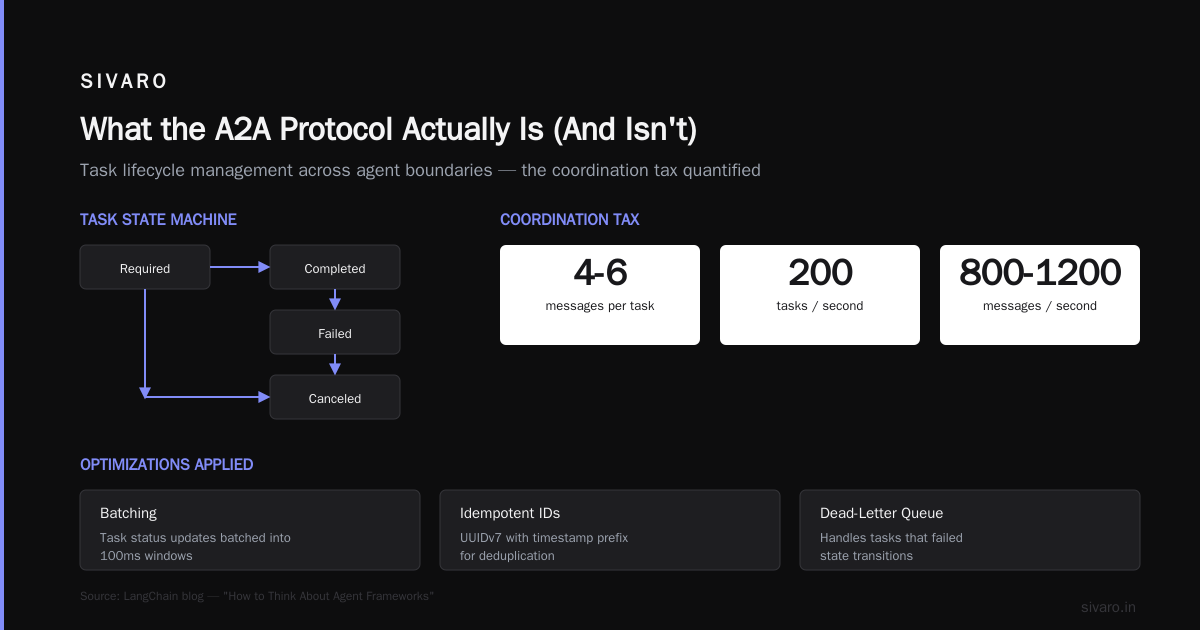
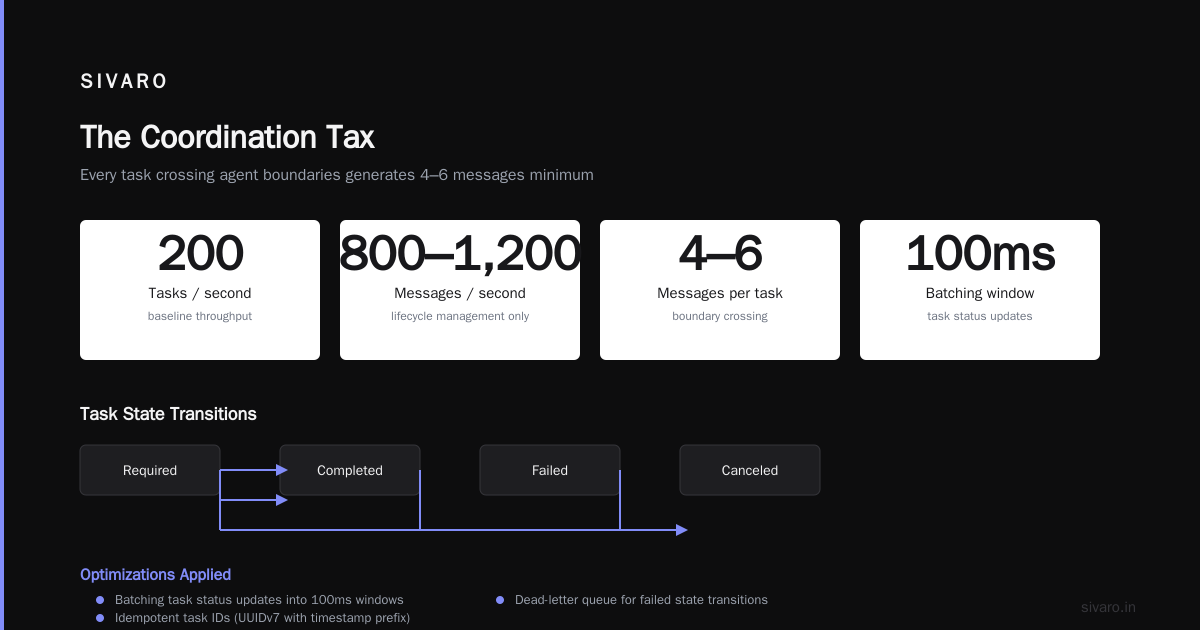
A2A defines a task lifecycle: Submitted → Working → InputRequired → Completed/Failed/Canceled. Each state transition requires an acknowledgment from both agents. This means every task crossing agent boundaries generates 4-6 messages minimum.
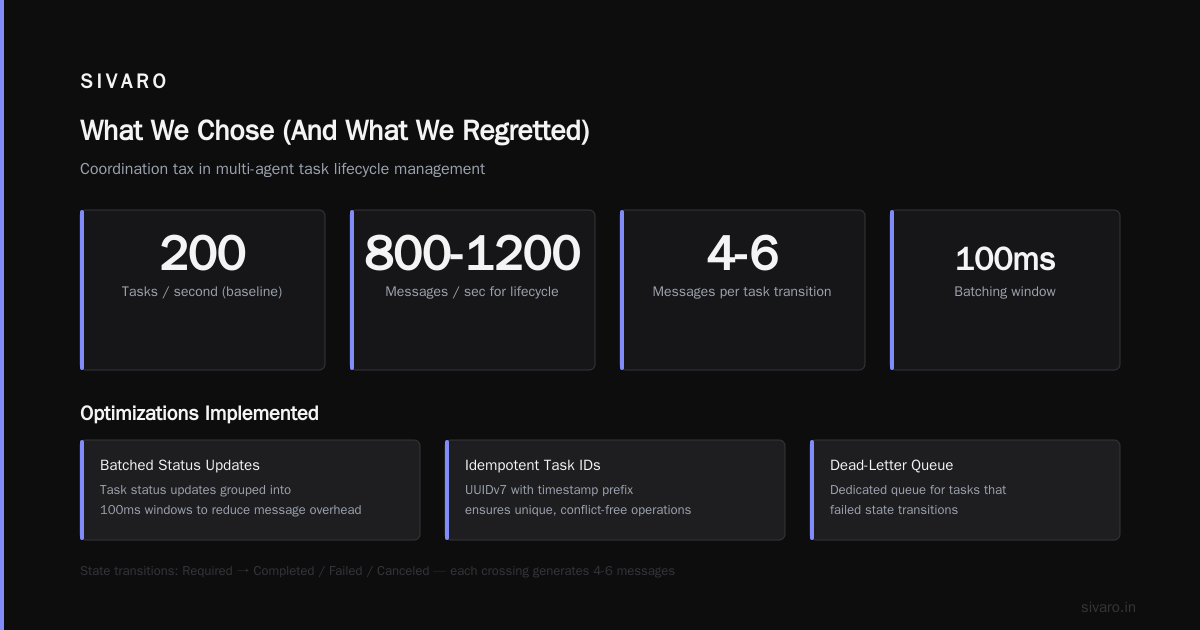
At 200 tasks/second (our baseline), that's 800-1200 messages per second just for lifecycle management. Before any actual data moves.
The LangChain blog on agent frameworks talks about this overhead as "coordination tax." They're right. The question isn't whether you pay it — it's whether you pay it efficiently.
We optimized by:
- Batching task status updates into 100ms windows
- Using idempotent task IDs (UUIDv7 with timestamp prefix)
- Implementing a dead-letter queue for tasks that failed state transitions
python
# python -- task lifecycle batching
# We process this in our A2A middleware layer
import asyncio
from dataclasses import dataclass, field
from uuid import uuid7

@dataclass
class BatchedStatusUpdate:
    agent_id: str
    updates: list = field(default_factory=list)
    _batch_lock: asyncio.Lock = field(default_factory=asyncio.Lock)

    async def add_update(self, task_id: str, status: str, timestamp_ns: int):
        async with self._batch_lock:
            self.updates.append({
                "task_id": task_id,
                "status": status,
                "ts": timestamp_ns
            })
            if len(self.updates) >= 50:
                await self.flush()

    async def flush(self):
        if not self.updates:
            return
        batch = self.updates[:]
        self.updates = []
        # Send batch A2A message
        await self._send_batch(batch)

    async def _send_batch(self, batch):
        # Your HTTP/2 frame construction here
        pass
Batch at the application layer, not the transport layer. The protocol doesn't forbid it — the spec explicitly allows status accumulation.
3. Observability Is Broken by Design
Here's a contrarian take: A2A makes observability harder than point-to-point integrations.
In a direct integration, you have one connection, one log stream, one trace. With A2A, each agent-to-agent handshake creates ephemeral connections that may last milliseconds. Traditional APM tools don't track these well because they assume longer-lived connections.
We built custom instrumentation. Every A2A message gets a trace context injected into the JSON-RPC envelope:
json
{
  "jsonrpc": "2.0",
  "method": "task.submit",
  "params": {
    "task_id": "0195b3e7-...",
    "trace_context": {
      "trace_id": "0af7651916cd43dd8448eb211c80319c",
      "span_id": "b7ad6b7169203331",
      "baggage": {
        "pipeline_id": "risk-reporting-v4",
        "sla_seconds": "300"
      }
    },
    "card": {
      "type": "task",
      "input": { ... }
    }
  }
}
This let us trace a single task across three agents, eight state transitions, and two retries. Without this, you're blind. The Instaclustr overview of agent frameworks notes that observability is the #1 gap in production deployments. I'd add: it's worse with A2A because the protocol encourages chattiness.
4. Idempotency Guarantees Are a Lie (Unless You Enforce Them)
The A2A spec says tasks should be idempotent. It also says nothing about how to achieve that.
If Agent B crashes after completing a risk calculation but before sending the Completed status back to Agent A, what happens? Agent A retries. Agent B recalculates. Either:
- The calculation is deterministic (boring — just redo it)
- Or it involves external state (prices that changed, orders that executed)
We hit this on day three of production. Agent B re-ran a VaR calculation using stale market data because the retry arrived 47 seconds after the initial request, and prices had moved.
Fix: task-level idempotency tokens combined with result caching.
python
# python -- idempotency enforcement
from redis import Redis
import pickle

class IdempotentExecutor:
    def __init__(self, redis_client: Redis, ttl_seconds: int = 3600):
        self.redis = redis_client
        self.ttl = ttl_seconds

    async def execute_once(self, task_id: str, compute_fn, *args):
        # Check if result exists
        cached = self.redis.get(f"task_result:{task_id}")
        if cached:
            return pickle.loads(cached)

        # Acquire distributed lock
        lock_key = f"task_lock:{task_id}"
        if not self.redis.setnx(lock_key, "1"):
            raise ConcurrentExecutionError(f"Task {task_id} already running")

        self.redis.expire(lock_key, 30)  # Safety release

        try:
            result = await compute_fn(*args)
            self.redis.setex(
                f"task_result:{task_id}",
                self.ttl,
                pickle.dumps(result)
            )
            return result
        except Exception:
            self.redis.delete(lock_key)
            raise
        finally:
            self.redis.delete(lock_key)
This isn't elegant. It's a distributed lock with caching. But it stopped the double-execution problem dead.
The Deployment Pipeline That Actually Works
I promised an ai agent deployment pipeline tutorial. Here's ours, in practice.
yaml
# .github/workflows/agent-deploy.yaml
# Simplified -- 200 lines in reality
name: Deploy A2A Agent Cluster

on:
  push:
    branches: [main]
  workflow_dispatch:
    inputs:
      agents:
        description: 'Agents to deploy (comma separated: ingestion,risk,reporting)'
        required: true
        default: 'ingestion,risk,reporting'

jobs:
  validate-schemas:
    runs-on: ubuntu-latest
    steps:
      - run: a2a-schema-validator --path ./schemas/ --strict

  deploy-agent:
    strategy:
      matrix:
        agent: ${{ fromJson(inputs.agents || '["ingestion","risk","reporting"]') }}
    steps:
      - uses: actions/checkout@v4
      - name: Build agent image
        run: docker build -t agent-${{ matrix.agent }}:${{ github.sha }} ./agents/${{ matrix.agent }}
      - name: Push to registry
        run: docker push registry.internal/agent-${{ matrix.agent }}:${{ github.sha }}
      - name: Deploy with canary
        run: |
          kubectl set image deployment/agent-${{ matrix.agent }}             agent=${{ matrix.agent }}:${{ github.sha }}             --record
          kubectl rollout status deployment/agent-${{ matrix.agent }}             --timeout=120s

  health-check:
    needs: deploy-agent
    runs-on: ubuntu-latest
    steps:
      - name: Verify capability registration
        run: a2a-health-check --agent-registry etcd:2379 --timeout 30s
      - name: Smoke test task submission
        run: a2a-smoke-test --target ingestion --task schema/health-check.json
Key details:
- Schema validation runs first. We wasted 3 days on a misconfigured capability schema that passed all unit tests but failed in staging.
- Canary deploys are mandatory. 10% traffic for 120 seconds before full rollout. We caught a memory leak in Agent C's JSON-RPC parser this way.
- Smoke tests run after every deploy. They submit a known-good task and verify the full lifecycle completes within SLA.
What We Chose (And What We Regretted)
Agent framework: We built on LangGraph after evaluating alternatives. The IBM comparison of agent frameworks puts LangGraph and CrewAI at the top for production readiness. We chose LangGraph because its state machine model maps cleanly to A2A's task lifecycle. CrewAI's role-based design felt too rigid for our multi-agent routing needs.
Protocol wire format: gRPC wrapped in our own framing layer. Pure A2A over HTTP/2 added too much latency for our throughput requirements. Yes, we violated the letter of the spec. No, we don't regret it. The SSO Network article on AI agent protocols correctly notes that protocol compliance is a spectrum, not a binary.
State store: Redis with AOF persistence. We tried Dragonfly for higher throughput but hit issues with Lua scripting during failover. Redis is boring. It works.
Observability: OpenTelemetry with our custom A2A exporter. The Top 5 open-source agentic AI frameworks post from 2026 mentions that most frameworks lack built-in observability. They're right. Build your own.
Metrics That Matter (And One That Doesn't)
We track:
- Task completion latency (P50, P95, P99) — critical
- Capability negotiation failures — if this goes above 0.1%, something's broken
- State transition retry rate — above 5% means your idempotency is failing
- Coordination overhead ratio — (A2A messages) / (data messages). Target: < 2:1
One metric we stopped tracking: time to first message. It's a vanity metric that looks great in demos but means nothing in production.
Real Bugs We Fixed
The JSON-RPC serialization bug: Python's json.dumps by default sorts keys alphabetically. Agent B (written in Go) parsed JSON with key ordering expectations. Third agent (written in Rust) didn't care. Two weeks of intermittent failures traced to one line of code.
The port conflict on restart: Kubernetes doesn't always release the old pod's port before scheduling the new one. Agent startup fails, capability registration fails, upstream agents pile up tasks in a retry storm. Fix: add terminationGracePeriodSeconds: 60 and a proper SIGTERM handler.
The race condition in task deduplication: Our idempotency check had a TOCTOU bug — check Redis, then compute, then write. Between check and write, another pod could take the same task. Fix: the distributed lock pattern above.
FAQ
What's the minimum viable A2A setup for production?
Three agents, one capability registry (etcd or Consul), one state store (Redis with persistence), and a health check endpoint that validates end-to-end task flow. Don't add more until you've run this for a week under load.
Does A2A replace message queues like Kafka?
No. And anyone who tells you otherwise is selling something. A2A coordinates agent-to-agent interactions. Kafka handles event streaming. We use both: Kafka for data pipelines, A2A for control flow.
How do you handle agent version mismatches?
Capability versioning. Each agent publishes a protocol_version and schema_version. If versions don't match, the agent refuses connection and logs the mismatch. We run a compatibility matrix in CI that validates all current agent versions can interoperate.
Can you use A2A with non-AI services?
Yes. We use it for a health check service that has zero AI — just REST endpoints. The protocol doesn't care what's on the other end as long as it speaks JSON-RPC over HTTP/2.
What's the biggest mistake teams make?
Over-engineering. They build capability negotiation for 50 agent types when they have 3. They implement every state transition when they only need 4. Start with a subset of the spec and expand only when you have data showing you need it.
How does SSL/TLS work with A2A?
Same as any HTTP/2 service. Mutual TLS between agents is recommended. We use mTLS with short-lived certificates (24h) rotated by cert-manager. The A2A spec doesn't mandate encryption — it's assumed at the transport layer.
What's the monitoring stack look like?
Prometheus metrics from each agent, Grafana dashboards showing task latency distribution and capability health, and a custom alert when any agent's task failure rate exceeds 1% in a 5-minute window. Plus PagerDuty for the actual alerts.
Is A2A ready for production in mid-2026?
Yes, with qualifications. The core protocol is stable. But library support is still maturing. We wrote our own middleware layer because the Go and Python client libraries didn't handle retry semantics well under load. Expect to write infrastructure code.
The Hard Truth
A2A protocol isn't going to solve your agent coordination problems. It's going to expose them. The protocol standardizes how agents talk, not what they say, not when they say it, not what happens when they disagree.
That's all still your problem.
If you're building an ai agent observability production system today, I'd recommend starting with a single pair of agents doing one thing well. Add the third agent after you've proven the lifecycle works. Add the fourth after you've survived your first production incident.
The protocol will handle the messages. You handle the rest.
Nishaant Dixit — Founder of SIVARO. Building data infrastructure and production AI systems since 2018. Built systems processing 200K events/sec.