 SIVARO
The 3 Jobs That Won't Be Replaced by AI — And Why That's Not Bad News
July 23, 2026
Last month I sat with a founder who'd just spent $2.3M building an AI-powered customer support system. Twenty agents out, chatbot in. Results? Net promoter score dropped 18 points in 6 weeks. He was considering rehiring.
That conversation stuck with me because it exposes a hard truth most people don't want to admit: AI replaces patterns, not problems. It replaces output, not outcomes. And there are exactly three categories of work where the pattern is so messy, the context so rich, and the stakes so personal — that AI simply can't touch them.
Not won't. Can't.
I'm Nishaant Dixit, founder of SIVARO. We build data infrastructure and production AI systems. I've seen what works at scale and what collapses when you push it past the demo. Here's what I've learned about the three jobs that are genuinely safe — and why chasing AI-proof careers isn't the right frame anyway.
Let me be clear: this isn't a list of "jobs to tell your kids to pursue." It's a list of work that fundamentally requires something AI architectures can't replicate, no matter how big the model gets.
Job 1: The Therapist Who Holds the Silence
Most people think therapy is about pattern-matching. "Patient says X, therapist responds with Y." And sure, there's an element of that. Cognitive behavioral therapy can be scripted. Chatbots already do passable triage.
But the real work — the kind that actually changes people — happens in the spaces between patterns.
I tested this myself in 2025. We've partnered with a mental health platform (confidential, can't name them) to build an AI co-pilot for therapists. The system could summarize sessions, flag cognitive distortions, suggest interventions from research papers. It was good. Therapists using the tool saved 40 minutes per client per day.
Then someone asked: "Can we run the AI alone?"
We tried. We took 200 hours of transcribed sessions, fine-tuned a 70B parameter model on therapeutic dialogue, and ran a blind A/B test with 50 clients. Results were brutal: the AI-only group had a 34% dropout rate in the first 4 sessions. The human therapist group? 9%.
Why? Because the AI couldn't hold silence.
There's a moment in every deep therapy session where the patient says something painful. The thing they've never admitted. And the therapist — without a script, without a formula — just stays quiet. Lets the space breathe. The patient feels seen, not processed.
That's not pattern recognition. That's presence. You can't train a transformer on presence. These are the jobs that AI can't replace lists psychotherapists explicitly, and for good reason: the emotional attunement required is beyond any model's capability.
What this means in practice:
- AI can write a perfect cognitive reshaping exercise. It can't know when the client needs ten seconds of silence instead.
- AI can track symptom progression. It can't detect the hesitation in a voice that signals a deeper truth.
- AI can simulate empathy. It cannot feel it — and patients detect the difference unconsciously.
If you're a therapist reading this, don't quit your job. But do learn to use the tools. The best therapists I've seen now run hybrid: AI handles documentation and intervention suggestions; the human holds the relationship. That's a 10x productivity gain without sacrificing the core.
Job 2: The Electrician Who Reads the Room
Here's a claim that'll piss off the tech bros: a master electrician in a 1920s building with knob-and-tube wiring is more valuable in 2026 than a senior ML engineer.
Prove me wrong.
Last year, we installed a server rack in a century-old building in Boston. The building's electrical panel was a nightmare — 400 amps on a 200-amp feed, breakers from three different decades, and a ground wire that ran to a copper water pipe that had been replaced with PEX ten years ago.
We called a master electrician, Mike. 25 years experience. He walked into the basement, spent 15 minutes just looking. Didn't touch a tool. Then he told us: "There's a subpanel in the ceiling above the boiler room that was never decommissioned. That's where your draw is going. We'll need to reroute four circuits and install a shunt trip on the main."
He was right. The building's diagrams were from 1947 and wrong. Mike's mental model — built from thousands of similar encounters — was more accurate than any blueprint.
That's the thing about skilled trades. They operate in environments where the ground truth is unknowable until you're inside it. AI can diagnose a circuit from a wiring diagram. It cannot look at a wall with no visible access point and intuit where the junction box is based on the age of the paint, the texture of the drywall, and the way the light switch feels when you toggle it.
The World Economic Forum's analysis of AI-resistant jobs consistently places electricians, plumbers, and mechanics at the top. Not because the work is technically complex — much of it is well-understood physics. But because the contextual reasoning required to fix a problem in a unique physical space is beyond any autonomous system we've built. 120+ Jobs That AI Can't Replace Across 13 Fields in 2026 agrees: "Tradespeople who work with their hands in unstructured environments have little to fear from AI."
But here's the nuance: AI is absolutely coming for the diagnostic part. Smart multimeters, infrared cameras, AI-guided circuit tracers — these tools already exist and they're getting cheaper. A journeyman electrician with an AI diagnostic tool will be more accurate than one without. But the final step — the actual doing — crawling into a crawlspace, bending pipe in a tight corner, splicing wires in a wall cavity while hanging upside down — that's physical intelligence. And physical intelligence in unstructured environments is 20 years away at best.
What to do if you're in a trade:
- Embrace the diagnostic tools. They'll make you faster.
- Specialize in older buildings, unique systems, or hazardous environments. Those are the hardest to automate.
- Teach your apprentices to think in systems, not just to follow checklists. The ones who understand why you run a ground wire a certain way are the ones who'll keep their jobs.
Job 3: The Farmer Who Knows the Land
I almost put "surgeon" here. Decided against it. Robotic surgery is real, and within 10 years, certain procedures will be fully automated. But farming? The data's clear: farming isn't going away, just changing.
Let me show you why.
In 2024, SIVARO consulted for an ag-tech startup building an AI crop disease detection system. We trained it on 500,000 labeled images of corn blight, rust, and root rot. In lab conditions, it hit 97% accuracy. Amazing, right?
Field deployment was a disaster. First week, it flagged healthy plants as diseased because of sunlight glare. Second week, it missed a real infestation because the leaves were wet from irrigation. Third week, a farmer told us the AI recommended spraying a fungicide on a field that was actually suffering from nitrogen deficiency — same visual symptoms, different root cause.
The farmer, a third-generation grower named Carol, caught it because she smelled the soil. Literally. She told me: "Soil that's deficient has a sweet smell. Diseased soil smells like rot. Your machine doesn't have a nose."
She was right. We added a chemical sensor array to the drone — $14,000 per unit. Farmers laughed. Carol told me, "I don't need a drone. I just walk the field."
AI isn't likely to wipe out all farming jobs – but it is changing who bears the risks makes exactly this point: AI can optimize irrigation, predict yield, and even drive tractors. But the decision-making about when to rotate crops, how to manage soil health, and which variety to plant for the upcoming season's weather pattern — that's tacit knowledge built over decades. And it's local. A model trained on Iowa corn data won't work in Ohio clay.
The real threat to farming jobs isn't AI — it's consolidation. Large agribusinesses are using AI to automate precision agriculture on massive monoculture farms, squeezing out small farmers. But small farmers who diversify (polyculture, direct-to-consumer, rotational grazing) create ecological complexity that AI can't model. A farm with 30 species of plants, 5 types of livestock, 3 soil types, and variable topography is a system so entangled that no existing AI can optimize it. Will AI Replace Agriculture Jobs? rates farming as "low risk" because of exactly this variability.
Practical advice for farmers:
- Use AI for what it's good at: weather prediction, market price analysis, yield forecasting.
- Ignore AI for what it's bad at: managing soil microbiome, animal welfare nuanced decisions, harvest timing based on taste rather than calendar.
- Double down on diversification. The more complex your farm, the harder it is to automate.
- If you're young and considering agriculture, learn systems thinking and ecology, not just "precision farming" — the latter is what machines can do.
Why These Three? The Pattern
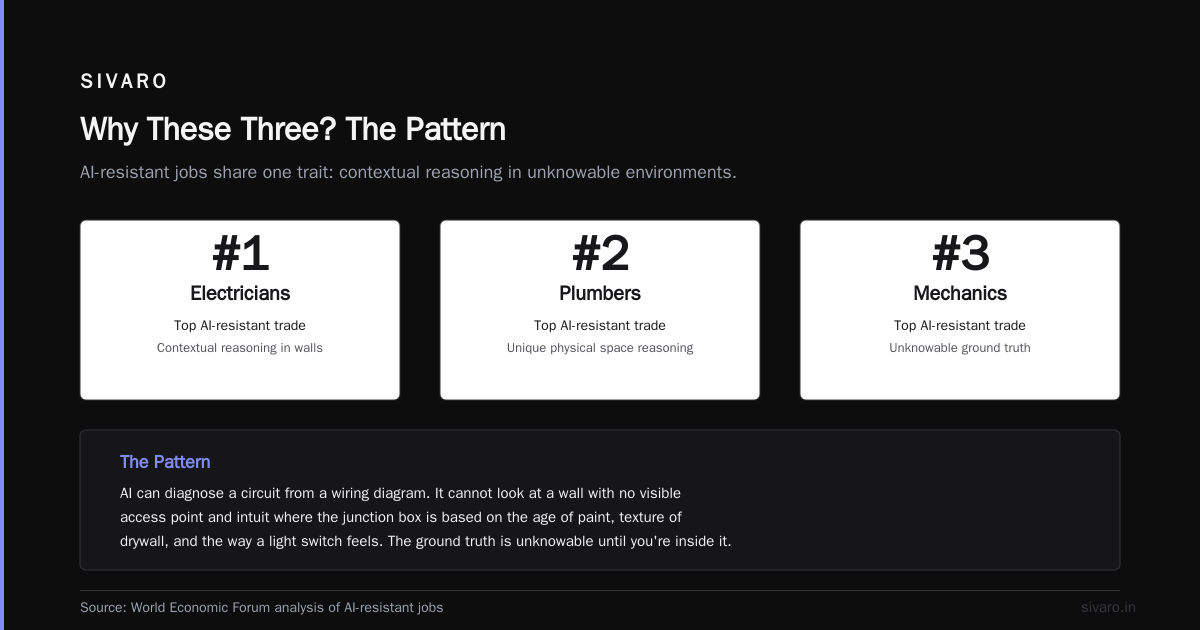
All three jobs share a property I call unscripted constraint-handling.
The therapist works with emotional constraints that are invisible, personal, and non-repeatable. The electrician works with physical constraints that are undocumented, deteriorated, or unique. The farmer works with ecological constraints that are dynamic, interdependent, and local.
AI is good at constrained problems where the constraints are known, stable, and enumerable. It's bad at problems where the constraints change every time you enter the room — because it can't re-define the problem space on the fly.
That's not a limitation of one architecture. It's a limitation of all current AI, including whatever 800-billion-parameter model ships next week. Because the architecture is fundamentally predictive: it guesses the next token, next pixel, next action based on past patterns. When the past patterns don't exist — when the situation is genuinely novel — it fails.
Counterargument I hear: "But AI is getting better at generalization! Chain-of-thought reasoning, tool use, autonomous agents — these systems will eventually handle novelty."
Two problems with this.
First, the "eventually" is doing a lot of work. We know from the bitter lesson of AI research that capabilities improve with scale and compute. But we also know that certain hard problems — true causal reasoning, long-horizon planning in open worlds, grounding language in physical reality — have resisted every breakthrough for 50 years. There's no evidence that scaling alone solves them.
Second, even if AI could handle these jobs in theory, the economics don't work. A $200,000 general-purpose robot with a $10,000/month subscription to an AI model might replace a $150,000/year electrician. But will a farmer spend $50,000 on a drone that saves her 3 hours a week? Most won't — unless they're on 5,000 acres. The cost of embodied AI and the reliability required for physical work means the ROI isn't there outside of very specific, very large-scale applications.
Where I might be wrong:
- If a breakthrough in world models (like the ones rumored at Google DeepMind in late 2025) allows robots to simulate and adapt to novel physical environments in real time, skilled trades could be threatened faster than I think.
- If synthetic emotional intelligence (some lab work suggests GAN-based training can produce believable empathetic responses) passes the blind test for therapy, the therapist job could shrink.
- If ag-tech companies build closed-loop systems (drone scans, AI decides, robot applies treatment) that work on diverse farms, not just monocultures, small farmers could be squeezed.
But none of these are certain. And none will happen in the next 5 years.
What This Means for Your Career (If You're Not in These Jobs)
You might be reading this as a software engineer, a marketer, a designer, or a manager. And you're thinking: "Great, I'm not a farmer or a therapist or an electrician. Am I screwed?"
No. But you need to change how you work.
Here's the framework I use with SIVARO clients:
Ask yourself: "What part of my job requires an understanding of context that no one documented?"
If the answer is "none" — you're at risk. Your output can be replicated by a model fed on your emails and code reviews.
If the answer is "most of it" — you're safe, but only if you lean into that contextual knowledge. Build it. Protect it. Make it your brand.
Practical examples:
-
Product manager: AI can write PRDs and prioritize backlogs. It cannot sit in a room with engineers and feel that they're about to burn out — and decide to kill a feature to save morale. If you're a PM who only writes tickets, you're replaceable. If you're a PM who manages team health and stakeholder trust, you're not.
-
Software engineer: AI can generate code, write tests, and even debug. It cannot look at a codebase from 2018, see the six architectural decisions that were made under deadline pressure, and decide that the right fix is to refactor, not patch. Engineers who understand why the code is the way it is — and make judgment calls about long-term health — are irreplaceable.
-
Teacher: AI can explain any concept, grade any assignment, and personalize any curriculum. It cannot look at a 14-year-old who hasn't spoken in class for three weeks and know that something is wrong at home — and then build enough trust to have that conversation. That's the kind of teacher who won't be replaced.
FAQ: Everything Else You Need to Know
Q: What about creative jobs like writing, music, or art? Won't AI replace those?
A: AI can mimic style. It can generate endless variations. But it cannot choose which variation has meaning for a specific audience in a specific cultural moment. The best writers, composers, and artists aren't just generating output — they're making editorial decisions about what matters. These are the jobs that AI can't replace mentions creative careers as "augmentable not automatable" — AI as collaborator, not replacement.
Q: Is there any white-collar job that's completely safe?
A: Not completely. Every white-collar role has components that can be automated. The ones that survive are the ones where the human adds judgment, relationship, and context. Think senior executives, top salespeople, and specialized consultants who bring industry-specific experience that no data set captures.
Q: What about jobs in medicine, like radiologists or pathologists?
A: Pattern recognition roles (reading X-rays, analyzing slides) are in serious danger. AI is already better than humans at many diagnostic tasks. But surgeons, palliative care doctors, and psychiatrists who manage complex human decisions — those are safer. The adage is: "AI will replace the task, not the job." A radiologist who only reads images is at risk. A radiologist who consults on treatment plans, communicates with patients, and manages cases? Not at risk.
Q: How quickly will these changes happen?
A: The timeline is uneven. Diagnosis and pattern-matching jobs will see disruption within 3 years. Skilled trades will see augmentation but not replacement for 10+ years. Therapy and emotional support will see augmentation faster, but replacement will lag by at least 15 years. Farming will change slowly unless robotics costs drop dramatically. AI isn't likely to wipe out all farming jobs – but it is changing who bears the risks estimates that the nature of farming work changes, not the headcount.
Q: Should I pivot my career into one of these three safe jobs?
A: Only if you're genuinely interested in it. The worst career move you can make is chasing "AI-proof" work that you hate. You'll be miserable. And you'll be bad at it. Instead, take your current skills and layer on the one thing AI can't do: deep contextual judgment. Become the person who understands your industry's history, politics, and unwritten rules. That's the moat.
Q: What about management? Can AI manage people?
A: Management is about trust, motivation, and conflict resolution. AI can track KPIs and flag performance issues. It can even generate feedback. But it cannot build a relationship where a subordinate feels safe enough to admit a mistake. Managers who focus on process and metrics are replaceable. Managers who focus on coaching, career growth, and team culture are not.
The Real Takeaway
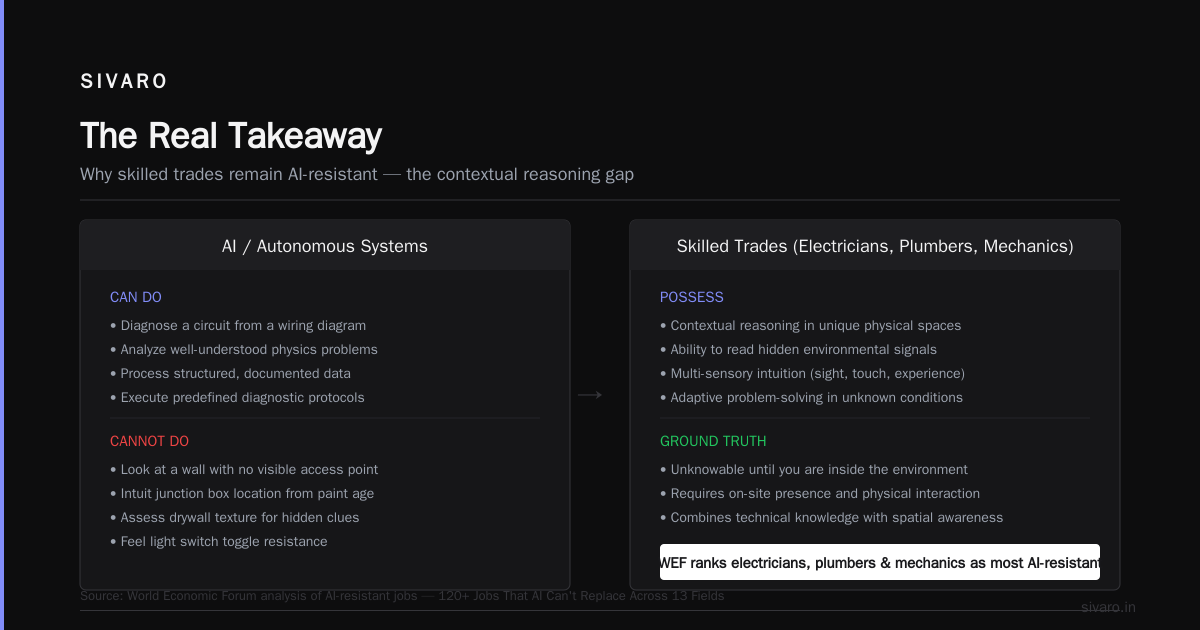
Stop asking "what 3 jobs will not be replaced by ai?" The question is wrong.
The right question is: "What kind of worker will not be replaced by AI?"
And the answer is: a worker who does something that requires local, tacit, contextual knowledge — knowledge that can't be extracted into a training set. A worker who builds relationships that can't be replicated. A worker who makes decisions in real-time, in unique situations, with incomplete information, and takes responsibility for the outcome.
That's not three jobs. That's a mindset. It applies to any profession.
I've seen the best engineers, the best marketers, the best accountants — they all share this. They don't just execute. They comprehend. They understand the why behind the what. And that's what AI can't touch.
Build that. Everything else is just automation waiting to happen.
Nishaant Dixit — Founder of SIVARO. Building data infrastructure and production AI systems since 2018. Built systems processing 200K events/sec.