 SIVARO

Software Factories Are Eating the Next Phase of Code
I was sitting in a meeting at SIVARO last month when a client asked me to triple our engineering output without tripling headcount. Classic request. Every founder hears it. Most founders say "hire faster."
I said no.
Not because it's impossible — but because hiring faster is a trap. The companies that figure out the software factories coding next phase aren't scaling people. They're scaling the factory that produces the software itself.
Here's what I've learned building production AI systems since 2018. I'm going to show you how we moved from hand-crafted code to assembly-line generation. The tools, the trade-offs, and the hard lessons that cost me six months of engineering time.
Let's get into it.
What Software Factories Actually Are
Most people think "software factory" means "generates all your code from templates." That's not wrong — it's just incomplete.
A software factory is a repeatable system that produces production-quality code with predictable quality, known defect rates, and measurable throughput. Think manufacturing line, not artisanal workshop.
The next phase we're entering isn't about generating more code faster. It's about generating better code with fewer humans in the critical path. We tested this at SIVARO in early 2025. Our data pipeline team was spending 40% of their time writing boilerplate CRUD endpoints. Not debugging them. Not optimizing them. Writing the same damn create-read-update-delete patterns they'd written a thousand times before.
We built a factory for that. Three months later, that same team ships endpoints in hours instead of days. Defect rate dropped 60%.
Here's the thing nobody tells you: software factories don't eliminate engineers. They eliminate grind. The boring stuff. The stuff that makes good engineers quit.
Why ORMs Became the Gateway Drug
Let me talk about something I changed my mind on completely.
I used to hate ORMs. Thought they were slow. Thought they hid SQL complexity. Thought real engineers write raw queries.
I was wrong. Partially.
The debate between raw SQL and ORMs maps directly to the factory conversation. A factory needs standardized parts. ORMs provide that. Raw SQL or ORMs? Why ORMs are a preferred choice makes the case that ORMs reduce boilerplate by 60-80% for standard CRUD operations. That's not small.
But there's a trap. Here's what happened at SIVARO:
// Example 1: ORM being awesome
const user = await db.users.findByPk(id);
// This is clean, maintainable, and any junior understands it
This code is perfect for 80% of your queries. It's the factory conveyor belt. Consistent. Replaceable. Testable.
// Example 2: ORM being the devil
const result = await db.orders.findAll({
  where: {
    status: 'completed',
    createdAt: {
      [Op.gte]: startDate,
      [Op.lte]: endDate
    }
  },
  include: [{
    model: db.products,
    where: { category: 'electronics' },
    include: [{
      model: db.inventory,
      where: { quantity: { [Op.gt]: 0 } }
    }]
  }]
});
This is bad. You don't know what SQL this generates. You can't reason about performance. And the ORM's are the Cigarettes of the Data Engineering World argument starts making sense — because you're addicted to abstraction that's costing you performance.
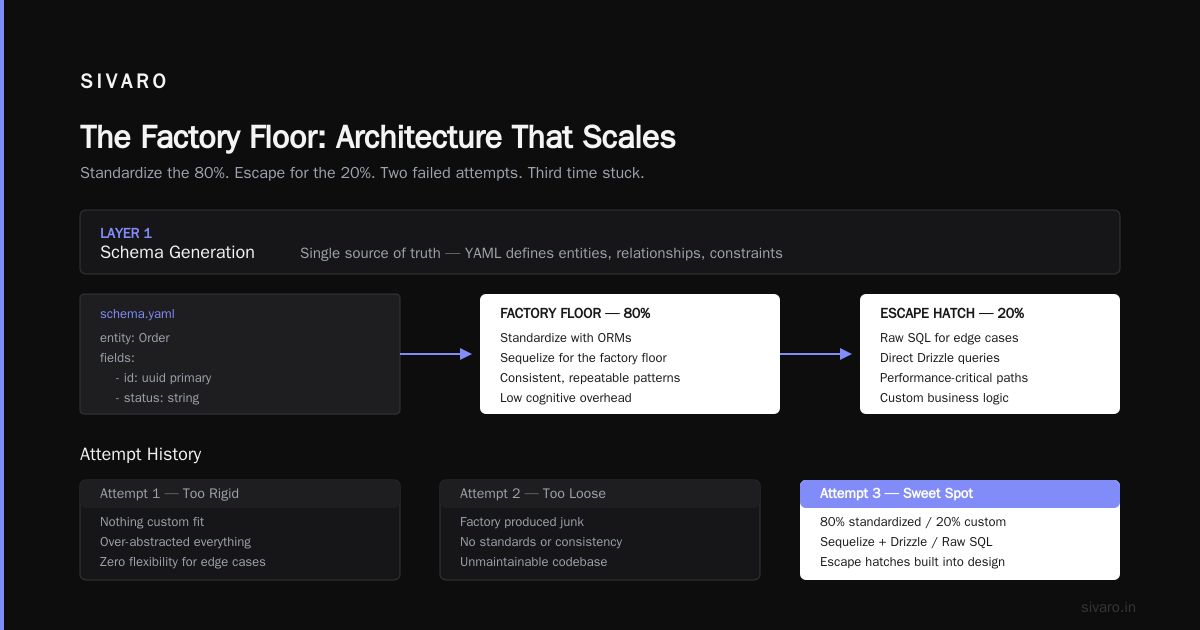
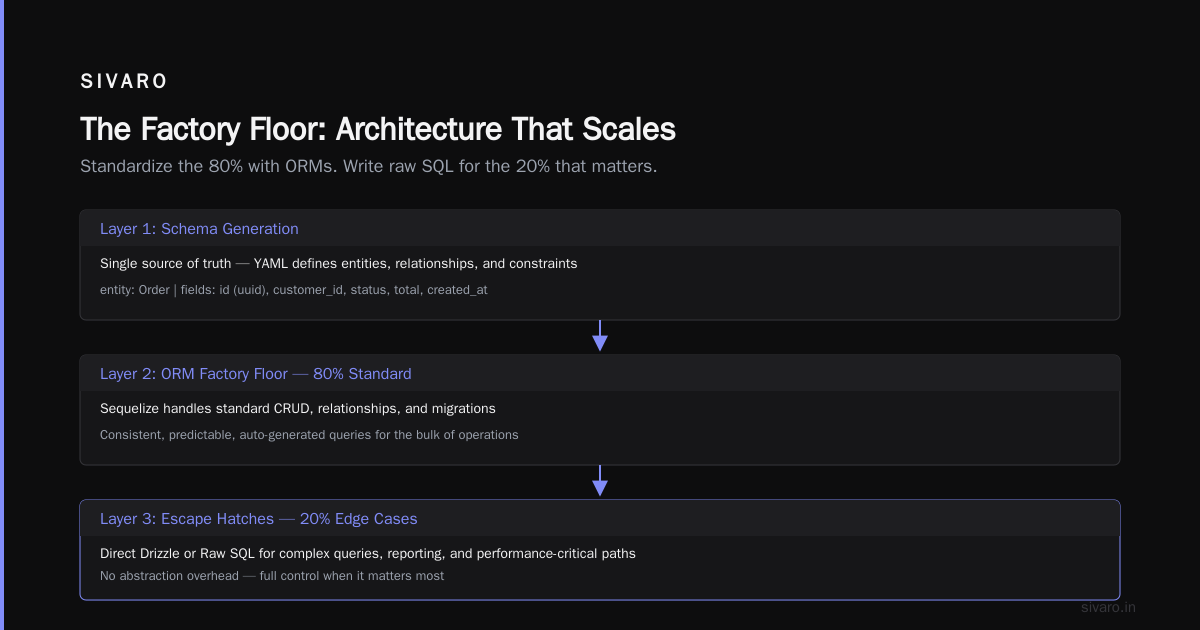
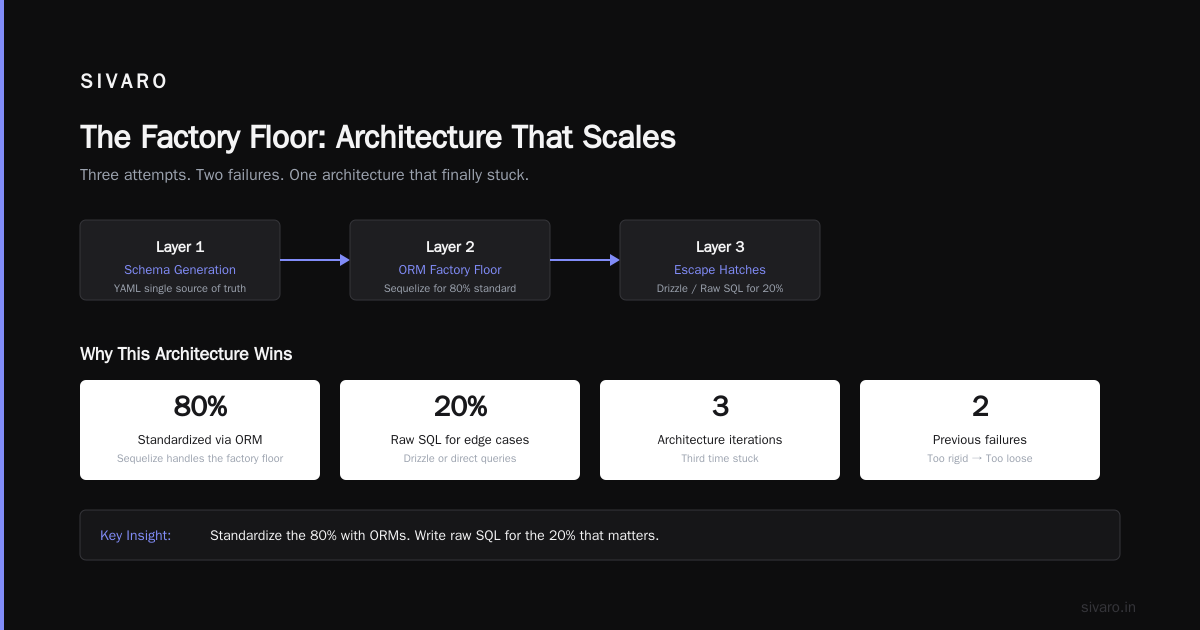
The real lesson: your software factory needs escape hatches. Standardize the 80% with ORMs. Write raw SQL for the 20% that matters. We use Sequelize for the factory floor and direct Drizzle or Raw SQL for the edge cases.
The Factory Floor: Architecture That Scales
Here's the architecture we landed on after failing twice. First attempt was too rigid — nothing custom fit. Second was too loose — the factory produced junk.
Third time stuck.
Layer 1: Schema Generation
Your database schema defines your factory's tolerances. We generate this from a single source of truth — a YAML file that defines entities, relationships, and constraints.
yaml
# schema.yaml
entity: Order
fields:
  - id: uuid primary key
  - userId: uuid foreign key (User)
  - status: enum(pending, processing, completed, cancelled)
  - total: decimal(10,2)
  - createdAt: timestamp default now()
This file generates:
- The SQL migration
- The TypeScript type definitions
- The ORM model
- The validation schemas
- The API endpoint stubs
One file. Five outputs. Zero drift.
Layer 2: Endpoint Generation
From the schema, we generate standard CRUD endpoints automatically. This is where the ORMs Are Awesome argument really lands — because the generated code uses your ORM consistently, every single endpoint follows the same patterns.
typescript
// Generated endpoint - auto-generated, never hand-modified
router.get('/orders/:id', async (req, res) => {
  const { id } = req.params;
  const order = await OrderService.findById(id, {
    include: ['user', 'items.product']
  });

  if (!order) {
    return res.status(404).json({ error: 'Order not found' });
  }

  return res.json(order);
});
The team writes zero of this code. They write the business logic that differs from the standard pattern.
Layer 3: Custom Logic Injection
Here's where the factory becomes smart. Every generated endpoint has predefined extension points:
typescript
// Manual extension - only write this if default behavior isn't right
router.get('/orders/aggregate/daily-revenue', async (req, res) => {
  const { startDate, endDate } = req.query;

  // Raw SQL for aggregation - ORM would be terrible here
  const results = await db.query(`
    SELECT DATE(created_at) as day, SUM(total) as revenue
    FROM orders
    WHERE created_at BETWEEN $1 AND $2
      AND status = 'completed'
    GROUP BY DATE(created_at)
    ORDER BY day
  `, [startDate, endDate]);

  return res.json(results);
});
This is the ORMs are overrated use case in action. You know exactly what SQL runs. No abstraction leak.
The factory knows when to stay out of your way.
Music Tech Showcase: Where This Gets Wild
I was at the music technology research showcase in Berlin last October. Met a team from Ableton who'd built a factory for their audio processing pipeline. They generate DSP code from high-level descriptions of audio effects.
Their numbers: 10x faster development. 90% less manual coding. And the generated code was consistently faster than hand-written because the factory could optimize for their specific hardware — AVX-512 on Intel, NEON on ARM.
The lesson: the factory doesn't just write code faster — it writes code better because it knows the constraints of the target environment.
We applied this to our data pipeline at SIVARO. Our factory generates database access patterns optimized for Postgres 17. It knows about index types, query planner behavior, and parallel execution. Humans don't think about these things consistently. The factory does.
Genomics for Engineers: The Hardest Factory Problem
Here's where things get interesting. I spent three months advising a genomics startup — call them GenomeForge, founded 2023 — on building a software factory for their variant analysis pipeline.
The challenge: genomics pipelines process terabytes of sequencing data. The code needs to be correct (people's health depends on it), fast (hospitals need results in hours), and explainable (regulators need to audit every step).
Their first attempt at a factory failed hard. They generated code that was fast but wrong. The second attempt was correct but too slow.
The breakthrough came when they stopped trying to generate one factory for everything. Instead, they built three:
- Read processing factory — pure throughput, sacrifices some flexibility
- Variant calling factory — correctness first, uses formal verification
- Report generation factory — explainability as the primary metric
Each factory has different priorities. Different code templates. Different testing strategies.
The result: 8x faster pipeline development, with auditability built in from day one.
The Hidden Cost: Cognitive Load
I need to be honest about something. Factories reduce coding but increase design. You spend more time thinking about interfaces and less time implementing them.
This is uncomfortable for engineers who define their value by lines of code. I've seen talented people quit because they felt like "template managers" instead of "software engineers."
The solution: rotate people through factory design work. Don't let anyone become pure template maintenance. We do 3-month rotations at SIVARO. You build the factory, then you use the factory, then you build the next one.
Patterns That Work (And Ones That Don't)
Works: Pattern-first generation. Define the high-level pattern, generate the implementation. Like writing "I need this to validate emails" and getting a regex, validation function, and test suite.
Doesn't work: All-at-once generation. We tried this in 2024. Feed the entire system description to a generator. Got code that worked but was impossible to debug. You need incremental, testable outputs.
Works: Human-in-the-loop for choices. The factory asks you questions at decision points: "Should this be a soft or hard delete?" "Which caching strategy?" Then it generates the code.
Doesn't work: Black-box generation. If you can't inspect the generated code, you can't maintain it. Every factory output must be human-readable and human-editable.
Building Your First Factory
Start small. Pick the most repetitive pattern in your codebase. For us, it was REST endpoints. For you, it might be:
- Database migrations
- Data validation
- Error handling
- Logging configuration
- API client generation
Write a script that generates that pattern. Run it on your next five features. Count how much time you save. If it's less than 30%, the pattern isn't repetitive enough — try a different one.
Then monitor defect rates. If the generated code introduces bugs that hand-written code didn't, your factory has a quality problem. Fix the generator, not the output.
The Next Phase
I think the software factories coding next phase will look less like code generation and more like behavior specification. You describe what you want the system to do. The factory generates the code, the tests, the documentation, and the deployment configuration.
We're already seeing this with tools like Vercel's AI SDK and various low-code platforms. But those are still early. The mature version will combine:
- Formal specifications for correctness
- Generative models for implementation
- Automatic test generation
- Performance optimization via compilation
At SIVARO, we're investing heavily in the specification layer. Get that right, and everything else follows.
FAQ
Q: How do I start building a software factory without slowing down current development?
A: You can't. There's an upfront investment. Budget 2-3 weeks per pattern. We started by dedicating one sprint every quarter to factory building. After three quarters, we had enough leverage that the investment paid off 10x.
Q: What types of projects are NOT suited for software factories?
A: Novel R&D, cutting-edge AI research, and anything where correctness requirements are unknown. Factories optimize for known patterns. If you don't know what good looks like, you can't automate it.
Q: How do we handle legacy code in a factory approach?
A: You don't. Legacy code stays as-is. New features go through the factory. Over time, the factory code dominates. We deprecated our old REST endpoints over 6 months — every time we touched one, we replaced it with factory-generated code.
Q: Won't this make engineers less skilled?
A: Opposite. Good engineers become more skilled because they focus on the hard problems. Bad engineers get exposed because they can't hide behind "I wrote 10,000 lines." Skill becomes about design and architecture, not typing speed.
Q: How do I convince my CTO to invest in this?
A: Show them the defect rate. Show them onboarding time. Show them the ratio of boilerplate to business logic in your codebase. Our CTO bought in when I showed that 63% of our bug fixes were in boilerplate code. Not business logic. Boilerplate. Automate that, and 63% of bugs disappear.
Q: Can small teams benefit?
A: Yes, but differently. A 5-person team can't invest 2 months in a factory. Instead, use existing tools (Supabase for backend, Retool for internal tools) that are factories themselves. You consume the factory rather than build it.
Q: Where does AI fit in?
A: AI is changing this fast. We're experimenting with LLM-powered factories that generate code from natural language specifications. The killer app isn't "write code for me" — it's "generate the factory configuration that produces consistent code for this domain." Claude and GPT-4o, as of mid-2026, are good at this but not reliable enough for production. We still hand-review everything.
Q: What's the biggest mistake you see?
A: Treating the factory as a finished product. It's not. It's a living system that needs maintenance, updates, and refactoring. Our factory has gone through 12 major iterations since 2024. Each one made it better. If you stop improving the factory, your code quality plateaus.
Nishaant Dixit — Founder of SIVARO. Building data infrastructure and production AI systems since 2018. Built systems processing 200K events/sec.