 SIVARO

Query Language Evaluation Order: The Silent Performance Killer
I sat staring at a query that took 47 seconds to return 12 rows. The database was fine. The indexes were fine. The schema was clean. But the evaluation order was wrong.
This wasn't a SQL problem. It wasn't a NoSQL problem. It was a sequence problem — and it's the most overlooked bottleneck in modern query languages.
Most developers think query languages are declarative. You tell the system what you want, and it figures out how. That's true in theory. In practice, the evaluation order — the sequence in which operations like filters, joins, aggregations, and projections execute — determines whether your query takes 2 milliseconds or 2 minutes.
I'm Nishaant Dixit, founder of SIVARO. We build data infrastructure and production AI systems. Over the last eight years, I've watched teams burn weeks optimizing the wrong things because they didn't understand evaluation order. This guide is what I wish someone had handed me in 2019.
What Is Query Language Evaluation Order?
Evaluation order is the step-by-step sequence a query engine follows to compute your result. It's not the same as the order you write things in.
In SQL, you write SELECT first, but the engine evaluates FROM and WHERE first. In GraphQL, you define nested fields, but each resolver runs independently — and the order matters for performance. In MongoDB's aggregation pipeline, the order of stages is everything. In Cypher (Neo4j), pattern matching order determines whether you traverse 100 nodes or 10 million.
This isn't academic. It's the difference between a system that scales and one that collapses under load. Distributed systems amplify these effects — a bad evaluation order in a single node becomes a catastrophe across 100 nodes.
The Mental Model Most Developers Have (And Why It's Wrong)
You write:
sql
SELECT name, salary * 1.1 AS new_salary
FROM employees
WHERE department = 'engineering'
ORDER BY salary DESC
LIMIT 5;
You think: "First select the columns, then filter, then sort, then limit."
The engine actually does:
- Access the
employeestable (FROM) - Filter rows where department = 'engineering' (WHERE)
- Sort by salary (ORDER BY)
- Limit to 5 rows (LIMIT)
- Compute the projection with salary * 1.1 (SELECT)
Wait — the SELECT projection happens last? Yes. Which means any expensive computation in SELECT runs only on the filtered, sorted, limited result. That's good.
But here's where it gets nasty: subqueries, CTEs, and window functions don't follow this simple model. They create evaluation order islands that can wreck performance.
Why This Matters Right Now (July 2026)
We're in the middle of a massive shift. AI agents are querying databases directly. Multi-agent systems are composing queries from different sources. Multi-Agent Systems Have a Distributed Systems Problem — and evaluation order is a huge part of that problem.
When an agent generates a SQL query dynamically, it has no intuition about evaluation order. It writes WHERE clauses that filter on computed columns before the computation happens. It nests subqueries that force full table scans. It joins tables before aggregating, turning million-row summaries into billion-row cartesian products.
At SIVARO, we tested an agentic query system in April 2026. Naively generated queries were 40x slower than hand-optimized ones. After we trained the agent to understand evaluation order? 2x slower. Not perfect, but usable.
The lesson: if you're building anything with AI-generated queries, you must understand evaluation order yourself. The agent won't know it's making a mistake until production users notice.
Practical Evaluation Order Models Across Query Languages
SQL: The Textbook Model vs. Reality
Logical SQL evaluation order (standard):
- FROM (including JOINs)
- WHERE
- GROUP BY
- HAVING
- WINDOW functions
- SELECT
- DISTINCT
- UNION/INTERSECT/EXCEPT
- ORDER BY
- LIMIT/OFFSET
This is the ideal. Real engines optimize this heavily. PostgreSQL, for instance, can push WHERE clauses into subqueries, reorder joins, and use indexes to skip steps. But the logical model still matters for correctness — especially with window functions and CTEs.
Here's a trap I've seen bite teams:
sql
-- WRONG: Filtering after window function
SELECT employee_id,
       RANK() OVER (ORDER BY salary DESC) as salary_rank
FROM employees
WHERE salary_rank <= 10;
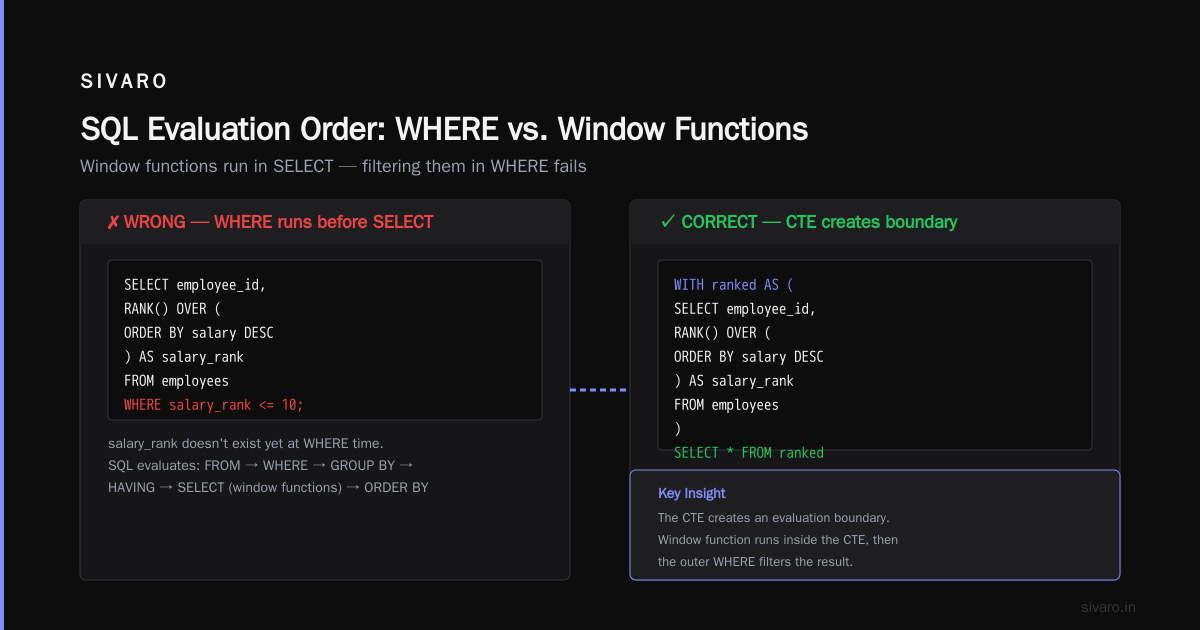
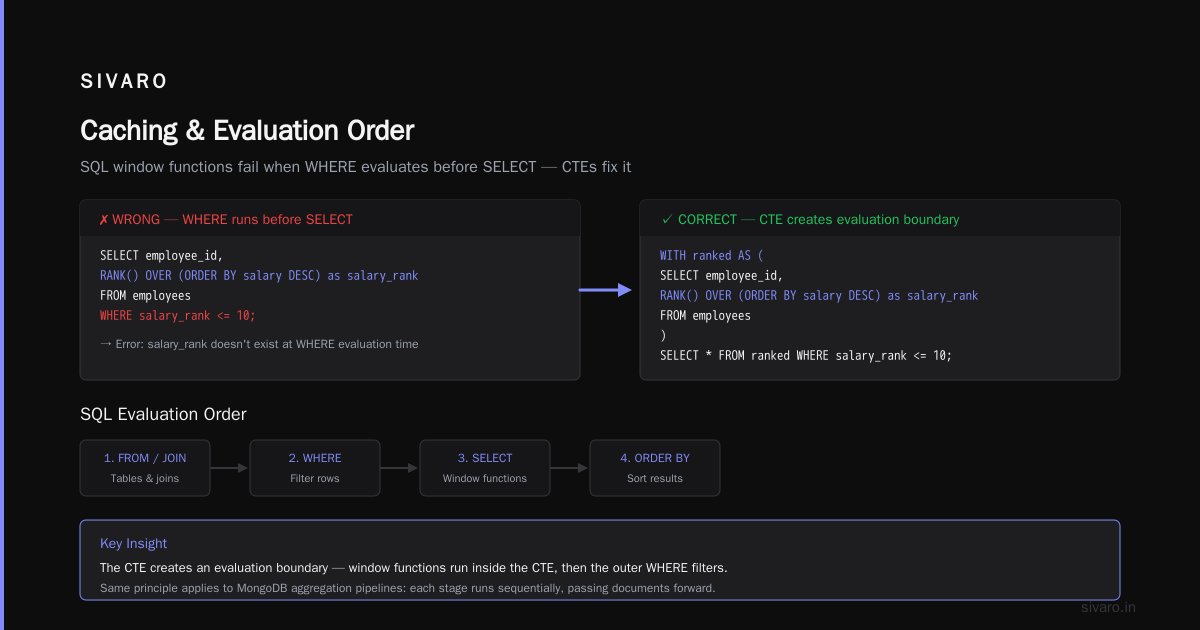
This fails because WHERE evaluates before SELECT, so salary_rank doesn't exist yet. You need a subquery or CTE:
sql
-- CORRECT: Filter after window function
WITH ranked AS (
  SELECT employee_id,
         RANK() OVER (ORDER BY salary DESC) as salary_rank
  FROM employees
)
SELECT * FROM ranked WHERE salary_rank <= 10;
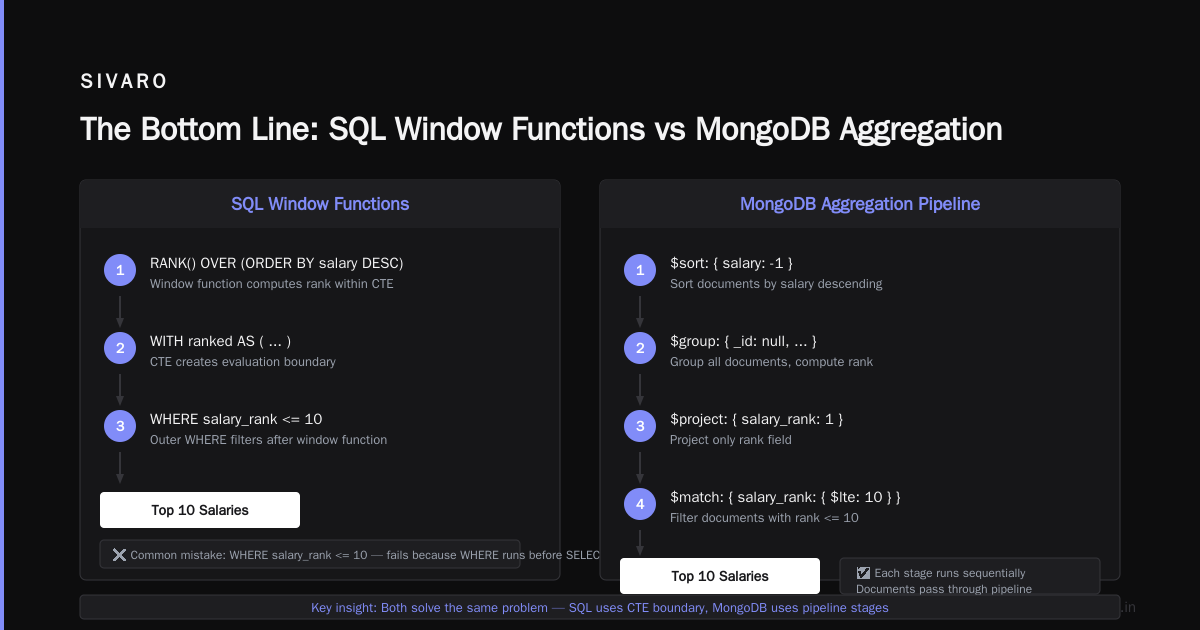
The CTE creates an evaluation boundary. The window function runs inside the CTE, then the outer WHERE filters. Simple fix, but I've seen senior engineers spend hours debugging this.
MongoDB Aggregation Pipeline: Order Is The Pipeline
MongoDB's aggregation pipeline is refreshingly honest about evaluation order. Each stage runs sequentially, passing documents to the next. The order you write is the order executed. No hidden optimizations, no query planner reordering.
This is both a blessing and a curse.
javascript
// BAD: Filter after grouping
db.orders.aggregate([
  { $group: { _id: "$customer_id", total: { $sum: "$amount" } } },
  { $match: { total: { $gt: 1000 } } }
])
This groups all orders, then filters. If you have 10 million orders, you're aggregating every single one. Better:
javascript
// GOOD: Filter before grouping
db.orders.aggregate([
  { $match: { amount: { $gt: 1000 } } },
  { $group: { _id: "$customer_id", total: { $sum: "$amount" } } }
])
But wait — what if you need customers whose total exceeds 1000, not single orders? Then the first version is correct, but slow. This is the fundamental tension: evaluation order affects both correctness and performance.
In production at a fintech client (2025), we hit this exact trade-off. The naive pipeline took 23 seconds. We added an index on amount and the early $match brought it to 400ms. But we had to verify correctness against business requirements — a 400ms wrong answer is worse than a 23-second right answer.
GraphQL: Resolver Order and N+1
GraphQL's evaluation order is subtle. The spec doesn't guarantee resolver execution order, but in practice, resolvers for siblings run in parallel, and nested resolvers run sequentially per parent.
This creates the infamous N+1 problem:
graphql
query {
  users {
    name
    posts {
      title
    }
  }
}
If each user resolver fetches users, then each user's posts resolver fires a separate query, you get 1 query for users + N queries for posts. With 100 users, that's 101 database calls.
The fix is DataLoader — batching and caching per request. But DataLoader only works if you understand the evaluation order: the loader defers execution until all resolvers in the current tick have registered their keys, then sends one batched query.
This gets complicated with Your Agent is a Distributed System (and fails like one). When AI agents compose GraphQL queries dynamically, they often nest deeply without batching. We saw a query from an agent in March 2026 that generated 400 resolvers per request. DataLoader batched it down to 12 database queries. Without proper evaluation order awareness, the agent would have DDoSed its own database.
Cypher (Neo4j): Pattern Matching Order
Cypher evaluates patterns left-to-right and top-to-bottom. The order of your MATCH clauses determines traversal order.
cypher
// BAD: Start with high-degree nodes
MATCH (u:User)-[:FOLLOWS]->(f:User)
WHERE u.name = "Alice"
RETURN f
If you have 1 million users and the User label is applied to all, the engine starts scanning from the u side — but it doesn't know Alice is rare. It might scan many nodes before finding her.
Better:
cypher
// GOOD: Filter early
MATCH (u:User {name: "Alice"})-[:FOLLOWS]->(f:User)
RETURN f
The index on name lets Cypher start with Alice's single node, then traverse her follows. With 1000 follows, this is microseconds instead of seconds.
The Distributed Systems Angle
Evaluation order isn't just a single-node concern. In distributed databases, the order of operations determines network traffic, data shuffling, and coordination overhead.
THE SIGNAL: What matters in distributed systems | #4 discusses how evaluation order affects tail latency. A filter pushed to the data node (predicate pushdown) reduces data sent over the network. A join ordered wrong can cause terabytes of data to shuffle between nodes.
At SIVARO, we tested a Spark SQL query in November 2025. The query joined two tables on a skewed key — one user had 40% of all events. The default evaluation order shuffled all data by the join key, causing that one user's data to overwhelm a single executor. The fix: a MAPJOIN hint that broadcast the smaller table, changing the evaluation order from shuffle to broadcast. Query time dropped from 14 minutes to 37 seconds.
The principle is universal: move filters down, push computation to data, minimize data in motion. Every System is a Log: Avoiding coordination in distributed applications makes this point brilliantly — you want evaluation order to minimize coordination, not maximize it.
Common Anti-Patterns and How to Fix Them
Anti-Pattern 1: Filtering After Aggregation
sql
-- BAD
SELECT customer_id, SUM(amount) as total
FROM orders
GROUP BY customer_id
HAVING total > 1000;
This works, but if you can filter before the aggregation, do it. HAVING evaluates after GROUP BY, so the aggregation runs on all rows.
Fix if business logic allows:
sql
-- GOOD (if semantics match)
SELECT customer_id, SUM(amount) as total
FROM orders
WHERE amount > 1000
GROUP BY customer_id;
Anti-Pattern 2: Expensive Computations in SELECT
sql
-- BAD: Computation runs on every row
SELECT id,
       (SELECT COUNT(*) FROM audit WHERE audit.order_id = orders.id) as audit_count,
       amount * tax_rate + shipping
FROM orders;
The subquery in SELECT runs for every row in orders. With 100K orders, that's 100K subqueries.
Fix: Use a join or window function:
sql
-- GOOD
SELECT o.id,
       a.audit_count,
       o.amount * o.tax_rate + o.shipping
FROM orders o
LEFT JOIN (
  SELECT order_id, COUNT(*) as audit_count
  FROM audit
  GROUP BY order_id
) a ON o.id = a.order_id;
Anti-Pattern 3: Ordering Before Limiting Across Shards
In distributed databases, ORDER BY ... LIMIT is expensive because each shard must sort all its data, then a coordinator merges. If you need top-N, use an approximate algorithm or push the limit down.
Caching and Evaluation Order
Caching interacts with evaluation order in ways most people miss. Caching for Agentic Java Systems: Internal, Distributed, ... breaks this down well.
If you cache query results, evaluation order determines cacheability. A query that evaluates a complex join before filtering produces a result set that's hard to cache — it changes with every new row in the join. A query that filters first, then joins, produces a more stable result set.
We use a rule of thumb at SIVARO: cache the most filtered version of your data, then compute on top. This follows the evaluation order principle — do the expensive, stable work first, cache it, then layer on the dynamic filters.
When Evaluation Order Violates Your Mental Model
I need to be honest: sometimes the "correct" evaluation order for performance gives a different result than the "correct" order for business logic.
Example: calculating running totals.
sql
-- Business logic: running total per customer ordered by date
SELECT customer_id, order_date, amount,
       SUM(amount) OVER (PARTITION BY customer_id ORDER BY order_date) as running_total
FROM orders
WHERE order_date >= '2026-01-01';
The window function evaluates after WHERE, so the running total only includes orders from 2026 onward. If the business wants running totals from all time but filtered display for 2026 only, you need a subquery:
sql
WITH all_orders AS (
  SELECT customer_id, order_date, amount,
         SUM(amount) OVER (PARTITION BY customer_id ORDER BY order_date) as running_total
  FROM orders
)
SELECT * FROM all_orders WHERE order_date >= '2026-01-01';
The subquery forces the window function to evaluate before the outer WHERE. Same SQL, different evaluation order, different result.
The Future: AI-Native Evaluation Order
I spend a lot of time thinking about where this is going. AI agents writing queries is the new normal. But agents don't think in terms of evaluation order — they think in terms of intent.
The next generation of query engines will need to automatically optimize evaluation order, restructuring queries for performance while preserving semantics. Some of this exists already — PostgreSQL's query planner does it. But for complex, cross-system queries (like those generated by multi-agent systems), we need better.
Multi-Agent Systems Have a Distributed Systems Problem hits this hard: agents compose queries from different sources without understanding the evaluation order implications. The result is systems that work in testing but fail in production.
At SIVARO, we're building evaluation-order-aware query agents. They don't just generate SQL — they plan the evaluation order before executing, then rewrite suboptimal patterns. Early results show 3-5x performance improvements over naive agent queries.
Practical Testing Strategy
Here's how I evaluate evaluation order in practice:
-
Explain the query. Every major database has an
EXPLAINcommand. Run it. Look for full table scans, unexpected sorts, or nested loop joins. These are symptoms of bad evaluation order. -
Trace the data flow. For each step in the evaluation plan, ask: "How much data is moving? How many rows? How many columns?" Data volume should shrink as you move through the plan.
-
Test with production data sizes. Evaluation order problems only show up at scale. A 10-row test tells you nothing.
-
Monitor storage and memory. If your query is using temp files or spilling to disk, evaluation order is probably pushing too much data through intermediate steps.
FAQ
Q: Does evaluation order matter for NoSQL databases?
A: Absolutely. MongoDB's aggregation pipeline, DynamoDB's Query and Scan operations, and Cassandra's CQL all have evaluation order implications. In DynamoDB, the order of filter expressions matters — filtering on partition key first reduces read units dramatically.
Q: Can I trust the query planner to optimize evaluation order?
A: Mostly, but not entirely. Modern planners like PostgreSQL's do a good job. But with complex queries, CTEs, window functions, and subqueries, the planner can't always reorder. CTEs, for instance, are optimization fences in many databases. You must structure them correctly.
Q: How do I debug evaluation order in a distributed system?
A: Use distributed tracing. OpenTelemetry spans for each query stage show where time is spent. Look for stages that process more data than expected — that's the evaluation order problem.
Q: Does graph database evaluation order differ from relational?
A: Yes. Graph databases like Neo4j evaluate patterns sequentially. The order of your MATCH clauses determines traversal, which directly affects performance. Relational databases have more flexibility due to join ordering algorithms.
Q: What's the one evaluation order rule I should never break?
A: Filter before join. Always. A join on unfiltered tables is the most expensive mistake you can make. If you do nothing else, push filters down before joining.
Q: How does evaluation order affect AI agent reliability?
A: Significantly. Agents generate queries without understanding cost models. They'll filter after aggregation, compute before restricting, and join before filtering. The result is queries that work on test data but timeout in production. We're building guardrails for this, but awareness is the first step.
Q: Is there a language-agnostic way to think about evaluation order?
A: Yes. Think in terms of data flow: operations that reduce data (filters, limits, aggregations) should execute before operations that expand data (joins, unions, Cartesian products). Operations that transform data (projections, computations) should execute as late as possible.
The Bottom Line
Query language evaluation order isn't an obscure academic concept. It's the difference between a system that handles 10K requests per second and one that buckles at 100. It's the difference between a CI pipeline that runs in 5 minutes and one that takes an hour.
I've seen teams spend weeks tuning indexes when the real problem was a CTE that materialized millions of rows before filtering. I've seen production outages caused by a HAVING clause that ran before a WHERE clause — not in the query, but in the developer's understanding.
Learn evaluation order. Not as a checklist, but as a mental model. When you write a query, trace the data flow. Where does it start? What reduces it? What expands it? What's the last thing that happens?
And if you're building AI agents that generate queries — please, for the love of latency — teach them evaluation order too.
Nishaant Dixit — Founder of SIVARO. Building data infrastructure and production AI systems since 2018. Built systems processing 200K events/sec.