 SIVARO
Platform Engineer vs Site Reliability Engineer: The Real Difference in 2026
I remember sitting in a conference room in early 2023, staring at a whiteboard covered in boxes and arrows. Two teams. Same problem. One called themselves SREs. The other was building what they called “the platform.” They argued for an hour about who owned the Kubernetes clusters. I watched the CEO’s face turn from curious to confused to frustrated.
That moment is why I’m writing this.
The debate between platform engineer vs site reliability engineer isn’t academic. It’s a decision that costs companies real money — in team structure, tooling, and velocity. In 2026, the stakes are higher because the infrastructure surface area has exploded. AI inference pipelines, real-time data streams, multicloud networking, compliance automation — it’s not just “keep the servers up” anymore.
I’ve built data infrastructure at SIVARO since 2018. I’ve hired both roles. I’ve been wrong about the distinction at least twice. This article is everything I wish someone had told me.
The Birth of Two Overlapping Roles
Let’s go back ten years.
SRE was Google’s invention — a software engineering approach to operations. It worked. Companies copied it. By 2020, every mid-stage startup had an SRE team that wrote runbooks, set up alerting, and rotated on-call. The problem? They spent 60% of their time fighting fires and 20% of their time building automation. The rest was meetings.
Then platform engineering emerged as a distinct discipline around 2022-2023. The idea: instead of giving every team its own infrastructure jungle, build a thin, consistent layer — a platform — that developers could self-serve. Think “PaaS but internal.” Think “Backstage by Spotify, but for your company.” Here is Why Platform Engineering May Be a More Lucrative ...
The term exploded. By 2024, LinkedIn listed “Platform Engineer” as the fastest-growing job title in DevOps. In 2026, it’s not a trend anymore. It’s a standard org chart entry.
But the confusion remains. Companies still ask: “Should I hire an SRE or a platform engineer?” The answer depends on what you’re trying to fix.
What Platform Engineering Actually Is (And Isn't)
Platform engineering is building product for internal developers. That’s it.
SIVARO’s platform team owns a control plane that provisions Kubernetes namespaces, configures service meshes, rolls out observability stacks, and manages secret rotation. They ship code. They write APIs. They handle user feedback from the 40+ engineering teams who consume their platform. Platform Engineer: Job Description Skills, Responsibilities, ...
The key word is product. Platform engineers treat internal users as customers. They write documentation. They run demos. They measure adoption. If a developer can’t deploy in under five minutes, that’s a feature bug, not an ops incident.
What platform engineering is not:
- It’s not “we build one Terraform module and call it done.” That’s infrastructure scripting.
- It’s not a rebranded DevOps team that still does incident response. If you’re on call for pager alerts, you’re not a platform engineer — you’re an SRE with a different title.
- It’s not a single tool. Backstage, Crossplane, and Humanitec are enablers. The job is about abstraction and developer experience. Platform Engineer Vs Software Engineer: Differences & ...
I’ve seen teams call themselves “Platform Engineering” but spend 80% of their time debugging production issues. That’s not platform engineering. That’s SRE in disguise.
What SRE Really Means
SRE — Site Reliability Engineering — is about keeping the system running within a defined error budget.
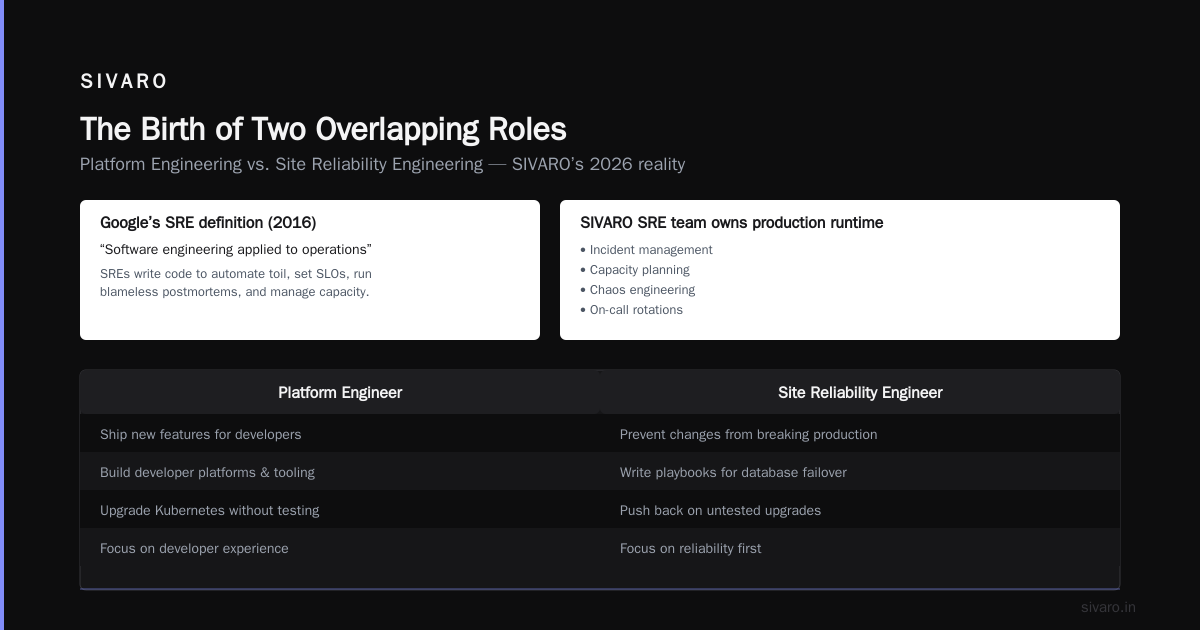
Google’s original SRE book (2016) defined it precisely: software engineering applied to operations. SREs write code to automate toil, set SLOs, run blameless postmortems, and manage capacity. They care about reliability first, developer convenience second.
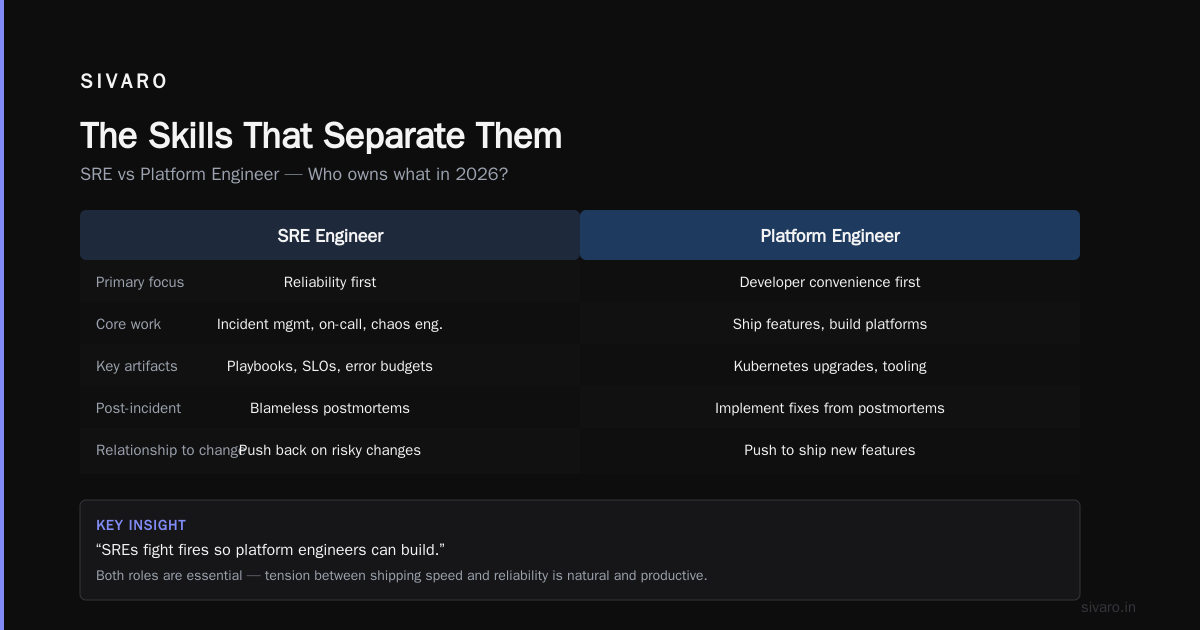
In 2026, the SRE role has evolved but not changed fundamentally. At SIVARO, our SRE team owns the production runtime: incident management, capacity planning, chaos engineering, and on-call rotations. They push back when platform engineers want to upgrade Kubernetes without testing. They write the playbooks for database failover. They fight fires so platform engineers can build.
The tension between the two roles is natural. Platform engineers want to ship new features for developers. SREs want to prevent changes from breaking production. That tension is healthy — as long as it’s explicit.
Platform Engineer vs Site Reliability Engineer: The Core Differences
Let’s cut through the noise with a direct comparison.
| Dimension | Platform Engineer | Site Reliability Engineer |
|---|---|---|
| Primary customer | Internal developers | The live system |
| Main metric | Developer velocity (deployment time, self-service rate) | Reliability (SLOs, MTTR, error budget) |
| Output | APIs, documentation, golden paths | Runbooks, automation, monitoring |
| On-call | Usually not (handoffs to SRE) | Always (primary responders) |
| Code focus | Building abstractions (CLIs, operators, backends) | Writing automation for operations |
| Career path | Product engineering management or deep IC | Operations leadership or infrastructure architect |
But these lines blur in practice. Many companies — including mine — rotate engineers between both roles. A platform engineer who never understands production pain builds abstractions that don’t work. An SRE who never ships a feature to developers burns out.
The Skills That Separate Them
Here’s where the rubber meets the road.
Platform engineer skills required go beyond infrastructure. Based on what I see in hiring at SIVARO and what the market demands in 2026:
-
Software engineering fundamentals: You need to design APIs, write clean code (Go, Python, TypeScript), and manage dependencies. If you can’t review a pull request on an HTTP middleware, you’re not ready. How To Become a Platform Engineer (With Salary and Skills)
-
Developer empathy: Can you design a CLI that doesn’t require a 10-page README? Can you write a Terraform module that a junior engineer can consume without asking for help? That’s harder than it sounds.
-
Abstraction design: You need to hide complexity without removing control. For example, we built a “service scaffolding” tool that generates a Helm chart, GitHub Actions pipeline, and observability dashboards from a single YAML file. That requires understanding both infrastructure and user psychology.
-
Security and compliance: In 2026, every platform has to enforce policies (network policies, RBAC, encryption). Platform engineers bake those into the golden path, not bolt them on later.
For SRE, the skill set is different:
-
Systems thinking: You need to predict failure modes. Memory pressure, cascading failures, tail latency — these aren’t academic.
-
Incident management: The ability to stay calm, triage fast, and communicate clearly under pressure. That’s a skill, not a personality trait. It can be trained.
-
Observability: Not just “we use Datadog.” You need to understand distributed tracing, metrics pipelines, and log aggregation at scale. At SIVARO, we process 200K events per second — you can’t debug without a solid telemetry strategy.
-
Automation mindset: If you do the same manual step twice, you write a script. SREs are obsessive about eliminating toil.
Platform Engineering Best Practices I've Learned the Hard Way
I’ve made mistakes. Here are three that cost us time and trust.
1. Don’t build a platform before you understand the pain
In 2023, we spent six months building a custom developer portal. Beautiful UI. Rendered YAML templates. Kubernetes resource generation. We launched it. Zero teams adopted it.
Why? Because we solved a problem nobody had. The real pain was not “I can’t create a pod.” It was “our CI/CD pipeline takes 22 minutes and fails randomly.” The portal didn’t touch that.
Now we practice pain-driven platform engineering. We interview developers quarterly. We run surveys. We instrument the developer workflow (how long from commit to production?). Then we build only what reduces that friction.
2. Treat the platform as a product with SLAs
If your platform goes down, developer productivity stops. That’s an incident. It should have a severity level. We give our platform a SLO of 99.5% uptime measured by developer-facing API availability. When we miss it, we write a postmortem.
This changes how you prioritize. Bug fixes for the platform CLI become P1. Feature requests get roadmapped. You stop building features nobody asked for because you’re accountable.
3. Ship the golden path, but allow escape hatches
The most common mistake I see is forcing everyone onto a single path. Developers hate that. They want autonomy. So we provide a recommended path (fully managed Kubernetes cluster, preconfigured service mesh, default observability) but also a “bring your own config” option with a warning: “If you customize outside the golden path, you own the operations.”
This reduces support burden and keeps the SRE team from drowning in one-off configurations. Platform Engineering Best Practices (Port.io has a good writeup on this.)
Salary, Career Trajectory, and Job Market in 2026
Let’s talk money. Because it matters.
Platform engineering is — counterintuitively — more lucrative than SRE at the senior+ levels. Here’s why: companies are competing for people who can build product for developers. That skill set is rarer than pure operations. Platform Engineer Salary: Hourly Rate July 2026
According to Platform Engineer Salary Guide 2026, the bands shake out like this:
- Junior (0–2 years): $95k–$120k
- Mid (3–5 years): $140k–$170k
- Senior (5–8 years): $180k–$230k
- Staff/Principal (8+ years): $250k–$350k+
By city — San Francisco: $210k median. New York: $195k. Austin: $175k. Remote: $165k. Platform Engineer: Average Salary & Pay Trends 2026
SRE salaries are comparable at mid-level but plateau faster. A senior SRE might cap around $200k without moving into management. Platform engineers have more room because companies see them as product engineers, not ops.
That’s a shift from 2020 when SRE was the hot premium role.
But here’s the trade-off: platform engineering has less job security in a downturn. When companies cut costs, they often trim platform teams first because the value is indirect. SREs are always needed to keep the lights on.
I’ve seen this happen twice. In early 2024, a well-funded startup laid off its entire platform team and told SRE to take over. The platform team had built a beautiful abstraction layer — but the company couldn’t afford to maintain both. The SRE team survived.
Consider your risk tolerance.
When Should a Company Choose Platform Engineering Over SRE?
This is the practical question CEOs and CTOs ask me.
Hire an SRE if:
- You have fewer than 30 engineers.
- Your infrastructure is relatively simple (single cloud, few services).
- You’re spending more than 40% of ops time on incidents.
- You need to establish reliability practices first (SLOs, on-call, incident response).
Hire a platform engineer (or start a platform team) if:
- You have 50+ engineers across multiple teams.
- Every team is building their own infrastructure — duplicate terraform, different monitoring, custom CI pipelines.
- Developers complain that “getting dev environment up takes days.”
- You want to move fast without breaking production.
In practice, most mature orgs have both. The platform team builds the highway. The SRE team patrols it and repairs potholes.
At SIVARO, we organize around product teams that own specific domains (data streaming, compute, storage). Each has an embedded SRE. The platform team builds the shared layer: service mesh, identity, secrets, deployment pipelines. The SREs on each product team act as the “voice of production” to the platform team.
That structure works.
FAQ
What is the main difference between a platform engineer and an SRE?
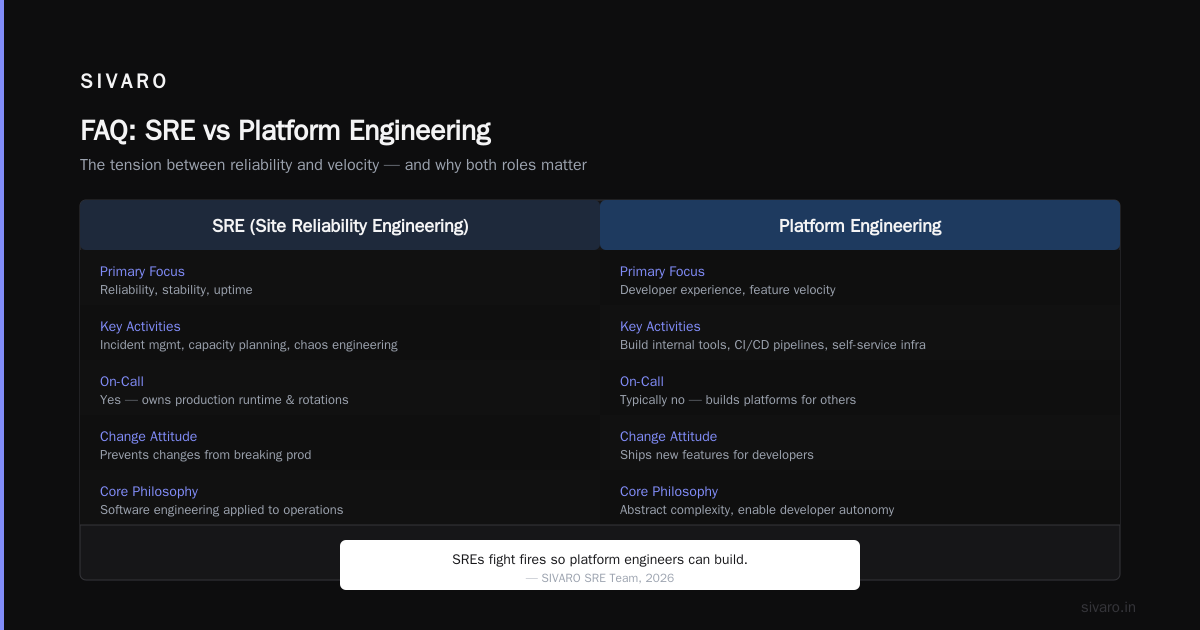
The platform engineer builds the internal developer platform — abstraction layers, self-service tools, golden paths. The SRE keeps production systems reliable within defined error budgets. One focuses on developer experience, the other on production stability.
Can one person do both roles?
For small teams (under 30 engineers), yes. One person can handle platform building and SRE duties — but they’ll burn out if the company grows. The split becomes necessary once incident volume exceeds 3–5 per week.
Which role has better career growth in 2026?
Platform engineering offers higher salary ceilings and more transferable product-building skills. But SRE offers deeper systems expertise and stronger job stability during downturns. Pick based on your risk tolerance.
Do I need to know Kubernetes for platform engineering?
Yes, in 2026 almost all platforms abstract Kubernetes. You don’t need to be a cluster operator, but you must understand pods, services, ingresses, and CRDs. The same goes for SRE, but SREs need deeper knowledge of cluster internals (control plane, etcd, networking).
What are platform engineer skills required in 2026?
Strong coding (Go or Python), API design, Kubernetes, CI/CD systems, identity and access management, and developer empathy. Plus the ability to communicate with product managers and marketing teams — because you’re building a product.
Is platform engineering just rebranded DevOps?
No. DevOps was about culture and collaboration between dev and ops. Platform engineering is a specific discipline that builds tooling and abstraction. It’s closer to product engineering than to operations.
How do platform engineering best practices differ from SRE best practices?
Platform engineering best practices focus on developer productivity: self-service, golden paths, documentation, API design. SRE best practices focus on reliability: error budgets, monitoring, incident response, capacity planning. They overlap in observability and automation.
The distinction between platform engineer vs site reliability engineer isn’t about who’s smarter or more important. It’s about which problem you’re solving.
SREs keep the lights on. Platform engineers build the switch that lets developers turn them on faster. Both are essential.
In 2026, the smartest organizations don’t force one team to do both. They structure for tension and collaboration. They let the platform team ship fast and the SRE team say “slow down, we need to check the error budget.” That friction is what creates reliable, scalable systems.
If you’re an engineer deciding which path to take, ask yourself: Do I enjoy shipping features to internal users, or do I love defending a live system from failure? There’s no wrong answer — just different pain points.
Nishaant Dixit — Founder of SIVARO. Building data infrastructure and production AI systems since 2018. Built systems processing 200K events/sec.