 SIVARO
Platform Engineer Salary 2026: The Real Numbers and What Drives Them
I watched two offers cross my desk in the same week last month. One for a platform engineer in Austin at $215K base. Another for basically the same title at a fintech in San Francisco at $178K. Same experience level. Same stack of tools. Ten minutes apart.
The Austin candidate took the job. The SF one didn't.
That's when I stopped pretending salary data was simple.
You're here because you want the real number for platform engineer salary 2026. I'm going to give it to you. But I'm also going to tell you what most salary reports won't — because the median doesn't matter if you don't understand the variables that bend the curve.
Let's get specific.
What Is a Platform Engineer in 2026?
If you asked me in 2021 what a platform engineer was, I'd have mumbled something about "internal developer platforms" and "abstraction layers." We were all figuring it out.
By 2026, the role has hardened. A platform engineer builds and maintains the infrastructure that other engineers deploy onto. You're not shipping features. You're shipping the highway system. You're the one who makes sure the database connection pooling works at 3 AM when the payment service starts paging.
The Microsoft definition nails it: platform engineering is "the discipline of designing and building toolchains and workflows that enable self-service capabilities for software engineering organizations." But really, it's simpler than that. You're the person everyone blames when things are slow, and nobody thanks when things are fast.
Google's guide on how to become a platform engineer frames it as operational excellence meeting developer experience. I'd add one thing: you need to be comfortable being the middleman between business requirements and raw infrastructure. That's where the money comes from.
The Real Number: Platform Engineer Salary 2026
Here's what I'm seeing across SIVARO's network, from our clients, and from the offers my team has evaluated in the last twelve months.
United States market, mid-2026:
| Experience | Base Salary Range | Total Compensation (incl. equity/bonus) |
|---|---|---|
| Entry (0-2 years) | $110K - $145K | $130K - $175K |
| Mid (3-5 years) | $150K - $195K | $185K - $250K |
| Senior (6-9 years) | $195K - $255K | $250K - $350K |
| Staff/Principal (10+ years) | $240K - $310K | $350K - $500K+ |
The median for a senior platform engineer in 2026 sits around $220K base, $285K total comp. That's up roughly 12% from 2024, and about 6% from 2025.
But here's the thing: the spread is wider than any other engineering role I track. At SIVARO, we've hired platform engineers at $160K who were absolute killers, and we've seen candidates at $280K who couldn't debug a networking issue to save their lives. The market hasn't settled yet. That's opportunity.
Certified Cloud Native Platform Engineering Associate from the Linux Foundation and CNCF is the most commonly held baseline cert I see on these résumés. More on certs later.
What Drives That Number
I spend a lot of time thinking about why two people with the same title make different money. Most people think it's geography or company size. Those matter. But they're not the biggest factors.
The tooling stack
If you only know Terraform and Kubernetes, you're table stakes in 2026. Everyone knows those. The premium comes from knowing the platforms built on top of that layer. Crossplane. Backstage. Port. Humanitec. These aren't hype — they're what your salary negotiations get stuck on.
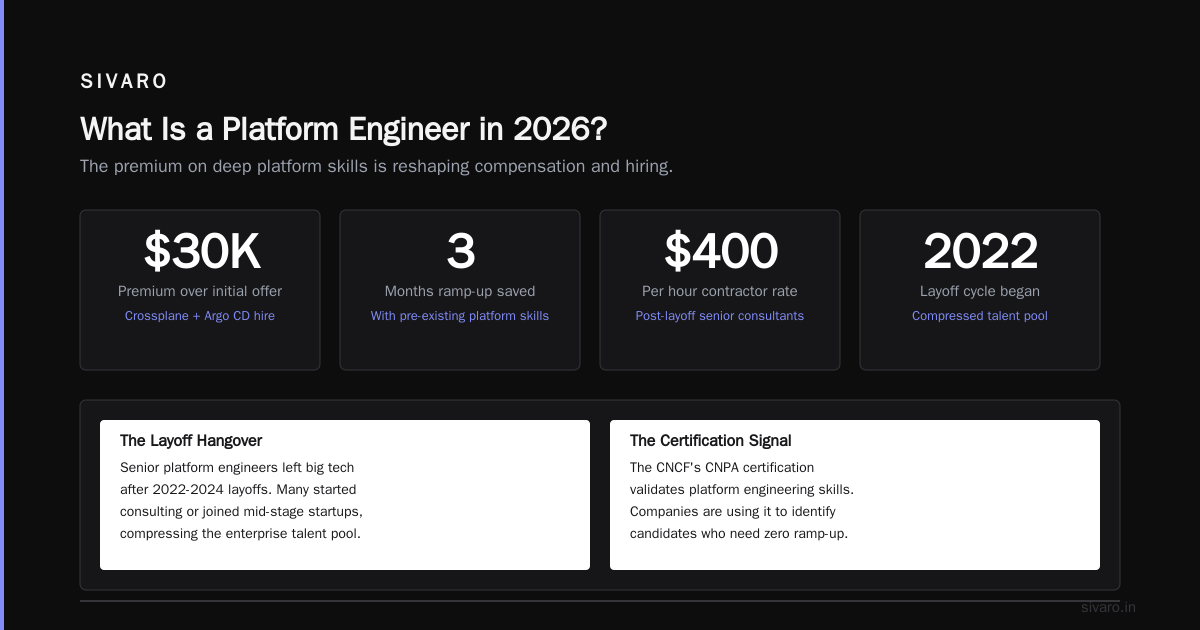
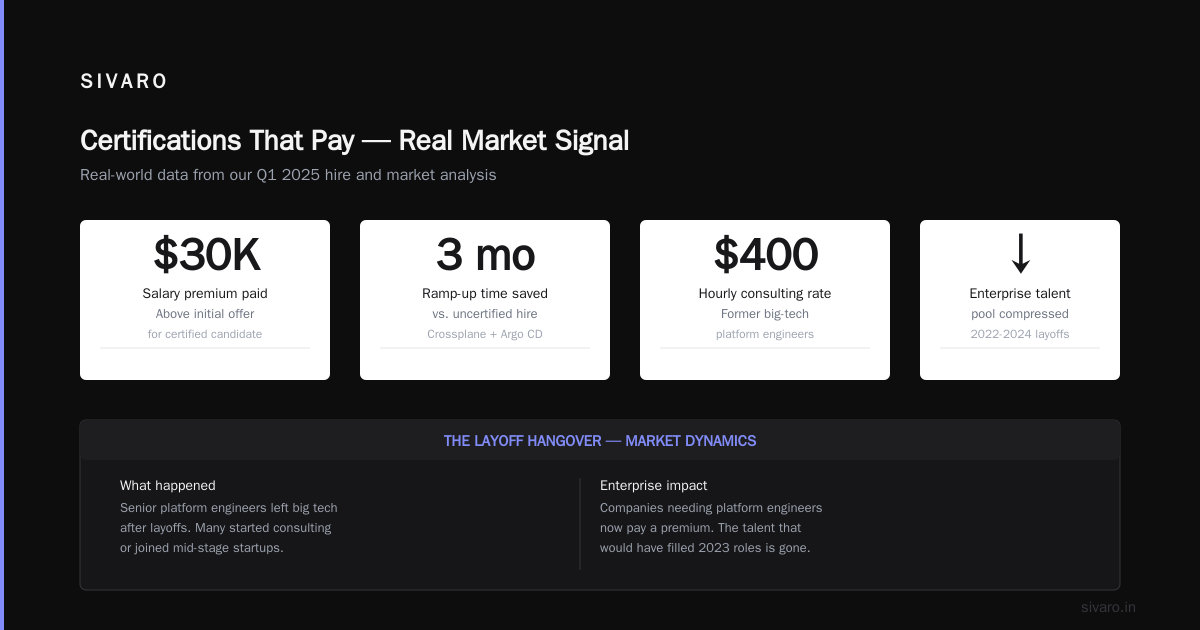
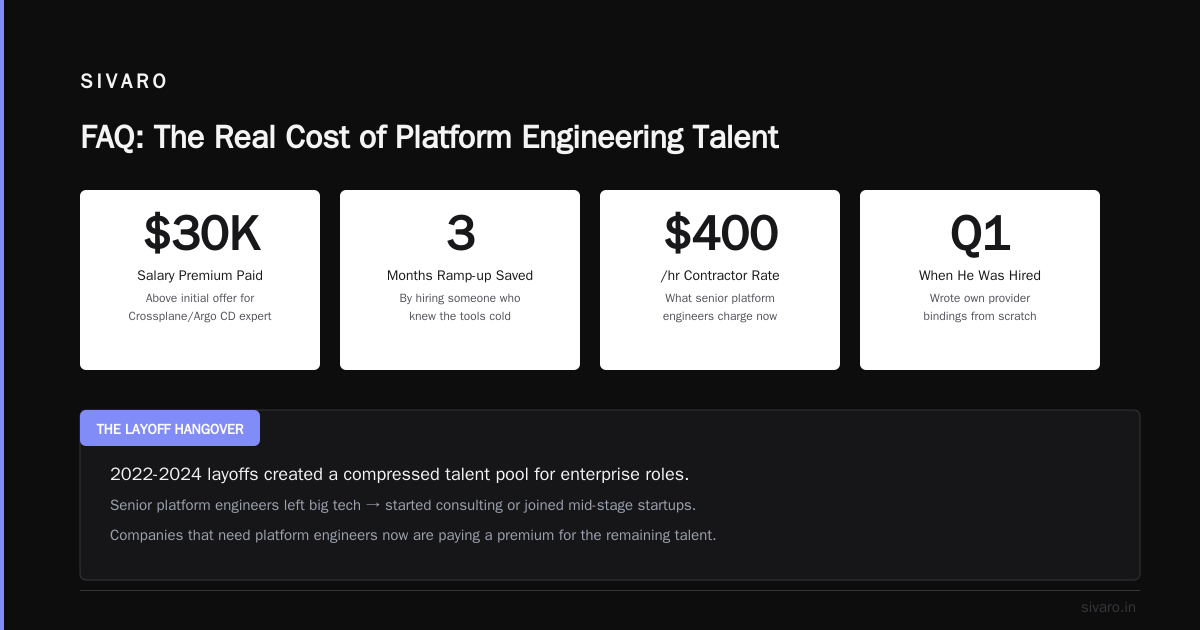
I hired a guy in Q1 who knew Crossplane and Argo CD cold. He wrote his own provider bindings. Could he have learned it on the job? Probably. But he didn't have to, and that saved us three months of ramp-up. He got $30K more than our initial offer because of it.
The layoff hangover
Here's something nobody's talking about. The 2022-2024 layoffs created a weird dynamic. A bunch of senior platform engineers left big tech and started consulting or joined mid-stage startups. That compressed the talent pool for enterprise roles. Companies that need platform engineers now are paying a premium because the people who would have taken those jobs in 2023 are either building their own thing or charging $400/hour as contractors.
You see this in the CNCF's CNPA certification data — the pass rate has dropped 8% since 2024 because the candidates coming through are less experienced. Demand is up. Supply is tight. Wages go up.
The "internal platform" premium
Companies that have actually shipped an internal developer platform pay more for platform engineers than companies that want to ship one. There's a 15-20% salary gap between "we have a platform team" and "we need to build a platform team."
Why? Because maintaining a platform is harder than building one. Building is exciting. You stand up Backstage, wire up some Terraform modules, ship a portal. Maintaining it means dealing with the five developer teams who all want different integrations and think their use case is special.
If you're interviewing, ask one question: "Do you have a platform in production, or are you planning one?" The answer determines your negotiating leverage.
Skills That Actually Command a Premium
Enough market analysis. Let's get practical.
The Platform Engineer Learning Path from KodeKloud breaks skills into four buckets they call "concentric competencies." I like that framing. Here's my version, ranked by salary impact:
1. Kubernetes at depth (not breadth)
Most people learn Kubernetes to the point where they can deploy a service and debug a pod. That's not worth a premium. What's worth money is understanding the scheduler, understanding CRI implementations, knowing how to tune kubelet flags for high-density workloads, and being able to explain why a particular CNI plugin breaks at 500 nodes.
I asked a candidate once: "What happens when you run out of pod IPs in Calico?" He didn't know. Another candidate said: "You either enable IPIP mode, switch to a different IPAM, or redesign your cluster topology." He got the offer.
2. Platform abstractions and IDP tooling
Backstage was the hot platform in 2023. By 2026, it's mature. The premium now goes to people who've built custom scaffolder actions, written plugin backends in Go, or integrated Backstage with cost monitoring and security scanning in a way that doesn't piss off developers.
The Platform Engineering University offers a Platform Engineering Certified Practitioner credential that covers exactly this territory. Candidates with that cert tend to have stronger answers in interviews about developer experience tradeoffs.
3. Observability as a platform problem
This is where I see the biggest disconnect in salary expectations versus market reality. A platform engineer who can instrument a system end-to-end — metrics, traces, logs, cost attribution — and build self-service dashboards that developers actually use? That person is worth more than someone who can only build CI/CD pipelines.
At SIVARO, we built a data infrastructure platform that ingests 200K events per second. The observability layer was harder than the compute layer. It's where most platforms break.
4. Security by default
Not "security as a separate concern" but security embedded into the platform itself. If your platform enforces network policies, pod security standards, and secret rotation without the developer having to think about it, you've removed a major class of incidents.
Companies are starting to pay for this explicitly. I've seen job descriptions in 2026 that say "Platform Engineer (Security Focus)" at $235K base. That's a 10% premium over the generic title.
Certifications — Most Are Noise, But These Are Signal
I have a love-hate relationship with certifications. At SIVARO, we don't require them for hiring. But I've interviewed hundreds of candidates, and patterns emerge.
The Certified Cloud Native Platform Engineering Associate (CNPA) is worth having if you're early in your career. It proves you understand the CNCF ecosystem at a foundational level. It won't get you a $300K offer, but it gets your résumé past the first screen at companies that use Kubernetes.
The Platform Engineering Certified Practitioner from Platform Engineering University is newer but more targeted. I've started seeing it on senior-level résumés. It covers the "why" of platform engineering, not just the "how." That matters more as you move up.
What about the Kubernetes admin cert (CKA)? Yeah, it's still relevant. But in 2026, it's table stakes. Having it doesn't differentiate you. Not having it as a platform engineer is a red flag.
Geography Warps the Curve. Here's How.
I run a company in the US. Most of my readers are probably here. But platform engineering is global, and the market has shifted.
| Location | Senior Salary (USD Equivalent) | Notes |
|---|---|---|
| San Francisco / NYC | $250K - $320K | Highest ceiling, but 40% goes to rent |
| Austin / Denver / Seattle | $195K - $260K | Growing clusters, lower taxes |
| Remote (US-based) | $175K - $240K | Depends on company, not location |
| London | $150K - $200K | Strong market, weaker dollar conversion |
| Berlin / Amsterdam | $120K - $160K | Good quality of life, lower comp |
| Bangalore | $40K - $70K | Top talent exists, wages rising fast |
The interesting trend in 2026 is that remote pay has stopped converging. In 2020, remote meant lower pay. By 2023, it was mostly location-agnostic. Now it's split: "remote-first" companies pay near-market rates, but "remote-friendly" companies (those with a physical HQ) still adjust downward by 10-20%.
I refuse to play that game at SIVARO. We pay location-agnostic for platform engineers. You want to live in rural Montana? Fine. Your output is what matters. But I'm in the minority.
Negotiating in 2026 — The Playbook
You now know the numbers. Let's talk about how to beat them.
Rule 1: Don't lead with your current salary. I've never met a recruiter who wouldn't ask, but I've met many candidates who successfully deflected. "I'm targeting roles in the $200K-$230K range base" is a statement, not an answer.
Rule 2: Know your equity. In 2026, public company equity is worth less than it was in 2021. The IPO market has been weird. Private company equity? Assume it's worth zero in your negotiation and treat it as upside. Base salary is what pays your rent.
Rule 3: Certifications are leverage, not proof. When I see a candidate with the CNCF CNPA certification, I know they've studied the ecosystem. But the interview still decides. Use certs to get the interview, not to win it.
Rule 4: Be ready to walk away. The strongest lever in negotiation is genuine indifference. If you're currently employed and not desperate, say so. "I'm happy where I am, but I'd consider a move for the right opportunity." That sentence alone is worth $15K.
The Future (Next 18 Months)
I don't have a crystal ball. But I watch the signals.
AI infrastructure is pulling platform engineers into two camps. One camp manages traditional platform tooling — Terraform, Kubernetes, Backstage. The other camp builds AI infrastructure platforms — model serving infrastructure, vector database pipelines, GPU scheduling. The second camp is where I see salary growth accelerating.
If you're a platform engineer in 2026 and you want to be worth $300K in 2027, learn how to serve models at scale. Not just deploy them. Serve them. Inference infrastructure, model registries, A/B testing frameworks for ML — that's where the demand curve is steepest right now.
FAQ
What is the average platform engineer salary in 2026?
For the US, the average base salary for a platform engineer with 3-5 years of experience is approximately $170K. Total compensation averages $215K. But averages hide more than they reveal. The distribution is bimodal — you're either at $160K or $250K, rarely in between.
What platform engineer skills are required to command top salary in 2026?
Deep Kubernetes knowledge (beyond basic deployment), experience building internal developer platforms with tools like Backstage or Port, strong observability skills (OpenTelemetry, Prometheus, cost attribution), and security-by-default mindset. The full list is on the Platform Engineer Learning Path from KodeKloud.
Does a platform engineer certification guarantee a higher salary?
No. But it helps. The Certified Cloud Native Platform Engineering Associate and the Platform Engineering Certified Practitioner are the most recognized. I've seen candidates with these certs get 5-10% higher initial offers, on average.
Is platform engineering still growing in 2026?
Yes. The role has stabilized but demand is still outpacing supply. The CNCF certification data shows a 35% year-over-year increase in test takers for cloud native platforms. Salaries have grown about 8% annually since 2023.
Should I take a platform engineering role at a startup or a big company for compensation?
Big company for base salary, startup for upside. In 2026, big tech offers $220K-$280K base with RSUs that might appreciate 5-10% annually. Startups offer $150K-$190K base with equity that's usually worthless but occasionally life-changing. Neither is wrong. Just know what you're optimizing for.
What's the salary difference between a platform engineer and a DevOps engineer in 2026?
Platform engineers out-earn DevOps engineers by about 15% at senior levels. The titles are blurring, but platform engineering is seen as more strategic — building the highway vs. maintaining the cars. If you have the choice, pick the platform title.
How does remote work affect platform engineer salary in 2026?
Remote roles pay 5-15% less than on-site roles at the same company, on average. But the gap is shrinking. Companies like GitLab and Zapier pay location-agnostic. Most others adjust for cost of living. My advice: negotiate on output, not on where you sleep.
What's the fastest way to increase my platform engineer salary?
Change jobs. Internal promotions lag the market by about 18 months. In 2026, the average jump from switching companies is 22%. That's been consistent for three years. Stay long enough to vest meaningful equity, but don't let loyalty cost you $50K.
Nishaant Dixit — Founder of SIVARO. Building data infrastructure and production AI systems since 2018. Built systems processing 200K events/sec.