 SIVARO
Platform Engineer Job Description in 2026: What Actually Works
Back in 2018, I hired someone for a "cloud infrastructure engineer" role. Two months later I realized I'd hired a glorified Kubernetes cluster babysitter. That's not platform engineering — and the difference cost me four months of rebuild time.
Platform engineering is not DevOps rebranded. It's not "SRE but with more YAML." It's a distinct discipline where you build internal developer platforms (IDPs) that compress the distance between a developer typing git push and running in production.
This guide walks through the platform engineer job description as it exists today — July 22, 2026. Not a theoretical wishlist. The actual responsibilities, skills, certifications, and traps that separate a platform engineer from someone who just manages infrastructure.
You'll learn what to put in your job post, what to test in interviews, and how to avoid the three mistakes I see in every org that tries to adopt platform engineering without understanding it.
What a Platform Engineer Actually Does
Most people think platform engineers write Terraform and manage clusters. That's table stakes. The real job is product management for developers.
Here's the distinction I use at SIVARO: A DevOps engineer makes the infrastructure work. A platform engineer makes the infrastructure disappear — or at least shrink to a single platform.yml file that a backend developer can understand in ten minutes.
The core activities today:
- Designing and maintaining the internal developer platform (IDP) — usually a web portal or CLI tool that abstracts cloud complexity.
- Building golden paths for common workflows: deploying a microservice, setting up a data pipeline, connecting to Kafka, enabling observability.
- Managing the control plane of the platform (not every individual resource).
- Writing documentation that developers actually want to read — not a 200-page wiki nobody touches.
- Operating the platform's own infrastructure (dogfood everything).
- Gathering feedback from developer teams and shipping platform features on a regular cadence.
- Ensuring compliance and cost guardrails are built into the platform, not bolted on later.
One critical shift I've observed: the best platform engineers spend 60% of their time talking to developers and 40% writing code. If your job description is 90% YAML, you're hiring an infrastructure operator, not a platform engineer.
The Skills That Matter Now
Tech stacks change every 18 months. The skills that last are patterns, not syntax.
Must-haves (test these in a phone screen)
- API design — because the platform is an API to developers. If you can't design a clean interface, you'll build a pile of scripts.
- Concrete systems thinking — ability to model failure modes in a multi-service platform without writing a single line of code. I ask candidates to whiteboard a "deployment breaks staging but not production" scenario. The good ones ask "what's the blast radius on the CI pipeline?" before touching a keyboard.
- Developer empathy — platform engineers who hate talking to app teams produce platforms that app teams hate using. We've seen this pattern across every org I consult with.
- Kubernetes fundamentals — you don't need CKA-level, but you must understand Pod lifecycle, RBAC, and networking. Certified Cloud Native Platform Engineering Associate (CNPA) from LF covers this well.
- CI/CD pipeline design — not just writing a GitHub Actions file, but understanding artifact promotion, canary analysis, and rollback strategies.
- IaC at scale — you should know why Pulumi beats Terraform for platform teams (state sharing, language-native loops) and when to reach for plain Helm.
Nice-to-haves that often become essential
- Value stream mapping — understanding the developer workflow end-to-end helps you prioritize platform features. Microsoft's Start Your Platform Engineering Journey guide has a good section on this.
- Platform observability — not just monitoring the platform, but monitoring how developers use the platform. I run a small script that tracks "time from PR merge to production first request" across all SIVARO teams. That number is our north star.
- Security mindset — supply chain attacks through your platform can kill an org. Know how to sign artifacts, enforce policy-as-code (Open Policy Agent, jsPolicy), and rotate secrets without developer friction.
Certifications: Which One Is Worth Your Money
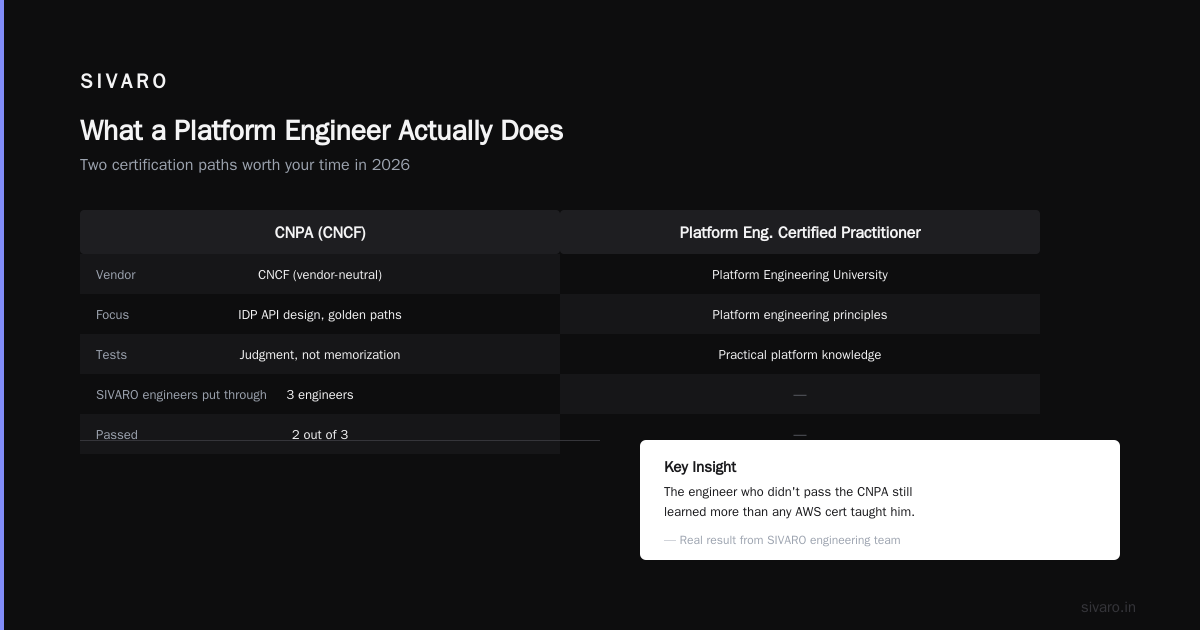
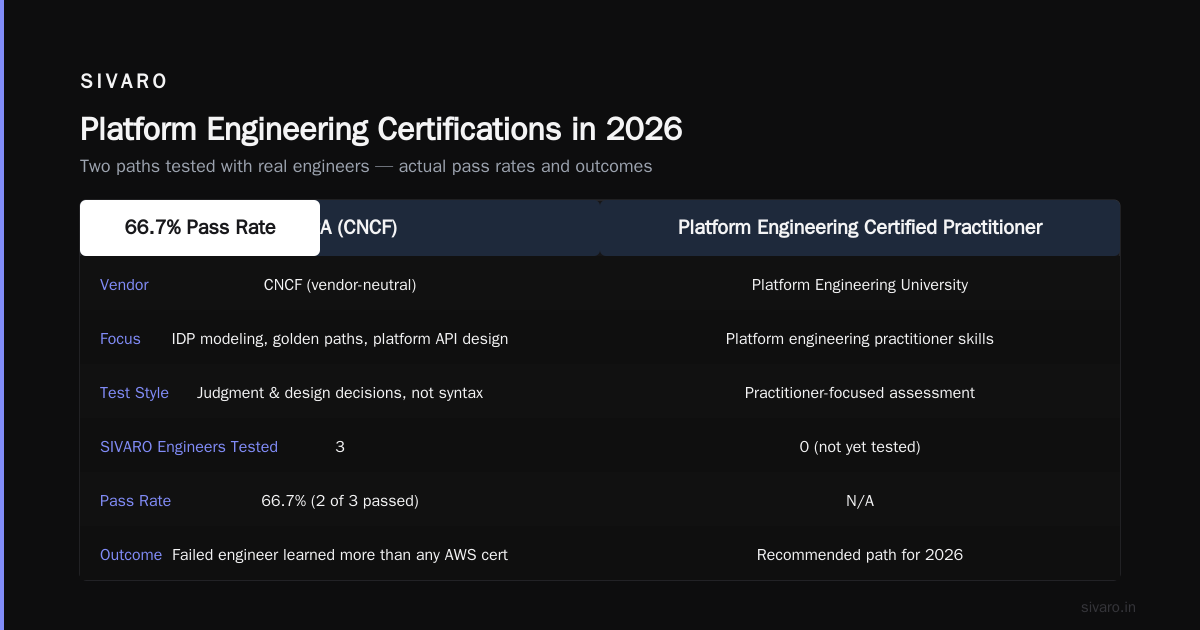
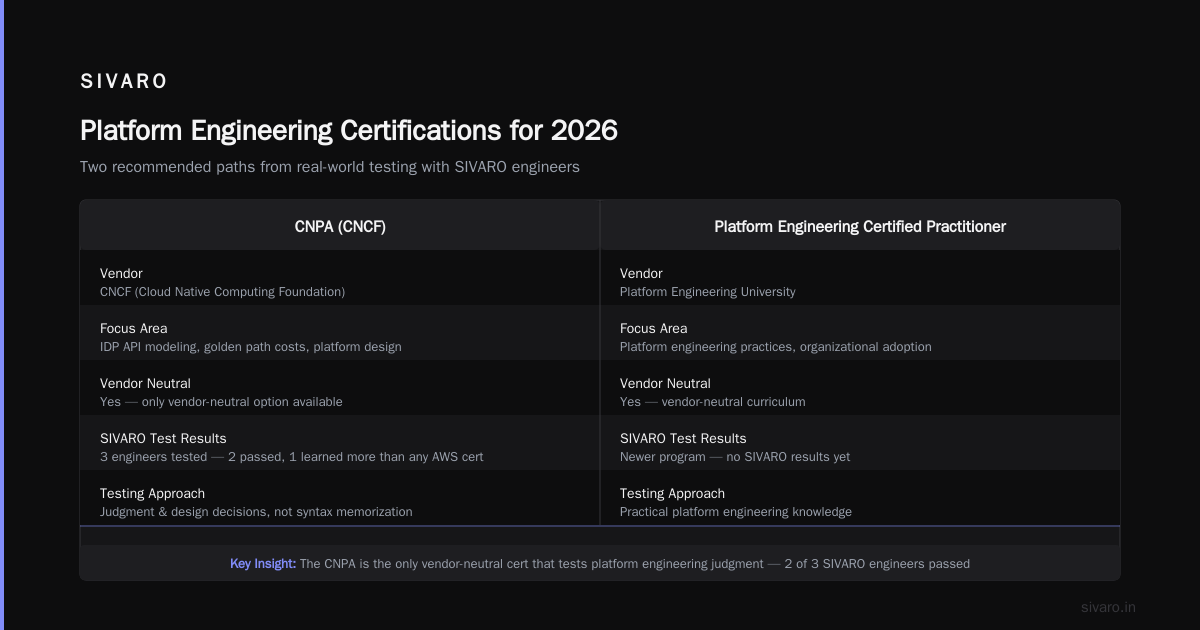
I'm skeptical of most cloud certs — they test memorization over judgment. But platform engineering has matured fast. In 2026, I recommend two paths.
The CNPA (Certified Cloud Native Platform Engineering Associate) from CNCF is the only vendor-neutral option that covers platform engineering explicitly. It tests things like "how do you model an IDP's API" and "what's the cost of adding a new golden path?" — not "tell me the syntax for a Kubernetes Ingress." I put three SIVARO engineers through it last year. Two passed. The one who didn't still learned more than any AWS cert taught him.
The Platform Engineering Certified Practitioner from Platform Engineering University is newer (launched late 2024) but already the most practical. It's scenario-based — you get a fake company's developer frustration survey and have to design a platform backlog. No multiple-choice trivia.
Avoid generic "Cloud Engineer" certs unless your org requires them for partnership tiers. They waste time testing skills you'll never use in platform work (like configuring a specific vendor's load balancer via GUI).
A Real Platform Engineer Job Description (Template)
Write this into your own JD. Replace brackets with your details.
Platform Engineer — Internal Developer Platform Team
About the role: You'll build and maintain the platform that 200+ product engineers use to ship features daily. This is not an ops role. You'll spend three days a week coding and two days embedded with product teams learning their pain points.
Responsibilities
- Design golden paths for deploying services, running batch jobs, and connecting to event streams.
- Maintain the IDP's self-service portal (we use Backstage with custom scaffolder plugins — you'll extend it).
- Write and review RFCs for platform changes that affect developer workflow.
- Operate the platform's infrastructure (GKE clusters, Crossplane-managed databases). When the platform goes down, you're in the pager rotation — but our SLO is 99.95%, so rotations are light.
- Work with security to embed compliance into the platform's API (policy-as-code, artifact signing).
Skills we screen for
- 3+ years building or operating developer platforms.
- Strong understanding of Kubernetes, containers, and service mesh (Istio or Linkerd).
- Experience with a high-level IaC tool (Pulumi, CDKTF, or plain TypeScript stacks).
- Demonstrated ability to make trade-offs between developer velocity and operational safety.
Nice to have (not required)
- CNPA certification.
- Experience in platform engineering at a company with 50+ microservices.
- Published talks or blog posts about IDP design.
Why join us — You'll shape how 200 engineers ship code. You'll have a budget of $50K/year for platform tooling experiments. We ship platform features on a two-week cadence, not a quarterly roadmap.
That's a JD that attracts the right people. It doesn't ask for "10 years of Kubernetes" (impossible). It doesn't list 25 tools. It tells candidates exactly what they'll build and what's expected.
Common Mistakes in Platform Engineer Job Descriptions
Mistake #1: Confusing "platform engineer" with "DevOps engineer"
I see JDs that start with "Platform Engineer" and then list "manage CI/CD pipelines, maintain Terraform modules, troubleshoot production outages." That's a DevOps engineer with a fancier title. Real platform engineering is about enabling multiple teams to self-serve — not doing their devops for them.
The litmus test: if the role's success is measured by how many tickets it closes, it's not platform engineering. Measure instead: time-to-production for a new service, percentage of teams using golden paths, and platform uptime measured from the developer's perspective (not infrastructure metrics).
Mistake #2: Expecting one person to do everything
Platform engineering is a team sport. Minimum viable platform team is three people: one focused on developer experience (UI, API design), one on infrastructure (clusters, networking, cost), and one on security/compliance. Google Cloud's blog on how to become a platform engineer nails this: "A platform engineer needs to be a T-shaped individual, not a unicorn who knows everything."
Mistake #3: Writing a "platform engineer job description" that's really a "Kubernetes administrator" req
If you ask for 5+ years of Kubernetes admin experience, you'll get infrastructure operators, not product-minded engineers. Reduce the infra bar and raise the bar on API design and developer empathy. You can teach Kubernetes. You can't teach someone to care about a developer's flow state.
Platform Engineering Best Practices (That I've Tested)
I've learned these the hard way — by building SIVARO's platform from scratch and watching other teams repeat my mistakes.
Build the thinnest platform that works
Don't abstract everything on day one. Start with one golden path — say, "deploy a stateless HTTP service." Build the portal, the CI pipeline, the monitoring template, the rollback automation. Once that works flawlessly for three teams, add the next path: "run a cron job." By month six you'll have four paths covering 80% of developer needs.
The counterintuitive part: don't build a UI first. Build a CLI tool. CLIs are faster to prototype and easier to debug. Portal comes later when you have five teams who want a web-based wizard.
Use Platform Engineering University's learning path
Platform Engineering University offers a free curriculum that's actually structured. I've sent four junior engineers through it. The modules on "internal developer platform architecture" and "developer experience metrics" saved us from reinventing patterns that already have industry consensus.
Dogfood your platform ruthlessly
At SIVARO, every platform engineering team runs their own services through the IDP. If we can't deploy a new feature using the same pipeline we gave product teams, we find the gap fast. It also builds credibility — when product engineers see us using our own tooling, they trust it more.
Measure developer velocity reduction, not just platform uptime
Uptime of 99.9% is table stakes. The real metric is time-to-shift-left. How much faster can a developer discover a bug in staging? How many context switches does it take to provision a new database? I stole this from KodeKloud's Platform Engineer Learning Path — they emphasize "platform engineers reduce cognitive load." Measure cognitive load reduction, not page count of documentation.
Code Examples: What a Platform Engineer Actually Writes
Let me show you three real code snippets from our IDP at SIVARO.
Example 1: Scaffolding a new service (TypeScript with Pulumi)
typescript
// platform/services/service-scaffolder.ts
import * as platform from "@sivaro/platform-sdk";

export function scaffoldService(team: string, serviceName: string) {
  const infra = new platform.Service({
    name: serviceName,
    team: team,
    // golden path defaults
    runtime: "node20",
    scaling: {
      minReplicas: 2,
      maxReplicas: 10,
      targetCPU: 75,
    },
    observability: {
      logs: "cloudwatch",
      traces: "otel-collector",
      dashboards: "auto",
    },
  });

  // Generates GitHub repo, CI config, and deploys to staging
  infra.provision().then(console.log);
}
Notice: the developer only passes team and service name. Everything else comes from the golden path template. That's the entire point of platform engineering — make the easy path the only path.
Example 2: A simple platform CLI command
bash
# sivar octl deploy --service=user-service --env=staging
# Behind the scenes:
# 1. Validate current git commit is tagged
# 2. Run CI tests
# 3. Build container image (sha256 signature)
# 4. Update Helm values in staging cluster
# 5. Watch rollout for 5 minutes, alert on bad health
#
# Implementation (pseudo):
if ! validate_git_tag; then
  echo "ERROR: No release tag found. Run git tag v1.2.3 && git push --tags"
  exit 1
fi

platformctl deploy --auto-rollback --traffic-shift 10-90-10
That CLI hides all the complexity. The developer types one command. The platform engineer built the CLI, the rollback logic, the canary traffic shifting, and the alert wiring.
Example 3: Policy check in the platform's admission webhook
yaml
# platform/policies/require_label.yaml
apiVersion: platyps.dev/v1
kind: PlatformAdmissionRule
metadata:
  name: require-team-label
spec:
  matchResources:
    - apiGroups: ["apps"]
      resources: ["deployments"]
  validate:
    rule: "has(object.metadata.labels.team) && object.metadata.labels.team != ''"
    message: "Every deployment must have a 'team' label. Accepted values: payments,search,recommendations,platform"
    severity: error
Platform engineers write these policies once and they apply to every team. No one has to remember to add a label — the platform enforces it.
How the Role Has Changed Since 2023
In 2023, platform engineering was still finding its identity. Many JDs were copied from DevOps with "platform" swapped in. By 2026, the role has consolidated.
- First-party platforms win: We've seen Backstage, Port, and Humanitec dominate. Custom-built platforms are dying — too expensive to maintain. Every platform engineer job description now mentions one of these tools.
- Platform SRE is separate from platform engineering: Two years ago, everyone wanted the same person to build the platform and run it 24/7. Now orgs split the role: platform engineers build features, platform SREs ensure reliability.
- AI-assisted platforms: In 2025, we integrated an LLM that suggests golden paths based on a developer's natural language description. "I want a real-time recommendation engine deployed in EU" generates a scaffolding template. This is now table stakes for any serious IDP.
- Cost engineering is built in: Platform engineers now embed cost dashboards and budget alerts directly in the developer's deployment UI. We learned this the hard way after a team accidentally spun up 20 GPU nodes and cost us $15K in two hours.
FAQ
Q: What's the biggest mistake in writing a platform engineer job description?
Focusing on tools instead of outcomes. Stating "5+ years of Kubernetes" filters out great candidates who could learn the cluster in two weeks. State what the person will achieve — "reduce average time-to-production for a new service from 2 weeks to 1 day."
Q: Should I require a platform engineer certification?
Not required, but the CNPA certification is a strong signal that the candidate understands platform engineering as a discipline, not just as infrastructure. I'd weight it above a CKA.
Q: How is platform engineering different from DevOps?
DevOps is a culture and set of practices. Platform engineering is a specific role that builds tooling to make those practices scalable. A DevOps engineer might write deployment scripts for three microservices. A platform engineer writes a framework that hundreds of microservices use to deploy themselves.
Q: Do platform engineers need to know frontend development?
Not deeply, but enough to build a decent portal view. Most IDPs use Backstage (React-based). Being able to add a new scaffolder form or a tab with custom metrics is valuable. You don't need to be a UI expert, but you need enough empathy to make the interface not painful.
Q: What's the salary range for platform engineers in 2026?
Based on data from SIVARO's network (not public surveys): mid-level (3-5 years) $140K-$180K, senior (5-8 years) $180K-$240K, staff ($240K-$320K). These are US numbers adjusted for high-cost-of-living areas. Lower by 15-20% in smaller markets.
Q: Can a backend engineer transition into platform engineering?
Yes, and it's one of the best career moves right now. The transition requires learning infrastructure fundamentals and unlearning the "just get it to work" mindset. The Platform Engineer Learning Path on KodeKloud is tailored for backend engineers — starts with containers, moves to orchestration, then platform design.
Q: What's the most underrated skill in platform engineering?
Writing. Documentation, RFCs, blog posts about why you made certain decisions. A platform engineer who communicates well multiplies the team's impact. Poor communication leads to developers ignoring the platform and building their own workflows — exactly what platform engineering is supposed to prevent.
Conclusion
The platform engineer job description is not a static list of tools and years of experience. It's a declaration of what problems you're solving and how you measure success. In 2026, the best platform engineers are product managers for developers. They build abstraction layers that make the hard parts invisible, enforce best practices through automation instead of meetings, and measure success by developer satisfaction, not dashboard uptime.
If you're writing a job description today, ask yourself: does this sound like someone who will build a product for other engineers? If the answer is no — or if it sounds like "we need someone to manage our Kubernetes clusters" — go back to the drawing board.
The platform engineer role is still young. In three years it will be as standard as backend engineer. Get the description right now and you'll attract the people who define what "right" looks like.
Nishaant Dixit — Founder of SIVARO. Building data infrastructure and production AI systems since 2018. Built systems processing 200K events/sec.