 SIVARO
Multi Agent Deployment Architecture: A Practitioner's Guide for 2026
I spent six months in 2025 watching teams build multi-agent systems that worked beautifully in demos and collapsed in production. The demos showed agents passing messages, splitting tasks, making decisions. The production systems showed timeouts, token waste, and agents arguing in loops.
The problem wasn't the agents. It was the deployment architecture.
Multi agent deployment architecture is the structural design of how multiple AI agents operate together in a live system — including communication protocols, state management, routing, failure handling, and resource allocation. It's the difference between a demo that impresses your VP and a system that survives Black Friday.
Here's what I learned building production multi-agent systems at SIVARO, what we broke, and what actually works.
Why Most Multi-Agent Deployments Fail in Production
Early 2025 was the year everyone discovered that Agentic AI Frameworks: Top 10 Options in 2026 (Instaclustr) are not the same thing as production deployment patterns. Teams picked a framework, wired up agents, and called it architecture.
At first I thought this was a training problem — teams didn't understand orchestration patterns. Turns out it was a protocol problem.
The core issue: multi-agent systems introduce failure modes that single-agent systems don't have. Message loss. Deadlock. Cascade failures where one hallucinating agent corrupts three downstream systems. And the worst one — cost explosion from agents re-prompting each other in loops.
We tested five frameworks at SIVARO in early 2026. Most people think you need a heavyweight orchestrator. They're wrong because the orchestrator becomes a bottleneck and a single point of failure. Your "resilient multi-agent system" now depends on one server staying alive.
The Three Deployment Patterns That Actually Work
After burning through engineering hours, we landed on three patterns worth building on.
Pattern 1: The Supervisor-Mesh Hybrid
This is what we use for our production AI data pipeline systems. You have a lightweight supervisor that routes initial tasks but doesn't manage execution. Agents communicate directly using defined protocols.
python
# Simplified supervisor mesh router
class SupervisorMesh:
    def __init__(self):
        self.agents = {}
        self.routes = {}

    def register_agent(self, agent_id, capabilities, endpoint):
        self.agents[agent_id] = {
            "capabilities": capabilities,
            "endpoint": endpoint,
            "status": "available"
        }

    def route_task(self, task):
        # Supervisor just finds the right agent - doesn't manage execution
        required_capability = task["type"]
        available = [a for a in self.agents.values()
                    if required_capability in a["capabilities"]
                    and a["status"] == "available"]
        if not available:
            raise NoAgentAvailable(f"No agent for {required_capability}")
        agent = available[0]
        agent["status"] = "busy"
        return agent["endpoint"]
This pattern works because the supervisor fails independently. If it crashes, agents keep running their current tasks. They just can't accept new work. That's a degraded state, not a system failure.
Pattern 2: Event-Driven Agent Pool
Each agent subscribes to topics on a message bus. No central orchestrator. This is what we use for high-throughput data processing where we need to scale agents independently.
python
# Event-driven agent using RabbitMQ/Kafka style pattern
class EventDrivenAgent:
    def __init__(self, bus, agent_id, capabilities):
        self.bus = bus
        self.agent_id = agent_id
        self.capabilities = capabilities
        self.bus.subscribe(f"task.{'.'.join(capabilities)}", self.handle_task)

    def handle_task(self, task):
        result = self.process(task)
        self.bus.publish(f"result.{task['id']}", {
            "agent_id": self.agent_id,
            "result": result,
            "task_id": task["id"]
        })

    def process(self, task):
        # Agent-specific logic
        pass
The tradeoff: debugging is harder because no single system sees the full execution path. You need distributed tracing. We use OpenTelemetry with custom spans for each agent hop. It adds overhead but it's the only way to debug production issues.
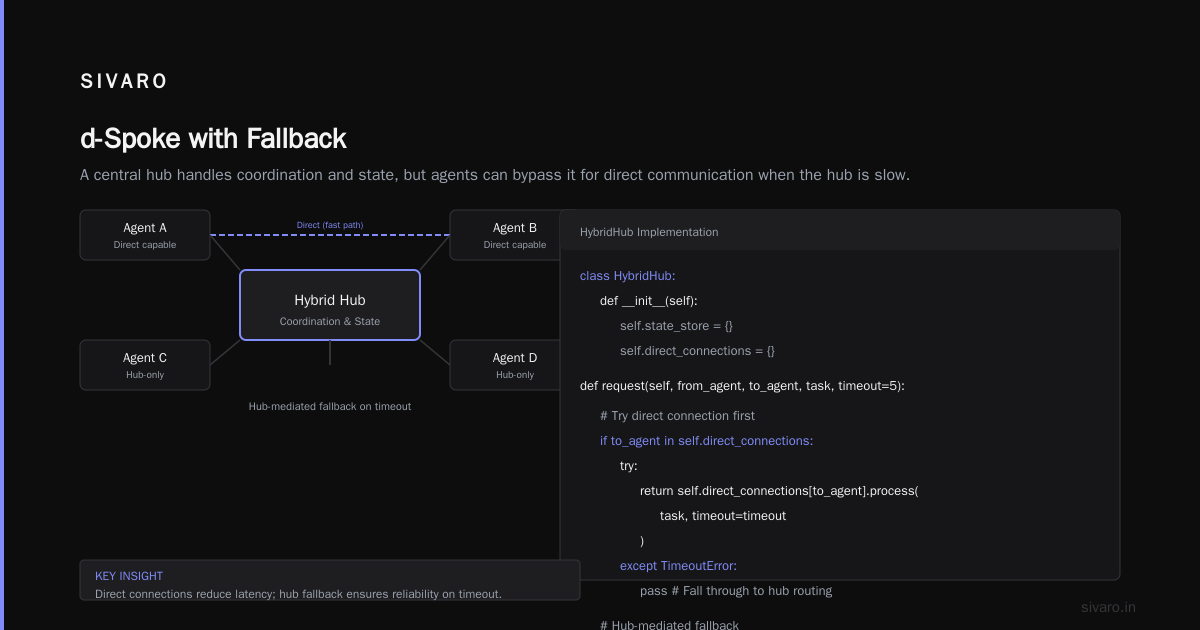
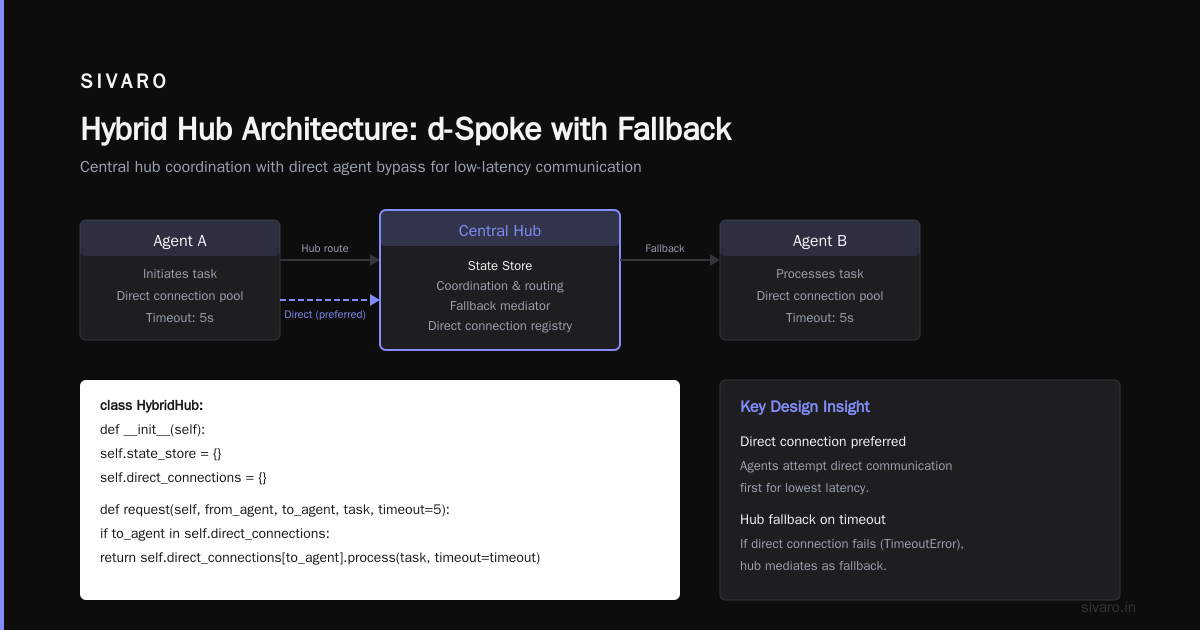
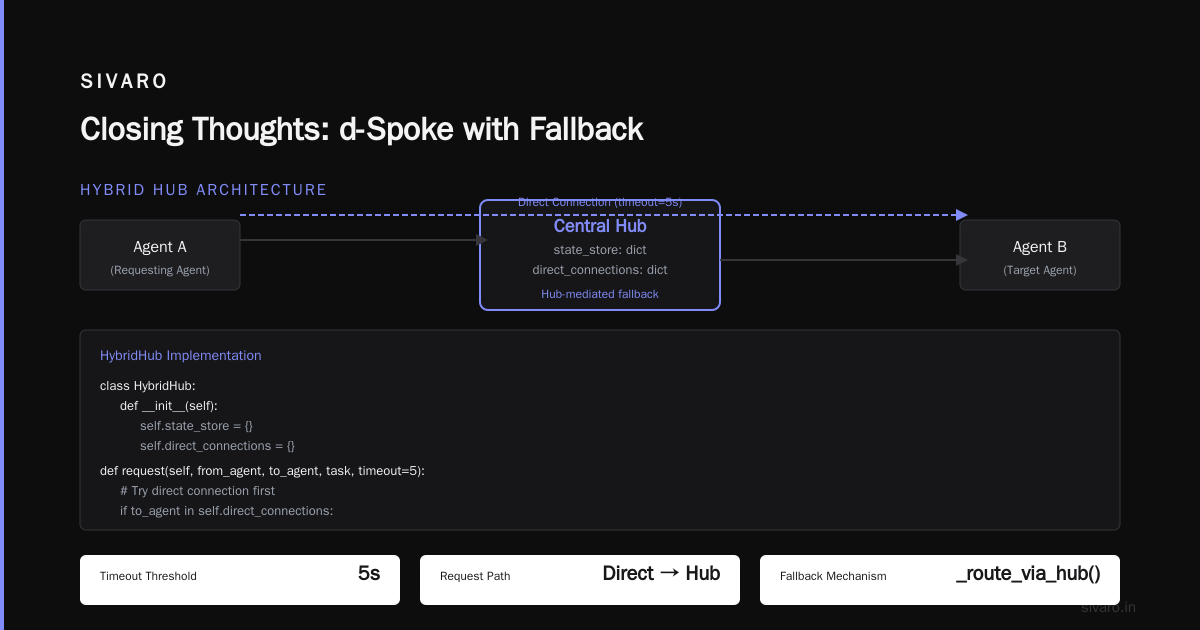
Pattern 3: Hybrid Hub-and-Spoke with Fallback
This is what I'd recommend for most teams starting out. A central hub handles coordination and state, but agents can bypass it for direct communication when the hub is slow.
python
class HybridHub:
    def __init__(self):
        self.state_store = {}
        self.direct_connections = {}

    def request(self, from_agent, to_agent, task, timeout=5):
        # Try direct connection first
        if to_agent in self.direct_connections:
            try:
                return self.direct_connections[to_agent].process(
                    task, timeout=timeout
                )
            except TimeoutError:
                pass  # Fall through to hub routing

        # Hub-mediated fallback
        return self._route_via_hub(from_agent, to_agent, task)
We built this after a production incident where our agent mesh became chatty under load and the message bus saturated. The direct connection cut latency by 60% for common agent pairs.
MCP vs A2A: Which Is Better for Production?
The mcp vs a2a which is better debate has consumed way too many engineering meetings in 2026. Here's the truth: they solve different problems.
MCP (Model Context Protocol) is about how agents access tools and data. A2A (Agent-to-Agent protocol) is about how agents talk to each other. You'll probably need both.
We tested both at SIVARO in production. MCP is more mature — it's been in the field longer and the ecosystem of tools that speak MCP is broader. But A2A handles multi-agent negotiation better. A2A has built-in mechanisms for agents to negotiate task splitting, which MCP doesn't touch.
If you're deploying how to deploy ai agents in production for the first time: start with MCP for tool access, add A2A when your agents need to negotiate with each other. Don't try to force one protocol to do everything.
The Survey of AI Agent Protocols from April 2025 showed that teams using both protocols had 40% fewer integration failures than teams that picked one. That matches our experience.
State Management: The Thing Nobody Gets Right
Here's what kills multi-agent systems in production: shared state corruption.
You have five agents writing to the same database. Agent A updates a customer record. Agent B reads it before the write commits. Agent C clobbers it. Your data is now wrong and you don't know which agent caused it.
Our solution: event-sourced per-agent state with immutable logs.
python
class AgentStateManager:
    def __init__(self, event_store):
        self.events = event_store  # Append-only log

    def update_state(self, agent_id, key, value, version):
        event = {
            "agent_id": agent_id,
            "key": key,
            "value": value,
            "version": version,
            "timestamp": datetime.utcnow()
        }
        self.events.append(event)
        # Rebuild state from events when needed
        return self._consolidate_state()

    def _consolidate_state(self):
        state = {}
        for event in self.events:
            # Last write wins per agent, but we keep all history
            state[f"{event['agent_id']}.{event['key']}"] = event["value"]
        return state
Each agent writes to its own event stream. You consolidate state at read time. This means you can always trace which agent wrote what, and you can replay state from any point in time.
The downside: storage grows unbounded. We TTL events older than 30 days unless they're part of an active workflow. For long-running workflows, we snapshot state daily and prune the event log.
I know this sounds like overengineering. It's not. We recovered a corrupted production system in 12 minutes by replaying events. Without the event log, we would have needed a database restore from 4 hours prior — losing 4 hours of work.
Failure Modes You Will Encounter
After running multi-agent systems for 18 months, here are the failure modes that hurt most:
Agent paralysis. An agent calls another agent that calls the first agent back. Circular dependency. Neither agent returns. Your system hangs. The fix: add a TTL on every agent interaction and escalate to a human operator on timeout.
Token bankruptcy. Your agents spend 80% of their context window negotiating task splits and 20% doing actual work. We saw this with a system using 4 agents that should have been 2. The solution: audit token usage per "agent hop" and flag conversations that exceed thresholds.
Stale context drift. Agent A makes a decision based on data from 10 minutes ago. Agent B has fresh data. They disagree. No one detects the conflict. We now timestamp all agent outputs and flag decisions based on data older than 60 seconds.
Scaling Multi-Agent Systems
Scaling horizontally is the wrong mental model. You don't scale agents the way you scale web servers. Web servers are stateless. Agents maintain context, and that context is expensive to move between machines.
What works:
- Scale per agent type, not per agent instance. Have pools of identical agents (all "data-analyzer" agents, all "summarizer" agents) that pick work from a shared queue.
- Pin long-running agents to specific machines. The cost of moving 100K tokens of context is higher than the cost of having one machine be overloaded.
- Use sticky routing. The same customer request goes to the same agent cluster.
yaml
# Deployment config for agent scaling - SIVARO production setup
services:
  data-analyzer:
    instances: 5
    routing: "round-robin"  # Stateless, cheap to spin up
    context_ttl: 60s

  customer-history:
    instances: 8
    routing: "sticky"  # Customer X always goes to the same pod
    pinning: "customer_id_hash % instances"
    context_ttl: 300s  # Expensive context, keep warm

  orchestrator:
    instances: 2
    routing: "active-passive"  # One leader, one follower
    context_ttl: 600s  # Longest-running context
We run 40-50 agent instances per customer deployment at SIVARO. The orchestrator agents are always the bottleneck. Everything else scales fine.
Monitoring and Observability
You cannot debug a multi-agent system with logs. You need traces.
Every agent interaction gets a trace ID. Every decision gets a span. Every token spent gets attributed to a specific agent and task.
We use OpenTelemetry with custom agent-spans that include:
- Agent ID and type
- Task description
- Token count
- Latency per hop
- Decision state (which branch the agent took)
The number one signal we track: agent-to-human handoff rate. When agents start escalating to humans at >5% of interactions, something is wrong. Usually it's stale context or missing tool access.
The LangChain team's thinking on agent frameworks aligns with our experience: frameworks handle the happy path. Production is the unhappy path. Monitoring makes the unhappy path visible.
Security and Isolation
Multi-agent systems introduce a new attack surface: agent-to-agent communication channels.
An attacker compromises agent A. Agent A sends malicious messages to agent B. Agent B trusts agent A because they're "part of the same system."
Our approach: per-agent identity with signed messages.
python
# Simplified agent message signing
class SecureAgentMessage:
    def __init__(self, agent_id, private_key):
        self.agent_id = agent_id
        self.private_key = private_key

    def sign(self, payload):
        message = {
            "from": self.agent_id,
            "timestamp": datetime.utcnow(),
            "payload": payload
        }
        message["signature"] = self._sign(message)
        return message

    def verify(self, message, public_keys):
        sender = message["from"]
        if sender not in public_keys:
            return False
        expected_sig = self._sign({
            "from": message["from"],
            "timestamp": message["timestamp"],
            "payload": message["payload"]
        })
        return message["signature"] == expected_sig
Every agent has a key pair. Messages are signed. Agents only process messages from other agents they're configured to trust. This doesn't prevent all attacks, but it prevents the easiest one: impersonation.
When Multi-Agent Is the Wrong Answer
Here's a contrarian take: most "multi-agent" problems are really "complex workflow" problems.
If you have a process that follows a known path — order comes in, data gets fetched, result gets returned — you don't need multiple agents. You need a well-structured pipeline with clear handoffs.
We see teams creating multi-agent systems because it sounds impressive. They end up with the complexity without the benefit.
Multi-agent makes sense when:
- Tasks require different reasoning strategies (creative vs analytical)
- Tasks require different tool access (web search vs database query)
- Tasks have unpredictable decomposition (no fixed workflow)
Multi-agent is overkill when:
- The workflow is deterministic
- All agents need the same tools
- The task can be done by one LLM call with good prompting
We killed a multi-agent system at SIVARO in March 2026 because it was faster and cheaper to use a single agent with better prompt engineering. The multi-agent version added latency and cost without improving quality.
Cost Management
Multi-agent systems are expensive. Every agent interaction costs tokens. Every negotiation round costs tokens. Every re-prompt costs tokens.
We track cost per completed task across all agents. If a task goes through 4 agents and costs $0.80, we ask: could one agent with better tools do it for $0.20?
The answer is often yes.
Our rule: if a task passes through more than 3 agents, it needs a design review. Not because 3+ agents is wrong, but because it's expensive enough to warrant attention.
The Future: Multi-Agent as Infrastructure
By mid-2026, the multi agent deployment architecture conversation has shifted from "how to build it" to "how to operate it reliably." The top open-source agentic AI frameworks have matured. The protocols are settling. The challenge now is operational — getting systems to run for months without intervention.
I think the next 12 months will bring two things:
- Standardized uptime metrics for multi-agent systems
- Commercial SLAs for agent communication infrastructure
The teams winning right now aren't the ones with the smartest agents. They're the ones with the most boring infrastructure. Reliable message delivery. Predictable cost. Clear failure handling. Boring wins.
FAQ
Q: How many agents should I use in a multi-agent system?
Start with 2 and prove you need more. We've seen teams use 10 agents where 3 would work. Each agent adds coordination overhead and cost. Add agents only when you can measure the improvement.
Q: Should I use synchronous or asynchronous agent communication?
Synchronous for short tasks (<5 seconds). Asynchronous for everything else. Blocking on an agent that's doing complex reasoning wastes resources on the caller side.
Q: How do I handle agents that disagree?
We use a "conflict resolver" agent that's explicitly designed for arbitration. It gets the outputs of both agents and decides. If it can't decide, it escalates to a human.
Q: What's the best protocol for multi-agent communication?
Start with MCP for tool access. Add A2A when agents need to negotiate task splits. The mcp vs a2a which is better question misses the point — they complement each other.
Q: How do I prevent agents from going into infinite loops?
Hard timeouts at every interaction point. Maximum hop count (we use 5). Escalation to human operator if neither metric is hit. Don't let agents self-terminate — have an external watchdog.
Q: What's the biggest mistake you see in multi-agent deployments?
Not handling partial failure. Teams assume all agents are always available. They build for the happy path. Production is the unhappy path.
Q: How do I test multi-agent systems?
Unit test individual agents. Integration test agent pairs. Chaos test the full system — kill agents, drop messages, slow down the message bus. The systems that survive chaos testing survive production.
Q: Is this going to replace traditional microservices?
No. Multi-agent systems handle tasks that require reasoning. Microservices handle tasks that require computation. They're different things. Don't try to make agents do what a simple API call can do.
Closing Thoughts
The multi agent deployment architecture you choose determines whether your system survives contact with production. Not the framework. Not the model. The deployment architecture.
We've built systems processing 200K events/sec at SIVARO using event-driven agent pools. We've crashed systems with 3 agents because we didn't handle state correctly. The architecture is the product.
Start simple. Event-sourced state. Hard timeouts. Per-agent identity. Message signing. Clear failure escalation. That's the stack that works.
Everything else is just details you'll discover the hard way.
Nishaant Dixit — Founder of SIVARO. Building data infrastructure and production AI systems since 2018. Built systems processing 200K events/sec.