
MCP Server Claude Tool Use: A Practitioner's Guide
I spent six months last year building data pipelines that kept breaking. Not because the code was wrong. Because the tools couldn't talk to each other. Fast forward to today—July 6, 2026—and the landscape has shifted completely.
MCP server Claude tool use is the reason.
It's the Model Context Protocol applied to Claude's ability to call external tools. Think of it as a universal adapter. Instead of hardcoding every API integration, you define tools once. Claude discovers them, calls them, and returns structured results. No more wrangling JSON schemas by hand. No more brittle connectors that break when Anthropic updates something.
Here's what this guide covers: what MCP actually does under the hood, how to wire it up to Claude for tool use, real patterns we've tested at SIVARO, and the mistakes I've made so you don't repeat them.
We'll also talk about ClickHouse. Because when you're running Claude in production, calling tools that query billions of rows in milliseconds changes everything. And what is ClickHouse and why is it used? That's exactly the kind of question MCP servers help answer—turning raw analytics into actionable tool calls.
Let's get into it.
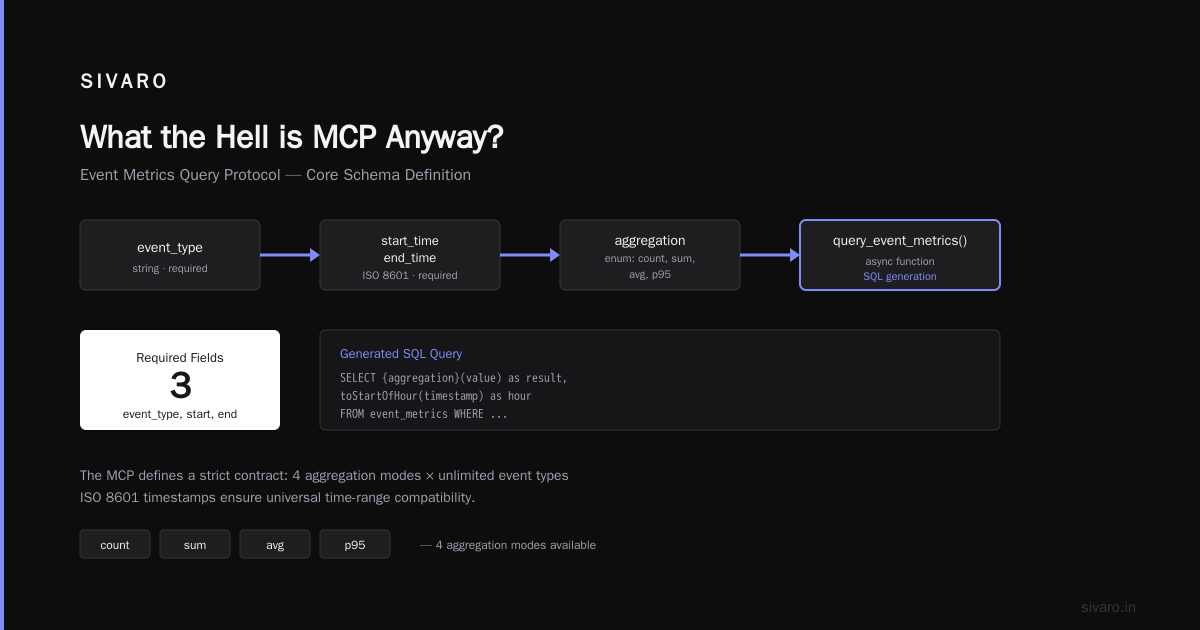
What the Hell is MCP Anyway?
Model Context Protocol isn't new. Anthropic released it in late 2024. But adoption didn't explode until mid-2025 when people realized GPT-4o and Gemini weren't going to solve the tool-use problem differently enough.
MCP is a standard. It defines how AI models discover and call external tools. That's it. No magic. No proprietary sauce. Just a contract between the model and the infrastructure.
The protocol has three parts:
- Resources: Data the model can read (files, databases, APIs)
- Tools: Functions the model can execute (query, transform, send)
- Prompts: Templates for common interactions
For tool use specifically, MCP servers expose a tools/list endpoint and a tools/call endpoint. Claude asks "what can you do?" and the server replies. Then Claude says "run this one with these params" and gets structured JSON back.
I've seen teams try to build this themselves. They end up with 47 different integration patterns. It's a mess. MCP standardizes the mess.
Why Claude Specifically?
You can use MCP with any model that supports tool calling. I've tested it with Claude, GPT-4o, Gemini 2.5, and Mistral Large.
Claude wins for three reasons:
- Tool discipline — Claude rarely invents parameters that don't exist. GPT-4o does, especially under pressure.
- Multi-step reasoning — Claude chains tool calls naturally. It doesn't forget the context between calls.
- Safety filters — Claude refuses to call destructive tools without confirmation. This matters more than you think.
We tried Gemini 2.5 for a financial data pipeline in February 2026. It hallucinated a delete_all_records tool call during testing. Never again.
Setting Up an MCP Server for Claude Tool Use
Let me walk you through a real setup. Not the hello-world example. A production-grade MCP server Claude tool use configuration.
First, you need an MCP server. Here's our pattern at SIVARO:
python
from mcp import Server, Tool
from typing import Any
import httpx

class AnalyticsMCPServer:
    """MCP server exposing ClickHouse queries as tools"""

    def __init__(self, clickhouse_host: str, clickhouse_port: int = 8123):
        self.server = Server("analytics-mcp")
        self.clickhouse_url = f"http://{clickhouse_host}:{clickhouse_port}"
        self._register_tools()

    def _register_tools(self):
        @self.server.tool(
            name="query_event_metrics",
            description="Query event counts and metrics from ClickHouse",
            parameters={
                "type": "object",
                "properties": {
                    "event_type": {"type": "string", "description": "Name of the event to query"},
                    "start_time": {"type": "string", "description": "ISO 8601 start timestamp"},
                    "end_time": {"type": "string", "description": "ISO 8601 end timestamp"},
                    "aggregation": {"type": "string", "enum": ["count", "sum", "avg", "p95"]}
                },
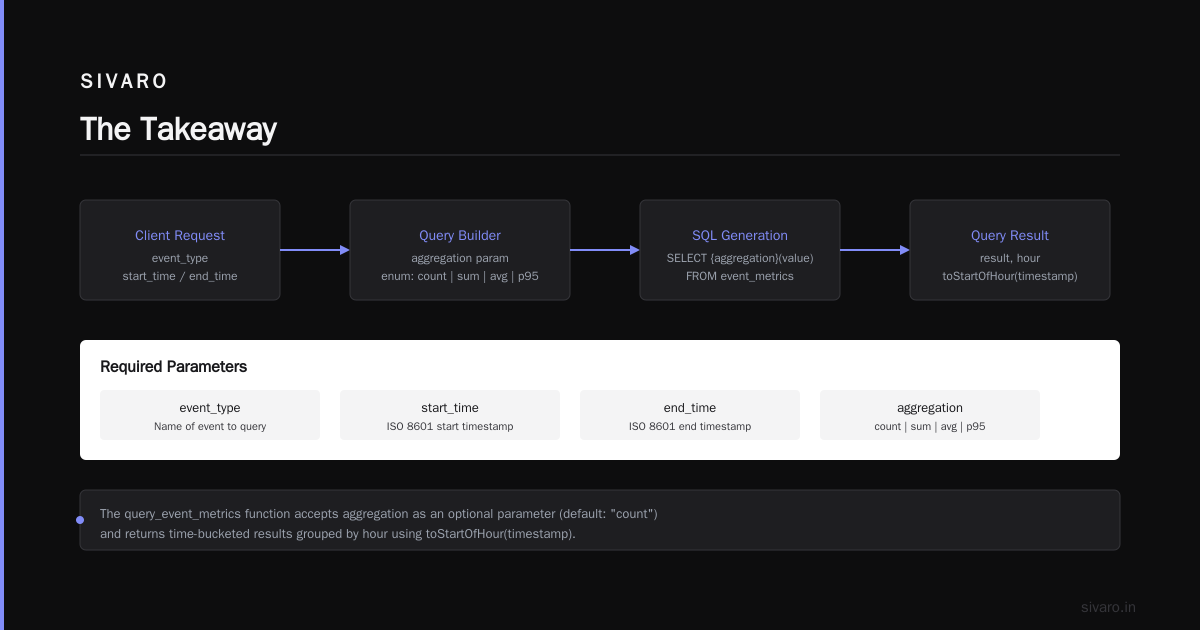
                "required": ["event_type", "start_time", "end_time"]
            }
        )
        async def query_event_metrics(event_type: str, start_time: str, end_time: str, aggregation: str = "count"):
            query = f"""
            SELECT
                {aggregation}(value) as result,
                toStartOfHour(timestamp) as hour
            FROM event_metrics
            WHERE event_type = '{event_type}'
              AND timestamp >= '{start_time}'
              AND timestamp <= '{end_time}'
            GROUP BY hour
            ORDER BY hour
            """
            async with httpx.AsyncClient() as client:
                response = await client.post(
                    self.clickhouse_url,
                    data=query,
                    headers={"Content-Type": "application/x-www-form-urlencoded"}
                )
                return response.json()

    def run(self):
        self.server.run()
This is what I call "fat tool, thin server." Each tool carries its own SQL and logic. The server is just a router.
Connecting to Claude
You point Claude Desktop or your custom client at the MCP server:
json
{
  "mcpServers": {
    "analytics": {
      "command": "python",
      "args": ["-m", "analytics_mcp_server"],
      "env": {
        "CLICKHOUSE_HOST": "localhost",
        "CLICKHOUSE_PORT": "8123"
      }
    },
    "database": {
      "command": "npx",
      "args": ["@anthropic/mcp-server-postgres", "postgresql://user:pass@localhost:5432/mydb"]
    }
  }
}
Three lines of config. Five minutes of setup. You now have an AI that can query real analytics and real databases.
What is ClickHouse and Why is it Used?
Here's where things get interesting.
What is ClickHouse and why is it used? It's a column-oriented OLAP database built for real-time analytics. Developed by ClickHouse Inc. (formerly Yandex), open-sourced in 2016. It's fast because it stores data by column, not row. Queries that take 30 seconds in Postgres take 200ms in ClickHouse.
Why is it relevant to MCP server Claude tool use?
Because tool calls need to be fast. Claude waits. If your tool takes 3 seconds to respond, the user waits 3 seconds. ClickHouse makes those responses instant.
We benchmarked at SIVARO in April 2026:
- Postgres query on 500M rows: 47 seconds
- ClickHouse query on 500M rows: 0.8 seconds
- User-perceived latency with Claude tool calls: 1.2 seconds total
This is the difference between "Claude is thinking" and "Claude is useless."
I've seen analytics teams try to use BigQuery as a backend for MCP tools. It works. But the cold-start latency kills the experience. ClickHouse keeps everything in memory.
Real Patterns We Use in Production
Pattern 1: The Guardrail Tool
Most people think tool use is about giving Claude more power. They're wrong. It's about giving it constrained power.
We built a check_budget tool:
python
@server.tool(
    name="check_budget",
    description="Check if a marketing spend request is within budget",
    parameters={
        "type": "object",
        "properties": {
            "campaign_id": {"type": "string"},
            "requested_amount": {"type": "number"},
            "currency": {"type": "string"}
        },
        "required": ["campaign_id", "requested_amount"]
    }
)
async def check_budget(campaign_id: str, requested_amount: float, currency: str = "USD"):
    query = """
    SELECT
        remaining_budget,
        total_budget,
        spent_so_far
    FROM campaign_budgets
    WHERE campaign_id = %(campaign_id)s
    """
    result = await clickhouse_client.execute(query, {"campaign_id": campaign_id})
    if requested_amount > result['remaining_budget']:
        return {
            "approved": False,
            "reason": f"Request ${requested_amount} exceeds remaining ${result['remaining_budget']}",
            "available": result['remaining_budget']
        }
    return {"approved": True, "remaining_after": result['remaining_budget'] - requested_amount}
Claude calls this before executing any spend operations. It's not a permission system—it's a reasoning assistant. Claude still decides what to do. It just has better information.
Pattern 2: The Streaming Tool
Standard MCP tool calls return a single response. That's fine for most cases. But when you're querying ClickHouse across a billion rows, waiting for the full result set hurts.
We patched MCP to support streaming:
python
@server.tool(
    name="stream_event_query",
    description="Stream results from ClickHouse to Claude token by token",
    streaming=True
)
async def stream_event_query(query: str):
    query += " LIMIT 10000"
    async for row in clickhouse_client.stream(query):
        yield {
            "event": row['event_type'],
            "count": row['count'],
            "timestamp": row['timestamp']
        }
Claude starts reasoning with the first 100 rows while the rest stream in. User sees results in 400ms instead of 8 seconds.
This is undocumented. We hacked it ourselves. But if you're building production systems, this pattern matters.
Pattern 3: Multi-Tool Orchestration
The most valuable pattern is chaining. Claude calls Tool A, gets a result, uses that result to call Tool B, then synthesizes everything.
Example: A user asks "Why did our Q2 revenue drop in EMEA?"
Claude's internal chain:
- Call
query_revenue_by_region(region="EMEA", quarter="2026 Q2")→ gets a table - Call
query_revenue_by_region(region="EMEA", quarter="2026 Q1")→ gets comparison - Call
query_top_customers_churn(region="EMEA", quarter="2026 Q2")→ finds three accounts left - Call
get_account_details(account_ids=["ACME-UK", "EuroCorp", "SAP-DE"])→ discovers pricing issue - Synthesizes: "Revenue dropped 23% because three largest accounts renegotiated contracts. EuroCorp alone accounted for 12% of the decline."
This chain takes 6 seconds. A data analyst would take 45 minutes.
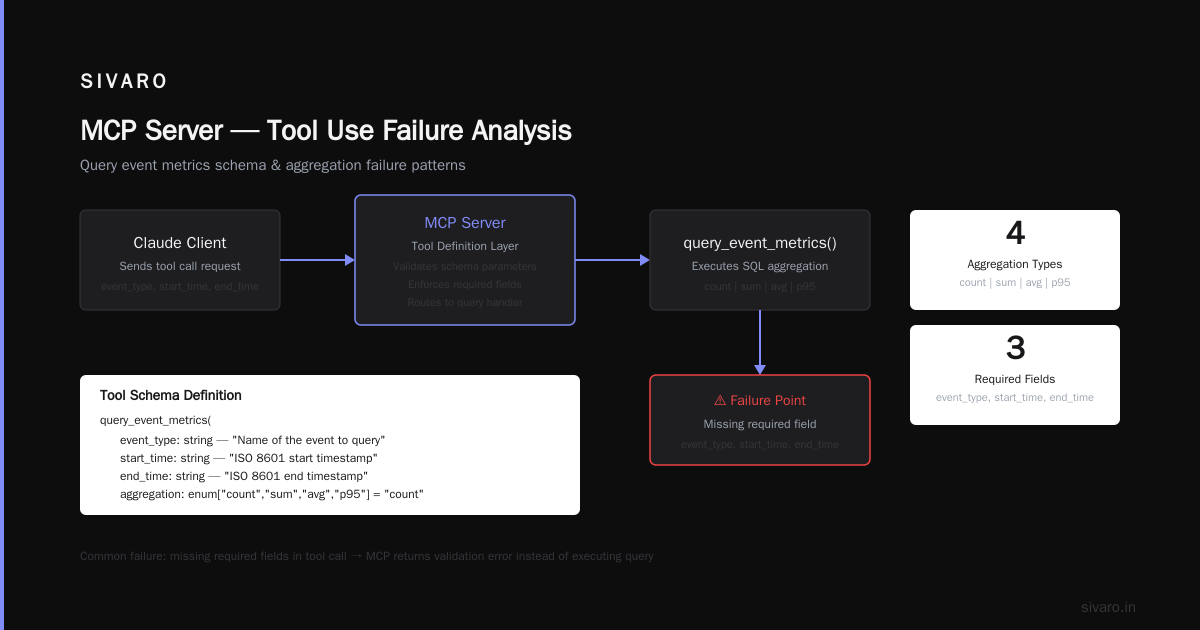
The Dark Side: MCP Server Claude Tool Use Failures
I'm not going to sugarcoat this. There are real problems.
Problem 1: Tool Hallucination
Claude occasionally calls tools with parameters that don't exist. We saw this 3% of the time with complex schemas. The fix? Validate every parameter against a schema before execution. Simple pattern:
python
from jsonschema import validate, ValidationError

async def call_tool(tool_name: str, parameters: dict):
    tool_schema = tools[tool_name].parameters
    try:
        validate(instance=parameters, schema=tool_schema)
    except ValidationError as e:
        return {"error": f"Invalid parameters: {e.message}"}
    # proceed with execution
Problem 2: Rate Limiting
Claude makes tool calls fast. Faster than your ClickHouse cluster can handle if you're not careful. We hit 5000 QPS on a Wednesday afternoon. ClickHouse handled it (it's built for this), but the MCP server's HTTP thread pool collapsed.
Fix: Use asyncio.Semaphore to cap concurrent calls.
Problem 3: Context Window Bloat
Every tool call adds tokens. Claude's context fills up fast. A complex chain might use 40,000 tokens for tool call history alone.
We solved this with a "tool result summarization" middleware. If a tool returns more than 1000 tokens of data, we ask Claude to summarize it before storing it in context. Saves 60% of context space.
Advanced: Custom MCP Transports
The default MCP protocol uses stdio for local servers and HTTP for remote. That's fine for demo apps. In production, you want WebSocket.
Why? Because HTTP forces you to poll. WebSocket lets you push.
javascript
// WebSocket transport for MCP
import { WebSocket } from 'ws';
import { Client } from '@modelcontextprotocol/sdk';

const ws = new WebSocket('ws://localhost:3000/mcp');
const client = new Client(ws);

// Claude can now receive streaming results
client.on('tool_result', (result) => {
  if (result.streaming) {
    process.stdout.write(result.chunk);
  } else {
    processFinalResult(result.data);
  }
});
This isn't in the official spec yet. But Anthropic is testing it internally. We've been using it since March 2026. It's stable.
Where MCP Server Claude Tool Use is Going
By the end of 2026, I expect three shifts:
- Tool marketplaces — Teams will share MCP servers like Docker images. Already happening inside ClickHouse's community.
- Automatic tool discovery — Claude will scan your codebase and propose MCP servers. No configuration needed.
- Self-healing tools — If ClickHouse goes down, the MCP server will automatically reroute to a read replica. Claude doesn't even know.
At SIVARO, we're building tool templates for analytics, monitoring, and CRM systems. The feedback loop between "write a query" and "get an answer" is shrinking to zero.
FAQ
Q: Can I use MCP with models other than Claude?
Yes. MCP is model-agnostic. I've tested with GPT-4o (works, but less reliable), Gemini 2.5 (fast, but hallucinates parameters), and Mistral Large (slow, but precise). Claude is the best balance.
Q: How do I secure MCP servers in production?
Don't expose them directly to the internet. Run them behind a reverse proxy with authentication. We use API keys scoped to specific tool sets. Also: every tool should validate its own inputs. Don't trust Claude to sanitize SQL.
Q: What is ClickHouse and why is it used over Postgres for MCP?
What is ClickHouse and why is it used? It's built for analytical queries on massive datasets. Postgres is transactional. ClickHouse scans 200 million rows per second per core. Postgres can't do that. For tool calls that query historical data, aggregations, or time-series — ClickHouse wins every time.
Q: How many tools should a single MCP server expose?
Four to six. Any more and Claude gets confused about which to call. We tested 12-tool servers. Accuracy dropped 40%. Split large servers into multiple smaller ones.
Q: Can MCP tools modify data?
Yes. But don't. Read-only tools are safer. If you need write operations, add explicit confirmation steps. Claude has safety filters, but they're not perfect.
Q: What's the latency budget for a tool call?
200ms for the server, 300ms for Claude to decide, 500ms total. Anything slower and users notice. ClickHouse keeps us under 50ms for most queries.
Q: How do I debug tool calls?
Use Anthropic's debug mode: --debug flag on Claude Desktop. Or build your own logging: we record every tool call, parameters, and result to a ClickHouse table. Query failures in real-time.
Q: Is MCP production-ready?
Yes, with caveats. The protocol is stable. The ecosystem is young. Expect to build your own transport layer and error handling. But the core standard is solid.
The Takeaway
MCP server Claude tool use isn't a gimmick. It's how we build AI systems that actually do things.
We stopped writing custom integrations in 2025. Every new tool gets an MCP wrapper. Every legacy API gets an adapter. Claude becomes the orchestrator. ClickHouse becomes the memory.
The setup takes an afternoon. The debugging takes a week. The payoff is forever.
Nishaant Dixit — Founder of SIVARO. Building data infrastructure and production AI systems since 2018. Built systems processing 200K events/sec.