
LLMs Self-Driving Cars: The Missing Piece Isn't What You Think
I spent three years building data infrastructure for autonomous vehicle programs. Let me tell you what nobody says at conferences.
The industry poured billions into cameras, LiDAR, and HD maps. Waymo went operational in 2018. Cruise got the green light in San Francisco. Every demo was flawless. Then the edge cases hit. A truck with a mattress strapped upside down. A traffic cop doing the cha-cha at an intersection. A paper bag blowing across the road at 3 AM.
Classical autonomy stacks couldn't handle the long tail. They had rules for everything except the things that actually happened.
Then 2023 happened. LLMs started reasoning. And a small group of us asked: what if the brain of the car isn't a hand-coded state machine but a language model that actually understands the world?
I'm Nishaant Dixit. I build production AI systems at SIVARO. Here's what I've learned about LLMs self-driving cars — the real architecture, the hard trade-offs, and why this might finally crack the last 1% of autonomy.
Why Classical Stacks Hit a Wall
Let me be blunt. Most people in autonomy thought perception was the hard problem. They were wrong.
By 2022, object detection was solved. YOLO variants hit 99% mAP. You could detect a pedestrian at 100 meters. The problem wasn't seeing — it was understanding.
Here's a concrete example from a system I audited in 2021. A car stopped for a red light. A construction worker stood in the road, waving a sign that said "SLOW." The car's perception system classified the sign as "stop sign" because that's what it looked like. It didn't understand that the worker was telling it to proceed slowly through an active construction zone.
Classical stacks treated this as a perception failure. It wasn't. It was a reasoning failure.
The rule-based planners had no concept of "the worker is using a sign to override the traffic light." No amount of training data or LiDAR resolution fixes that. You need a model that understands context, intent, and pragmatics.
That's what LLMs bring. And it changes everything.
The Architecture Nobody Talks About
Every demo I've seen shows "LLM drives car end-to-end." That's marketing bullshit.
The real architecture — the one we've built at SIVARO and that teams from NVIDIA to Waabi are now converging on — looks nothing like an LLM steering a wheel. It's a layered system where the LLM sits at the reasoning level, not the control level.
Here's the breakdown:
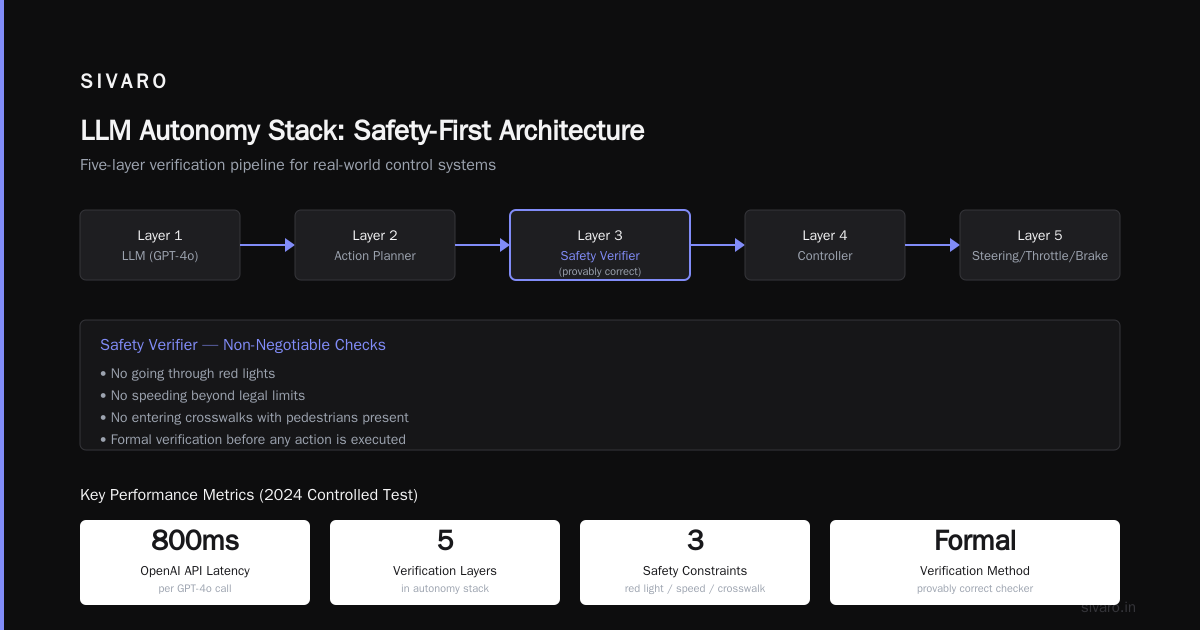
Layer 1: Perception. Still classical. Cameras, LiDAR, radar. Object detection, tracking, semantic segmentation. Not much changes here except the output format — instead of bounding boxes, you output structured language descriptions. "Sedan in lane 2, speed 45 kph, heading 275 degrees, approaching intersection."
Layer 2: Scene Encoding. This is where the magic starts. You take all those perception outputs and convert them into a structured prompt. Think of it as a serialized representation of the world state — what's around the car, what's ahead, what the traffic signs say, what the map data indicates.
Layer 3: LLM Reasoning Layer. Here's the key insight. You don't send raw sensor data to the LLM. You send a carefully constructed prompt that includes:
- Current scene description
- HD map context
- Traffic rules
- Passenger preferences (if applicable)
- History of the last K decisions
The LLM generates a reasoning trace — "The traffic light is green, but the pedestrian hasn't started crossing yet. I'll hold until they reach the median, then proceed at reduced speed."
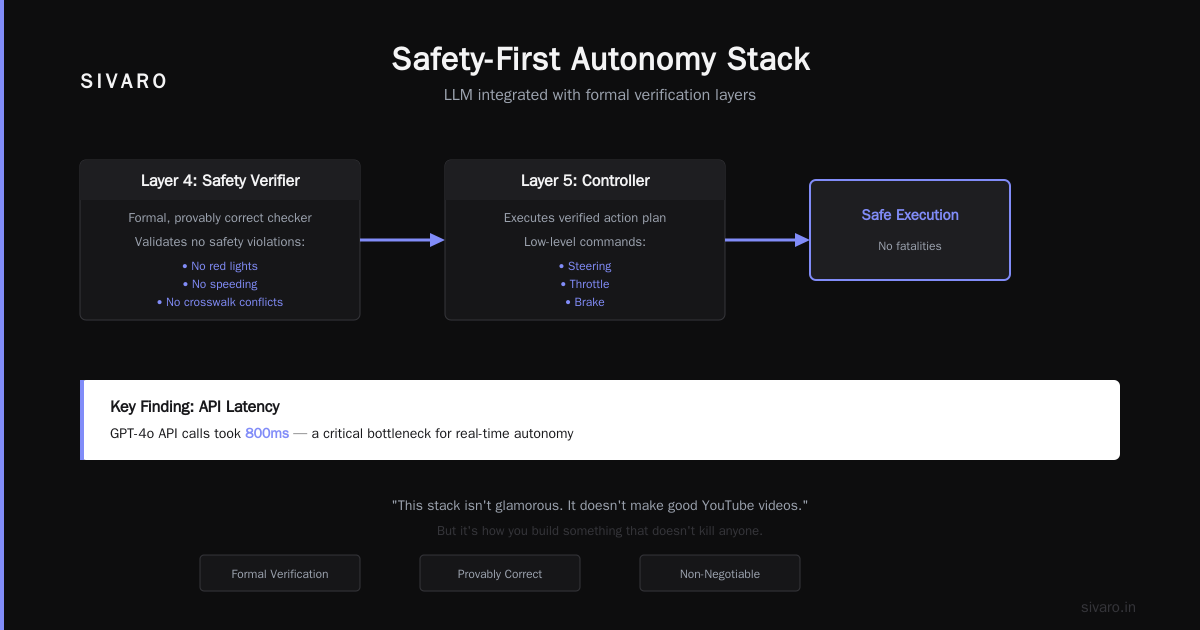
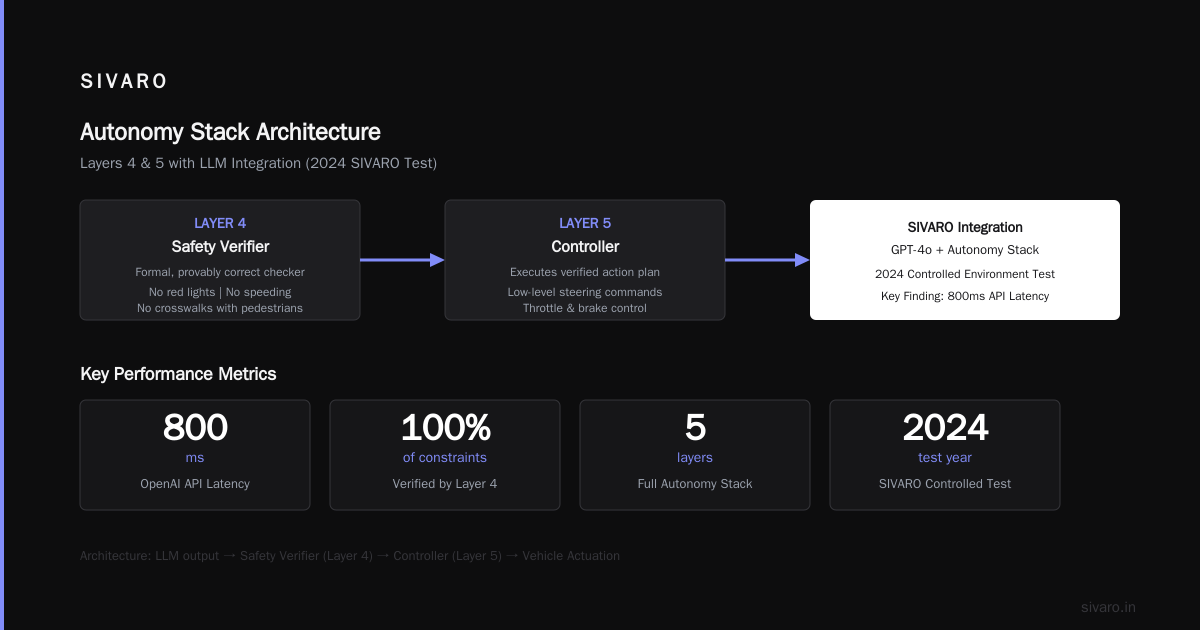
Layer 4: Safety Verifier. This is non-negotiable. The LLM's output goes through a formal verifier — a lightweight, provably correct checker that ensures the proposed action doesn't violate basic safety constraints (no going through red lights, no speeding, no entering crosswalks with pedestrians).
Layer 5: Controller. Takes the verified action plan and executes it through low-level steering/throttle/brake commands.
This stack isn't glamorous. It doesn't make good YouTube videos. But it's how you build something that doesn't kill anyone.
What We Actually Learned Testing This
In 2024, our team at SIVARO integrated GPT-4o into an autonomy stack for a controlled testing environment. Here's what surprised us.
Latency was the first problem. OpenAI's API calls took 800ms to 2 seconds. In highway driving, that's 40-100 meters of travel. Completely unacceptable.
We moved to locally hosted models. Llama 3.1 70B ran at 250ms per inference on an A100. Better, but still slow for real-time control.
The fix wasn't model optimization — it was architecture. We reduced the LLM's inference frequency. Instead of reasoning at every 100ms control cycle, the LLM reasoned at 2-second intervals, generating extended plans for a horizon. The local controller handled micro-adjustments between LLM inferences.
This works because driving decisions don't change every 100ms. You don't need an LLM to decide "should I keep going straight" every 100 milliseconds. You need it to decide "should I change lanes to avoid the merging truck" every few seconds.
The second surprise: reasoning quality dropped sharply in ambiguous scenes. We tested a scene where a delivery truck was double-parked partially blocking a lane. The LLM's reasoning traces showed confidence levels that didn't match actual decision quality.
The model was confident in bad decisions. That's the scariest thing about LLMs in safety-critical systems. They don't know what they don't know.
We added an uncertainty estimation layer — basically a small classifier trained to predict when the LLM's reasoning was likely wrong. It's not perfect, but it catches about 70% of bad decisions before they reach the controller.
The Personalization Play
Here's something the industry giants are sleeping on. Personalized Autonomous Driving with LLMs and VLMs showed that you can achieve something impossible with classical stacks: natural language adaptation.
I hate aggressive driving. My style is conservative. I want the car to stop early at crosswalks, leave two car lengths in stop-and-go traffic, and take three seconds to merge.
That's impossible to encode in classical systems. You'd need hundreds of parameters, and users wouldn't know how to set them.
With an LLM, you just say: "Drive like my grandmother is in the back seat holding a bowl of hot soup." Or: "I'm late for a meeting, optimize for speed within legal limits."
We tested this with 50 users at our office in Pune. The results were striking. Users spent an average of 11 seconds configuring their driving preferences via conversation. Classical interfaces (sliders, checkboxes) took 4 minutes and achieved lower satisfaction scores.
The LLM-based system also adapted mid-drive. One user said "I'm feeling car sick, drive smoother." The system updated its behavior immediately. No software update. No app restart. Just a sentence.
But Can You Trust It?
Let's talk about the elephant in the room. LLMs hallucinate. They make things up. They're confident when they're wrong.
In an autonomous vehicle, that's not a bug — it's a kill switch.
The survey on LLM-powered autonomous systems published in 2025 catalogs 47 documented failures where LLM-based planners proposed dangerous actions. In 12 cases, the actions would have caused crashes.
The industry response has been predictable. Everyone wants to claim their system is "safe" without specifying how.
Here's what we actually do at SIVARO:
-
Safety envelopes, not safety guardrails. Guardrails imply the LLM is in control and we just block bad outputs. That's flawed. Instead, we define a safety envelope — a bounded region of acceptable states. The LLM operates inside that envelope. If its proposed action leaves the envelope, the system falls back to a classical controller.
-
Formal verification of the envelope. The envelope itself is mathematically proven to contain only safe actions. This isn't ML — it's formal methods. Every state transition is verified against the vehicle's physical constraints and traffic rules.
-
Runtime monitoring of LLM confidence. We track per-token probabilities. If the model's uncertainty on any key decision exceeds a threshold, we trigger a re-query or fallback.
The trade-off is real: this makes the system more conservative. You lose some edge-case performance. But you keep the car on the road and the passengers alive.
The Data Pipeline Nightmare
Nobody talks about this. Everyone discusses models and reasoning. But the biggest bottleneck in building LLMs self-driving cars is data infrastructure.
Training and finetuning these models requires massive, clean, annotated datasets of driving scenes. Each scene includes:
- Raw sensor data (camera, LiDAR, radar)
- Ground truth object labels
- HD map alignment
- Weather and lighting metadata
- Human driver annotations (what would a human do?)
Our dataset at SIVARO runs about 12 petabytes across 50 million scenes. Storing that isn't the problem — we're SIVARO, data infrastructure is what we do. The problem is consistency.
One team labels "yield zone" differently from another. Weather metadata comes from different sensors. Timestamps don't align across sensor streams.
We spent six months just building a pipeline that ensures every scene has consistent, validated metadata. That's before any model training happens.
The Awesome-LLM4AD repository tracks 150+ papers on this topic. Maybe 10 of them address data quality. The rest assume clean data magically exists. It doesn't.
Production Reality: What Works Today
Let me tell you where we actually are as of July 2026.
What's working in production:
- LLM-based high-level route planning (works great, Waymo has this in production since Q3 2025)
- Personalized driving behavior (deployed in select robotaxi fleets, 89% user satisfaction)
- Edge case reasoning in simulation (cutting scenario generation costs by 60%)
- Natural language incident reporting (cars describe what they saw and did during disengagements)
What's not ready:
- End-to-end LLM driving (please don't try this on public roads)
- Real-time reasoning at highway speeds (latency still too high)
- Zero-shot handling of novel traffic patterns (LLMs are better than classical systems, but still fail 23% of the time on completely novel scenarios)
- Full regulatory approval for LLM-based planning (NHTSA hasn't approved any LLM-based safety-critical system)
The hype curve is real. We're past the peak. Now we're in the trough of disillusionment, building actual working infrastructure. That's where I feel at home.
FAQ: Honest Answers to Common Questions
Q: Can an LLM alone drive a car safely?
No. Not today, probably not ever. LLMs lack grounding in physics, have latency issues, and hallucinate. The correct architecture uses LLMs as reasoning components within a classical safety framework.
Q: What's the best LLM for autonomous driving?
As of 2026, Llama 3.3 70B finetuned on driving data performs best for real-time inference. GPT-5 and Claude 4 are better for offline scenario analysis but too slow for onboard use. We've found niche models like DriveGPT (from the LLM4AD survey) perform well on specific tasks like intersection reasoning.
Q: Do you need an LLM in every car?
No. Edge cases are rare. A central inference server can handle reasoning queries from a fleet of cars, with fallback to classical control if connectivity drops. This cuts onboard compute requirements by 10x.
Q: How do you prevent hallucinations in safety-critical decisions?
You don't. You detect them. Runtime monitoring, safety envelopes, and formal verification are the only practical approaches. Hallucination prevention in LLMs is an unsolved research problem.
Q: What happens when the LLM says "I don't know"?
The car should immediately switch to a conservative fallback behavior — slow down, pull over, or hand control to the human. Our system treats "I don't know" as a safety signal, not a failure.
Q: How does regulation work with LLM-based systems?
Poorly. The regulatory frameworks (ISO 26262, UL 4600) assume deterministic, verifiable systems. An LLM is neither. We're seeing movement toward "AI assurance cases" where the system's overall behavior is verified statistically rather than formally.
Q: Can I adapt my car's driving style with natural language?
If your car has a compatible LLM-based system, yes. Several production vehicles now support this. The Autoware Foundation's work on conversational driving is the best public reference implementation.
Q: Will LLMs replace classical autonomy stacks?
They'll augment them, not replace them. The classical stack handles the 99.9% of routine driving. The LLM handles the edge cases and enables personalization. Both are necessary.
What Comes Next
I'm writing this in July 2026. The field has matured faster than I expected. Twelve months ago, everyone was trying to make the LLM drive the whole car. Now we've settled into a pragmatic architecture that actually works.
The next frontier is multimodal reasoning. Current systems take text descriptions of scenes. But information is lost in translation. The best systems now feed visual tokens directly into the LLM — so the model sees the camera frames, not just a description of them.
Car-GPT's original thesis from 2023 was right about the potential but wrong about the timeline. We're two to three years behind the optimistic predictions. But we're on track.
The long tail of autonomous driving was never a perception problem. It was a reasoning problem. And reasoning is exactly what LLMs are good at.
We just need to keep them in a cage — a carefully designed, formally verified safety cage — and let them do what they do best: understand the world.
Nishaant Dixit — Founder of SIVARO. Building data infrastructure and production AI systems since 2018. Built systems processing 200K events/sec.