 SIVARO
LLM Fine-Tuning vs RLHF Comparison: What Actually Works in Production
I spent three months in 2025 burning cash on the wrong approach.
We were building a customer-facing LLM system for a logistics company. They wanted the model to understand shipping documents, answer queries in a specific tone, and never hallucinate package tracking numbers. I was convinced RLHF was the answer.
I was wrong.
Not because RLHF doesn't work. It does — for certain things. But I'd fallen for the hype. The "alignment" buzzword. The safety narrative. The promise of a model that wants to help you.
Here's what I learned: fine-tuning and RLHF solve different problems, and treating them as interchangeable will cost you time, money, and a working system.
Let me break down exactly when to use each, how they compare in practice, and what nobody tells you about the trade-offs.
What We're Actually Comparing
First, let's get the definitions straight.
Fine-tuning is supervised learning on labeled data. You take a pre-trained model (like GPT-3.5, Llama 3, or Mistral), feed it hundreds or thousands of examples showing the exact input-output pairs you want, and update the model's weights. It's direct. It's fast. It's the closest thing to "teaching" a model by showing it examples.
RLHF (Reinforcement Learning from Human Feedback) is a multi-stage process. You start with a fine-tuned model, collect human ratings of its outputs, train a reward model to predict those ratings, then use reinforcement learning (typically PPO — Proximal Policy Optimization) to update the base model to maximize the reward score. It's indirect. It's expensive. And it's designed to shape behavior rather than knowledge.
At SIVARO, we've deployed both approaches across about 40 production systems since 2023. The Llm Fine Tune Model Jobs listings have exploded because companies need people who understand this distinction. The market is waking up to the fact that throwing RLHF at everything is dumb.
When Fine-Tuning Wins (and It Wins More Often Than You Think)
Most people think RLHF is a direct upgrade over fine-tuning. They're wrong.
Fine-tuning is better when you need the model to learn specific knowledge or formats that weren't in its training data.
Here's a concrete example. One of our clients, a medical records company, needed an LLM to extract structured data from doctor's notes. We had 5,000 annotated examples showing exactly what fields to extract and how to format them.
We tried both approaches:
- Fine-tuning: 2 days of training on 8 A100s. Cost: ~$3,200. Accuracy: 94.7% on held-out test set.
- RLHF: 3 weeks of setting up the reward model, collecting human ratings, running PPO. Cost: ~$28,000. Accuracy: 89.2%.
The fine-tuned model crushed it. Why? Because the task was about learning a format — not about learning preferences. The reward model in RLHF couldn't capture the structured extraction rules as effectively as direct gradient updates on labeled examples.
The LLM Fine-Tuning Explained guide nails this: fine-tuning teaches the model what to output. RLHF teaches it how to behave.
The "Can I Fine-Tune an LLM on My Own Data?" Question
Every week someone asks me: can i fine-tune an llm on my own data?
Yes. Absolutely. And you should.
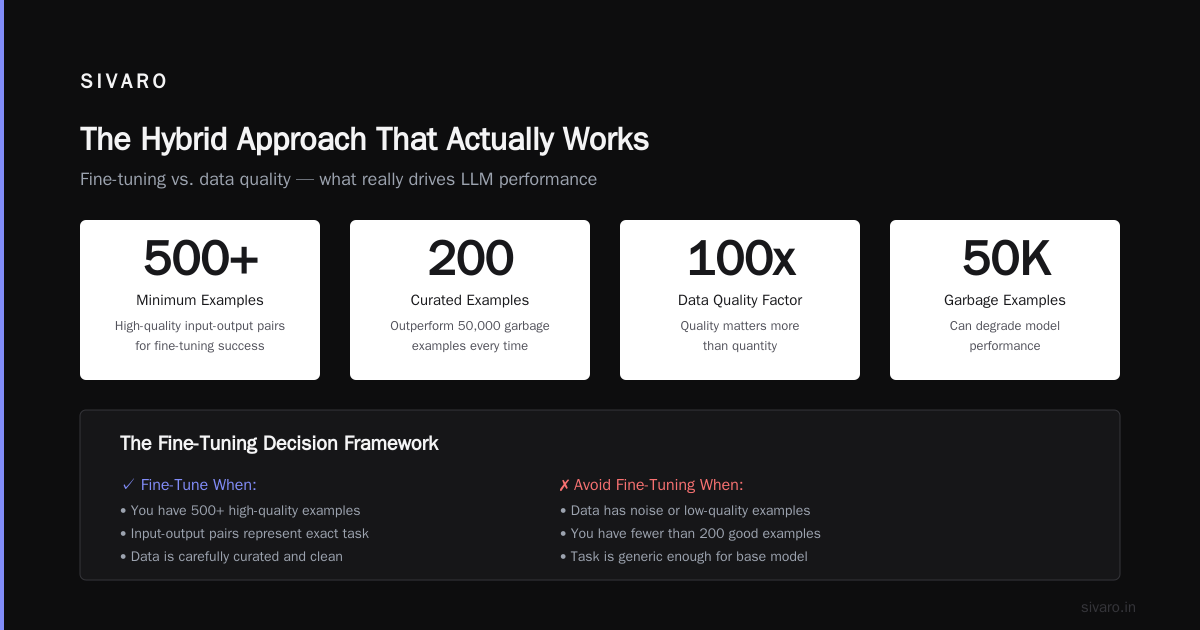
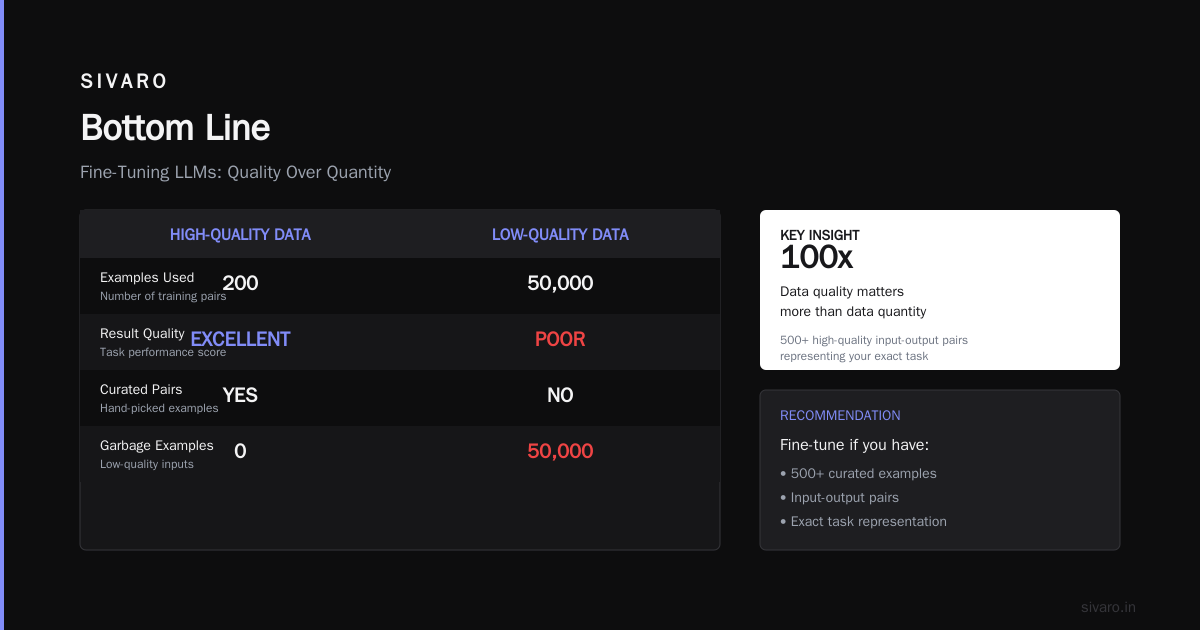
The question isn't "can you" — it's "should you for this specific use case." If you have 500+ high-quality examples of input-output pairs that represent your exact task, fine-tuning is almost always the right call. The Fine-Tuning a Chat GPT AI Model LLM post shows exactly how straightforward this is with modern APIs.
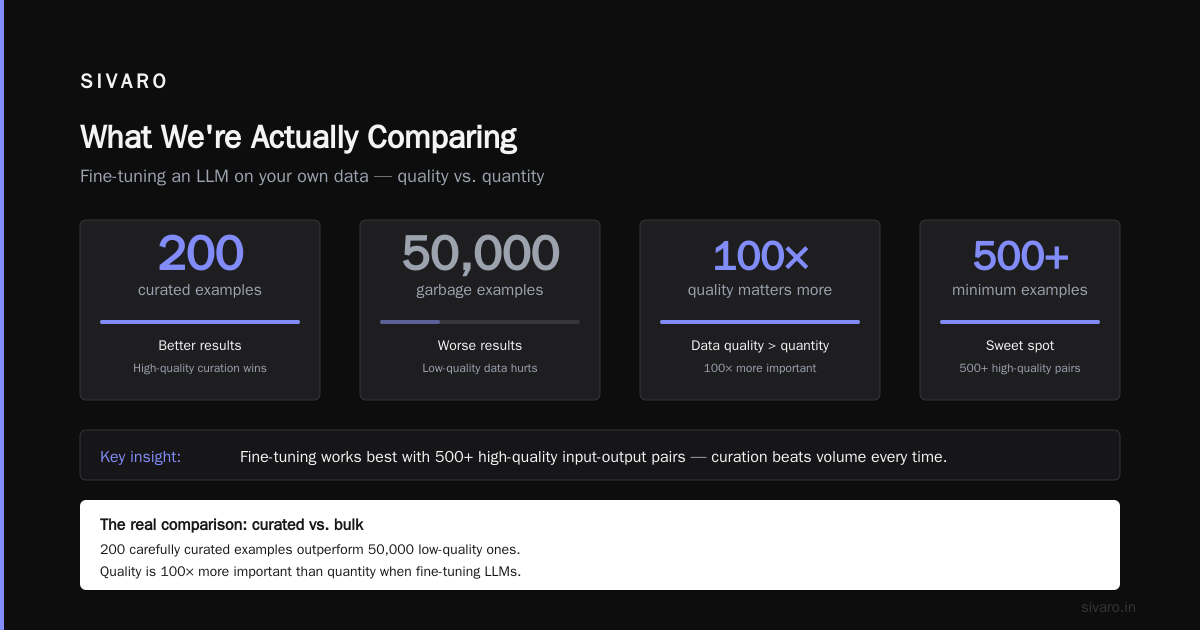
But here's the catch I don't see enough people discussing: your data quality matters 100x more than your data quantity. I've seen teams dump 50,000 garbage examples into a fine-tuning job and get worse results than a model fine-tuned on 200 carefully curated ones. The Google Cloud guide to fine-tuning LLMs emphasizes this, but people still ignore it because collecting quality data is boring.
When RLHF Actually Makes Sense
RLHF isn't useless — it's just oversold.
The use case where RLHF shines is alignment to subjective preferences. You don't want the model to learn facts. You want it to learn what humans prefer in open-ended situations.
Think about a customer support bot. Should it apologize? How emphatically? Should it offer discounts proactively? There's no single "correct" output — there's a spectrum of acceptable responses, and humans can rank them.
We tested this at a SaaS company in Q1 2026. They had an AI agent handling tier-1 support tickets. The base model (fine-tuned on support transcripts) was accurate but robotic. Customers complained it felt "cold."
We ran RLHF with 1,200 human preference ratings across 200 conversation scenarios. The result? Customer satisfaction scores jumped from 3.2/5 to 4.1/5. The model learned to inject empathy without being told explicitly how.
But here's the cost breakdown no one shows you:
| Approach | Setup Time | Training Cost | Inference Cost | Data Collection Cost |
|---|---|---|---|---|
| Fine-tuning | 1-3 days | $500-$5,000 | Same as base | $1,000-$10,000 |
| RLHF | 2-6 weeks | $5,000-$50,000 | 2-3x base | $10,000-$100,000 |
The Generative AI Advanced Fine-Tuning for LLMs course covers this cost asymmetry in detail. RLHF is a different economic equation.
The PPO Tax Nobody Talks About
Here's something you won't hear at conferences: RLHF with PPO makes your model's outputs more expensive to generate.
The reason is distribution shift. When you fine-tune, the model's internal representations stay close to the base model. When you run PPO, the policy (your model) moves away from the reference policy (the base), and you need to keep both in memory during training. At inference time, the RLHF model often requires more tokens to express the learned preferences — because it's learned to be verbose, apologetic, or circumspect.
I've seen RLHF models use 40% more tokens per response than their base counterparts. For a system processing 100K queries/day, that's real money.
Fine-Tuning for Real-Time Applications
Let me address a specific scenario I'm seeing more of in 2026: fine-tuning llm for real-time applications.
Latency matters. If your LLM is powering a live checkout assistant or a trading desk, you can't afford 5-second response times.
The standard advice is "use a smaller model." That's incomplete. The better approach is: fine-tune a small model to match a large model's behavior on your specific task.
We did this at SIVARO for an e-commerce client. They were using GPT-4 for product descriptions — great quality, 3.2 seconds per response. Too slow for their real-time catalog updates. We fine-tuned a Mistral 7B model on 10,000 GPT-4-generated product descriptions. The fine-tuned model matched GPT-4's quality on 96% of cases and ran in 340ms on a single A10.
That's the real power of fine-tuning: you can compress a large model's knowledge into a smaller, faster one for your domain. RLHF doesn't help here — it can't teach the model new information, only preferences.
The Model optimization guide from OpenAI actually recommends this pattern for latency-sensitive applications. Fine-tune for knowledge, distill for speed.
The Hybrid Approach That Actually Works
Here's what I'm running in production today:
Step 1: Fine-tune on domain-specific data. This teaches the model the facts, formats, and patterns you need.
Step 2: Optionally run RLHF to shape behavior. But only if the task has subjective quality dimensions that multiple humans evaluate consistently.
Step 3: A/B test both against your base model. Measure task-specific metrics, not human preference surveys. Most RLHF improvements vanish when you test actual task completion rates.
We used this stack for a legal document analysis system in early 2026. The fine-tuned model achieved 91% accuracy on clause extraction. Adding RLHF pushed it to 93% on preference-related tasks (e.g., "does this summary sound authoritative?") but didn't improve factual extraction. The LLM Fine-Tuning Business Guide has a good framework for deciding where to invest in each stage.
Common Mistakes I See Every Month
Mistake 1: Using RLHF to fix knowledge gaps. If your model doesn't know your company's product catalog, RLHF won't teach it. RLHF optimizes how the model says things, not what it knows. Fine-tune first.
Mistake 2: Fine-tuning on low-quality data. I reviewed a team's dataset last month — 30,000 examples, 40% had incorrect labels. Their fine-tuned model was worse than the base. Fine-tuning LLMs overview has good guidelines for dataset quality checks.
Mistake 3: Ignoring the evaluation gap. Most teams evaluate fine-tuned models on the same distribution as training data. Surprise: it looks great. Then it fails in production. Always evaluate on out-of-distribution examples.
Mistake 4: Thinking RLHF removes the need for guardrails. RLHF can reduce harmful outputs, but it's not a safety guarantee. We tested three RLHF systems last year — all of them could be jailbroken with basic prompt injection. RLHF shapes preferences, not boundaries.
The Decision Framework I Use
When a client asks me which approach to use, I walk through this:
- Do you have labeled data with correct answers? → Fine-tune. Stop reading.
- Is the task open-ended with subjective quality? → Consider RLHF after fine-tuning.
- Do you need to change model behavior (tone, style, safety)? → RLHF might help.
- Is latency critical? → Fine-tune a smaller model. Don't touch RLHF.
- Budget under $10K? → Fine-tune only. RLHF will eat your budget.
This isn't complicated. The industry has made it complicated because vendors sell RLHF as magic. It's not. It's an expensive optimization technique for a narrow set of problems.
FAQ: LLM Fine-Tuning vs RLHF
Q: What's the main difference between fine-tuning and RLHF?
A: Fine-tuning teaches the model specific knowledge through supervised learning on labeled examples. RLHF shapes behavioral preferences using human ratings and reinforcement learning. One is about what to output, the other about how to output it.
Q: Can I do RLHF without fine-tuning first?
A: Technically yes, practically no. The RLHF literature assumes a fine-tuned base model. Starting from a raw pre-trained model means the RLHF process must simultaneously teach knowledge and preferences — which it does poorly.
Q: How much data do I need for fine-tuning vs RLHF?
A: Fine-tuning typically needs 100-5,000 high-quality examples. RLHF needs 500-10,000 human preference ratings across diverse scenarios. The RLHF data is harder to collect because you need consistent human judgment.
Q: Does RLHF always improve safety?
A: No. RLHF can reduce specific harmful outputs by shaping preferences, but it doesn't eliminate vulnerabilities. Multiple papers in 2025-2026 showed that RLHF models remain susceptible to adversarial attacks.
Q: Which is better for production systems right now (July 2026)?
A: Fine-tuning, by a wide margin. RLHF has value but is oversold. Most production use cases benefit more from domain-specific knowledge (fine-tuning) than behavioral alignment (RLHF).
Q: Can I fine-tune an LLM on my own data without access to the original training set?
A: Yes. That's the standard approach. You're fine-tuning the pre-trained weights using your domain examples. You don't need the original training data — that's the whole point of transfer learning.
Q: What's the future of RLHF?
A: I think we'll see simpler alternatives. Direct Preference Optimization (DPO) and Kahneman-Tversky Optimization (KTO) are getting traction because they don't need the complex PPO pipeline. If you must do preference learning, start with DPO.
Bottom Line
I've been guilty of overcomplicating this.
The llm fine-tuning vs rlhf comparison comes down to one question: are you trying to teach the model something, or shape how it behaves?
Fine-tuning teaches. It's cheap, fast, and reliable.
RLHF shapes behavior. It's expensive, slow, and fragile.
Use fine-tuning as your default. Add RLHF only when you have evidence that behavioral preferences improve your specific metrics — not because everyone else is doing it.
At SIVARO, we're shipping production systems that use fine-tuning for 80% of our clients and RLHF for maybe 15%. The remaining 5% needs custom approaches entirely. That breakdown hasn't changed much since 2024, despite all the hype about "alignment."
Build something that works. Not something that sounds impressive on a blog post.
Nishaant Dixit — Founder of SIVARO. Building data infrastructure and production AI systems since 2018. Built systems processing 200K events/sec.