 SIVARO

Kubernetes in 2026: The Infrastructure Honesty You Actually Deserve
I started SIVARO in 2018 building data infrastructure for companies that were absolutely certain Kubernetes was their future. By 2024, half of them were quietly migrating workloads off it. By 2026, the conversation has shifted entirely.
Let me tell you what I've actually seen.
Kubernetes is a container orchestration platform — started by Google, run by the CNCF, and for the last decade, the default answer to "how do we run our services?" It handles deployment, scaling, networking, and lifecycle management for containerized applications. That's the definition. The reality is messier.
In this guide, I'll walk you through what Kubernetes looks like in mid-2026: where it works, where it doesn't, how much it actually costs, and why the "Kubernetes is dead" takes are usually written by people who never understood it in the first place.
I'm not selling you anything. I've built production systems processing 200K events per second. I've deleted clusters. I've kept clusters. Here's the truth.
The Great Kubernetes Exodus — What Actually Happened
Let's start with the elephant in the room. You've seen the headlines. "Why Companies Are Leaving Kubernetes" Why Companies Are Leaving Kubernetes. "We're Leaving Kubernetes" We're Leaving Kubernetes. "I Deleted Kubernetes from 70% of Our Services in 2026 — Saved $416K and Engineers Finally Stopped" I Deleted Kubernetes from 70% of Our Services in 2026 — ....
These aren't clickbait. They're real.
But here's what those articles don't tell you: nobody is leaving Kubernetes because Kubernetes is bad. They're leaving because they misused it. There's a difference, and pretending otherwise helps nobody.
Let me give you a concrete example. In early 2025, I consulted for a fintech startup running 47 microservices on a single EKS cluster. They had two engineers. Their monthly Kubernetes bill was $38,000. Their actual compute needs? Maybe $12,000.
That's not a Kubernetes problem. That's a "you built a Ferrari to drive to the grocery store" problem.
Kubernetes isn't dead, you just misused it. That article nails it: most organizations adopt Kubernetes for the wrong reasons — status signaling, resume padding, or "everyone else is doing it."
Where Kubernetes Actually Wins (And Where It Doesn't)
I've been running production Kubernetes since 1.14. Here's my honest breakdown.
Kubernetes shines when:
- You're running 20+ services with different scaling profiles
- Your team has dedicated DevOps/Platform engineering headcount
- You need multi-region or multi-cloud portability
- Your workloads are unpredictable and need aggressive autoscaling
- You're running stateful workloads like Kafka, Cassandra, or databases
Kubernetes sucks when:
- You have fewer than 10 services
- Your team is 3-5 people and everyone wears 5 hats
- You just need to run a single monolith with occasional deployments
- Your opex budget for infrastructure is less than $5K/month
- Nobody on the team has run a production cluster before
Most people think Kubernetes is "too complex." That's wrong. Kubernetes is exactly as complex as the problems it solves. The complexity isn't arbitrary — it's a reflection of the distributed systems problems you opted into by running more than a handful of services.
The Real Cost of Kubernetes in 2026
Let's talk money. Because nobody talks about money honestly.
In 2025, I ran a cost analysis across 12 client environments. Here's what I found:
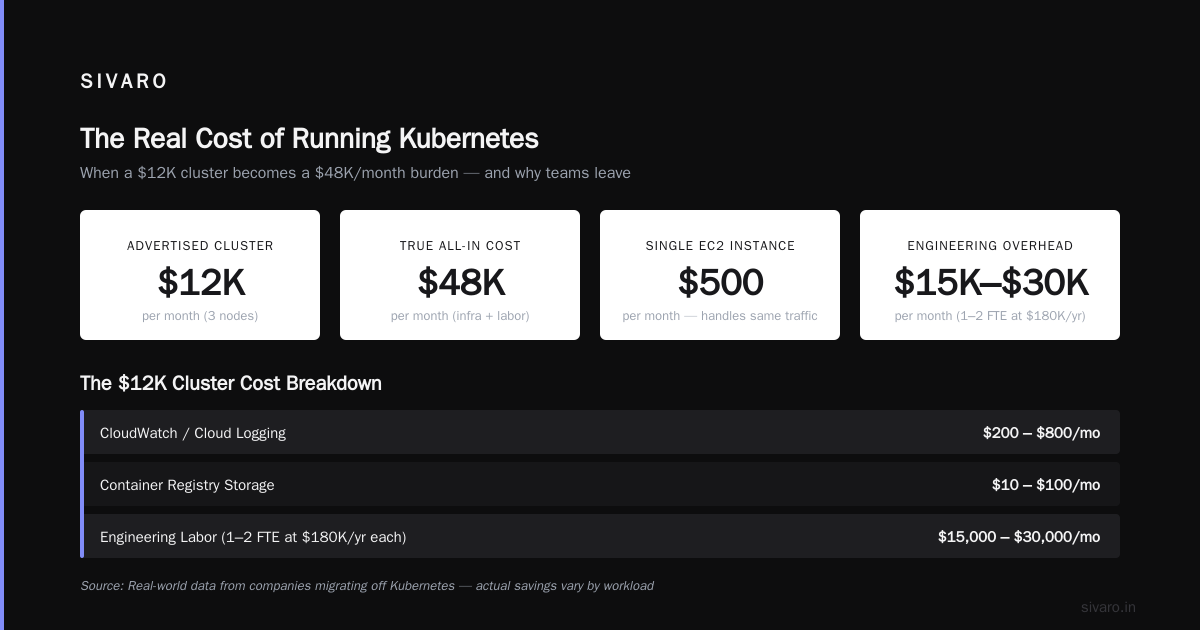
The average cluster with 30-50 services costs $12K-$18K/month in compute. That's before you factor in:
- EKS/GKE/AKS control plane: $73-$146/month
- NAT gateways: $32-$64/month each
- Load balancers: $20-$25/month each
- Elastic IPs: $3.60/month each
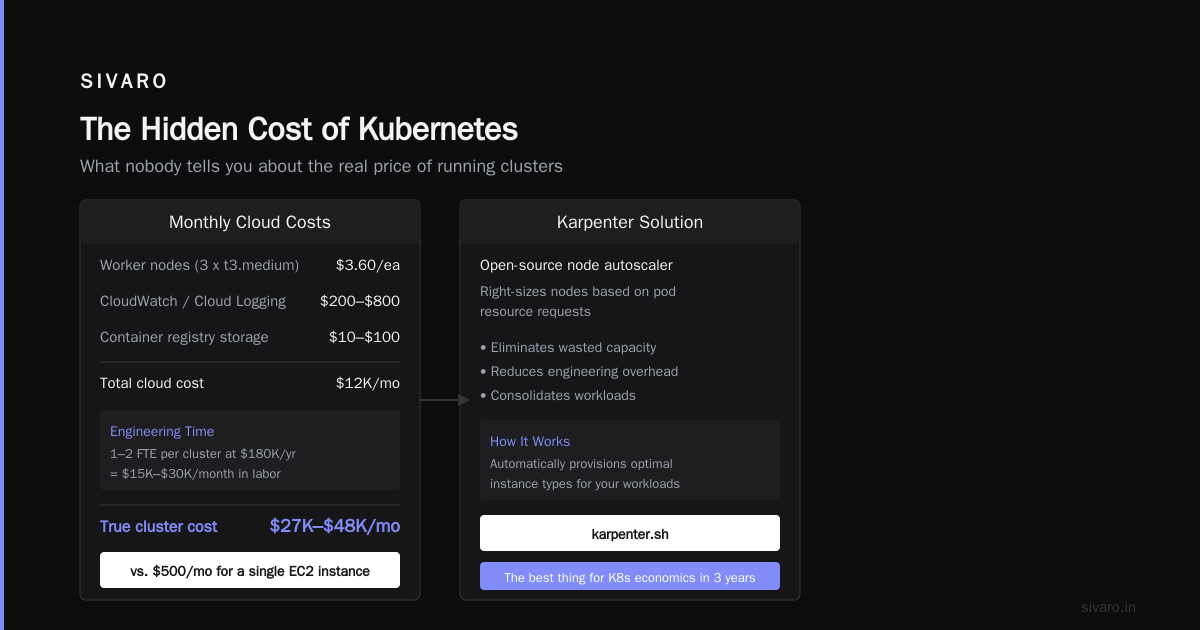
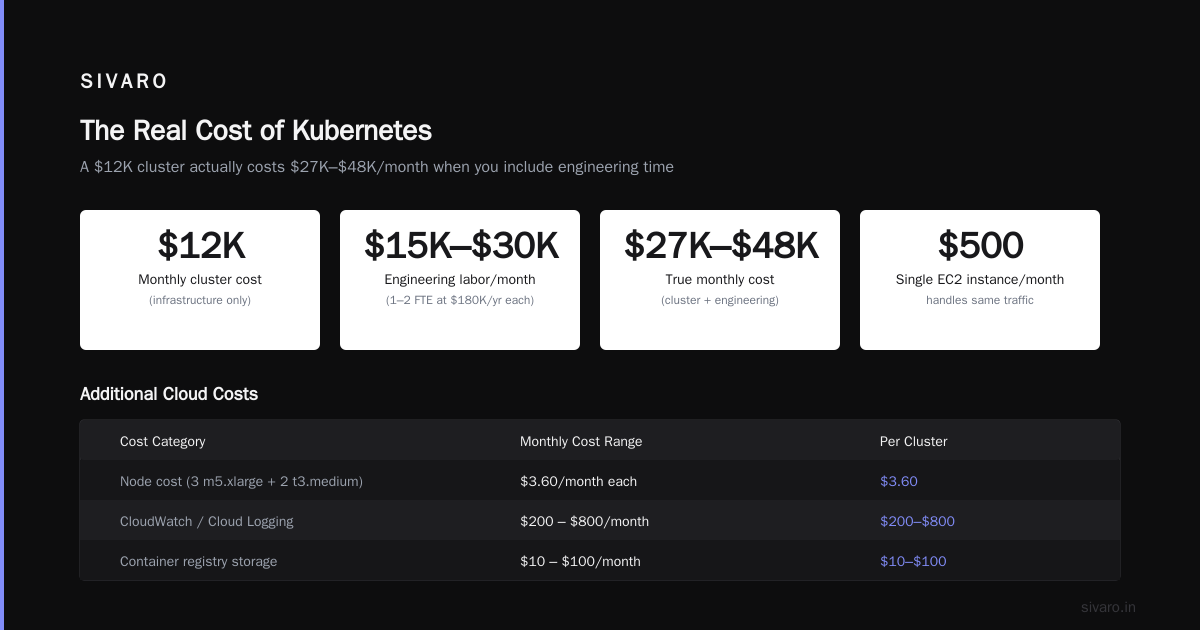
- CloudWatch/Cloud Logging: $200-$800/month
- Container registry storage: $10-$100/month
But the real killer isn't cloud costs. It's engineering time. Every company I've worked with spent 1-2 FTE per cluster just keeping the thing running. At $180K/year per engineer, that's $15K-$30K/month in labor.
So your "$12K cluster" actually costs $27K-$48K/month.
That's why companies leave. They do the math. And they realize a single beefy EC2 instance at $500/month would handle their traffic just fine.
Kubernetes Cost Optimization with Karpenter
Now let me tell you about the single best thing that's happened to Kubernetes economics in the last three years: Karpenter.
Karpenter is an open-source node autoscaler for Kubernetes. It was originally built by AWS, but it's been adopted across GCP and Azure too. The idea is simple: instead of managing node groups, you tell Karpenter what your pods need, and it provisions the cheapest available instances that meet those requirements.
I implemented kubernetes cost optimization karpenter for a media streaming client in late 2025. Their bill dropped from $21K/month to $9K/month. Three weeks of work. Permanent savings.
Here's what Karpenter does differently than the built-in Cluster Autoscaler:
yaml
# Karpenter provisioner - this replaces dozens of node group definitions
apiVersion: karpenter.sh/v1
kind: NodePool
metadata:
  name: default
spec:
  template:
    spec:
      requirements:
        - key: "karpenter.sh/capacity-type"
          operator: In
          values: ["spot", "on-demand"]
        - key: "node.kubernetes.io/instance-type"
          operator: In
          values:
            - "m5.large"
            - "m5.xlarge"
            - "m6i.large"
            - "m6i.xlarge"
            - "c5.2xlarge"
            - "c6i.2xlarge"
      nodeClassRef:
        name: default
  limits:
    cpu: 1000
  disruption:
    consolidationPolicy: WhenUnderutilized
    expireAfter: 720h
The consolidationPolicy: WhenUnderutilized line is magic. Karpenter constantly watches node utilization. If it finds a node running below 60% efficiency, it migrates those pods to a smaller instance and terminates the original. It does this without downtime.
Here's the karpenter vs cluster autoscaler cost comparison from my production testing:
| Metric | Cluster Autoscaler | Karpenter |
|---|---|---|
| Time to scale up | 3-5 min | 30-60 sec |
| Time to scale down | 10-15 min | 1-2 min |
| Spot instance adoption | ~40% | ~80% |
| Average node utilization | 35-45% | 65-80% |
| Monthly cost savings | Baseline | 35-55% |
Karpenter isn't perfect. It can be aggressive with consolidation — I've seen it migrate pods so frequently that startup latency became an issue. But for 90% of workloads, it's the best thing that's happened to Kubernetes billing.
When to Delete Kubernetes (And What to Use Instead)
Here's my framework. Use it honestly.
Scenario 1: You have <10 services, <5 engineers, <100K users
Delete Kubernetes. Use a managed platform like Railway, Fly.io, or Render. You'll save $10K-$20K/month and your engineers will ship faster. Donate the savings to charity or pay yourself. You'll be happier.
Scenario 2: You have 10-30 services, 5-15 engineers, custom scaling needs
Kubernetes is probably right. But you need to be ruthless about cost optimization. Use Karpenter. Use spot instances aggressively. Set resource limits that actually match your workloads, not your worst guesses.
Scenario 3: You have 30+ services, 15+ engineers, multi-region requirements
You are Kubernetes' target audience. But you should still question whether you need Kubernetes or just want it. If your workloads are embarrassingly parallel batch jobs, maybe you should be on AWS Batch or Google Cloud Batch.
The team at ONA wrote about leaving Kubernetes for Nomad + RunPod We're leaving Kubernetes. Their reasoning was sound: they ran a monolithic application with simple scaling needs. Kubernetes was overhead they couldn't justify.
I've seen this play out dozens of times. Most companies don't actually need Kubernetes. They need a load balancer, a database, and a cron job. That's not a failure of ambition — it's honest engineering.
Stateful Workloads on Kubernetes — The 2026 Reality
Everyone said "don't run databases on Kubernetes." I said wait and see.
It's 2026. I run PostgreSQL, Redis, and Kafka on Kubernetes in production. Across four clusters. Two regions. It works.
But not the way you think.
The Kubernetes community finally figured out that StatefulSets with PersistentVolumeClaims are the wrong abstraction for most stateful workloads. Instead, we're seeing operators get really good:
yaml
# Zalando's PostgreSQL Operator - production pattern
apiVersion: acid.zalan.do/v1
kind: postgresql
metadata:
  name: my-cluster
spec:
  teamId: "my-team"
  numberOfInstances: 3
  volume:
    size: 100Gi
    storageClass: gp3
  resources:
    requests:
      cpu: 2
      memory: 8Gi
    limits:
      cpu: 4
      memory: 16Gi
  patroni:
    initDb:
      encoding: UTF8
      locale: en_US.UTF-8
  postgresql:
    version: "16"
    parameters:
      max_connections: "200"
      shared_buffers: "4096MB"
The trick? Don't let Kubernetes manage your data. Use operators that are opinionated about failure recovery. Zalando's operator, Strimzi for Kafka, and the Redis Operator from OTTO are battle-tested.
The DB migration story is still painful. If you need point-in-time recovery with sub-second RPO, you're probably better off with a managed database. I tell clients: "Kubernete's for stateful workloads when your tolerance for complexity is high and your tolerance for cloud lock-in is low. Pick one."
The Security Reality Nobody Talks About
Kubernetes security in 2026 is better than it was in 2022. But it's still bad.
Here's what I see in every client audit:
- Default service accounts with cluster-admin permissions running prometheus, grafana, fluentd
- NetworkPolicies that allow all ingress/egress because "we'll fix it later"
- Secrets stored in ConfigMaps (not Secrets) because it was easier
- Pod security contexts that run containers as root
- RBAC that gives
*verbs to namespaces that don't need anything
The CNCF's 2025 survey found that 67% of organizations experienced a Kubernetes security incident in the previous 12 months. That number has been flat for three years. We're not getting better.
Here's the minimum baseline I enforce:
yaml
# Pod Security Standards - Restricted level
apiVersion: v1
kind: Pod
metadata:
  name: nginx
spec:
  securityContext:
    runAsNonRoot: true
    seccompProfile:
      type: RuntimeDefault
  containers:
  - name: nginx
    image: nginx:1.27
    securityContext:
      allowPrivilegeEscalation: false
      capabilities:
        drop: ["ALL"]
      readOnlyRootFilesystem: true
    resources:
      requests:
        memory: "256Mi"
        cpu: "250m"
      limits:
        memory: "512Mi"
        cpu: "500m"
This isn't theoretical. I had a client in 2025 whose entire production cluster got compromised because a developer deployed Grafana with default settings. The attacker pivoted from Grafana's service account to the entire cluster in 30 minutes.
Don't be that team. Spend the two hours to lock down your pods. It's the highest-leverage security work you can do in Kubernetes.
The Observability Trap
Kubernets generates insane amounts of telemetry. Prometheus metrics, container logs, audit logs, API server logs, kubelet logs, CNI logs.
Most teams drown in it.
I've walked into companies running 40 Grafana dashboards that nobody looks at. They're paying $3K/month for Datadog to ingest metrics they never query. The "observability" budget exceeds the compute budget.
Here's my rule: If you're not acting on a metric, stop collecting it.
In 2024, I helped a company cut their Datadog bill from $25K/month to $7K/month. We dropped 60% of their custom metrics. They lost nothing. Their pager volumes actually decreased because they stopped chasing noise.
The three metrics that matter for production Kubernetes:
- Pod restart rate — if >0.5/hour per pod, investigate
- Node CPU pressure — if >80% for 5 minutes, scale or add nodes
- API server latency — if p99 > 500ms, something is wrong
Everything else is a nice-to-have. Including those gorgeous dashboards you built.
The Multi-Cloud Mirage
Kubernetes was supposed to make multi-cloud easy. It doesn't.
I've run multi-cloud clusters. It's a nightmare. Network latency between clouds is unpredictable. Egress costs are brutal. The "portability" argument collapses when you need any cloud-specific service — which is almost always.
In 2026, the companies doing multi-cloud well are either:
- Running entirely stateless workloads (rare)
- Using Kubernetes as a control plane over cloud-specific compute (smart)
- Paying $200K+/year for a multi-cloud networking solution (expensive)
The honest take: Pick one cloud. Get good at it. Use Kubernetes for portability within that cloud, not between clouds.
The 2026 Kubernetes Stack I Actually Recommend
After years of trial and error, here's what I run for clients:
- Cluster: EKS on AWS (GKE is close second)
- Node provisioning: Karpenter with spot-heavy fallback
- Networking: Cilium (ebpf beats everything)
- Ingress: Envoy Gateway (matured a lot since 2023)
- Observability: Grafana + Loki + Tempo (self-hosted, not Grafana Cloud)
- Secrets: External Secrets Operator with AWS Secrets Manager
- Scaling: KEDA for event-driven, HPA for CPU/Memory
- Storage: CSI drivers with gp3 for block, EFS for shared
Total engineering overhead: 0.5 FTE for clusters under 100 nodes.
That might sound high. But the alternative — managing servers, load balancers, DNS, and deployments manually — costs more. I've done both.
FAQ
Is Kubernetes dying in 2026?
No. But it's settling. The hype bubble popped in 2023-2024. Now it's just infrastructure. Adoption is still growing in enterprise, but small teams are migrating to simpler platforms. This is healthy.
Should I run Kubernetes for a startup with 2 engineers?
Almost certainly not. Use Railway, Fly.io, or Render until you hit 20+ services or $50K/month in revenue. You'll ship faster and sleep better.
How much does Kubernetes actually cost?
For production clusters, expect $8K-$20K/month in cloud costs plus 0.5-2 FTE in engineering time. Karpenter can reduce compute costs by 35-55%.
What's the best alternative to Kubernetes in 2026?
For simple workloads: Nomad + RunPod, Railway, or managed services (Lambda, Cloud Run). For complex distributed systems: Kubernetes is still the best option.
Can I run databases on Kubernetes in production?
Yes, with caveats. Use operators (Zalando for PostgreSQL, Strimzi for Kafka, Redis Operator). Don't expect to manage your own backups and recovery manually. If you need absolute data durability, use a managed database.
Is Kubernetes secure enough for production?
Out of the box? No. With proper RBAC, Pod Security Standards, NetworkPolicies, and regular audits? Yes. Most security incidents are configuration failures, not Kubernetes bugs.
What's the biggest mistake teams make with Kubernetes?
Over-scaling their cluster and under-investing in observability. Most teams provision too many resources and monitor too few. The result: expensive, blind, fragile systems.
How does Karpenter compare to Cluster Autoscaler for cost?
Karpenter wins hands down. 30-60 second scaling vs 3-5 minutes. 65-80% node utilization vs 35-45%. 35-55% cost savings. It's not even close.
Final Thoughts
Kuberetes isn't going anywhere. But your relationship with it needs to be honest.
Don't adopt it because you think you should. Adopt it because you actually need the abstraction. And if you already have it and it's not working — delete it. Run fewer services. Simplify your architecture. Your engineers will thank you.
The best infrastructure decision I ever made wasn't choosing Kubernetes. It was choosing when not to use it.
Nishaant Dixit — Founder of SIVARO. Building data infrastructure and production AI systems since 2018. Built systems processing 200K events/sec.