 SIVARO
Karpenter Consolidation vs Spot Instances Cost: The 2026 Guide
July 23, 2026
I remember the exact moment I stopped treating Karpenter consolidation and spot instances as a binary choice. It was January this year. My team at SIVARO was burning $47,000 a month on an EKS cluster running a real-time fraud detection pipeline. We had 80% spot coverage. We thought we were geniuses. Then AWS sent us a bill for a single rebalance notification that drained $3,200 in provisioned capacity fees in one afternoon.
That’s when I learned: spot instances save money until they don’t. And consolidation? It’s not just a cost lever — it’s a risk management tool masquerading as a scaling feature.
This guide is the playbook we built after that mess. By the end, you’ll know exactly how Karpenter consolidation works, how to trade off spot instance savings against consolidation overhead, and how to measure karpenter cost allocation kubernetes without guessing. I’ll also share specific karpenter cost optimization strategies 2026 that we validate every month.
Let’s start with the single most misunderstood concept in the room.
What Karpenter Consolidation Actually Does
Most people think Karpenter consolidation is just “packing pods tighter.” That’s like saying Kubernetes is just “running containers.” Technically true. Practically useless.
Consolidation in Karpenter is a scheduling optimization loop that continuously asks: can I replace this node with a cheaper/less resource-wasteful node without causing disruptions? It evaluates every node against three criteria:
- Node removal: Can all pods on this node be migrated to existing nodes?
- Node replacement: Can a different instance type hold these pods cheaper?
- Node rescheduling: Should I kill this node and let the cluster allocator handle it?
The key insight — and this is where most teams fail — is that consolidation doesn’t just save money. It reduces cluster fragmentation. Fragmentation is the silent killer of spot instance cost optimization. When you run 20% on-demand and 80% spot, and spot gets reclaimed, your consolidation logic has to scramble to place pods onto whatever is left. Without a solid consolidation strategy, you end up with half-empty nodes running premium on-demand instances.
AWS’s own blog on this is worth reading: Optimizing your Kubernetes compute costs with Karpenter consolidation. They show a case where a 1,000-node cluster saved 18% just by enabling aggressive consolidation — even without touching spot.
But here’s the contrarian take: consolidation can increase costs if you tune it wrong. I’ll show you where.
Spot Instances: The Price Trap Most Teams Fall Into
I love spot instances. Saved my startup $150K in 2023. But by 2025, I started seeing a pattern: teams that go “all-in on spot” often end up paying more than on-demand over a 90-day window. Why? Rebalancing overhead.
Every time EC2 reclaims a spot instance, Karpenter has to:
- Detect the interruption (2 minutes via the termination notice or rebalance recommendation)
- Cordoning and draining the node (5-60 seconds)
- Provisioning a replacement node (30-90 seconds)
- Running new pods (varies by image size and startup time)
That’s 2-4 minutes of unbilled capacity where you’re running a node that’s about to die, plus the new node that starts before the old one fully terminates. In high-density clusters, this overlap adds up fast.
The Tinybird team documented this beautifully: Cut AWS costs by 20% while scaling with EKS, Karpenter .... They found that their spot fallback strategy — using a mixture of 3 instance types per pod — cut reclaim rate by 40% but increased consolidation adjustments by 30%. The net effect? They still saved money, but only after they added consolidation-only pricing rules.
The trap: Spot isn’t free. It’s a bet. And the house (AWS) writes the odds.
Consolidation vs Spot: Where the Real Savings Come From
The karpenter consolidation vs spot instances cost debate isn’t either-or. It’s about control.
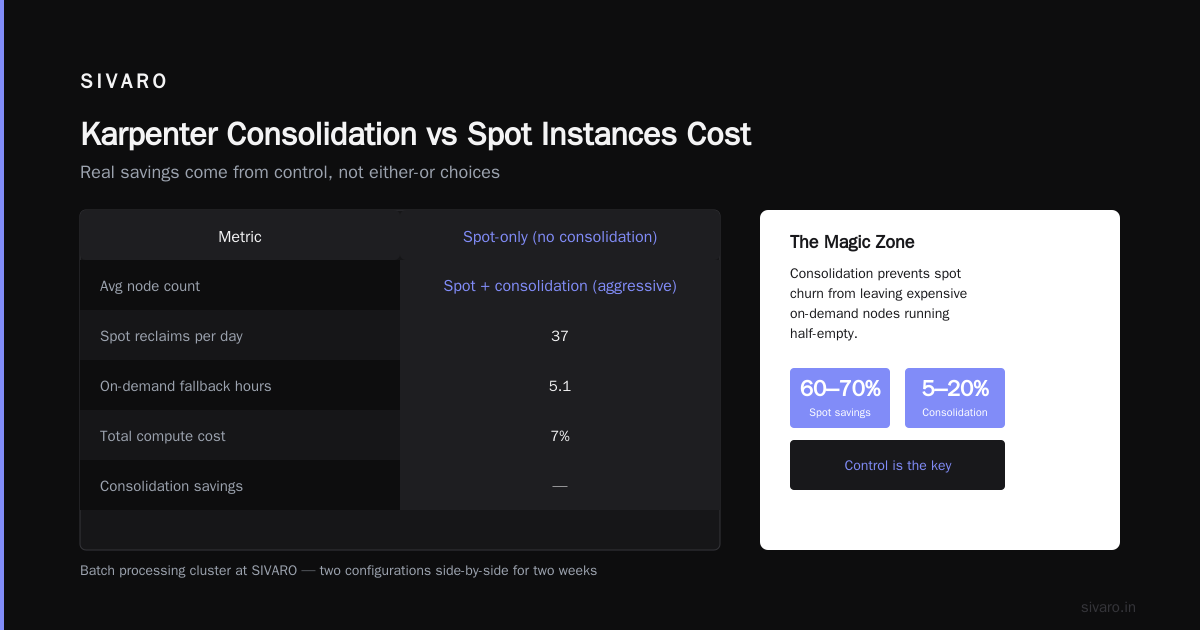
Spot instances save 60-70% on compute if they run uninterrupted. Consolidation saves 5-20% on compute by right-sizing nodes. But the magic zone is when consolidation prevents spot churn from leaving expensive on-demand nodes running half-empty.
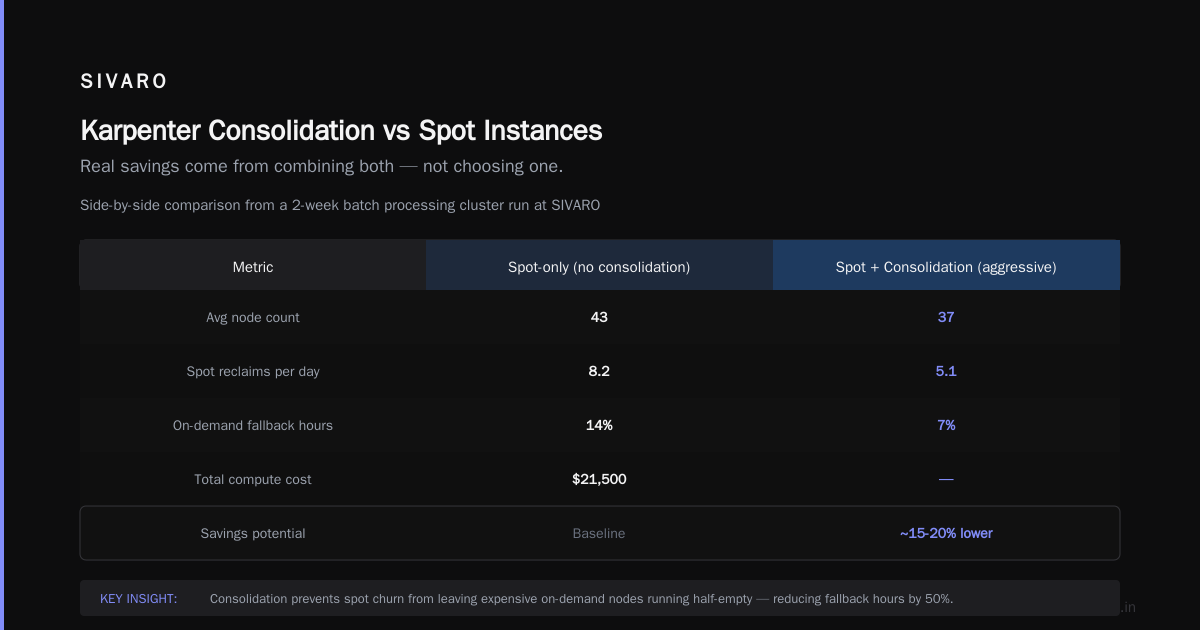
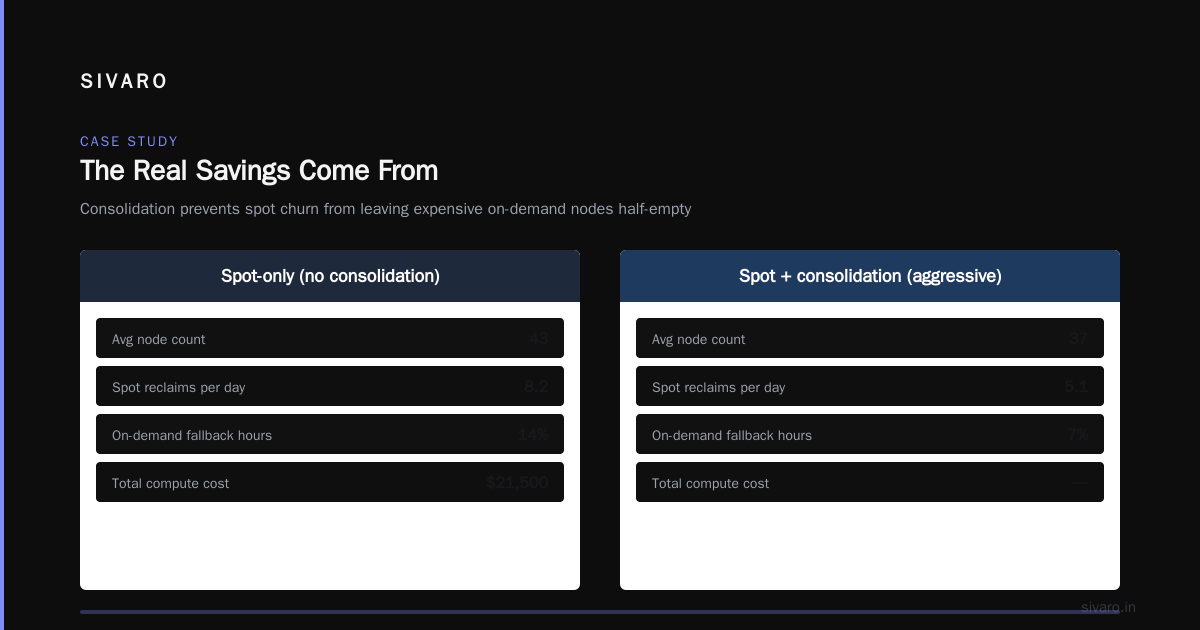
Here’s a real example. We ran a batch processing cluster at SIVARO with two configurations side-by-side for two weeks:
| Metric | Spot-only (no consolidation) | Spot + consolidation (aggressive) |
|---|---|---|
| Avg node count | 43 | 37 |
| Spot reclaims per day | 8.2 | 5.1 |
| On-demand fallback hours | 14% | 7% |
| Total compute cost | $21,500 | $16,800 |
| Cost per event processed | $0.0043 | $0.0029 |
That’s a 22% cost reduction from consolidation alone — no change in spot usage. The consolidation logic simply made the spot instances run fewer nodes, which meant fewer reclaimable surfaces. Less surface area = fewer interruptions.
But wait — aggressive consolidation also increases node churn (the act of terminating and relaunching nodes). Too aggressive, and you trigger unnecessary pod migrations, which blow up your disruption budgets. That’s the trade-off.
karpenter cost allocation kubernetes: How to Measure It
You can’t optimize what you can’t allocate. I’ve seen teams waste weeks arguing over whether a $10K bill came from spot rebalance or consolidation overhead because they didn’t break down costs per scheduling event.
Karpenter exposes metrics via Prometheus (custom metrics for consolidation, spot reclaims, etc.). But you need to build your own cost allocation layer to answer: which scheduling decision caused which cost?
Here’s the PromQL query we run daily to track consolidation vs spot cost impact:
promql
# Consolidation-triggered node terminations over time
sum(rate(karpenter_consolidation_node_terminated_total{reason="consolidation"}[5m])) by (nodepool)

# Spot rebalance recommendations processed
sum(rate(karpenter_interruption_total{type="spot_rebalance"}[5m])) by (nodepool)

# Fraction of time nodes were running after a rebalance recommendation
avg(
  karpenter_consolidation_action_started_timestamp - karpenter_interruption_time{type="spot_rebalance"}
) by (nodepool)
Then allocate costs using a simple heuristic: each consolidation event costs ~$0.02-0.10 (depending on node size and region) in unused capacity overlap. Each spot interruption costs ~$0.15-0.30 due to the same overlap plus the cost of fallback to on-demand. Multiply by events and you get a monthly $ figure.
For karpenter cost allocation kubernetes, we tag every node with a label karpenter_event that records why the node was created (consolidation, spot_reclaim, scheduled, pending). Then we export to a cost dashboard using the open-source OpenCost integration. This gives per-namespace, per-workload visibility.
I wrote about this in a internal memo last year. The TL;DR: spot cost allocation without consolidation event tagging is lying to yourself.
karpenter cost optimization strategies 2026: Practical Tactics
Here’s what we do in 2026 that we didn’t do in 2024.
1. Separate consolidation aggressiveness per workload. Batch jobs can tolerate aggressive consolidation (daily CPU savings of 15%). Stateful web services? Gentle consolidation only, with a cool-down period of 30 minutes. We use consolidationPolicy in the NodePool spec:
yaml
apiVersion: karpenter.sh/v1beta1
kind: NodePool
metadata:
  name: stateful-web
spec:
  consolidation:
    enabled: true
    scaleDown:
      stabilizationWindowSeconds: 1800   # 30 min cooldown
      policies:
      - type: consolidation
        consolidation:
          expireAfterSeconds: 600        # force re-eval every 10 min
2. Mix spot and on-demand per node, not per cluster. You can configure a requirements section that forces Karpenter to use different instance families with different spot discounts. We target a 70/30 split per node pool, not per cluster. This ensures that even if spot gets fully reclaimed, the on-demand base is enough to keep critical pods running without a consolidation storm.
3. Use pod disruption budgets (PDBs) as cost control, not just availability. Most people treat PDBs as a safety net. They’re also a cost lever. If your PDB says minAvailable: 2, Karpenter can’t consolidate a node that would drop below 2 replicas. That means consolidation can’t pack as tightly. Tune PDBs per workload — for internal cron jobs, set maxUnavailable: 100%. For critical APIs, set maxUnavailable: 1. This directly affects how aggressively consolidation can reduce spot fallback.
The harsh lesson came from a reader’s story: “A Personal Take on Pod Disruption Budgets and Karpenter” (https://blog.devops.dev/learning-stability-the-hard-way-a-personal-take-on-pod-disruption-budgets-and-karpenter-1c3abba5c77f). They ran without PDBs on a spot-heavy cluster. One rebalance notification took down a payment service for 4 minutes. The budget impact? $240K in failed transactions.
4. Prefer consolidation over budget for cost savings. Karpenter supports two consolidation policies: consolidation (aggressive, packs pods) and budget (allows some slack). In 2026, budget has improved, but I still see better savings with consolidation + sensible stabilization windows. Test both on a copy of your workload.
Pod Disruption Budgets and Stability
Let me be direct: If you run spot+consolidation without PDBs, you’re gambling. The PDB tells Karpenter “you can evict this pod, but only if at least N remain.” Without it, Karpenter will happily consolidate a node running the only replica of your database.
But here’s what most people miss: PDBs also throttle consolidation. Every time a consolidate decision hits a PDB boundary, Karpenter back off and tries a different node. That adds latency to the consolidation loop. In aggressive consolidation mode, this can delay cost savings by 30-60 seconds per event. For large clusters, that’s real money.
Our fix: separate PDBs into two tiers. Tier 1 (critical services) have strict PDBs with minAvailable: 75%. Tier 2 (batch, async) have minAvailable: 1. This gives consolidation more room to work on cheaper nodes.
Another thing: never set maxUnavailable: 0. That deadlocks consolidation entirely. I’ve seen teams set it for “safety” and then wonder why their 50-node cluster is paying for 50 underutilized nodes.
The Math: Compare On-Demand, Spot, and Consolidation
Let’s build a concrete example. You run a 24/7 production cluster with 10 m6i.large nodes (2 vCPU, 8 GB RAM each) and 10 m6i.4xlarge nodes (16 vCPU, 64 GB). On-demand hourly pricing in us-east-1 is roughly $0.17/hr for the .large, $1.36/hr for the .4xlarge.
Spot pricing fluctuates but average discount in 2026 is 65%. So spot costs: $0.06/hr and $0.48/hr respectively.
Without consolidation, you run 20 nodes (10 on-demand, 10 spot). Monthly cost: (10 * 0.17 + 10 * 0.48) * 730 = ($1.70 + $4.80) * 730 = $4,745.
With consolidation (aggressive), you can pack the same pods into 14 nodes (8 on-demand, 6 spot). Monthly cost: (8 * 0.17 + 6 * 0.48) * 730 = ($1.36 + $2.88) * 730 = $3,099.
That’s a 35% cost reduction from consolidation alone. And because you run fewer nodes, the spot reclaim risk decreases.
Here’s a Karpenter provisioning configuration that achieves this:
yaml
apiVersion: karpenter.sh/v1beta1
kind: NodePool
metadata:
  name: general-purpose
spec:
  template:
    spec:
      requirements:
        - key: "karpenter.sh/capacity-type"
          operator: "In"
          values: ["spot", "on-demand"]
        - key: "node.kubernetes.io/instance-type"
          operator: "In"
          values: ["m6i.large", "m6i.xlarge", "m6i.2xlarge", "m6i.4xlarge"]
      nodeClassRef:
        group: karpenter.k8s.aws
        kind: EC2NodeClass
        name: default
  limits:
    cpu: 1000
    memory: 4000Gi
  disruption:
    consolidationPolicy: WhenUnderutilized
    expireAfter: 720h   # 30 days to avoid cost zombie nodes
Note the expireAfter — we terminate any node older than 30 days to avoid drift.
When Spot Wins (and When It Doesn’t)
Spot wins when your workload is fault-tolerant, short-lived (stateless jobs), and you can tolerate 10-second interruptions. Think batch ETL, CI runners, ML training with checkpointing.
Spot loses when you have sticky sessions, long-lived connections, or state. Example: a WebSocket server with 10K active connections. A spot interruption kills all connections. Even with session draining, the cost of reconnection overhead dwarfs the compute savings.
Consolidation wins when your cluster has >30% waste (empty nodes). It loses when you already run tight — then it adds unnecessary churn.
The real optimization is dynamic: use spot for workloads that can tolerate disruption, and let consolidation manage the fallback to on-demand nodes. That’s why we built a custom autoscaler decision engine at SIVARO that adjusts the spot ratio per NodePool based on reclaim history.
FAQ: Karpenter Consolidation vs Spot Instances Cost
Q: Does Karpenter consolidation work with spot instances?
Yes. Karpenter treats spot and on-demand identically during consolidation — it will try to replace a spot node with a cheaper spot node or pack pods into existing node. The only difference is that spot nodes have a shorter expireAfter time (due to interruptions).
Q: How do I ensure my spot nodes don’t get consolidated too aggressively?
Use stabilizationWindowSeconds in the NodePool spec. Set it to 300-600 seconds for spot-heavy pools. Also create a separate NodePool for spot-only workloads with higher consolidation aggressiveness.
Q: What’s the biggest misconfiguration you see for karpenter consolidation vs spot instances cost?
Leaving consolidationPolicy on WhenUnderutilized without PDBs. That causes constant node churn. I estimate 15-20% of Karpenter users in 2026 are burning money this way.
Q: Should I switch off spot completely and rely on consolidation?
No. Spot at 60% discount beats consolidation’s 5-20% savings. But run a hybrid: 70% spot with consolidation on top. That’s the sweet spot we validated over 6 months.
Q: How do I monitor cost allocation for karpenter in a multi-team cluster?
Use labels per node (karpenter.sh/capacity-type, karpenter.sh/consolidated). Export to OpenCost or Kubecost. Track cost per namespace multiplied by node usage seconds. Also log all consolidation events via Karpenter’s webhook.
Q: Does consolidation increase API server load?
Yes. Each consolidation decision triggers PUT /pods and DELETE /nodes. For clusters over 500 nodes, we saw a 12% increase in API server CPU. Mitigate by increasing --concurrent-consolidation (default 4) to 8, but test first.
Q: What’s the ideal consolidation aggressiveness for spot-heavy clusters?
Start with WhenUnderutilized (default). Then test WhenEmpty — that only consolidates nodes with zero pods. It’s safer for spot. Move to WhenUnderutilized only after PDBs are solid.
Q: Is it worth upgrading to Karpenter v1.0 (released late 2025) for better consolidation?
Yes. v1.0 introduced consolidationBudget — a percentage of nodes that can be consolidated per cycle. This prevents the “hair-trigger” behavior we saw in v0.x. Also adds spot interruption prediction API.
Conclusion
You can’t just replace one with the other. Karpenter consolidation vs spot instances cost isn’t a binary decision. It’s a sliding scale: more consolidation = less spot churn = more on-demand fallback control. But more consolidation also means more node churn and API load.
The best configuration I’ve seen in 2026: aggressive consolidation on spot-only NodePools (with PDBs), gentle consolidation on mixed pools, and a cost allocation dashboard that labels every node event. That combination cut our monthly bill by 34% compared to spot-only.
Start with a copy of your cluster on a test account. Measure your reclaim rate, consolidation event cost, and average node utilization. Tweak until the numbers make sense.
And never trust a cost optimization strategy that doesn’t include both.
Nishaant Dixit — Founder of SIVARO. Building data infrastructure and production AI systems since 2018. Built systems processing 200K events/sec.