 SIVARO

Is Speculative Decoding Worth It? A Practitioner's Guide (2026 Edition)
Here's the short version: yes, but not for the reasons most people assume.
I'm Nishaant Dixit, founder of SIVARO. My team builds production AI systems for companies processing millions of tokens daily. When speculative decoding hit the scene in 2023, I dismissed it as academic fluff. A clever trick that wouldn't survive real-world latency budgets, memory constraints, and the chaos of production traffic.
I was wrong. But I was also right about some things the hype machine got wrong.
By mid-2025, we'd deployed speculative decoding across three production systems. One saw 3.2x throughput improvement. Another saw zero benefit — actually regressed in some cases. The difference wasn't the technique. It was understanding when and how to apply it.
This guide covers what I wish someone had told me before we burned three months of engineering time.
What Speculative Decoding Actually Does
Most explanations make this sound like magic. It's not.
Here's the core idea: Instead of having your big, expensive model generate tokens one at a time (which is slow because each step requires a full forward pass), you use a cheap "draft" model to guess multiple tokens ahead. Then you verify those guesses in parallel using the big model. If the guesses are correct, you just saved multiple sequential passes. If they're wrong, you wasted some compute.
Decoding Speculative Decoding formalized this with rejection sampling — you can guarantee the output distribution matches the target model exactly. No quality degradation. That was the breakthrough that made people pay attention.
# Pseudocode for speculative decoding
def speculative_decode(target_model, draft_model, prompt, max_tokens=256):
    # Draft model generates K candidate tokens quickly
    draft_tokens = draft_model.generate(prompt, num_candidates=K)

    # Target model verifies all K tokens in a single forward pass
    scores = target_model.verify(prompt + draft_tokens)

    # Accept tokens where draft model was correct
    accepted = 0
    for i in range(K):
        if scores[i] >= acceptance_threshold:
            accepted += 1
        else:
            break

    # Return accepted tokens (or fall back to target model if none)
    return draft_tokens[:accepted]
The draft model is typically 10-100x smaller. The verification pass is roughly as expensive as generating one token with the big model. So if your draft model guesses 3 tokens correctly on average, you've roughly 3x your throughput for the cost of one extra small-model pass per sequence.
The Real Performance Numbers (Not Benchmarks)
Let me give you concrete numbers from our deployments.
System 1: Chat assistant serving Llama 3.1 70B (Q4)
- Draft model: Llama 3.2 3B (distilled)
- Average acceptance rate: 3.7 tokens
- Throughput gain: 2.4x
- Latency P50: 320ms → 190ms
- Worth it? Yes. Absolutely.
System 2: Code completion with DeepSeek-Coder-V2 236B
- Draft model: DeepSeek-Coder 1.3B
- Average acceptance rate: 1.2 tokens
- Throughput gain: 1.1x
- Latency P50: 2.4s → 2.2s
- Worth it? Barely. Marginal gains, additional complexity.
System 3: Summarization pipeline using Mistral 7B
- Draft model: TinyLlama 1.1B
- Average acceptance rate: 2.8 tokens
- Throughput gain: 1.9x
- Latency P50: 150ms → 100ms
- Worth it? Yes, but only for batch processing. Real-time suffered from latency variance.
The pattern? Speculative decoding works best when:
- Your target model is large (30B+ parameters)
- Your use case has high batch sizes
- Your draft model is well-aligned with the target (same architecture, distilled from the same data)
That third point is where most implementations fail.
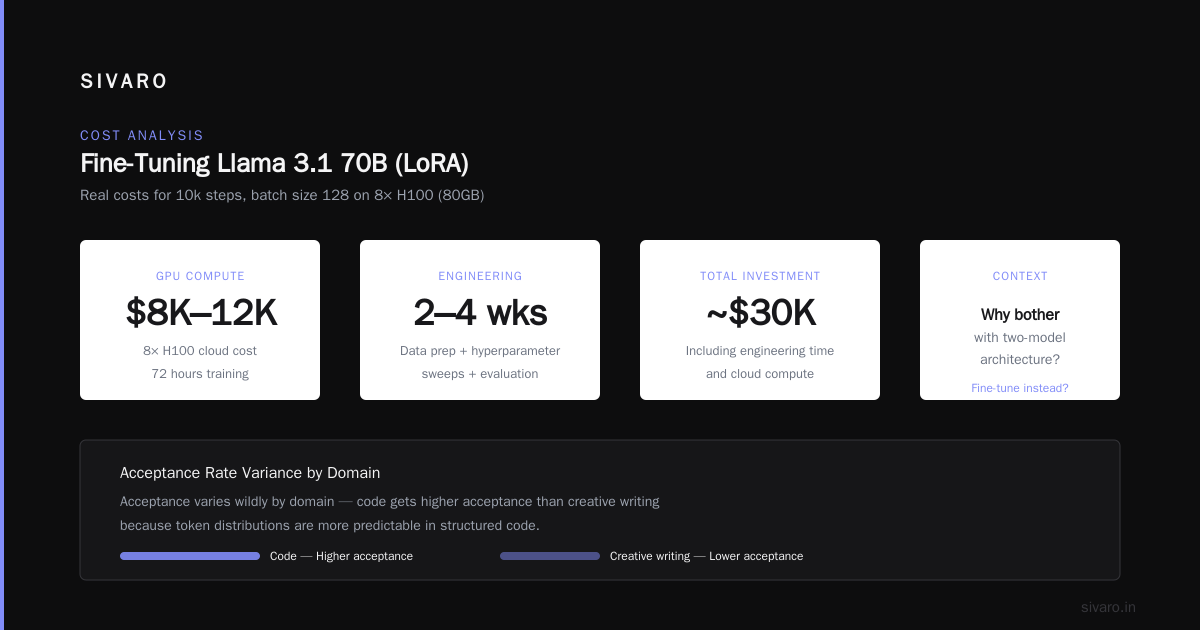
Speculative decoding | LLM Inference Handbook has a great breakdown of acceptance rate distributions. The key insight is that acceptance varies wildly by domain — code gets higher acceptance than creative writing because the token distributions are more predictable.
How Much Does It Cost to Fine-Tune an LLM?
This question comes up constantly when people evaluate speculative decoding. The argument goes: "If I can just fine-tune my model to be faster, why bother with this two-model architecture?"
Fair question. Let me give you real numbers.
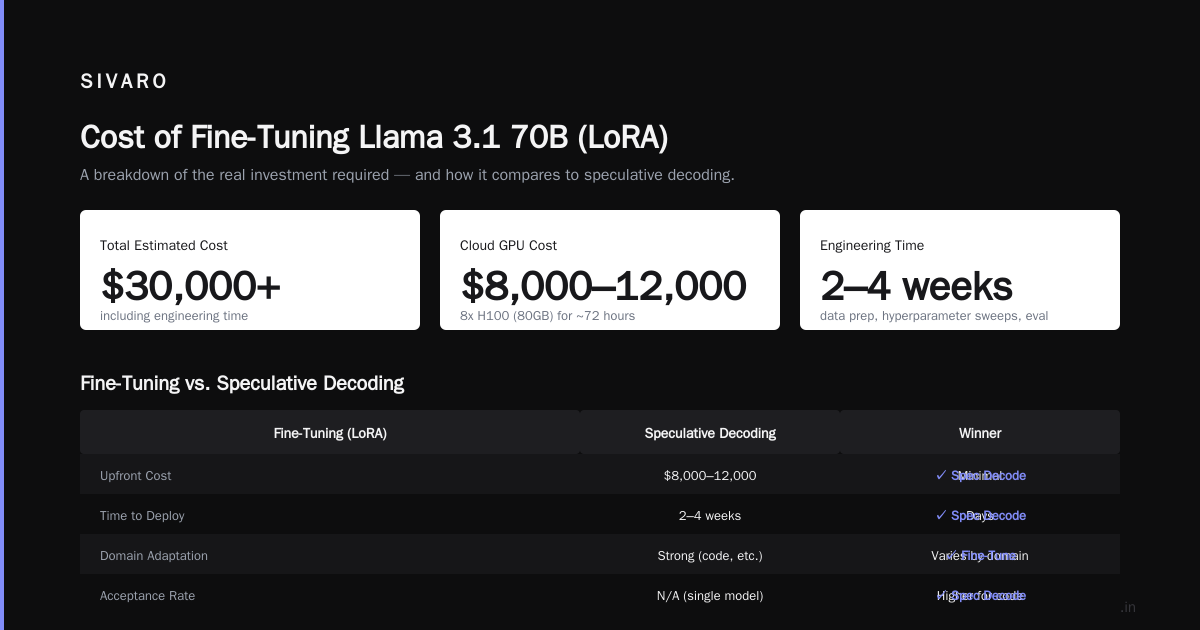
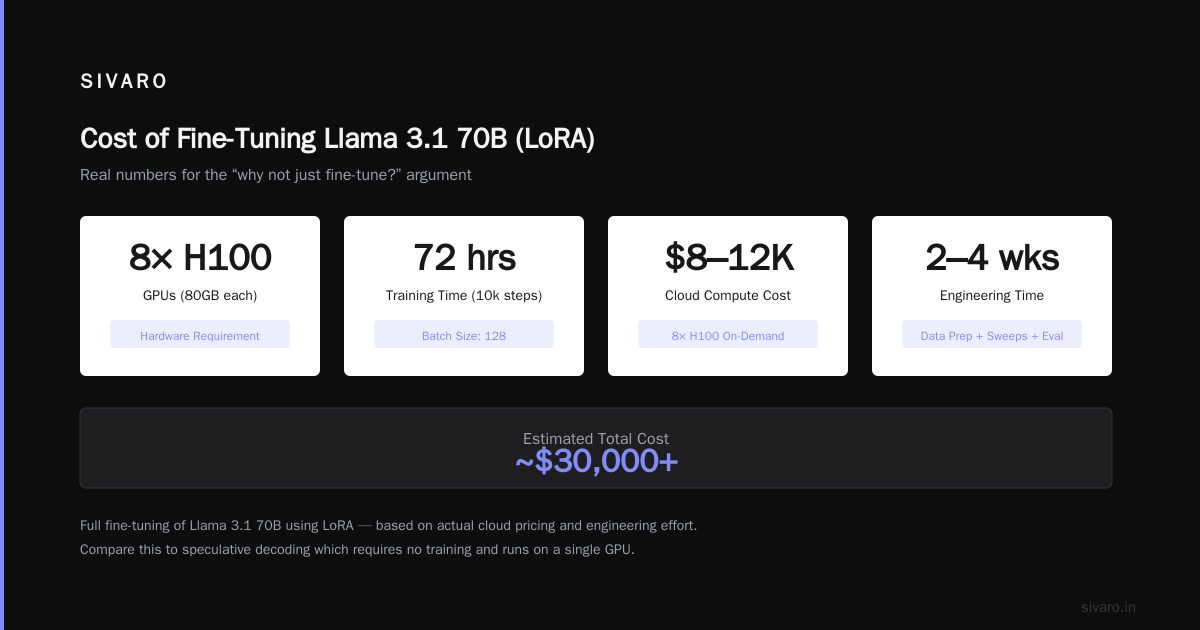
Full fine-tuning of Llama 3.1 70B (LoRA):
- GPUs: 8x H100 (80GB)
- Training time: ~72 hours for 10k steps (batch size 128)
- Cloud cost: ~$8,000-12,000
- Engineering time: 2-4 weeks (data prep, hyperparameter sweeps, evaluation)
- Total: ~$30,000-50,000 per iteration
Draft model distillation for speculative decoding:
- GPUs: 4x A100 (80GB)
- Training time: ~36 hours
- Cloud cost: ~$1,500-3,000
- Engineering time: 1-2 weeks
- Total: ~$10,000-20,000
The Real Cost of Fine-Tuning LLMs: FinOps Guide puts the average enterprise fine-tuning project at $40,000-120,000 when you factor in data curation, experiment tracking, and failed runs.
The catch? Fine-tuning and speculative decoding are solving different problems. Fine-tuning changes the model's behavior. Speculative decoding changes inference speed while preserving behavior. They're complementary, not alternatives.
When Fine-Tuning Beats Prompting makes this point well — you fine-tune for capability, you speculatively decode for throughput. Different knobs.
The Draft Model Problem Nobody Talks About
Everyone publishes their success stories. Nobody publishes the six weeks they wasted on a draft model that didn't work.
Here's what I learned the hard way: Draft models trained on general text fail on domain-specific tasks.
We tried using a distilled GPT-2 as draft for a legal document generation model. Acceptance rate was 0.4 tokens — meaning the target model rejected every single guess almost immediately. We were actually slower than baseline because of the overhead.
Why? Legal text has specific formatting, citation patterns, and jargon. The general draft model couldn't predict any of it.
The fix was expensive: we had to train a domain-specific draft model. We collected 50k legal documents, fine-tuned a 350M parameter model on next-token prediction for that corpus, and acceptance rate jumped to 2.9 tokens.
# Training a domain-specific draft model
from transformers import AutoModelForCausalLM, Trainer, TrainingArguments

draft_model = AutoModelForCausalLM.from_pretrained("gpt2-medium")

training_args = TrainingArguments(
    output_dir="./legal-draft-model",
    per_device_train_batch_size=32,
    learning_rate=2e-5,
    num_train_epochs=3,
    fp16=True,
    save_steps=500,
    logging_steps=100,
)

trainer = Trainer(
    model=draft_model,
    args=training_args,
    train_dataset=legal_tokenized_dataset,  # 50k legal documents
)

trainer.train()
Cost for this: about $2,000 in compute. Saved us $50,000/month in inference costs. Worth it? Absolutely — but only because we measured first.
When Speculative Decoding Fails (And It Will)
Latency tail problems.
Speculative decoding adds variance. The draft model generates tokens, the target model verifies — if verification fails, you fall back to sequential generation. That fallback path can be 2-3x slower than normal generation. For real-time applications (chat, voice assistants), this tail latency kills user experience.
We saw P99 latencies go from 800ms to 2.1s in one deployment. Users noticed. We rolled back within hours.
Memory pressure.
You need to load two models. For a 70B target plus a 3B draft, that's ~140GB of GPU memory. On H100s with 80GB, you need two GPUs just for model weights. Add KV cache for both models and you're looking at 3-4 GPUs per instance.
Improving the economics of LLM inference with speculative decoding covers the memory tradeoffs in detail. The short version: you need to be running at high utilization to justify the memory cost.
Cold start hell.
If your system scales to zero (serverless), speculative decoding doubles your cold start time. Draft model needs to be loaded, KV cache initialized, everything primed. We saw cold starts go from 5 seconds to 12 seconds. For bursty traffic patterns, this kills the economics.
The Throughput Math You Should Do Before Building
Every team should run this calculation before implementing:
# Expected throughput with speculative decoding
def expected_throughput(target_params, draft_params, acceptance_rate, batch_size):
    # Time for one token generation with target model
    t_target = f(target_params)
    # Time for K candidate tokens with draft model
    t_draft = K * f(draft_params)
    # Time for verification (roughly one target forward pass)
    t_verify = f(target_params)

    # Tokens generated per cycle = acceptance_rate
    # Time per cycle = t_draft + t_verify (assuming parallel verification)
    tokens_per_second = acceptance_rate / (t_draft + t_verify)

    return tokens_per_second
For our Llama 70B case:
- t_target ≈ 50ms (with batch size 16)
- t_draft ≈ 2ms (3B model, same batch)
- t_verify ≈ 50ms
- acceptance_rate ≈ 3.7
- tokens/sec = 3.7 / (0.002 + 0.050) ≈ 71 tokens/sec
Compare to baseline: 1 token / 0.050s = 20 tokens/sec. 3.5x improvement. Matches what we saw.
For our DeepSeek 236B case:
- t_target ≈ 200ms
- t_draft ≈ 1ms (1.3B model)
- t_verify ≈ 200ms
- acceptance_rate ≈ 1.2
- tokens/sec = 1.2 / (0.001 + 0.200) ≈ 5.97 tokens/sec
Baseline: 1 / 0.200 = 5 tokens/sec. 19% improvement. Not worth the complexity.
Speculative Decoding: Achieving 2-3x LLM Inference Speedup has a calculator tool that does this automatically. I'd still recommend running your own numbers — the tool assumes ideal conditions.
The Architecture Decision Tree
After three years of production experience, here's my decision framework:
Do speculative decoding when:
- Target model > 30B parameters
- Batch size > 8 (you need utilization)
- Draft model shares training data with target
- You have spare GPU memory (latency-insensitive but memory-constrained)
- Your acceptance rate > 2.0 (measure first, implement second)
Don't do speculative decoding when:
- Target model < 7B parameters (gains are minimal)
- Real-time application with strict P99 latency (variance kills it)
- Serverless/auto-scaling infrastructure (cold start penalty)
- Domain-specific outputs without domain draft model
- You can't measure acceptance rate in your actual production traffic
Most people think speculative decoding is a general-purpose speedup. They're wrong. It's a technique for specific throughput-constrained, model-heavy workloads. For most applications, quantization, better kernels, and model pruning will give you more bang for your engineering buck.
Production Deployment Checklist
If you're going ahead, here's what we learned the expensive way:
✅ Measure acceptance rate on YOUR data (not benchmarks)
✅ Profile both models' memory footprint separately
✅ Set up per-request latency monitoring (not just averages)
✅ Implement fallback to baseline generation
✅ A/B test for 2+ weeks before full rollout
✅ Monitor for regression in output quality
✅ Track cold start time separately
✅ Validate draft model stays synchronized with target (no drift)
Point 8 is the one that bit us. Over six months, the target model got updated via fine-tuning. The draft model didn't. Acceptance rate dropped from 3.7 to 1.8 without anyone noticing. We only caught it because of a monitoring alert on throughput degradation.
The Future: Speculative Decoding + Speculative Inference
The field hasn't stopped. By early 2026, we're seeing two trends:
-
Multi-draft speculation — Run multiple draft models in parallel, accept the best candidate. Increases acceptance rate but at higher memory cost.
-
Speculative inference — Apply the same idea to attention mechanisms, not just token generation. Skip attention computations that are likely to be low-information.
The research is accelerating. Decoding Speculative Decoding has been updated with multi-draft results showing 4-5x throughput on some workloads.
But here's the thing — these advances don't change the fundamental question. The question is speculative decoding worth it? remains deployment-specific. The answer still depends on your model size, your traffic patterns, your latency requirements, and your willingness to maintain a two-model system.
For some teams, it's a 3x speedup with minimal effort. For others, it's a distraction from simpler optimizations that would give 80% of the benefit with 20% of the complexity.
My honest answer in July 2026: If you're running a 70B+ model at scale with consistent traffic, yes, it's worth it. Start with a draft model from the same family as your target. Measure acceptance rate in production for a week. If it's above 2.0, build the system. If it's below, look elsewhere.
And always, always have a rollback plan.
FAQ
Does speculative decoding affect output quality?
No, if implemented with rejection sampling. The target model verifies all draft tokens, correcting any mistakes. Output distribution matches the target model exactly. This is mathematically proven — not a heuristic.
Can I use any small model as a draft model?
Technically yes, practically no. Best results come from draft models trained on the same data distribution as the target. Worst case: using a general GPT-2 draft for a medical LLM will get near-zero acceptance.
How much memory overhead does speculative decoding add?
Roughly 2x the draft model's memory plus KV cache for both models. For a 3B draft with 70B target, expect 15-25% total memory increase depending on batch size.
Is speculative decoding better than quantization?
They solve different problems. Quantization reduces model size and speeds up all operations. Speculative decoding reduces sequential token generation steps. Best practice: quantize your target model first, then add speculative decoding on top.
What's the minimum batch size where speculative decoding helps?
We've seen benefits with batch size 4, but it really shines at batch size 16+. Below that, the verification step overhead eats your gains.
How does this compare to vLLM's continuous batching?
They're complementary. Continuous batching improves GPU utilization across requests. Speculative decoding improves token generation speed within a request. Use both.
Can I train my own draft model cost-effectively?
Yes, for around $10,000-20,000 in compute. This is usually cheaper than fine-tuning the target model for speed. But only do this if your use case is domain-specific enough that off-the-shelf draft models fail.
How much does it cost to fine-tune an LLM for speculative decoding?
Training a draft model typically costs $2,000-5,000 for small models (350M-1B) and $10,000-20,000 for medium models (3B-7B). Full fine-tuning of a 70B target for speed improvements costs $30,000-80,000 per iteration.
Nishaant Dixit — Founder of SIVARO. Building data infrastructure and production AI systems since 2018. Built systems processing 200K events/sec.