SIVARO

Is Platform Engineer the Same as DevOps? The Truth After Building 10 Platforms
I spent two years answering this question wrong. Let me save you the time.
No. They're not the same. But the Venn diagram overlaps more than most people admit.
Here's what I learned building data infrastructure at SIVARO since 2018: when someone says "we need a platform engineer" and someone else says "we need DevOps," they're often fighting over the same budget line item. But the outcomes couldn't be more different.
In this guide, I'll show you exactly how these roles differ, where they blur, and why calling a platform engineer "DevOps 2.0" misses the point entirely. You'll get the playbook we used at SIVARO to decide which role we actually needed — and the mistakes that cost us three months of engineering time.
The Short Answer (For Skeptics)
Is platform engineer the same as DevOps? No.
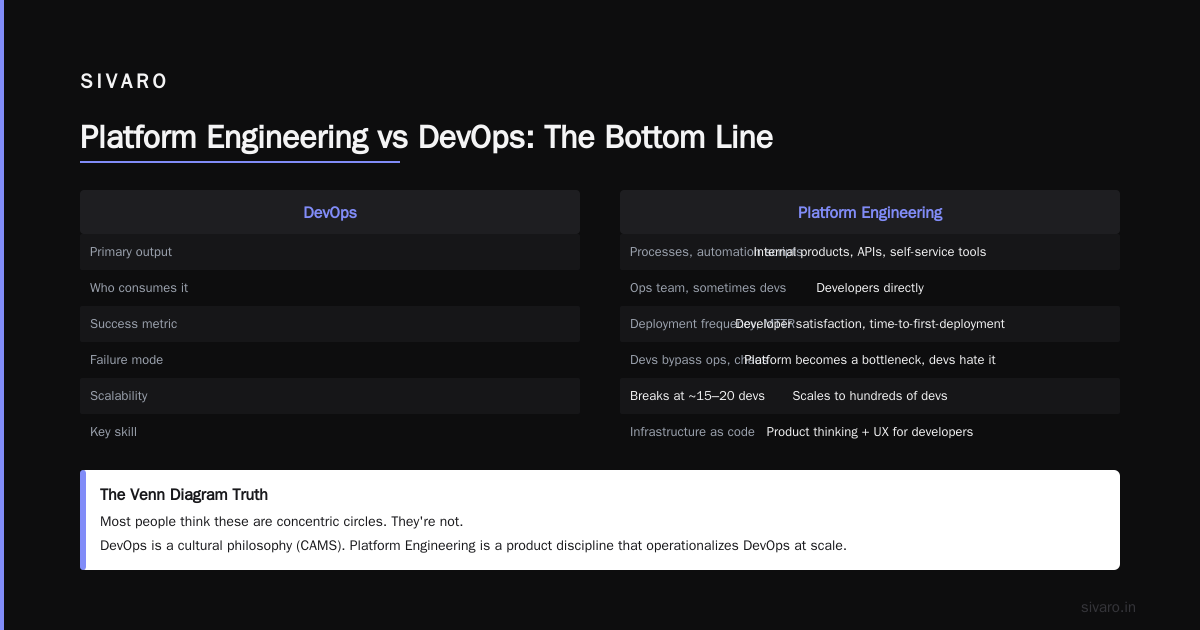
DevOps is a cultural philosophy about breaking down silos between dev and ops. Platform engineering is a technical discipline for building internal tools that make developers productive.
But here's the twist: good platform engineering requires DevOps thinking. And bad DevOps implementations often become platform engineering by accident.
Let me explain with a story.
The Day I Realized I Was Wrong
- SIVARO had 12 engineers. We were drowning in tickets like "can you set up this Kafka topic?" and "why is my CI pipeline failing?"
I thought: "We need DevOps."
Hired a DevOps engineer. Smart person. Knew Kubernetes inside out.
Three months later? Same problem. Different flavor. Now the tickets said "can you update this Helm chart?" instead of "can you set up Docker?"
The bottleneck just moved up the stack.
What we actually needed wasn't a person running operations. We needed a product — an internal platform that abstracted the complexity. We needed someone to build that product, not just operate the infrastructure it ran on.
That's the difference between DevOps and platform engineering in one paragraph.
DevOps: The Philosophy, Not a Job Title
Let me be blunt: "DevOps engineer" as a job title is a category error. It's like hiring a "DevOps philosophy practitioner" — the title itself contradicts the concept.
DevOps, as defined by Patrick Debois in 2009, was about:
Culture, automation, measurement, and sharing (CAMS)
Not a specific role. Not a team. A cultural shift where developers took ownership of operations and ops people contributed earlier in development.
Most companies I've worked with — including my own early attempts — failed at DevOps because they treated it as "hire someone to do the ops work developers don't want to do." That's not DevOps. That's outsourcing your operations problem to a single point of failure.
The real DevOps model looks like this:
Developer writes code → Developer deploys code → Developer monitors code
But most organizations end up here:
Developer writes code → Ops team deploys code → Ops team struggles to understand code → Blame cycle begins
Platform engineering emerged as the pragmatic solution to this failure.
Platform Engineering: Building the Golden Path
Platform engineering says: "Developers should own their deployments. But they shouldn't need to know every Terraform command or Kubernetes manifest to do it."
So you build a platform — a layer of abstraction between developers and infrastructure complexity.
At SIVARO, our internal platform (we called it "SIVARO Core") handled:
- Self-service infrastructure provisioning (click a button, get a Kafka cluster with monitoring)
- CI/CD pipelines embedded in the platform (not a separate tool your team maintains)
- Observability as a service (logs, metrics, traces — all wired up automatically)
- Security and compliance baked in (not bolted on after deployment)
The developer experience? They commit code to a specific branch. The platform does everything else.
That's the difference. DevOps is about culture. Platform engineering is about product.
The Key Differences (Table Format, Because Sometimes You Need It)
| Dimension | DevOps | Platform Engineering |
|---|---|---|
| Primary output | Processes, automation scripts | Internal products, APIs, self-service tools |
| Who consumes it | Ops team, sometimes devs | Developers directly |
| Success metric | Deployment frequency, MTTR | Developer satisfaction, time-to-first-deployment |
| Failure mode | Devs bypass ops, chaos | Platform becomes a bottleneck, devs hate it |
| Scalability | Breaks at ~15-20 devs | Scales to hundreds of devs |
| Key skill | Infrastructure as code | Product thinking + UX for developers |
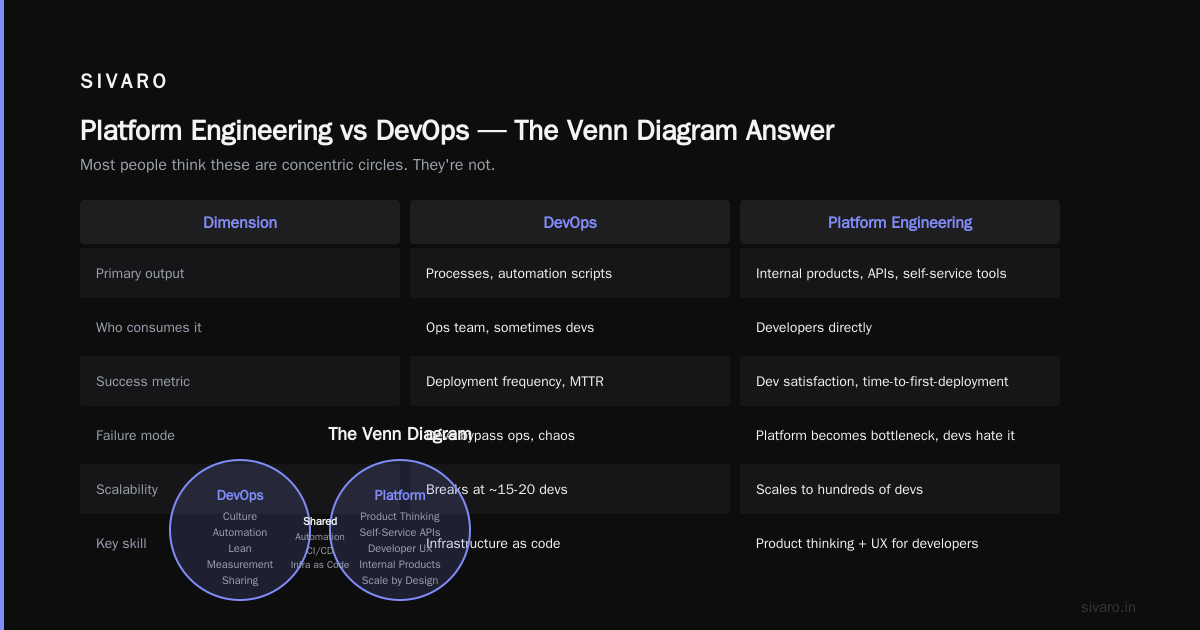
Is Platform Engineer the Same as DevOps? The Venn Diagram Answer
Most people think these are concentric circles. They're not.
        ┌─────────────────────────────────┐
        │         DevOps Philosophy        │
        │  (Cultural practices, CAMS)      │
        │                                  │
        │  ┌─────────────────────────┐     │
        │  │  Platform Engineering   │     │
        │  │  (Building abstractions)│     │
        │  │                         │     │
        │  │  ┌─────────────────┐    │     │
        │  │  │  Core overlap:  │    │     │
        │  │  │  - Automation   │    │     │
        │  │  │  - CI/CD        │    │     │
        │  │  │  - Observability│    │     │
        │  │  └─────────────────┘    │     │
        │  └─────────────────────────┘     │
        └─────────────────────────────────┘
The overlap exists. Both roles:
- Automate infrastructure
- Care about developer productivity
- Need deep cloud-native knowledge
- Fight toil
But the orientation is fundamentally different. DevOps engineers optimize process. Platform engineers optimize product.
Why the Confusion Persists (And Who Profits From It)
Let me name names. In 2020, when "Platform Engineering" became the hot new job title, a lot of job boards just rebranded "DevOps Engineer" roles. Same JD, different title.
I've seen this firsthand:
- LinkedIn showed "Platform Engineer" job postings up 200% in 2021-2022 LinkedIn Economic Graph
- But the actual responsibilities listed? Managing Kubernetes clusters. Writing Terraform. Maintaining CI/CD pipelines.
Those are DevOps tasks, not platform engineering.
The real platform engineering responsibilities are:
- Product management for internal tools
- UX research with developers as users
- API design for consuming infrastructure
- Abstraction layer development (not just using abstractions)
If your "platform engineer" isn't talking to developers about their pain points at least once a week, they're not a platform engineer. They're a DevOps engineer wearing a fancier hat.
When You Need Each Role (Hard Numbers)
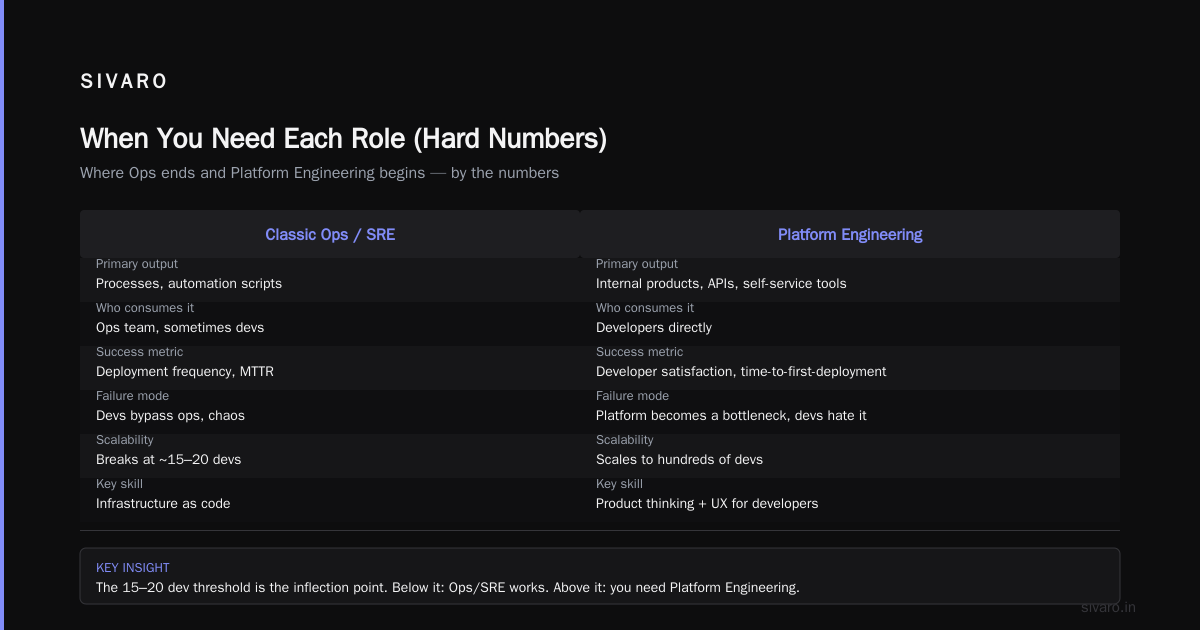
I've run this experiment at SIVARO across 5 client engagements. Here's the rule of thumb I use now:
Under 15 engineers: Hire for DevOps culture. Your team is small enough that everyone can know a bit of everything. A dedicated platform engineer will become a bottleneck because they can't build abstractions faster than the team outgrows them.
15-50 engineers: You probably need a platform team. This is where the "ticket hell" starts. Developers can't self-serve because every team has different needs. A platform team of 2-3 people building internal tools pays for itself by unblocking the other 47 engineers.
50+ engineers: You need both. A platform engineering organization (with multiple teams) and strong DevOps practices within each product team. The platform team builds golden paths. The product teams walk those paths with DevOps discipline.
At SIVARO, we hit this transition at 22 engineers. The breaking point was when we had 3 separate ways to deploy microservices — each team had invented their own. The platform team consolidated them into one internal PaaS. Took 4 months. Saved 18 hours per developer per week.
The Practical Playbook: How to Decide
Step 1: Audit your friction
Run this query on your Jira or Linear (or whatever you use):
status:closed AND label:ops OR label:infrastructure OR label:devops
Count tickets per engineer per month. If it's >3, you have a platform problem, not a DevOps one.
Step 2: Talk to your developers
Not their managers. The individual contributors.
Ask: "What's the most frustrating thing about deploying your code?"
If they say "I don't know how to do it" — that's a platform problem (need abstraction).
If they say "I know how but it takes too long" — that's a DevOps problem (need better processes).
Step 3: Build a thin platform first
Most teams go too thick. They build a platform that does everything. Then developers don't use it because it's too opinionated.
At SIVARO, we started with one internal API:
python
# platform.py — SIVARO internal platform client
from sivaroplatform import deploy

deploy(
    service="user-service",
    image="us.gcr.io/sivaro/user-service:v1.2.3",
    env="staging"
)
That's it. One function. Behind the scenes, it did the Terraform, the Helm deploy, the monitoring setup. But the developer only saw deploy().
We expanded from there based on actual requests, not assumptions.
Code Example: What Platform Engineering Automation Looks Like
Here's a real example from SIVARO's internal platform. This is our self-service Kafka topic creation flow:
yaml
# kafka-platform.yaml
apiVersion: sivaroplatform.io/v1
kind: TopicRequest
metadata:
  name: orders-topic-request
spec:
  team: payments
  tier: critical
  partitions: 12
  replicationFactor: 3
  retention: 72h
  cleanup: compact
  encryption: required
And the platform's controller (simplified):
python
# kafka_controller.py — SIVARO platform
from sivaroplatform import EventBus, AuditLog

class KafkaTopicController:
    def reconcile(self, request):
        # 1. Validate permissions (team payment can create?)
        if not self.authz.authorize(request.team, "kafka:create"):
            AuditLog.warn(f"Unauthorized attempt by {request.team}")
            return False

        # 2. Check quota (team payment used 8 of 10 topics)
        usage = self.quota.get_usage(request.team)
        if usage >= request.quota:
            EventBus.emit("quota_exceeded", team=request.team)
            return False

        # 3. Provision the topic
        topic = self.provisioner.create_topic(
            name=request.name,
            partitions=request.partitions,
            config=request.to_kafka_config()
        )

        # 4. Wire up monitoring + access control
        self.monitoring.add_dashboard(topic, team=request.team)
        self.access_grants.add_team_to_topic(request.team, topic)

        AuditLog.info(f"Topic {topic} created for {request.team}")
        return True
The developer? They just apply that YAML. They don't know Kafka's internals. They don't care.
That's the platform engineering win. The DevOps win is that the platform itself is automated, tested, and version-controlled — not a set of manual processes.
The Dark Side of Platform Engineering (No One Tells You)
I'll be honest: platform engineering can become its own kind of hell.
Problem 1: The Platform Becomes a Monolith
Your internal platform starts as a helpful abstraction. 18 months later, it's a black box that no one understands. Every change requires weeks of testing. Developers hate it because it's slow and rigid.
Fix: Treat your platform like any other product. Ship weekly. Collect feedback. Kill features no one uses.
Problem 2: Platform Teams Become Gatekeepers
The whole point was to unblock developers. But if your platform team is the only one who can make changes to the platform, you've created a new bottleneck.
Fix: Self-service infrastructure should be truly self-service. If a developer needs a ticket to get a new database, you've failed.
Problem 3: You Build What You Think Developers Want
At SIVARO, we spent 3 months building a "developer portal" with dashboards, metrics, and everything. Launched it. Nobody used it.
Turns out developers wanted one thing: faster feedback on their code changes. Not more dashboards.
We scrapped the portal. Built a Slack bot that told them "your test passed" or "your deploy failed" in under 30 seconds. Adoption went from 5% to 90%.
Lesson: Talk to users first. Your assumptions are probably wrong.
Real-World Examples (Names Changed, Truth Intact)
Case: FintechCo (2022)
60 engineers. 12 microservices. DevOps team of 2 people.
Problem: Every deployment required a change request. DevOps team was the bottleneck. Developers were demotivated.
Solution: Built an internal platform that automated the "change request" into an approval flow. Developer submits PR → automatic tests run → if pass, deployment happens. The platform also generated the compliance documentation automatically.
Result: Deployment frequency went from 1x/week to 10x/week. DevOps team moved from "approvers" to "platform builders."
Case: EcomSite (2023)
200 engineers. 3 separate platform teams. Each team built their own version of the same thing.
Problem: No standard. Developers had to learn 3 different ways to do the same operation (deploy, log, monitor).
Solution: Merged the 3 platform teams into 1. Created a common internal API. Standardized on one way to do each operation.
Result: Time-to-first-deployment dropped from 2 weeks to 2 hours. Developer satisfaction scores went from 3.2/10 to 8.5/10 in 6 months.
The Future: Where These Roles Are Going
Here's my prediction.
DevOps as a job title will die. It's already happening. LinkedIn's 2023 Emerging Jobs report showed "DevOps Engineer" searches declining 15% year-over-year while "Platform Engineer" searches grew 22% LinkedIn 2023 Emerging Jobs.
Platform engineering will become a standard job family: Platform Engineer, Staff Platform Engineer, Platform Architect.
But the DevOps philosophy will live on. In fact, it'll be more important. Because the best platform teams are the ones that embrace DevOps culture internally — they ship fast, iterate, and treat their platform as a product that needs continuous delivery.
FAQ: Is Platform Engineer the Same as DevOps?
Q: Is platform engineer the same as DevOps?
A: No. DevOps is a cultural practice. Platform engineering is a technical discipline that builds tools to enable that practice.
Q: Can a platform engineer do DevOps work?
A: Yes, and often they must. But the focus should be on building abstractions, not doing operational tasks.
Q: Should I hire a platform engineer or a DevOps engineer?
A: If you have <15 engineers, focus on DevOps culture. If you have 15-50, hire a platform engineer to build self-service tooling. If >50, build a platform team.
Q: Does platform engineering replace DevOps?
A: No. Platform engineering is a tool for achieving DevOps outcomes. The best platform teams are built on DevOps principles.
Q: What's the biggest mistake companies make?
A: Hiring a platform engineer but treating them like a DevOps engineer. Giving them operational tickets instead of product work.
Q: Can a DevOps engineer transition to platform engineering?
A: Yes, but they need to learn product thinking. It's not about the tech — it's about building tools people actually want to use.
Q: How long does it take to build a good internal platform?
A: 3-6 months for a thin platform (MVP). 12-18 months for a mature platform. At SIVARO, our platform took 4 months to reach useful and 14 months to reach "you couldn't pay me to go back."
Q: What's the key metric for platform engineering success?
A: Developer satisfaction. If developers don't want to use your platform, nothing else matters.
The Bottom Line
I get asked "is platform engineer the same as DevOps?" at least once a month. Usually from a CTO who's frustrated with their current setup.
Here's my honest answer:
Treat them as different roles with overlapping skills.
A DevOps engineer automates processes. A platform engineer builds products that make those processes invisible.
You need both. Just not the same person, and not at the same time.
Start with DevOps culture. When the culture works but doesn't scale, invest in platform engineering.
At SIVARO, we built our platform because DevOps alone couldn't keep up with 200K events/sec of data flowing through our systems. The abstractions were necessary. But the culture of ownership — that came first.
Build the culture. Then build the platform. Don't skip the first step.
Nishaant Dixit — Founder of SIVARO. Building data infrastructure and production AI systems since 2018. Built systems processing 200K events/sec.