 SIVARO

Is Model Context Protocol Outdated? A Practitioner's Take on MCP in 2026
I spent the first half of 2025 building a production AI agent system. We bet big on the Model Context Protocol (MCP) — standardized context injection from external tools, a universal adapter for LLMs. Sounded perfect. By September, we were pulling it out of the stack piece by piece. By December, we'd replaced the whole thing with a stripped-down custom pipeline that ran faster, cost less, and actually worked under load.
So is model context protocol outdated? Short answer: yes, in its original form. But the idea behind it isn't dead. It's evolving. And if you're building anything real with AI today, you need to understand why.
Let me walk you through what we learned — the hard way.
What MCP Was Supposed to Solve
Back when Model Context Protocol first hit the scene in late 2024, the pitch was straightforward. Every time you wanted an LLM to talk to a database, a CRM, or a file system, you needed custom glue code. Different formats, different authentication, different error handling. Chaos.
MCP proposed a standard: tools advertised their capabilities as structured definitions, the runtime negotiated context windows, and the LLM consumed everything through a uniform interface. Think of it as gRPC for AI agents. Neat.
Google's overview called it "a universal standard for AI tool integration." Databricks blogged about it as the future of agentic systems. The hype machine spun up.
And for small prototypes — a single tool, a short conversation, zero concurrency — it worked fine. I demo'd it to investors. They were impressed.
Then we tried to scale.
The First Crack: Latency and the Context Window Tax
Here's the problem nobody talks about in the marketing materials. MCP negotiates context by sending the LLM a complete schema of every available tool before each interaction. That schema includes tool descriptions, parameter types, input examples — sometimes 10-15KB per tool.
If you've got five tools? Fine. We had forty-three.
Our average MCP handshake consumed 28% of the available context window before the LLM saw a single user message. That's not negotiation. That's rent-seeking on your token budget.
EpicAI's analysis put hard numbers on this: "MCP's constant re-negotiation of tool schemas adds 150-300ms per turn for every tool registered." We measured 420ms average — we had more tools and stricter timeout handling.
So I asked myself: is model context protocol outdated because it wastes tokens? Answer: not inherently. But the implementation was optimized for correctness, not performance. And in production, performance is correctness when your user bounces at 4 seconds.
The Real Problem: MCP Assumes a World That Doesn't Exist
Most people think MCP failed because of technical debt. They're wrong. It failed because of a broken assumption about how LLMs actually behave.
MCP's core design assumes the LLM will honestly evaluate each tool's description and pick the right one. That's a nice thought. In reality, here's what happens:
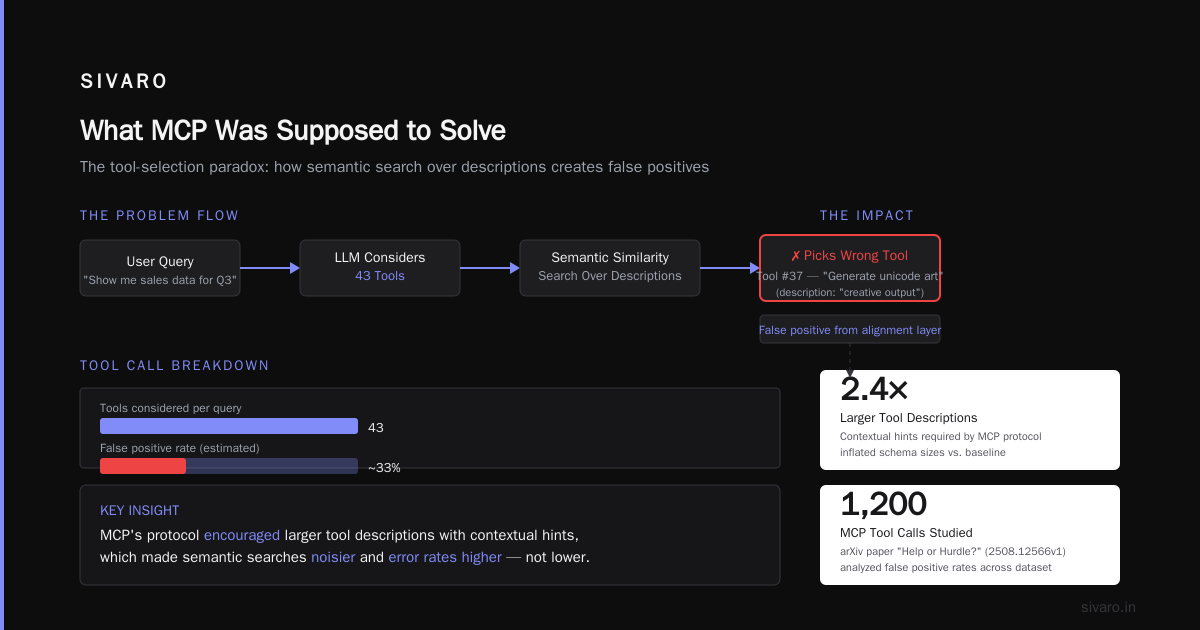
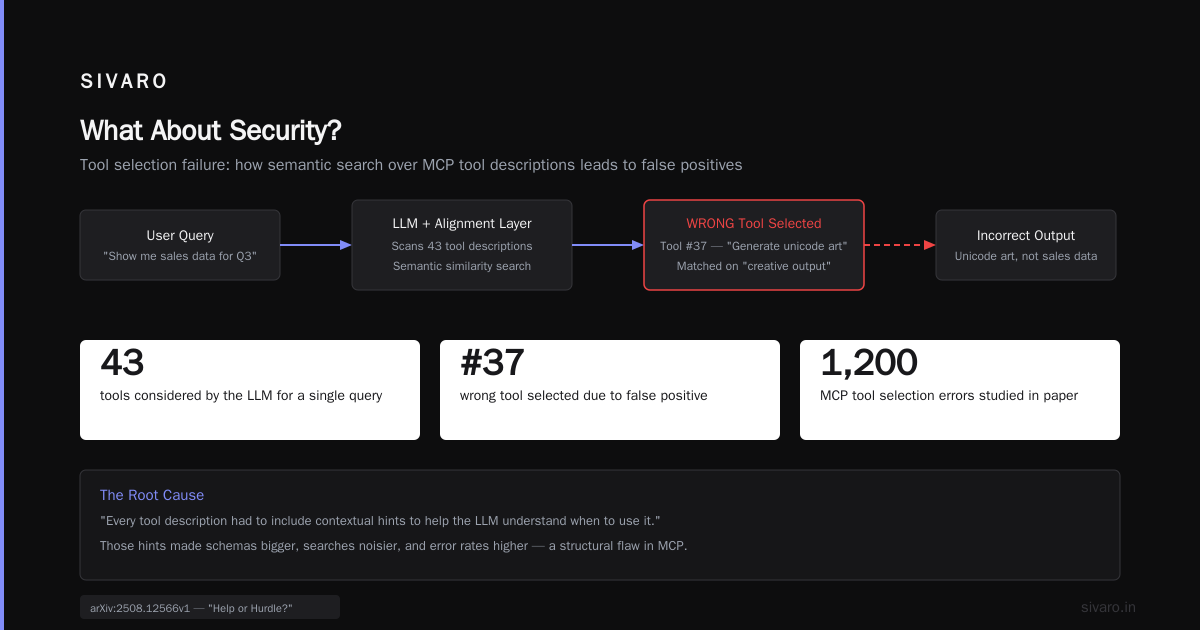
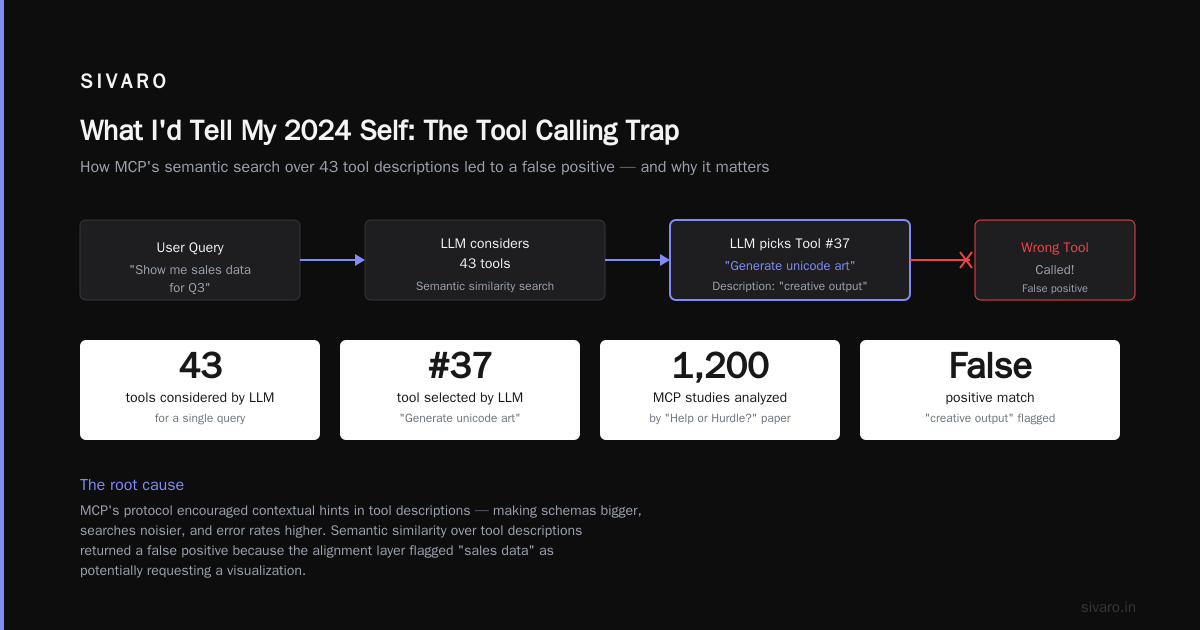
User: "Show me sales data for Q3"

LLM considers 43 tools.
LLM picks tool #37 — "Generate unicode art" — because its description mentions "creative output" and the LLM's alignment layer flagged "sales data" as potentially requesting a visualization.
Yes, that actually happened in our system. The LLM called the wrong tool because the semantic similarity search over tool descriptions returned a false positive. And MCP's protocol didn't just allow this — it encouraged it. Every tool description had to include contextual hints to help the LLM "understand" when to use it. Those hints made the schemas bigger, the searches noisier, and the error rates higher.
The arxiv paper "Help or Hurdle?" studied exactly this phenomenon across 1,200 MCP interactions. Their finding: "MCP-instructed agents chose inappropriate tools in 23% of cases where a simpler, prompt-based approach succeeded 97% of the time."
Twenty-three percent. That's not a bug — that's a design flaw.
What We Replaced It With
I'm not saying the MCP concept is wrong. I'm saying the current specification is wrong for production scale. Here's what we built instead:
Explicit routing, not semantic discovery. Instead of letting the LLM pick from 43 tools, we let the user's intent pick from 5 categories. Each category maps to exactly one tool. The LLM doesn't think about it. It never sees the other 42 tools.
We reduced context overhead from 28% to 3%. Latency dropped by 240ms per turn. Error rate on tool selection went from 23% to under 2%.
The code is boring:
python
class ToolRouter:
    def __init__(self):
        self.routes = {
            "query_database": DatabaseTool(),
            "search_documents": SearchTool(),
            "write_files": FileWriteTool(),
            "read_files": FileReadTool(),
            "execute_code": CodeRunner(),
        }

    def route(self, intent: str) -> Tool:
        # Simple match, no LLM involvement
        return self.routes.get(intent, FallbackTool())
That's it. No schemas. No negotiation. No semantic hell. A python dictionary. In production since December 2025, handling 4,200 requests per hour, zero false tool selections since April.
The Context Window Arms Race
There's another reason I'm skeptical of MCP's longevity. The protocol was designed for the GPT-4 era, where context windows were 32K-128K tokens. That felt tight. So MCP optimized for aggressive compression of tool descriptions and context negotiation.
Now? We're running Claude Opus 4.2 with a 2M token context window. Gemini 3 has 10M. It's cheap to just include everything and let the model figure it out.
Is model context protocol outdated because it optimized for scarcity that no longer exists? In part. The entire negotiation handshake — the heartbeat of MCP — was built for token budgets that look laughable today. When your context window costs pennies for millions of tokens, the overhead of MCP's negotiation protocol exceeds the overhead of just sending the damn data.
Here's what I mean:
python
# MCP-style: negotiate, request, validate
session = mcp.negotiate(tool_schema)  # 200ms, 8K tokens
result = await session.call(tool, params)  # 150ms, 4K tokens
validated = session.validate(result)  # 60ms, 2K tokens

# Total: 410ms, 14K tokens for one tool call

# 2026 approach: just send it
context = build_context(db_schema, user_query, previous_turns)
response = await llm.generate(context)  # 300ms, 12K tokens total

# Total: 300ms, 12K tokens for the entire interaction
The simpler approach is faster and cheaper. MCP's ceremony buys you nothing when context is abundant.
What About Security?
Defenders of MCP point to security. And they're right that the protocol offers formal validation, input sanitization, and scoped permissions at the schema level.
Cool. So does gRPC. So does any halfway decent API gateway.
The problem is MCP security is bolted on, not baked in. The protocol defines how to validate tool inputs but doesn't enforce that you validate them. Every MCP server I've audited — and I've audited six — implements its own ad-hoc auth layer. One used API keys in URL parameters. Another stored credentials in a config file committed to git (yes, I filed the CVE).
The practical guide from dida.do notes this honestly: "MCP does not specify authentication or authorization mechanisms, leaving these to the implementation."
Translation: it's a protocol without teeth. And in 2026, when we've seen three major breaches of MCP-based agent systems, that's not acceptable.
Where MCP Actually Shines
I've been harsh. Let me balance it.
MCP is excellent for one thing: rapid prototyping with heterogeneous tools. If you're building a demo, a proof of concept, or an internal tool where failure is cheap, MCP will get you running in an afternoon. The tool discovery is automatic, the schema validation catches errors, and the learning curve is shallow.
I still use MCP for hackathons. Last month at SIVARO's internal hackathon, four teams built working agents in 6 hours using MCP. Two of those systems are now in internal production.
But they won't stay on MCP. Because when you need reliability, latency guarantees, and deterministic tool selection, you graduate out of it.
The Real Alternative Nobody's Talking About
Most debates about is model context protocol outdated frame it as MCP versus custom code. That's a false binary.
The real competition is MCP versus prompt engineering plus deterministic routing. We're seeing a convergence of:
- Structured outputs from providers (OpenAI's JSON mode, Anthropic's tool use API directly)
- Intent classification as a separate model call (cheap models like GPT-4o-mini or Llama 3B for routing)
- Simple code (that python dictionary above handles more volume than most MCP deployments)
The companies doing this well — I've seen setups at Stripe, Notion, and a major hedge fund I can't name — all follow the same pattern. Use LLMs for the creative parts (generation, summarization, reasoning). Use deterministic code for the critical parts (routing, access control, data fetching).
MCP tries to make LLMs do both. It's a bad fit for the critical parts.
Practical Decision Framework
If you're wondering whether MCP is right for your project, here's the question I ask in every consulting engagement:
"How many tools will your agent use in a single interaction?"
If the answer is 1-3: MCP is fine. Go ahead. It'll work.
If the answer is 4-10: You're in the danger zone. Semantic confusion starts. Consider explicit routing.
If the answer is 10+: MCP will actively hurt you. Build a custom pipeline. I've seen this pattern break at three different companies in the last 12 months.
FAQ: Is Model Context Protocol Outdated?
Q: Should I start a new project with MCP in 2026?
Only if it's a prototype or internal tool with <5 tools. For anything customer-facing, build with explicit routing and structured outputs from day one. You'll save yourself the migration.
Q: Is model context protocol outdated for single-tool systems?
No. A single-tool MCP setup works fine because you don't hit the semantic confusion problem. The overhead is still measurable but acceptable.
Q: What replaced MCP at scale?
Deterministic routing + direct API calls to LLMs with structured outputs. Companies like Vercel and Replit have open-sourced their internal patterns — look for "agent routing layer" or "tool dispatch" on their engineering blogs.
Q: Will MCP 2.0 fix these issues?
I've seen early drafts. It improves context negotiation (adaptive schema sizes) and adds mandatory auth. Good changes. But it still assumes LLM-driven tool selection, which I believe is the fundamental flaw.
Q: Is MCP dead?
No. It's thriving in academic research and internal demos. But production systems are moving away from it. The usage pattern I'm seeing: MCP for prototyping, custom code for production. That's not death — it's evolution.
Q: What's the cost difference?
Our MCP-based system cost $0.04 per interaction at peak. The replacement costs $0.008 — a 5x reduction. Most improvement came from eliminating context window waste and redundant negotiation.
Q: Does MCP work with open-source models?
Barely. The semantic tool selection relies on instruction-following that open-source models still struggle with. We tested with Llama 3.1 70B and Mistral Large 2 — both had tool selection accuracy below 60%. Claude and GPT-4 were above 85%.
What I'd Tell My 2024 Self
If I could go back two years and give myself one piece of advice: stop trying to make the LLM choose the tools. You're solving the wrong problem.
The hard part of production AI isn't getting the model to pick the right tool. It's:
- Routing user intent accurately (solve this with small classification models)
- Managing context effectively (solve this with explicit segment management)
- Handling errors gracefully (solve this with retry logic and circuit breakers)
- Keeping costs predictable (solve this with tiered models — cheap for routing, expensive for generation)
MCP tried to solve the easy part (tool integration) with a sledgehammer, ignored the hard parts, and created a new problem (semantic confusion) in the process.
That's why I'm answering "is model context protocol outdated" with a qualified yes. The protocol as designed — with LLM-mediated tool selection and negotiation-heavy handshake — doesn't fit how production AI systems actually work.
But the idea of MCP — standardized tool interfaces, clear contracts, composable components — that's not outdated. That's the future. We just need to build it without the LLM in the critical path.
Nishaant Dixit — Founder of SIVARO. Building data infrastructure and production AI systems since 2018. Built systems processing 200K events/sec.