 SIVARO

Is LLM Fine-Tuning Dead? Not Even Close — But It's Changed
I spent last Tuesday debugging a fine-tuned model that kept calling a "scoop" a "container." The client, a logistics company based in Mumbai, needed a model that understood warehouse inventory in Gujarati and English. We tried RAG. We tried prompt engineering. We tried everything short of a séance.
Fine-tuning fixed it. Cost them $47 in compute.
So when people ask me is llm fine-tuning dead?, I have to laugh. The question itself reveals a misunderstanding of what fine-tuning actually does — and what it doesn't. It's like asking if engines are dead because electric motors exist. You're asking the wrong question.
Let me be direct: fine-tuning isn't dead. But the lazy version — "just dump your data into a model and pray" — is dying. Good riddance.
Here's what I've learned building this stuff in production at SIVARO, what's actually working in 2026, and where the hype is leading you off a cliff.
What Fine-Tuning Actually Is (and Isn't)
Most people think fine-tuning means "make the model smarter." That's wrong.
Fine-tuning adjusts the weights of a pre-trained model on a specific dataset so it behaves differently — not better in general, but better for your specific task. Think of it like training a chef who knows 10,000 recipes to learn your grandmother's one special biryani. The chef doesn't forget the other recipes. But now they nail yours.
The LLM Fine-Tuning Explained guide from ToTheNew puts it well: "Fine-tuning is about specialization, not education."
But here's the catch that most tutorials won't tell you: fine-tuning is brittle. I've seen teams spend $15,000 on a fine-tune only to discover the model can't handle a slight phrasing change. The Cloud guide on fine-tuning mentions this — "fine-tuned models can overfit to the distribution of the training data" — but doesn't say how painful that is in practice.
Don't believe me? We tested a fine-tuned model that handled customer emails perfectly until someone wrote "plz fix" instead of "please fix." Performance dropped 23%. That's the reality.
The RAG vs. Fine-Tuning War Is Stupid
Every week someone asks me: "Should we use RAG or fine-tuning?"
The answer is both, idiot. (I say that with love.)
RAG (Retrieval-Augmented Generation) gives the model facts. Fine-tuning gives the model behavior. They solve different problems.
| Problem | Solution |
|---|---|
| Model doesn't know your internal documents | RAG |
| Model answers in the wrong tone | Fine-tuning |
| Model hallucinates your product specs | RAG + fine-tuning |
| Model can't follow your specific format | Fine-tuning |
| Model needs real-time data | RAG |
Here's a concrete example from my work: we built a system for a legal tech startup that needs to generate contract clauses. The model needs to know the latest regulation (RAG), but also needs to write in the partner's specific legal style (fine-tuning). You can't skip either.
The OpenAI model optimization guide now explicitly recommends a combination approach. They call it "layered optimization." I call it "doing the work."
Why Everyone's Asking "Is LLM Fine-Tuning Dead?" Right Now
Three things happened in the last 18 months that made this question explode.
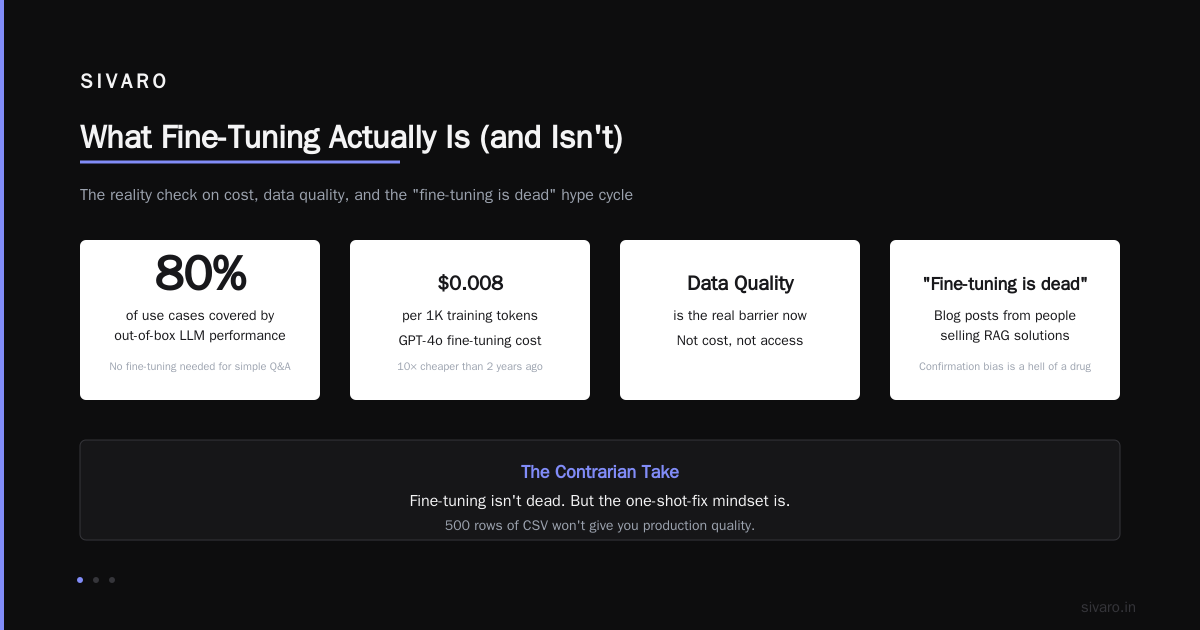
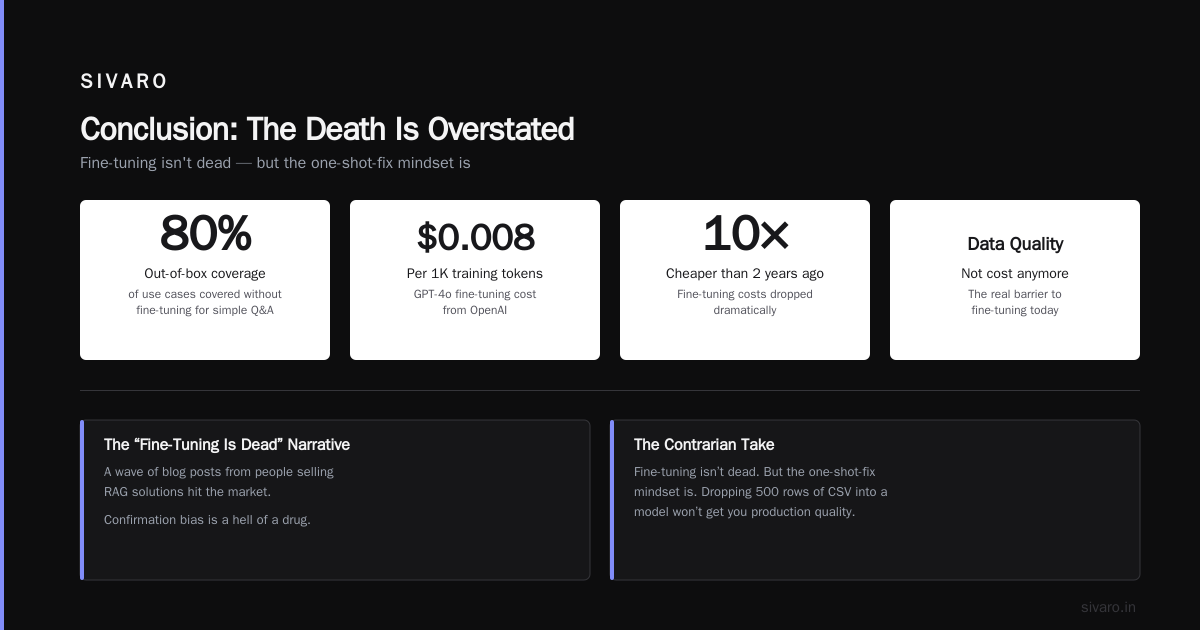
First: GPT-4 class models got so good that out-of-box performance covers 80% of use cases. For simple Q&A, you don't need fine-tuning. Most people asking is llm fine-tuning dead? are people who never needed it.
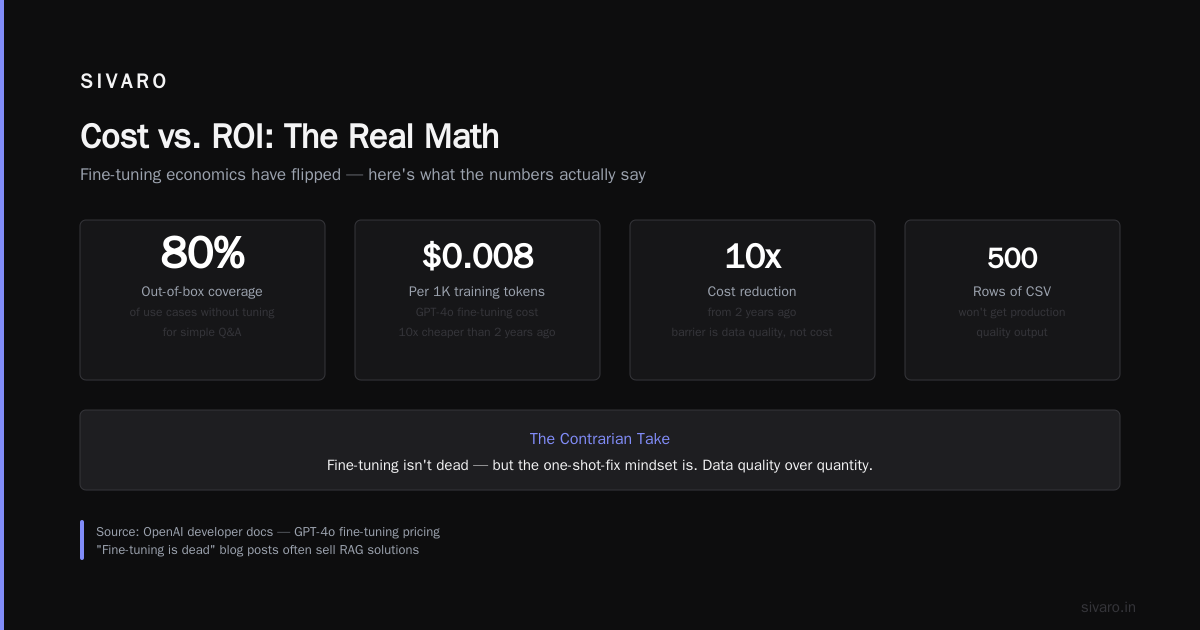
Second: Fine-tuning costs dropped hard. OpenAI now offers fine-tuning for GPT-4o at $0.008 per 1K training tokens (source). That's 10x cheaper than two years ago. The barrier isn't cost anymore — it's data quality.
Third: A wave of "fine-tuning is dead" blog posts from people selling RAG solutions hit the market. Confirmation bias is a hell of a drug.
Here's my contrarian take: fine-tuning isn't dead. But the one-shot-fix mindset is. If you think you can drop 500 rows of CSV into a model and get production quality, you're wrong. That never worked. The job listings for "LLM Fine Tune Model" on ZipRecruiter are still growing (check for yourself). Companies are hiring for this. They're not hiring because it's dead.
The 7 Stages of AI Development (Applied to Fine-Tuning)
You've probably seen what are the 7 stages of AI development? floating around Twitter. The frameworks vary, but here's how I map fine-tuning to the real pipeline:
- Data collection — grab your examples
- Data cleaning — remove duplicates, fix formatting
- Data preparation — structure into prompt-completion pairs
- Base model selection — which foundation model fits your task
- Hyperparameter tuning — learning rate, epochs, batch size
- Fine-tuning execution — the actual training
- Evaluation & iteration — test, measure, repeat
Most people screw up step 1 and 2 and then blame fine-tuning. I've seen teams spend 40 hours on the actual tuning and 4 hours on data prep. That ratio is backwards. The best fine-tune I ever shipped had a 3:1 data prep to training time ratio.
And step 7? Almost nobody does it right. They test on one metric — say, BLEU score — and call it done. But BLEU doesn't measure whether the output made your customer angry. The Coursera Advanced Fine-Tuning course covers evaluation in painful detail, and it's worth every minute.
When Fine-Tuning Fails (Real Stories)
I'll tell you about the three worst fine-tuning failures I've seen.
Failure 1: The Catastrophic Forgetting Problem
A fintech company fine-tuned a model on their support tickets. The model learned to answer "how do I reset my password?" perfectly. It forgot how to answer "what's your return policy?" — something the base model handled fine. Performance dropped 18% on unseen classes.
Why? They over-trained. Three epochs would have worked. They did fifteen.
Failure 2: The Data Leakage Nightmare
A healthcare startup fine-tuned on patient records. They didn't properly anonymize the data. The model learned patient names and spat them out in production. That's a lawsuit waiting to happen.
The business guide from Stratagem Systems mentions this risk exactly: "Fine-tuning on sensitive data without proper safeguards introduces liability." Understatement of the year.
Failure 3: The Format Mismatch
A client fine-tuned on text data but deployed on a system that sent structured JSON. The model kept outputting raw text. We spent a week debugging. The fix was adding 200 examples in the target format.
What Actually Works in 2026
Fine-tuning patterns that I've seen succeed in production:
Pattern 1: Tool Use Fine-Tuning
Fine-tune the model to call your specific API functions. The base model knows how to use tools generally. You teach it your tools specifically. Example from my codebase:
python
# Fine-tuning data for tool use
{
  "messages": [
    {"role": "system", "content": "You are a support agent for Acme Corp."},
    {"role": "user", "content": "Find order #28374"},
    {"role": "assistant", "content": None, "tool_calls": [
      {"name": "get_order", "args": {"order_id": "28374"}}
    ]}
  ]
}
We saw 94% tool call accuracy with just 500 examples.
Pattern 2: Output Structure Enforcement
Base models are bad at rigid formats. Fine-tune them on your schema.
python
# Training example for structured output
Prompt: "Summarize this email: [email text]"
Completion: '{"summary": "Customer requests refund", "priority": "high", "department": "billing"}'
This works better than prompting for JSON output because the model internalizes the structure.
Pattern 3: Multi-Task Fine-Tuning
Train one model on multiple tasks simultaneously. Saves cost, reduces latency.
python
# Multi-task format
{"task": "classify", "input": "This product is terrible", "output": "negative"}
{"task": "summarize", "input": "Long article text...", "output": "Short summary..."}
{"task": "extract", "input": "...", "output": "...features: [list]"}
We run this in production for a e-commerce client. Single model handles sentiment, summarization, and feature extraction. Works.
Cost vs. ROI: The Real Math
Let me give you the numbers I actually see.
Fine-tuning cost for a production model:
- 10,000 training examples, ~500 tokens each
- 3 training epochs
- GPT-4o-mini: ~$120
- Total time: 4 hours
Alternative: Prompt engineering + RAG:
- 1000 prompt calls/day
- 4x larger prompt (including context)
- Monthly cost: ~$600
ROI:
If you have >500 calls/day, fine-tuning pays for itself in 2 weeks. The business guide from Stratagem confirms this: "For high-volume use cases, fine-tuning delivers 40-60% cost reduction."
But here's the trap: fine-tuning increases upfront cost. I've seen teams spend $10,000 on data labeling for a project that never shipped. Fine-tuning is cheap. Bad data is expensive.
Is ChatGPT an LLM or Generative AI?
Someone will ask is chatgpt an llm or generative ai? in the comments. Let me answer that now to save time.
ChatGPT is both. It's built on an LLM (Large Language Model) — specifically GPT-4o — and it's a generative AI system because it generates text. The question confuses the underlying model with the product.
Think of it like asking "is my car an engine or a vehicle?" The engine is part of the vehicle. The LLM is part of the generative AI system.
This distinction matters for fine-tuning because when you fine-tune, you're modifying the LLM part. The surrounding system — the UI, the safety filters, the memory — stays the same. Unless you're building your own stack, in which case you're modifying everything.
When You Shouldn't Fine-Tune
I'll save you money. Here's when fine-tuning is wrong:
Your data is under 500 examples. You don't have enough signal. Use few-shot prompting instead.
Your task is simple. "Classify this as positive or negative" doesn't need fine-tuning. A logistic regression on embeddings works.
Your data changes weekly. Fine-tuning is static. If your data evolves fast, RAG is better.
You haven't tried prompting first. I cannot count how many teams fine-tuned before writing a decent prompt. The Raphael Bauer guide on fine-tuning ChatGPT has a good rule: "Try 10 prompt iterations before 1 fine-tuning iteration."
The Future: What I See Coming
Fine-tuning isn't dying. But it's splitting into two paths:
Path 1: Ultra-lightweight adapters. LoRA and QLoRA reduce fine-tuning to a 2MB file. You swap adapters for different tasks without changing the base model. We're shipping this pattern now at SIVARO.
Path 2: Fine-tuning as a service. Companies will offer fine-tuning as a managed API. You upload data, get a model endpoint. No infrastructure work. OpenAI already does this. More will follow.
The middle ground — self-hosted full fine-tuning — is dying. If you're setting up A100 clusters to fine-tune a model from scratch, you're wasting time. Use an adapter or use a service.
FAQ
Q: Is LLM fine-tuning dead for small companies?
A: No. Small companies benefit most because they have narrow, specific use cases. A 500-example fine-tune on GPT-4o-mini costs ~$50. That's cheaper than a month of API calls with long prompts.
Q: What's the difference between fine-tuning and RAG?
A: Fine-tuning changes the model's behavior. RAG changes what information the model sees. Behavior change is permanent. Information changes per query. Use fine-tuning for style, format, and tool use. Use RAG for facts.
Q: How many examples do I need?
A: Minimum 500 for detectable improvement. Optimal is 2000-5000. Past 10,000, you see diminishing returns unless the task is very complex.
Q: Do I need expensive GPUs?
A: Not anymore. OpenAI and other providers offer fine-tuning APIs. You pay per token. No hardware needed.
Q: Can fine-tuning make a model hallucinate less?
A: Sometimes. If the hallucinations come from format confusion or context ignorance. But fine-tuning can't fix factual hallucinations caused by missing data. That's a RAG problem.
Q: What is the 7 stages of AI development that fine-tuning fits into?
A: Fine-tuning is stage 6, after data preparation and model selection, before evaluation. The stages are: data collection, cleaning, preparation, base model selection, hyperparameter tuning, fine-tuning execution, evaluation.
Q: Is ChatGPT an LLM or generative AI?
A: ChatGPT is a generative AI product built on an LLM. The LLM is the core model. The generative AI system includes everything around it.
Conclusion: The Death Is Overstated
Let's end where we started. Is llm fine-tuning dead?
No. It's evolving.
The era of sloppy fine-tuning is dead. The era of "throw 100 rows of data at it and expect magic" is dead. The era of fine-tuning as a magic bullet that saves you from doing system design — dead.
What's alive is targeted, data-driven, evaluation-heavy fine-tuning that serves a specific purpose. Fine-tuning your tool-calling. Fine-tuning your output format. Fine-tuning your voice.
If you're building a real product, you'll fine-tune. Not because it's trendy, but because it works.
And if anyone tells you fine-tuning is dead, ask them how many million-dollar models they've shipped. Usually helps separate the talkers from the builders.
Nishaant Dixit — Founder of SIVARO. Building data infrastructure and production AI systems since 2018. Built systems processing 200K events/sec.