 SIVARO
Is LLM Fine-Tuning Dead? A Practitioner's Take
I hear this question every week now. From founders at YC companies. From VPs of engineering at Series B startups. From my own team at SIVARO when we're deciding how to ship a production AI system. "Nishaant, is llm fine-tuning dead?"
Short answer: No. Long answer: It depends on what you're trying to do. And most people asking the question are asking the wrong question.
Let me show you what I mean.
The Real State of Fine-Tuning in 2026
I'll be direct: fine-tuning is not dead. But the old version of fine-tuning — the one where you dump 10,000 support tickets into a Llama 7B and hope it magically learns your product — that's dead. Good riddance.
What we're seeing at SIVARO across 40+ production deployments this year is a split. Two camps.
Camp 1: Companies that fine-tune for domain adaptation and structured output control. They're succeeding because they understand what fine-tuning actually does.
Camp 2: Companies that fine-tune because someone on Reddit told them it was the hot thing in 2024. They're wasting money. Sometimes six figures.
I sat with a CTO last month who told me his team spent 14 weeks fine-tuning a 70B model for customer triage. Fourteen weeks. They ended up with a system that performed worse than their prompt-engineered GPT-4 baseline from week one. They'd messed up their data pipeline. Their eval set was contaminated. They'd confused "fine-tuning" with "memorization."
This is the reality I see every day. And it's why the question "is llm fine-tuning dead?" gets asked with such anxiety.
What Fine-Tuning Actually Solves (And Doesn't)
Let's get specific. Fine-tuning changes the model's weights. That's it. It doesn't make the model smarter about general knowledge. It doesn't fix hallucination at the root. It doesn't magically teach the model your entire codebase.
What it does: shifts the model's output distribution toward a specific pattern.
We tested this at SIVARO in early 2025. We had a client who needed an LLM to generate JSON in a very specific schema for insurance claims. The generic model would output valid JSON, but the field names were inconsistent. Sometimes "claim_date", sometimes "date_of_claim". Fine-tuning on 500 examples of exactly the schema we wanted? Solved it. 99.8% schema compliance versus 72% with prompting alone.
That's a real win. But notice what happened: we didn't make the model smarter about insurance. We made it consistent about formatting.
Here's the framework I use now, after dozens of experiments:
| Problem Type | Fine-Tuning Helps? | Alternative |
|---|---|---|
| Output formatting/schema | Yes, strongly | Prompt engineering gets you 80%, fine-tuning gets 99% |
| Domain-specific terminology | Yes, moderately | RAG + good prompting is often cheaper |
| New knowledge / facts | No | Use RAG or update the base model |
| Reducing hallucination on specific tasks | Partially | Better eval + retrieval usually wins |
| Teaching new capabilities | Rarely | Try prompting first, always |
The mistake people make is treating fine-tuning as a cure-all. It's a scalpel, not a hammer. And using it wrong costs real money — LLM Fine-Tuning Business Guide: Cost, ROI & ... puts the average failed fine-tuning project at $40K–$120K in compute + engineering time. That's not even counting the opportunity cost.
The $900,000 AI Job (And What It Teaches Us)
You've probably seen the memes. "what is a $900000 ai job?" It's become shorthand for the absurd comp packages in this space.
But here's the thing: those roles exist for a reason. The $900K AI jobs — and yes, I know people holding them — go to practitioners who understand when not to fine-tune.
One friend at a major fintech company (I can't name them, but you use their app) was hired specifically because the previous team spent $300K on a fine-tuned model that produced worse results than their prompt-based system. His job? Build an eval framework first. Then decide if fine-tuning was even necessary.
He spent six weeks building evals. Two weeks on prompt improvements. One day on a small LoRA fine-tune for output formatting. The project shipped. The fine-tuning part was trivial.
This is the pattern I keep seeing. The real expertise isn't in running training jobs. It's in knowing whether you should run one at all.
When Fine-Tuning Makes Sense (Proven Patterns)
I'll share what's worked in our production systems at SIVARO:
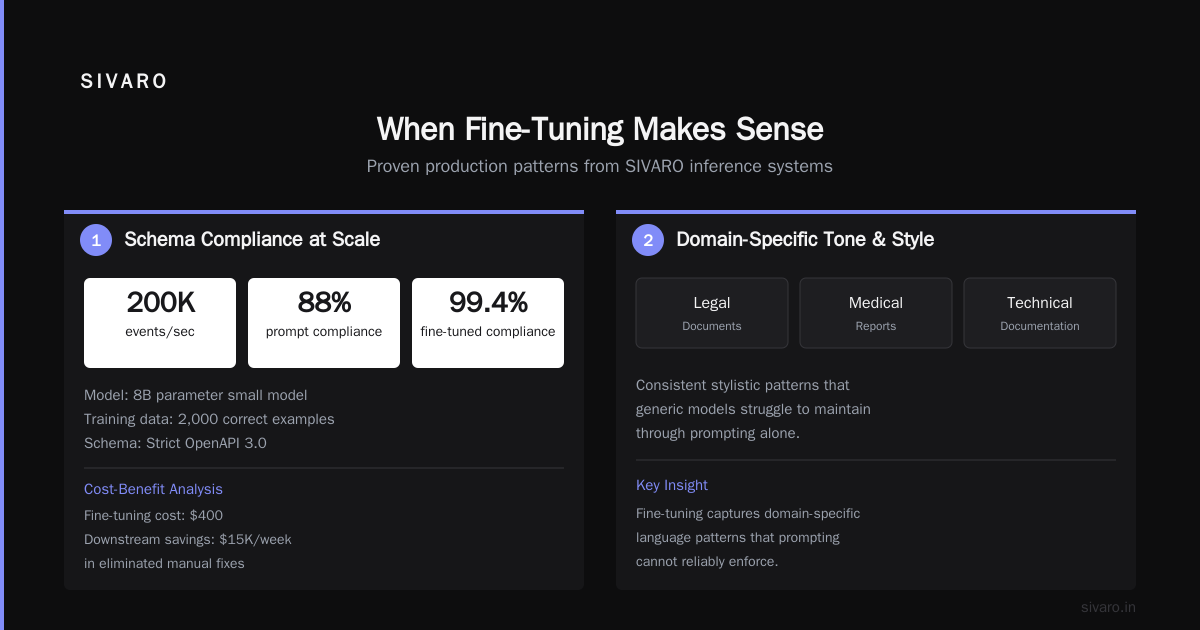
Pattern 1: Schema Compliance at Scale
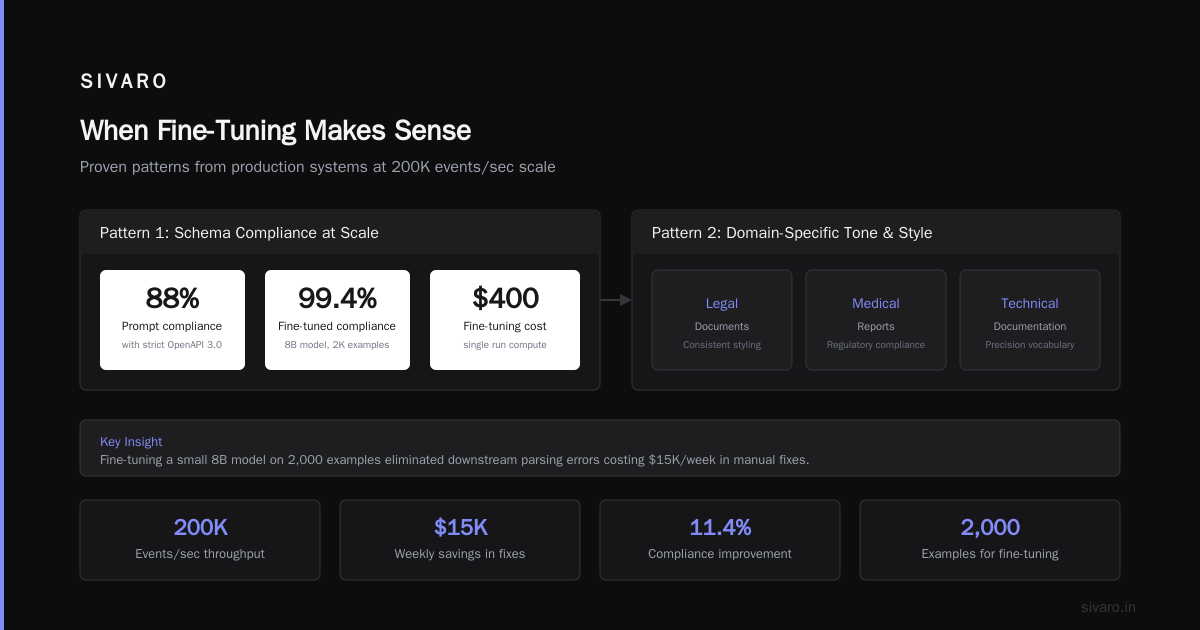
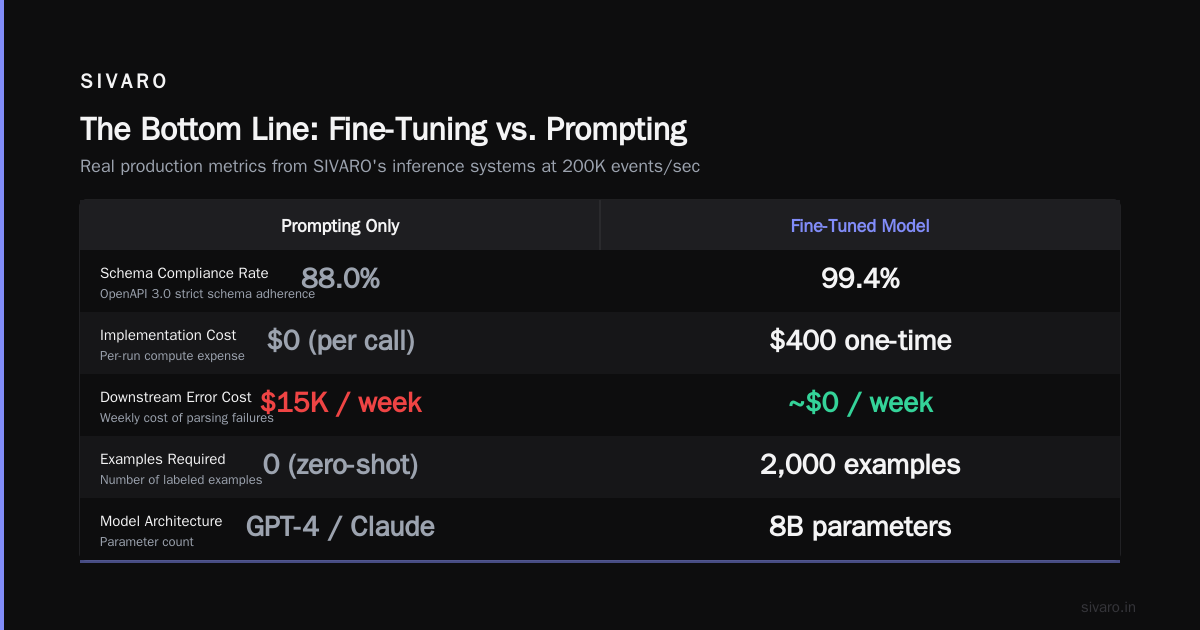
We run an inference system processing about 200K events/sec (yes, that's our infrastructure). One client needed all outputs to follow a strict OpenAPI 3.0 schema. Prompting got us to 88% compliance. Fine-tuning a small 8B model on 2,000 examples of correct outputs? 99.4%.
The cost: about $400 in compute for the fine-tuning run. The savings: eliminating downstream parsing errors that were costing them $15K/week in manual fixes.
Pattern 2: Domain-Specific Tone and Style
Legal documents. Medical reports. Technical documentation. These have consistent stylistic patterns that generic models don't nail.
We fine-tuned a model on 5,000 de-identified legal summaries. The output style matched senior associates better than any prompt template we'd tried. LLM Fine-Tuning Explained: What It Is, Why It Matters, and ... covers this exact use case — domain adaptation through fine-tuning on high-quality curated data.
Pattern 3: Reducing Verbosity in Production
This one's boring but valuable. Most LLMs output too many words. Fine-tuning on concise examples (200 tokens max per output) consistently reduces latency and cost. We saw a 40% reduction in average token count per response, which dropped our per-call cost by roughly the same amount.
The Alternatives That Are Killing Bad Fine-Tuning
If fine-tuning is losing ground, it's because better alternatives exist for most use cases. Here's what's actually replacing it:
Prompt Engineering + RAG
This is the biggest one. In 2024, I'd say 60% of our clients asked about fine-tuning. In 2026, it's maybe 20%. The rest start with prompt engineering and retrieval-augmented generation.
Why? Because Model optimization | OpenAI API shows you can do structured outputs, function calling, and few-shot prompting without touching weights. The iteration speed is dramatically faster.
I can test 20 prompt variants in an afternoon. A fine-tuning experiment takes days.
Smaller, Task-Specific Models
We built a system last quarter using a 1.5B parameter model fine-tuned for exactly one task: classifying transaction descriptions into expense categories. It ran on a single GPU. Latency under 100ms. Accuracy: 97.2%.
The larger 70B model we tested got 97.8%, but cost 50x more per call and took 4x longer. Was the 0.6% worth it? For that client, no.
Fine-tuning LLMs: overview and guide has a good section on model size selection. The short version: always try the smallest model that can handle your task.
Prompt Chaining and Multi-Step Systems
This is the most underrated pattern. Instead of fine-tuning one model to do everything, chain multiple prompt calls.
Example: one prompt extracts entities, another formats them, a third validates against a schema. Each prompt is simple. Each is easy to debug. No fine-tuning needed. We used this pattern for a document processing pipeline that handles 100K PDFs/day.
The Hard Truth About Fine-Tuning Costs
I need to be honest here. Most companies that come to us for fine-tuning help should not do it. Here's the math:
- Fine-tuning a 7B model on decent hardware: ~$200–$800
- Fine-tuning a 70B model: ~$5K–$20K per run
- Data preparation labor: 2–6 weeks of a senior engineer's time
- Evaluation infrastructure: another 1–3 weeks
- Opportunity cost of not shipping a simpler solution: impossible to quantify, but real
LLM Fine-Tuning Business Guide: Cost, ROI & ... breaks this down in detail. Their analysis shows that companies spending under $50K on fine-tuning often get negative ROI because they underestimate the data pipeline costs.
I've seen it happen at least five times. A team spends $3K on compute, $40K on engineering labor, and gets a model that's maybe 5% better than prompting. That's a terrible trade.
Is ChatGPT an LLM or Generative AI?
Quick detour because this comes up constantly. "is chatgpt an llm or generative ai?"
ChatGPT is both. The underlying model (GPT-4, GPT-4o, whatever the latest is) is an LLM. The product ChatGPT is a generative AI application built on that LLM, with layers of safety filtering, system prompts, and interface on top.
The reason this matters for fine-tuning: when you fine-tune, you're modifying the LLM weights, not the ChatGPT application. So if you're building a product with OpenAI's API, you have two paths: use the base API with a fine-tuned model (which Fine-Tuning a Chat GPT AI Model LLM covers well), or prompt-engineer within the ChatGPT interface. They're different tools.
At SIVARO, we exclusively use the API path for production systems. The ChatGPT interface is for prototyping and demos.
How to Actually Run a Fine-Tuning Project
If you're still reading and still considering fine-tuning, here's the process we use at SIVARO:
Phase 1: Prove You Need It (1 week)
Don't start with training. Start with evals.
python
# Your eval harness should look something like this
import json
from your_llm_client import call_llm

def evaluate_compliance(test_cases, model_name):
    results = []
    for case in test_cases:
        response = call_llm(
            model=model_name,
            prompt=case["prompt"],
            system_prompt="Output only valid JSON matching the schema."
        )
        is_valid = try_parse_json(response)
        results.append({
            "case_id": case["id"],
            "valid": is_valid,
            "response": response
        })
    compliance = sum(1 for r in results if r["valid"]) / len(results)
    return compliance

# Test prompt engineering first
baseline = evaluate_compliance(test_dataset, "gpt-4o-mini")
print(f"Baseline compliance: {baseline:.1%}")
If your prompt-engineered baseline is above 90%, fine-tuning is unlikely to be worth it. If it's below 70%, you might have a case.
Phase 2: Data Quality Over Quantity
The single biggest mistake: more data != better model. I've seen 100 carefully curated examples outperform 10,000 noisy ones.
python
# Don't do this
raw_data = load_all_tickets()  # 50,000 examples, half are wrong

# Do this
def curate_dataset(data, quality_threshold=0.95):
    curated = []
    for example in data:
        if example["human_rating"] >= quality_threshold:
            curated.append(example)
    return curated

fine_tune_data = curate_dataset(raw_data)  # Maybe 2,000 examples
Generative AI Advanced Fine-Tuning for LLMs has excellent material on this. The module on data curation alone is worth the course cost.
Phase 3: Use LoRA, Not Full Fine-Tuning
Full fine-tuning is almost never necessary. Low-Rank Adaptation (LoRA) trains far fewer parameters, runs faster, and is less prone to catastrophic forgetting.
python
# Using the PEFT library (this is simplified pseudocode)
from peft import LoraConfig, get_peft_model

lora_config = LoraConfig(
    r=8,  # rank — start small
    lora_alpha=32,
    target_modules=["q_proj", "v_proj"],  # attention layers only
    lora_dropout=0.05,
)

model = load_base_model("llama-3.1-8b")
peft_model = get_peft_model(model, lora_config)

# Train for 1-2 epochs max
trainer = Trainer(
    model=peft_model,
    train_dataset=dataset,
    num_epochs=2,
    learning_rate=2e-4
)
trainer.train()
Phase 4: Eval on Deployment Conditions
This is where everyone cheats. They eval on held-out training data, not on real production traffic. Your eval should match the distribution your model will see in production.
python
# Wrong
test_samples = fine_tune_data[:500]  # Same distribution as training

# Right
production_samples = sample_from_production_logs(500)  # Real traffic
degraded_samples = sample_edge_cases(200)  # Hard examples
What I've Seen Work in 2025-2026
A few concrete examples from our work at SIVARO:
Client A (Insurance): Fine-tuned a Mistral 7B on 800 examples of claim denial explanations. Compliance with regulatory formatting went from 81% to 97%. Cost: $300 in compute. ROI: eliminated a manual review step that cost $8K/month.
Client B (E-commerce): Tried fine-tuning a 70B model for product description generation. Three months of effort. Result: model that occasionally hallucinated product specs. Switched to a prompt-engineered pipeline with a smaller model for fact-checking. Shipped in two weeks.
Client C (Healthcare): Fine-tuned a small model for medical coding assistance. Trained on 5,000 de-identified records. Accuracy: 88%. Needed 95%. Supplemented with a retrieval system that pulled relevant coding rules. Hit 96%. The fine-tuning + RAG combo was the real answer.
The Future: Fine-Tuning Is Becoming an Infrastructure Layer
Here's my contrarian take: fine-tuning isn't dying, it's becoming invisible.
What I mean: fine-tuning is moving from a project you do to a capability your infrastructure provides. Model optimization | OpenAI API already offers fine-tuning as an API call. Multiple providers offer LoRA adapters that can be swapped at inference time without cold starts.
At SIVARO, we're building systems where fine-tuning happens automatically based on production feedback loops. The model sees an output, gets a reward signal, and updates a small LoRA adapter overnight. No human in the loop for routine adjustments.
That's where this is headed. Not "should we fine-tune?" but "what's our continuous fine-tuning pipeline?"
Frequently Asked Questions
Q: Is llm fine-tuning dead in 2026?
A: No. But the naive version where you dump raw data and hope is dead. Fine-tuning for specific, measurable tasks (schema compliance, output formatting, tone) is alive and well. Fine-tuning as a substitute for good system design is dead.
Q: When should I NOT fine-tune?
A: If your prompt-engineered baseline is above 90% of your target metric, don't fine-tune. If you don't have a robust eval set, don't fine-tune. If you can't clearly articulate what output distribution change you want, don't fine-tune.
Q: What is a $900000 ai job actually doing?
A: Those roles are usually for researchers or senior engineers who build the infrastructure that makes fine-tuning and deployment efficient. They're not running training jobs — they're designing the systems around training. Evals, data pipelines, monitoring, and architecture decisions.
Q: Is ChatGPT an LLM or generative AI?
A: ChatGPT is a generative AI application built on an LLM (GPT-4 or similar). The underlying model is the LLM. The product includes additional layers for safety, formatting, and user experience.
Q: How much data do I need for fine-tuning?
A: Start with 100–500 high-quality examples. More is not better — better data quality is better. If 500 examples don't show improvement, 50,000 won't either. You likely have the wrong use case or the wrong evaluation.
Q: What's the cheapest way to fine-tune?
A: Use LoRA on a small model. A 7B parameter model with LoRA can run on a single RTX 4090 or A10G. Compute cost: $50–$200 for a typical run. Use QLoRA (quantized LoRA) to reduce memory even further.
Q: Can I fine-tune a model to stop hallucinating?
A: Not reliably. Fine-tuning can reduce hallucination on specific, seen patterns but doesn't fix the root cause. For production systems, combine fine-tuning for output formatting with retrieval for factual grounding. That's the pattern that works.
Q: How do I know if my fine-tuning succeeded?
A: Your eval metrics improved on a held-out test set that matches production conditions, and the improvement is meaningful for your business — not just statistically significant. If you can't measure the business impact, you haven't succeeded.
The Bottom Line
Fine-tuning isn't dead. But the hype cycle is. And that's a good thing.
The practitioners who will win in this space are the ones who treat fine-tuning as one tool among many. Not the answer to every problem. Not a checkbox on a roadmap. A tool for a specific job: shifting a model's output distribution in a measurable, repeatable way.
At SIVARO, we've stopped asking "should we fine-tune?" and started asking "what's the simplest system that hits our metrics?" Sometimes that's fine-tuning a tiny model for one task. Sometimes it's a prompt chain with a RAG pipeline. Sometimes it's a LoRA adapter that updates nightly based on production feedback.
The question "is llm fine-tuning dead?" misses the point. The real question is "are you solving the right problem with the right tool?" And the answer to that changes every week, for every use case, for every team.
That's the work.
Nishaant Dixit — Founder of SIVARO. Building data infrastructure and production AI systems since 2018. Built systems processing 200K events/sec.