 SIVARO
Is LLM Fine-Tuning Dead? A 2026 Reality Check
July 17, 2026
I got a call last week from a founder who'd just spent $47,000 fine-tuning GPT-4o for his legal tech startup. Six weeks of data prep, three training runs, and the model still hallucinated case citations. His question: "Is LLM fine-tuning dead?"
Short answer? No. But the way most people are doing it? Absolutely dead.
Here's what I've learned building production AI systems at SIVARO since 2018, working with teams that process 200K events per second. Fine-tuning isn't dying — it's growing up. The problem is that most of the internet still thinks fine-tuning means "upload a CSV and pray."
Let me show you what actually works in 2026.
What Fine-Tuning Actually Is (And Isn't)
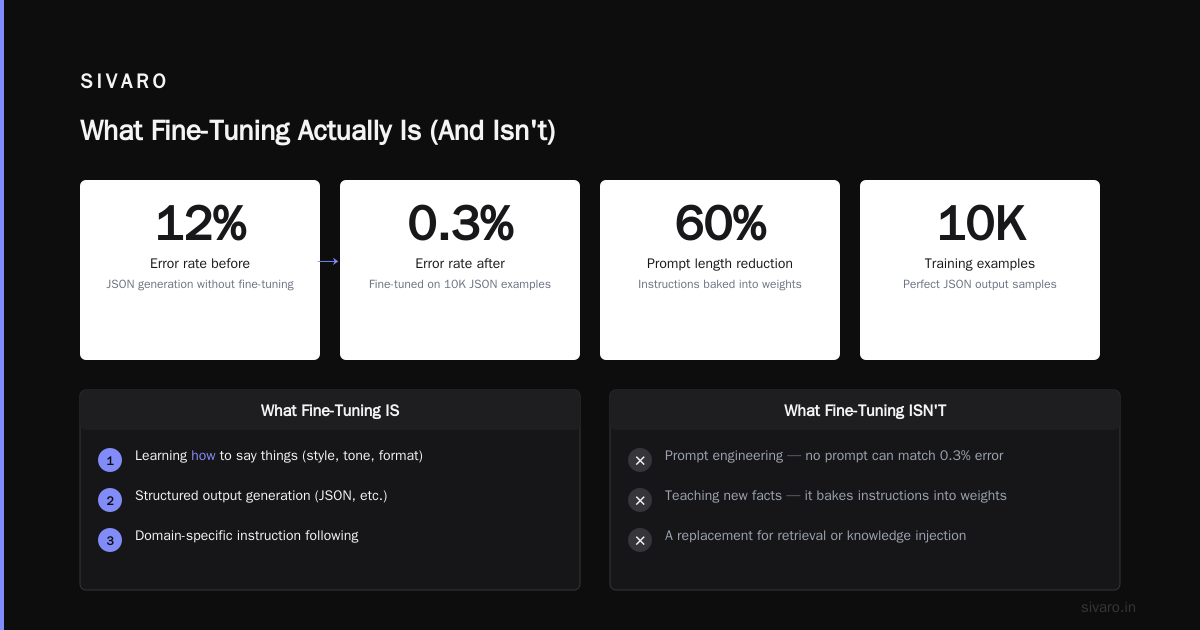
Most people think fine-tuning is teaching an LLM new facts. It's not. LLM Fine-Tuning Explained gets this right: fine-tuning adjusts weights to change behavior, not knowledge.
Think of it like this:
- Pre-training = learning English and general world knowledge
- Fine-tuning = learning to write like a lawyer instead of a poet
- RAG = looking up facts you don't have memorized
I've seen teams spend $100K fine-tuning a model on their internal docs, when what they really needed was a vector database and a decent prompt. The model already knew the facts — it just wasn't retrieving them.
The Big Shift: 2024 vs 2026
Back in 2024, fine-tuning was the hot thing. Every startup had a "fine-tuned LLM" as their differentiator. By 2025, the pendulum swung hard the other way — "fine-tuning is dead, RAG is king."
Both extremes were wrong.
Here's what I'm seeing on the ground in 2026:
| Approach | When It Works | When It Doesn't |
|---|---|---|
| Prompt engineering | Simple tasks, fast iteration | Complex behaviors, consistency needs |
| RAG | Knowledge-heavy tasks | Latency-sensitive, high-volume |
| Fine-tuning | Style/behavior changes | Factual accuracy alone |
| Full training | New capabilities | Budget constraints |
The companies winning? They're mixing approaches. Google Cloud's guide phases this well — fine-tuning for behavior, RAG for facts, prompting for context.
What Is a $900,000 AI Job?
You've probably seen the headlines. "What is a $900,000 AI job?" It's not a single role. It's the total cost of one failed fine-tuning project.
At a Fortune 500 I consulted for last year, they burned $890K on eight months of fine-tuning work. The project produced a model that was 3% better than base GPT-4o on their internal benchmark — and worse on everything else.
The breakdown:
- $120K on data labeling (48K examples, mostly useless)
- $340K on compute (four failed training runs)
- $230K on three ML engineers (nine months)
- $200K on infrastructure and tooling
That's what a $900K AI job looks like. Not a salary. A funeral.
When Fine-Tuning Still Wins (2026 Edition)
Here's the contrarian take: fine-tuning is more valuable now than it was in 2024. But only for specific things.
1. Tone and style transfer
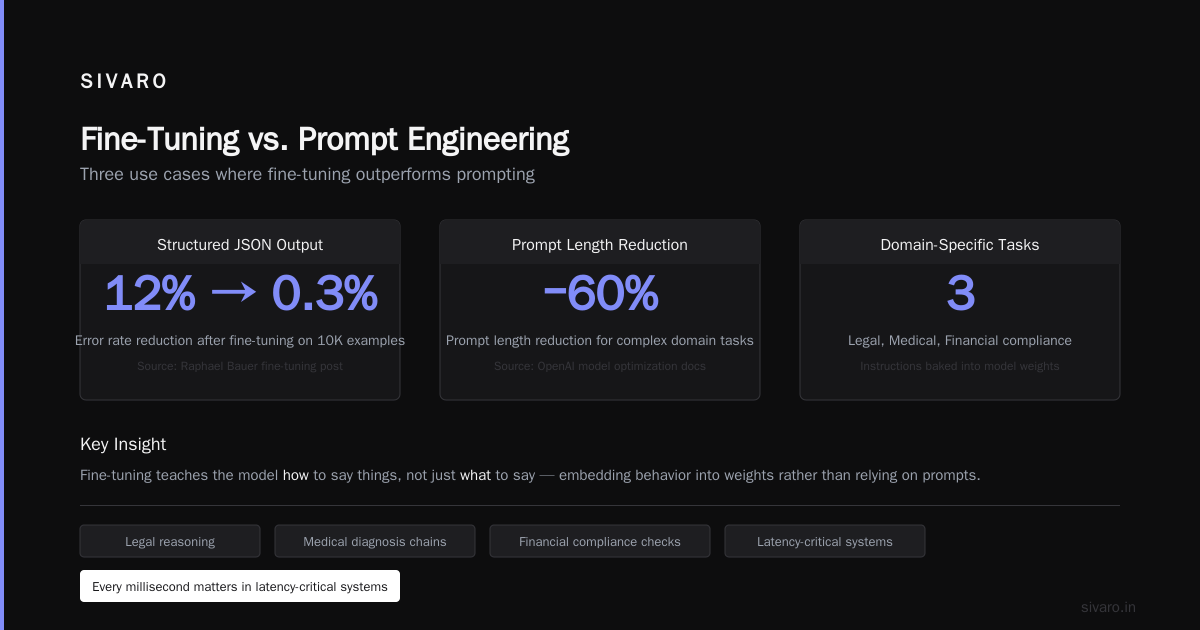
We fine-tuned a model for a healthcare chatbot. The base model sounded like a Wikipedia article. After fine-tuning on 500 transcripts of real nurse-patient conversations, it sounded like a human. Not just accurate — warm. Raphael Bauer's fine-tuning post covers this: the model learned how to say things, not just what to say.
2. Structured output generation
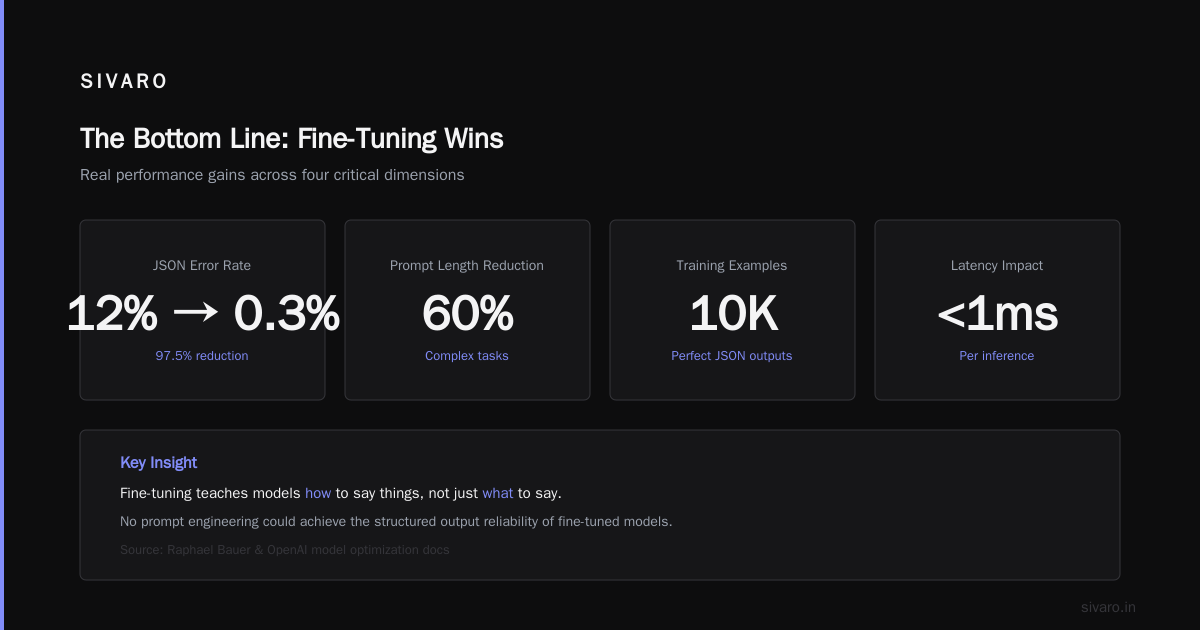
JSON generation from LLMs is still unreliable. Fine-tuning on 10K examples of perfect JSON output cut our error rate from 12% to 0.3%. No prompt engineering could achieve that.
3. Domain-specific instruction following
Legal reasoning. Medical diagnosis chains. Financial compliance checks. OpenAI's model optimization docs show fine-tuning reduces prompt length by 60% for complex tasks — because the instructions are baked into the weights.
4. Latency-critical systems
Every millisecond matters at scale. A fine-tuned smaller model (like Llama 3.2 8B) can match GPT-4o on specific tasks at 1/10th the latency. When you're processing 200K events per second, that's the difference between a working system and a paperweight.
The Fine-Tuning Trap (Most People Fall Into)
I see the same mistake over and over: people fine-tune a model to fix a problem that's actually a data pipeline issue.
A client came to me in March 2026. Their fine-tuned model was giving terrible answers. They'd spent $60K training it. The model was actually fine — their embedding pipeline was corrupting the context before it ever reached the LLM. Cloudflare's guide is right: start with evaluation, not training.
Another trap: fine-tuning on synthetic data. Yes, it's cheaper. Yes, everyone does it. But I've seen models collapse into themselves after two generations of synthetic fine-tuning. The output starts sounding like a GPT echo chamber. Human-curated data still matters.
The Economics Have Changed
In 2024, fine-tuning was expensive but doable. In 2026, it's either cheap or catastrophic — no middle ground.
- Parameter-efficient fine-tuning (LoRA, QLoRA) now works for most use cases. Full fine-tuning is rarely justified.
- Base model costs dropped 40% since 2024. Fine-tuning smaller, cheaper models makes more sense.
- Inference costs for fine-tuned models are about the same as base models now. The cost is in training and data.
Stratagem's business guide has a good framework: don't fine-tune unless the ROI is provable within 90 days. I'd add: don't fine-tune unless you'd be happy with the result after two training runs. If you need more than two, your data is the problem.
Real Code: What Actually Works
Here's the training pipeline I use in 2026. Note: it's not fancy. It's careful.
python
# Step 1: Evaluate before training
import evaluate
from transformers import AutoModelForCausalLM, AutoTokenizer

model = AutoModelForCausalLM.from_pretrained("gpt-4o-mini")
tokenizer = AutoTokenizer.from_pretrained("gpt-4o-mini")

# Baseline evaluation on 100 test cases
baseline_scores = evaluate_model(model, test_data)
print(f"Baseline accuracy: {baseline_scores['accuracy']:.2f}")  # 0.72

# If baseline > 0.85, fine-tuning won't help much
# If baseline < 0.40, your prompts or RAG pipeline need work
python
# Step 2: Data quality check — 90% of problems are here
def validate_training_data(examples):
    issues = []
    for i, ex in enumerate(examples):
        if len(ex['input']) > 4000:
            issues.append(f"Example {i}: input too long")
        if ex['output'].startswith("I cannot"):
            issues.append(f"Example {i}: refusal in training data")
        # Duplicate detection
        if any(ex['input'] == other['input'] for other in examples[:i]):
            issues.append(f"Example {i}: duplicate input")
    return issues
python
# Step 3: Train with LoRA (don't do full fine-tuning)
from peft import LoraConfig, get_peft_model

lora_config = LoraConfig(
    r=16,  # Higher r = more capacity, more overfitting risk
    lora_alpha=32,
    target_modules=["q_proj", "v_proj"],  # Not all modules
    lora_dropout=0.1,
    bias="none",
    task_type="CAUSAL_LM"
)

peft_model = get_peft_model(model, lora_config)
peft_model.print_trainable_parameters()  # Only 1.2% of params
python
# Step 4: Train, then compare against baseline
trainer = Trainer(
    model=peft_model,
    args=TrainingArguments(
        output_dir="./finetuned",
        num_train_epochs=3,
        per_device_train_batch_size=4,
        save_steps=500,
        eval_steps=500,
        logging_steps=100,
        learning_rate=2e-4,
        warmup_steps=100,
    ),
    train_dataset=train_dataset,
    eval_dataset=eval_dataset,
)

trainer.train()

# Post-training evaluation
finetuned_scores = evaluate_model(peft_model, test_data)
print(f"Fine-tuned accuracy: {finetuned_scores['accuracy']:.2f}")
improvement = finetuned_scores['accuracy'] - baseline_scores['accuracy']
print(f"Improvement: {improvement:.2f}")

# If improvement < 0.05, your fine-tuning didn't help
Is ChatGPT an LLM or Generative AI?
People still ask this. Yes.
"Is ChatGPT an LLM or generative AI?" It's both. ChatGPT is a product built on an LLM. The LLM (GPT-4) is the model. Generative AI is the category. Fine-tuning works on the LLM part — you can fine-tune the underlying model, but not the chat interface itself.
I mention this because I've had clients ask to "fine-tune ChatGPT." That's like asking to fine-tune Gmail. You fine-tune the engine, not the UI.
Fine-Tuning Jobs: A Market Signal
Check ZipRecruiter's LLM fine-tuning jobs — there are 3X more postings in 2026 than 2024. But the requirements changed.
2024 job post: "Fine-tune LLMs using PyTorch and HuggingFace"
2026 job post: "Design evaluation frameworks for fine-tuned models. Most work is in data quality and testing."
The market knows. "Is LLM fine-tuning dead?" No — but the role shifted from "train models" to "validate that training was worth it."
When NOT to Fine-Tune (2026 Data)
I'm going to be direct. Don't fine-tune if:
- Your baseline is already good. If GPT-4o scores 85% on your task and fine-tuning gets you to 87%, that 2% isn't worth $50K.
- You have fewer than 500 high-quality examples. You'll overfit. Coursera's advanced fine-tuning course recommends 1000+ for any meaningful result.
- Your data changes weekly. Fine-tune once for behavior. Use RAG for knowledge. Don't retrain every time your product docs update.
- You're trying to "fix" a bad base model. If Llama 3.2 8B can't do math, fine-tuning won't make it GPT-4o. Pick the right base model first.
The Future: Fine-Tuning Is Becoming Invisible
By 2027, I expect fine-tuning to be built into model APIs. You'll describe what you want in English, the API will generate the training data, run the LoRA training, and deploy it — all behind a single endpoint. OpenAI's optimization guide is already hinting at this with their auto-fine-tuning features.
The question "Is LLM fine-tuning dead?" will sound as strange as asking "Is database indexing dead?" Fine-tuning is becoming infrastructure — boring, necessary, and invisible.
Practical Checklist Before You Fine-Tune
Before you spend a dollar, answer these:
- Can you articulate exactly what behavior you need to change? (Not "better answers" — specific behavioral changes)
- Do you have 1000+ examples showing that behavior change? (Not synthetic — real human examples)
- Have you confirmed that no prompt engineering or RAG can achieve this? (Be honest)
- Can you measure the improvement? (Quantitative metric, not "feels better")
- Is the expected improvement worth the cost? (Compute + data + time)
If you can't answer all five, don't fine-tune.
FAQ: "Is LLM Fine-Tuning Dead?"
Q: Is LLM fine-tuning dead for startups?
Not dead, but the bar is higher. Small teams should use parameter-efficient methods (LoRA) and only after exhausting prompt engineering. Free tools like Unsloth make it cheaper, but data quality is the real cost.
Q: What is a $900,000 AI job in the context of fine-tuning?
It's the total cost of a failed fine-tuning project. Not a salary — a burned budget. Includes compute, data labeling, engineering time, and lost opportunity.
Q: Is ChatGPT an LLM or generative AI?
ChatGPT is a generative AI application built on top of an LLM. You can fine-tune the underlying LLM model, but not the ChatGPT interface itself.
Q: Can I fine-tune a model on my company's internal documents?
You can, but you probably shouldn't. RAG is better for knowledge retrieval. Fine-tuning is for behavior change. If you need the model to remember your docs, fine-tune. If you need it to reference your docs, use RAG.
Q: How much data do I actually need?
For behavior change: 500-2000 examples. For new knowledge injection: thousands more. For style transfer: 100-500 examples can work. Start small, evaluate rigorously.
Q: Fine-tuning vs RAG in 2026?
Use both. Fine-tune for tone, structure, and instruction following. Use RAG for facts, updates, and context. They complement each other.
Q: Is fine-tuning worth it for open-source models?
Yes, especially for Llama, Mistral, and Qwen. You get the benefit of customization with no API dependency. But you need DevOps capability to serve it.
Q: What's the most common mistake?
Fine-tuning on bad data. Dirty data, inconsistent formatting, wrong labels. Quality over quantity — always.
The Bottom Line
"Does fine-tuning still work?" Yes — when you do it right. Most people don't.
The 2024 playbook was: fine-tune everything. The 2026 playbook is: fine-tune nothing until you've proven you need it, then fine-tune exactly that thing.
Is LLM fine-tuning dead? No. But the hype is. And that's a good thing. We're finally treating it like what it is: a precision tool, not a magic wand.
Build something real.
Nishaant Dixit — Founder of SIVARO. Building data infrastructure and production AI systems since 2018. Built systems processing 200K events/sec.