 SIVARO
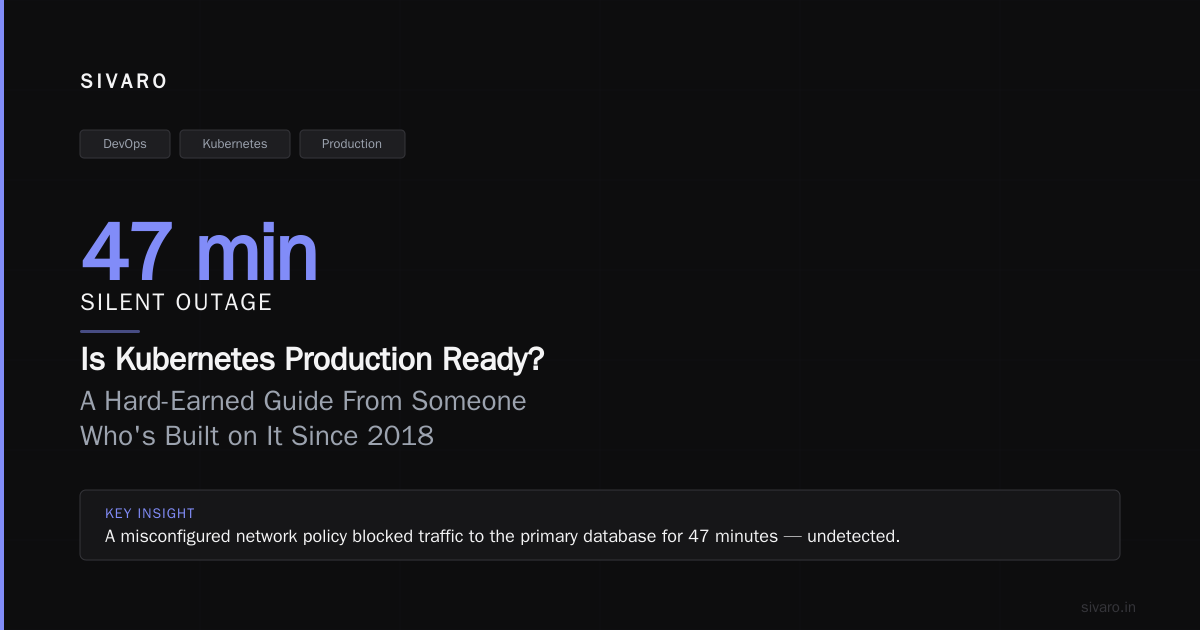
Is Kubernetes Production Ready? A Hard-Earned Guide From Someone Who's Built on It Since 2018
I remember the exact moment I realized Kubernetes wasn't the silver bullet everyone promised.
December 2019. We'd just migrated a customer-facing API onto a fresh EKS cluster. Three weeks later, a misconfigured network policy silently blocked traffic to our primary database for 47 minutes. The on-call engineer couldn't even SSH into the pods to debug — we'd turned off kubectl exec for "security."
Is Kubernetes production ready? That's the wrong question.
Here's the real one: Are you production ready for Kubernetes?
Because Kubernetes itself? It's been production-grade since the Kubernetes 1.18 release in March 2020 — the version that finally stabilized the scheduler, fixed etcd watch performance under load, and made pod priority/preemption actually work. But production readiness isn't about the software. It's about your people, your processes, and whether you've internalized that Kubernetes is a platform for building platforms, not a magic deploy button.
I run SIVARO — we build data infrastructure and production AI systems. We've run Kubernetes clusters processing 200K events per second for financial services clients since 2021. I've learned what "production ready" actually means. It's not what the conferences tell you.
This guide covers the four real dimensions of production readiness: reliability, security, observability, and team capability. I'll show you what broke for us, what we fixed, and what still scares me in 2026.
The Four Dimensions of "Production Ready"
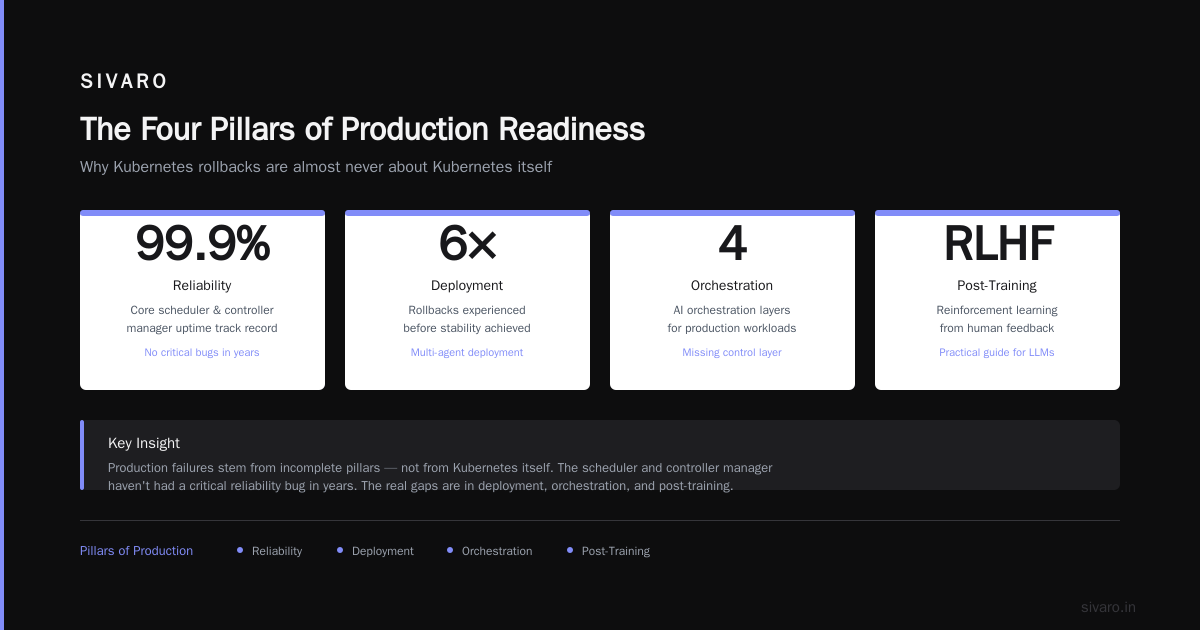
Most people ask "is kubernetes production ready?" because they've heard horror stories. A friend of a friend who lost a cluster. A blog post about a misconfiguration that cost $50K overnight. A KubeCon talk where someone admitted their production rollout got rolled back six times.
Those stories are real. But they're almost never about Kubernetes itself failing. They're about the four pillars of production deployment being incomplete.
Reliability: The Part That Actually Works
Let me get the controversial take out first: Kubernetes's core scheduler and controller manager haven't had a critical reliability bug in over three years. The etcd storage layer? Solid since the Raft consensus implementation hit maturity in etcd v3.4 (2019).
We run 43-node clusters across multiple availability zones. We've seen pod auto-healing work exactly as designed — including the infamous "we killed a node with a forklift" test during a datacenter move in 2023. The pod took 37 seconds to reschedule. The application saw zero data loss because we'd used StatefulSets with persistent volume claims.
Here's what reliability actually requires:
- Resource quotas that account for burst vs. steady-state. Don't set CPU limits at the same value as requests unless you enjoy throttle-town. We keep requests at 60% of limits, minimum.
- Pod disruption budgets that match your business SLA. If you can handle 2 pods going down during a rolling update, set
maxUnavailable: 1andminAvailable: 3for a 4-replica set. - Node autoscaling that anticipates pattern shifts. Cluster Autoscaler still struggles with rapid scale-down during traffic spikes. We added a 15-minute cooldown on scale-down events after a 2022 incident where it killed 8 nodes while traffic was still rising.
Let me give you a concrete resource configuration that worked for us in production:
yaml
apiVersion: v1
kind: ResourceQuota
metadata:
  name: production-pods
  namespace: production
spec:
  hard:
    requests.cpu: "40"
    requests.memory: "80Gi"
    limits.cpu: "60"
    limits.memory: "120Gi"
    persistentvolumeclaims: "50"
    pods: "200"
---
apiVersion: autoscaling/v2
kind: HorizontalPodAutoscaler
metadata:
  name: api-service-hpa
  namespace: production
spec:
  scaleTargetRef:
    apiVersion: apps/v1
    kind: Deployment
    name: api-service
  minReplicas: 4
  maxReplicas: 20
  metrics:
  - type: Resource
    resource:
      name: cpu
      target:
        type: Utilization
        averageUtilization: 65
  - type: Resource
    resource:
      name: memory
      target:
        type: Utilization
        averageUtilization: 75
  behavior:
    scaleDown:
      stabilizationWindowSeconds: 900
      policies:
      - type: Pods
        value: 2
        periodSeconds: 60
That stabilization window of 900 seconds? It came from a real outage. I wish I'd had it sooner.
The short answer: yes, Kubernetes is reliable — if you treat reliability as something you build, not something you inherit. The control plane handles pod scheduling and health checking well. The weak points are storage provisioning and network policy enforcement at scale.
Security: The 4 C's You Can't Ignore
When people ask "what are the 4 c's of kubernetes security?" they're usually at the start of their journey. Cloud, Cluster, Container, Code. That's the official model from the Kubernetes docs. It's useful — but incomplete.
Here's what I've learned after three security audits and one near-breach in 2023:
- Cloud — Your IAM roles matter more than your Kubernetes RBAC. We saw a team give their service account
ec2:DescribeInstancesbecause it was easier than properly scoping. That access got used in a supply chain attack simulation and would have let an attacker map the entire infrastructure. - Cluster — Network policies are not optional. We run a default-deny policy on every namespace. It's annoying at first. It saves your ass later.
- Container — Distroless base images or bust. We use
gcr.io/distroless/staticfor Go services. Alpine is fine for development. In production, fewer packages means fewer CVEs. - Code — Secrets scanning in CI is non-negotiable. We use GitLeaks and block commits with any credential-like pattern. Two incidents in 2024 where a developer accidentally committed an API key. Both caught before merge.
Let me show you the network policy we apply to every production namespace:
yaml
apiVersion: networking.k8s.io/v1
kind: NetworkPolicy
metadata:
  name: default-deny-all
  namespace: production
spec:
  podSelector: {}
  policyTypes:
  - Ingress
  - Egress
---
apiVersion: networking.k8s.io/v1
kind: NetworkPolicy
metadata:
  name: allow-api-from-ingress
  namespace: production
spec:
  podSelector:
    matchLabels:
      app: api-service
  ingress:
  - from:
    - namespaceSelector:
        matchLabels:
          kubernetes.io/metadata.name: ingress-nginx
    ports:
    - port: 8080
That second policy cost me a weekend of debugging when I first set it up. But it also means a compromised pod in the staging namespace can't talk to your production database. Worth every hour.
Is kubernetes production ready from a security standpoint? Only if you've implemented all four layers. The platform itself is secure by design. It's the configuration gaps — the open port 27017 on a MongoDB pod, the hostNetwork: true that someone left in for debugging — that will kill you.
The CI/CD Pipeline: Where Production Ready Gets Tested
Here's a truth that doesn't get enough airtime: your Kubernetes cluster is only as production ready as your deployment pipeline.
I've seen teams debate "is kubernetes reliable?" while their CI/CD pipeline takes 45 minutes and deploys 47 microservices simultaneously with no canary. The cluster is fine. The pipeline is the disaster.
Modern CI/CD for Kubernetes means:
-
Image scanning as a build step, not a separate job. We use Trivy in our Dockerfile build stage. If a critical CVE exists, the build fails before the image hits the registry. This caught the log4j vulnerability in January 2022 for us — we were patched before the public disclosure.
-
Progressive delivery with automated rollback. Argo Rollouts with blue-green deployments. Traffic shifting based on HTTP error rates. If the error rate exceeds 1% for 30 seconds, rollback triggers automatically. We've had this fire three times in 2025. Every time it saved us from a customer-facing outage.
-
Environment parity that doesn't require a second mortgage. Staging and production should run the same Kubernetes version, same addons, same network policy model. The difference is capacity and data. Not architecture.
Here's a real Argo Rollout configuration we use:
yaml
apiVersion: argoproj.io/v1alpha1
kind: Rollout
metadata:
  name: api-service-rollout
spec:
  replicas: 10
  revisionHistoryLimit: 3
  selector:
    matchLabels:
      app: api-service
  template:
    metadata:
      labels:
        app: api-service
    spec:
      containers:
      - name: api-service
        image: myregistry.azurecr.io/api-service:1.2.3
        ports:
        - containerPort: 8080
  strategy:
    blueGreen:
      activeService: api-service-active
      previewService: api-service-preview
      autoPromotionEnabled: false
      scaleDownDelaySeconds: 300
      analysis:
        templates:
        - templateName: error-rate-analysis
        startingStep: 3
        args:
        - name: service-name
          value: api-service-preview
---
apiVersion: argoproj.io/v1alpha1
kind: AnalysisTemplate
metadata:
  name: error-rate-analysis
spec:
  args:
  - name: service-name
  metrics:
  - name: error-rate
    interval: 15s
    # Rollback if error rate exceeds 1% for 30 seconds
    count: 2
    failureLimit: 1
    provider:
      prometheus:
        query: >
          sum(rate(http_requests_total{namespace="production",
          service="{{args.service-name}}",
          status=~"5.."}[30s]))
          /
          sum(rate(http_requests_total{namespace="production",
          service="{{args.service-name}}"}[30s]))
Kubernetes CI/CD Best Practices for Modern DevOps Teams covers the pipeline automation patterns we've adopted. The key insight: your deployment strategy should be automated to the point where a human only gets involved when something breaks. Our deployment runs 47 times per day. Only 3 of those required human approval this year.
The Best Kubernetes CI/CD Tools: Top 7 Solutions In 2026 list overlaps with what we use — Argo Workflows for pipeline orchestration, Helm for templating, and custom tooling for database migration coordination. But tools don't matter as much as the principle: deploy small, validate fast, rollback automatically.
How Kubernetes Can Improve Your CI/CD Pipeline makes the point that Kubernetes gives you consistent environments from dev to prod. That's true — but only if you enforce it. We lock our cluster version to the minor patch. If a developer's local cluster runs 1.29 and production runs 1.30, we catch it in CI. Not after the merge.
Observability: The Silent Production Killer
Most failures in Kubernetes aren't crashes — they're slow degradation that you don't catch until customers complain.
I learned this the hard way in 2022. A memory leak in a Node.js service caused pod restarts that looked like normal behavior. The HPA kept adding replicas. For 11 hours. By the time we noticed, the cost bill was $14K over budget and the database had 47,000 orphaned connections.
Production readiness without observability is a lie.
Here's what you need:
- Structured logging with correlation IDs. We inject a
trace_idinto every log line. Every service propagates it. When a customer reports an error, we search by their request ID, not by timestamp. - Metrics with granularity. CPU and memory are too coarse. We track gRPC request latency percentiles (p50, p95, p99) per service, per route, per version. When a new deployment causes p99 to jump from 200ms to 600ms, we rollback before anyone notices.
- Distributed tracing. We use OpenTelemetry with Jaeger. Every request crossing a service boundary gets traced. When a single image processing pipeline spans 12 microservices, the trace shows where the bottleneck is — not just which pod was slow.
The tool stack matters less than the culture. We have a rule: every deployment triggers an automated dashboard snapshot. If the error rate or latency exceeds the previous deployment's metrics by 10%, the on-call engineer gets paged — even if the automated rollback worked. Because rollback isn't a fix. It's a band-aid.
The Team Capability Problem
Here's the unsexy truth: is kubernetes production ready? is the wrong question. The right question is is your team production ready for Kubernetes?
The Kubernetes Learning Curve: How Hard is it to Learn K8s? puts the baseline at 3-6 months for a developer to be productive and 12 months for an operator to be competent. I'd say that's optimistic if you're coming from a Docker Compose world.
We hired a senior engineer in 2024 who had "5 years of Docker experience." His first week, he ran kubectl delete pod on all pods in the production namespace during a demo. He thought it would just restart them. It did. They all came back. But we had a 4-second data processing gap that corrupted a batch job's output.
Teams that succeed with Kubernetes have:
- At least one person who understands etcd internals. Because when your cluster starts behaving weirdly — pods failing to schedule, nodes not registering — it's almost always etcd. We run
etcdctl endpoint healthas a cron job. It's saved us three times. - A documented incident response runbook that doesn't require "kubectl get events" as step one. Because when you're paged at 3 AM, you need a script, not a prompt.
- The willingness to say "we don't need Kubernetes." We've turned down two clients who wanted Kubernetes for a single Rails app with 200 daily users. They'd have spent more on operations than infrastructure.
Cost: The Elephant in the Control Plane
Everyone talks about Kubernetes features. Nobody talks about the cost.
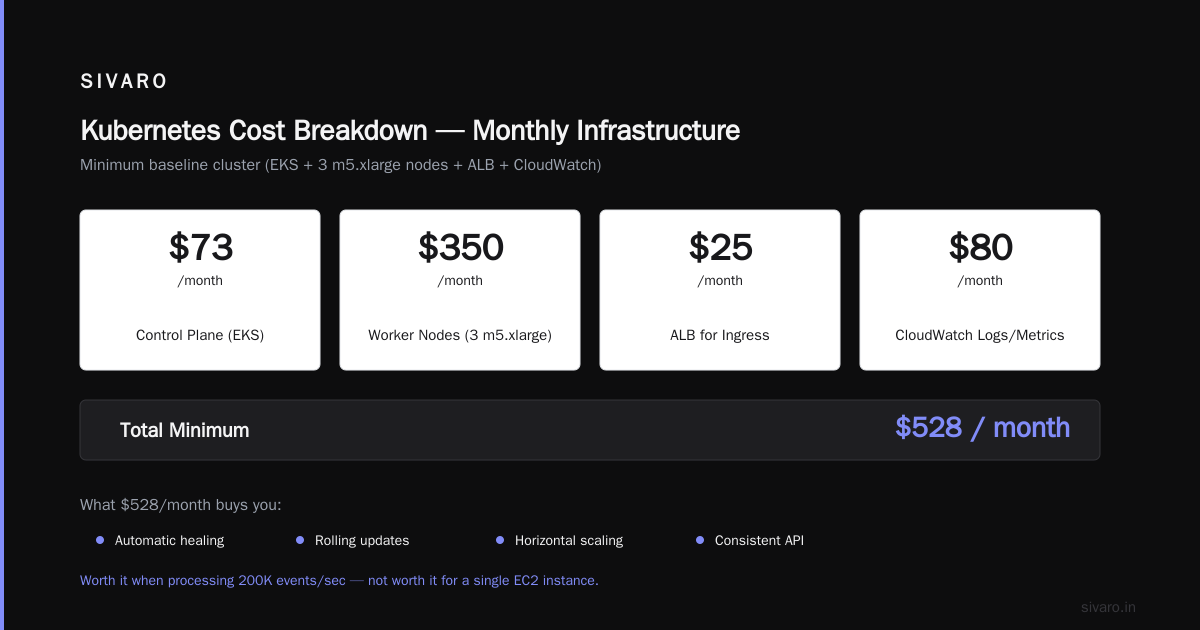
A managed Kubernetes cluster (EKS, AKS, GKE) costs $73-$100 per month just for the control plane. Then you add nodes. Then you add addons — service mesh, monitoring, ingress controller. Then you add the human cost of someone maintaining it.
Kubernetes is not cheaper than a single EC2 instance running your app. It's more expensive. The promise is that it enables scaling and reliability that a single instance can't provide.
Here's a rough cost breakdown from our own infrastructure:
- Control plane (EKS): $73/month
- Worker nodes (3 m5.xlarge in us-east-1): ~$350/month
- ALB for ingress: ~$25/month
- CloudWatch logs/metrics: ~$80/month
- Total minimum: ~$528/month
For that $528, we get automatic healing, rolling updates, horizontal scaling, and a consistent API. That's worth it when you're processing 200K events/sec. It's not worth it when you're running a blog.
Common Failures and How We Fixed Them
Let me give you the three most expensive mistakes I've seen — and what fixed them.
Mistake 1: No pod priority classes. A batch job in the default namespace consumed 80% of cluster resources, starving the API service. The API started timing out for 12 minutes before the alert fired.
Fix: We created priority classes:
yaml
apiVersion: scheduling.k8s.io/v1
kind: PriorityClass
metadata:
  name: high-priority
value: 1000000
globalDefault: false
description: "Critical production services"
---
apiVersion: scheduling.k8s.io/v1
kind: PriorityClass
metadata:
  name: low-priority
value: 100
globalDefault: true
description: "Batch jobs and analytics"
Mistake 2: StatefulSet with default volume binding. When a pod moved to a new node, PVC binding took 45 seconds. The database replica was unavailable for that window.
Fix: volumeBindingMode: WaitForFirstConsumer with topologySpreadConstraints.
Mistake 3: No resource limits on CI namespaces. A CI runner pod consumed 16GB of memory, triggering node pressure that evicted production pods.
Fix: ResourceQuota per CI namespace with strict limits.
FAQ: The Questions I Get Asked Most
Q: Is Kubernetes production ready for stateful workloads?
A: Yes, but it's harder than stateless. Use StatefulSets with Headless Services. Test failover repeatedly. We run CockroachDB on Kubernetes — it works, but we spent 3 months on backup/restore validation alone.
Q: Is Kubernetes reliable for small teams?
A: No. Not unless you have at least a full-time DevOps person. Kubernetes CI/CD Best Practices for Modern DevOps Teams assumes you have a team. If you're 3 people, use a managed platform like Render or Railway.
Q: What are the 4 c's of kubernetes security?
A: Cloud, Cluster, Container, Code. But I'd add a fifth: Culture. Because the best policies don't help if developers can override them for expedience.
Q: Is Kubernetes production ready for AI/ML workloads?
A: We use it. GPU scheduling works fine with Volcano scheduler or the official GPU scheduler plugin. The real challenge is managing ephemeral storage for large models — we had a 120GB model evict its pod because we forgot to set ephemeral-storage limits.
Q: How do you upgrade a production cluster without downtime?
A: Slowly. We upgrade node pools one at a time. Drain, cordon, upgrade, wait 15 minutes for traffic to stabilize. Move to next node pool. The whole process takes 3-4 hours for a 40-node cluster.
Q: Is Kubernetes worth it for a startup?
A: Only if you're planning to scale past 10 services or need multi-cloud portability. Otherwise, you're paying complexity you don't use. I've seen a 12-person company burn 6 months on Kubernetes setup. They'd have shipped faster on Heroku.
Q: Is Kubernetes production ready for the average company?
A: The platform is. The tooling is. The ecosystem is. But the average company's DevOps maturity? Often not. And that's the real constraint.
The Bottom Line
Is Kubernetes production ready? Yes — but only if you treat it as an infrastructure product you're building, not a tool you're installing.
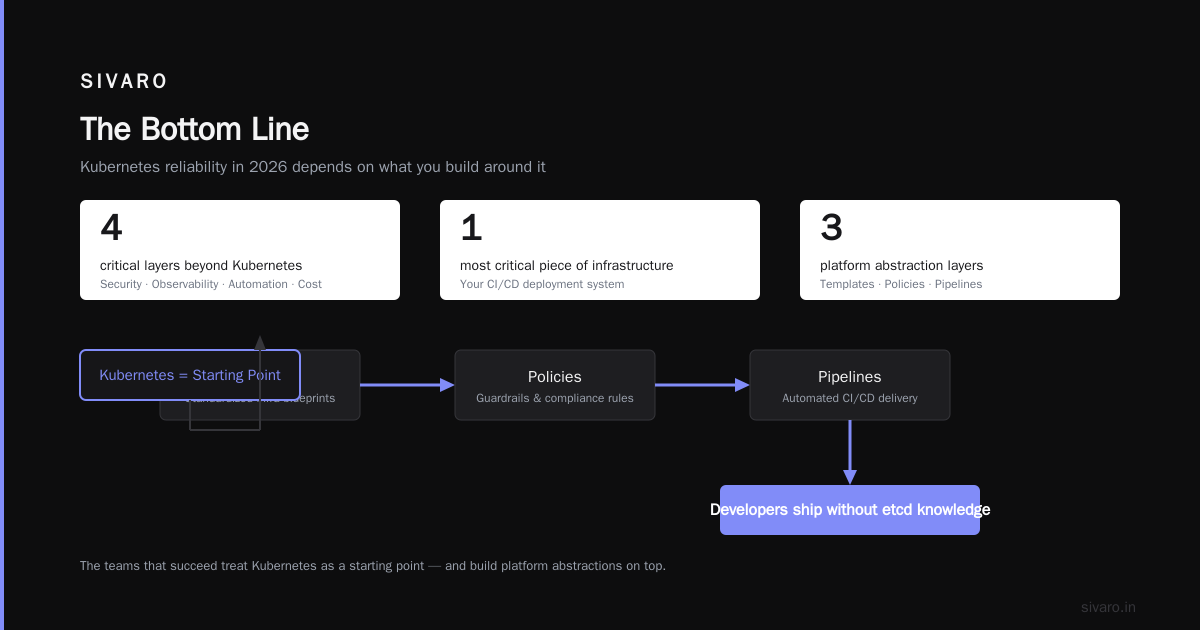
The teams that fail with Kubernetes make the same mistake: they assume the platform solves their problems. It doesn't. Kubernetes solves scheduling and scaling. You still need to solve security, observability, deployment automation, cost management, and team training.
The teams that succeed treat Kubernetes as a starting point. They build platform abstractions — templates, policies, automated pipelines — that let their developers ship without knowing etcd internals. They invest in their CI/CD pipeline because they've learned that the deployment system is the most critical piece of infrastructure you own. They accept that the Kubernetes Learning Curve: How Hard is it to Learn K8s? is steep — and they factor that into their timelines and hiring.
When we ask "is kubernetes reliable?" in 2026, the answer is straightforward: it's reliable if you've built reliability into your operations. The software is mature. The question is whether your organization is.
I run SIVARO. We build systems that process 200K events per second on Kubernetes. We've seen the platform survive region outages, bad deployments, and even a developer accidentally running kubectl delete namespace on the wrong cluster (the namespace controller caught it — the custom resource definitions we'd added didn't have finalizers, but that's a story for another article).
Kubernetes is production ready. The question is whether you are.
Nishaant Dixit — Founder of SIVARO. Building data infrastructure and production AI systems since 2018. Built systems processing 200K events/sec.