
Is Kubernetes CI or CD? The Honest Answer from Someone Who's Built Both
Here's the short answer: Kubernetes is neither CI nor CD. It's the platform where CI/CD happens.
I've spent the last three years at SIVARO building production AI systems on Kubernetes. Before that, I ran data infrastructure for a fintech processing 200K events per second. Every team I've worked with has asked some version of "is kubernetes ci or cd?" — usually because they're trying to figure out where to draw the line between their pipeline tooling and their runtime environment.
The confusion is understandable. Kubernetes blurs boundaries. It runs your build agents, hosts your artifact registry, manages your test environments, and orchestrates your production deployments. But treating it as a CI/CD tool is like calling a kitchen a recipe.
Let me walk you through what actually works — and what doesn't.
What Kubernetes Actually Is (And Isn't)
Kubernetes is a container orchestration platform. Period. According to the official Kubernetes docs, it "automates the deployment, scaling, and management of containerized applications." No mention of CI/CD. No mention of pipelines.
But here's where it gets messy: most teams run their CI/CD on Kubernetes. Jenkins, GitLab CI, Argo Workflows, Tekton — these tools run as containers inside your cluster. So when someone asks "is kubernetes ci or cd?", they're really asking "should my pipeline run inside my cluster or outside it?"
At first I thought this was a philosophical question. Turns out it's a practical one with real consequences.
The Contrarian Take: Stop Running Your CI in Production Clusters
Most people think running CI/CD in Kubernetes is the modern way to do things. They're wrong — or at least, they're missing the trade-offs.
I worked with a company in early 2025 running 500+ microservices on a shared EKS cluster. Their CI pipeline ran in the same cluster as production. When a developer pushed a bad test that consumed 32GB of RAM, it OOM-killed a production pod serving customer traffic. The outage lasted 14 minutes.
The problem wasn't Kubernetes. It was conflating CI infrastructure with deployment infrastructure.
CI workloads are bursty. They need to spin up quickly and die fast. They consume unpredictable resources. Production workloads need stability, predictable scaling, and strict resource isolation. Running both in the same cluster violates every operational principle I've learned.
Does this mean you shouldn't use Kubernetes for CI? No. It means you need to treat CI and CD as separate concerns — even if they share the same underlying platform.
Why Teams Keep Asking "Is Kubernetes CI or CD?"
The question keeps coming up because Kubernetes changed how we think about deployment. In the pre-Kubernetes world, CI/CD was straightforward:
- CI builds artifacts and runs tests
- CD pushes artifacts to servers
- Servers run the code
Kubernetes collapsed that model. Now your deployment artifacts (images) get consumed by the same system (Kubernetes) that might have built them. Your test environments are ephemeral namespaces in the same cluster as staging. Your canary deployments use the same scheduler as your batch jobs.
I get why people ask the question. It's not stupid. It's just looking for a boundary that's become blurred.
The Architecture That Actually Works
Here's what I've settled on after running 40+ clusters across three companies:
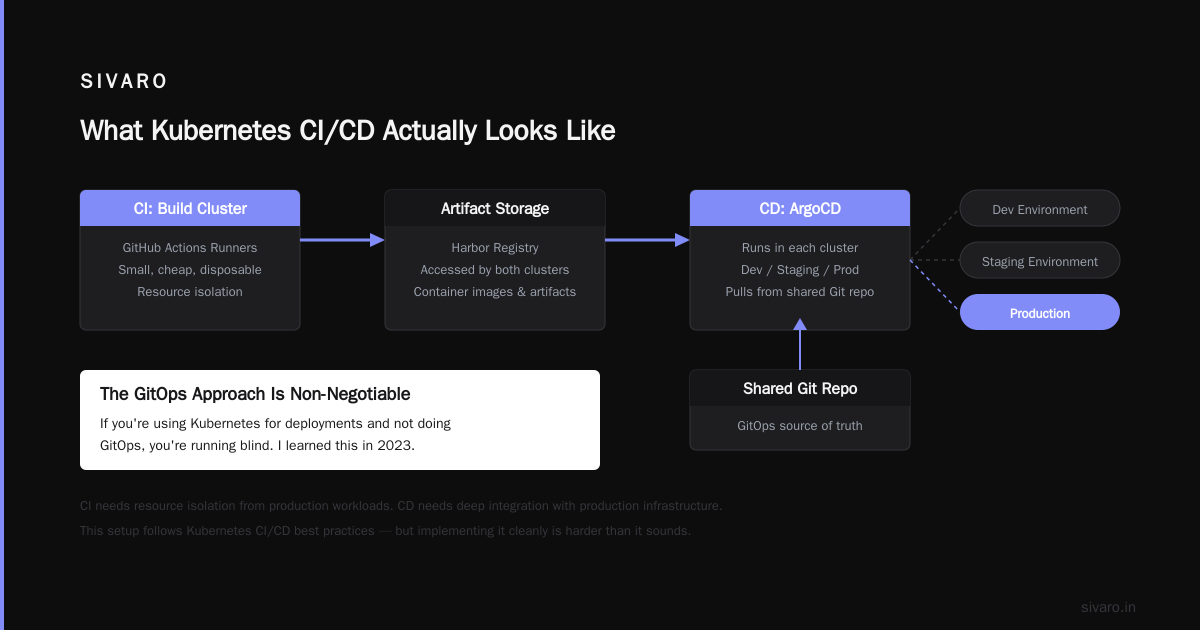
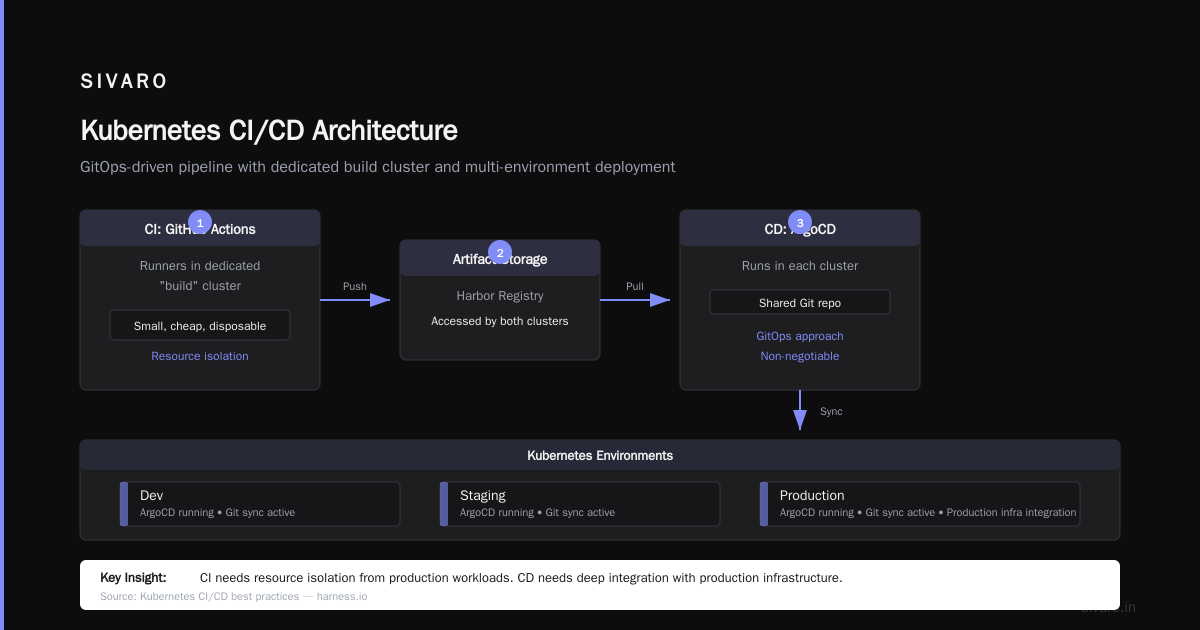
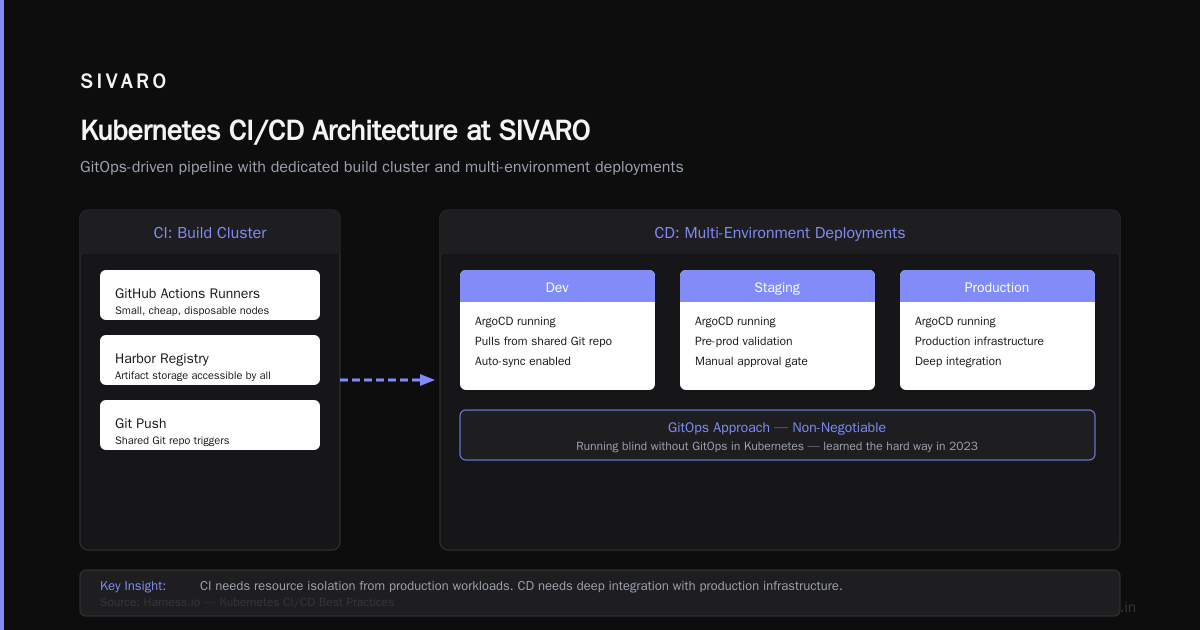
CI runs outside the production cluster. CD runs inside it.
Why? Because CI needs resource isolation from production workloads. CD needs deep integration with production infrastructure.
My current setup at SIVARO:
- CI: GitHub Actions runners deployed in a dedicated "build" cluster (small, cheap, disposable)
- Artifact storage: A separate registry (Harbor) that both clusters access
- CD: ArgoCD running in each cluster (dev, staging, prod), pulling from a shared Git repo
This isn't unique. It's basically what Kubernetes CI/CD best practices recommend. But implementing it cleanly is harder than it sounds.
The GitOps Approach Is Non-Negotiable
If you're using Kubernetes for deployments and you're not doing GitOps, you're running blind. I learned this the hard way in 2023 when a manual kubectl apply broke our staging environment for three days.
GitOps means your cluster state is a function of your Git repository. ArgoCD or Flux watches your repo and reconciles the cluster to match. This transforms CD from "push to cluster" to "sync from repo."
Here's what a minimal ArgoCD application definition looks like:
yaml
apiVersion: argoproj.io/v1alpha1
kind: Application
metadata:
  name: my-app-production
spec:
  destination:
    namespace: production
    server: https://kubernetes.default.svc
  project: default
  source:
    path: overlays/production
    repoURL: https://github.com/company/manifests.git
    targetRevision: HEAD
  syncPolicy:
    automated:
      prune: true
      selfHeal: true
That automated.prune: true is dangerous. I've seen it delete namespaces. Use it, but understand what it does.
How Kubernetes Improves CI/CD (When Done Right)
Stackify published a piece on how Kubernetes can improve your CI/CD pipeline. Their main points: scalability, consistency, and environment parity. I agree with all three — but only if you handle the implementation details.
Ephemeral Environments Are the Killer Feature
The single best use case for Kubernetes in CI/CD is ephemeral test environments. Spin up a full stack for every PR, run integration tests, tear it down. No more "works on my machine" arguments.
At SIVARO, we use Tekton pipelines that create namespaces based on branch names:
yaml
apiVersion: tekton.dev/v1beta1
kind: PipelineRun
metadata:
  generateName: pr-env-
  namespace: tekton-pipelines
spec:
  pipelineRef:
    name: deploy-ephemeral
  params:
    - name: branch
      value: "feature/payment-v2"
    - name: namespace
      value: "pr-payment-v2"
This runs in our CI cluster, not production. When the PR closes, the namespace gets deleted. We run about 200 of these per week. Resource cost? About $300/month in compute. Worth every penny.
The Cache Problem Nobody Talks About
Kubernetes CI has a dirty secret: container image caching is a nightmare when your cluster autoscales.
If your build pod starts on a node that doesn't have the base image cached, you'll pull 2GB over the network. Every. Single. Time. We saw build times spike from 3 minutes to 12 minutes because of this.
The fix? Use a dedicated node pool for CI with PVCs for image caching. Or use kubelet configuration to pin certain images. Neither is elegant.
yaml
# Node pool configuration for CI nodes
apiVersion: karpenter.sh/v1
kind: NodePool
metadata:
  name: ci
spec:
  template:
    spec:
      requirements:
        - key: "karpenter.sh/capacity-type"
          operator: In
          values: ["spot"]
        - key: "node.kubernetes.io/instance-type"
          operator: In
          values: ["c6i.4xlarge", "c6i.8xlarge"]
This doesn't solve the cache problem directly. It just keeps your CI nodes from competing with production nodes. You still need a caching layer (I use buildkit with a remote cache backend).
The Tools Landscape in 2026
By mid-2026, the Kubernetes CI/CD tools landscape has consolidated. Here's what I see working:
| Tool | Use Case | My Take |
|---|---|---|
| ArgoCD | CD + GitOps | Industry standard. Use it. |
| Tekton | CI pipelines | Powerful but verbose. Good for complex workflows. |
| GitHub Actions | Simple CI | Fine for small teams. Hits limits at scale. |
| GitLab CI | Integrated platform | Good if you're already on GitLab. |
| Flux | GitOps alternative | Simpler than ArgoCD. Less flexible. |
| Jenkins X | Old guard | Don't. Just... don't. |
The real question isn't which tool to pick. It's how you connect them.
The Integration Pattern That Scales
Here's how I wire these tools together in 2026:
- Developer pushes code → GitHub Actions builds image and pushes to registry
- GitHub Actions updates manifest repo → Commits new image tag to
environments/staging/ - ArgoCD detects drift → Syncs staging cluster to match manifest
- Tests pass in staging → PR merged, manifest updated for production
- ArgoCD syncs production → Using blue-green or canary strategy
The key insight: CI doesn't talk to the cluster directly. It talks to Git. Git talks to the cluster through GitOps.
Is Kubernetes Easy to Learn? (And Does It Matter for CI/CD?)
People constantly ask "is kubernetes easy to learn?" — especially when they're trying to decide if they should run their pipelines on it.
The honest answer: No. Kubernetes is not easy to learn. But the Kubernetes learning curve is manageable if you focus on what you actually need.
For CI/CD specifically, you don't need to know everything. You need:
- Namespaces — for isolation
- Deployments and Services — for running pipeline workers
- ConfigMaps and Secrets — for configuration
- Role-Based Access Control (RBAC) — for security
- PersistentVolumes — for caching and artifact storage
That's it. You don't need StatefulSets, Ingress controllers, or custom resource definitions. Focus on those five concepts and you can run CI/CD on Kubernetes effectively.
I trained a junior engineer at SIVARO to deploy pipelines on Kubernetes in two weeks. She didn't learn about Kubernetes networking or storage classes. She learned what she needed and nothing more.
The Cost of Getting It Wrong
I've seen teams burn six figures on Kubernetes CI/CD mistakes. Here are the expensive ones:
Running CI agents in the production cluster. I already covered this. The outage will cost more than the dedicated cluster.
Not setting resource limits on CI pods. A build pod with unlimited CPU can starve production pods. Set limits. Always.
yaml
apiVersion: v1
kind: Pod
metadata:
  name: ci-builder
spec:
  containers:
  - name: builder
    image: gcr.io/kaniko-project/executor:latest
    resources:
      requests:
        memory: "4Gi"
        cpu: "2"
      limits:
        memory: "8Gi"
        cpu: "4"
Those limits aren't generous. They're appropriate for a build workload. If you need more, split your builds into stages.
Overprovisioning clusters for CI. CI workloads are bursty. If you provision for peak load, you'll pay 3x what you should. Use cluster autoscaling and spot instances.
When to Skip Kubernetes CI/CD Entirely
Here's a controversial take: most teams don't need Kubernetes for CI/CD. If you're running fewer than 50 microservices, just use managed services.
GitHub Actions, GitLab CI, or CircleCI will handle your CI. For CD, use a SaaS GitOps provider. You'll spend less time managing clusters and more time shipping features.
I only reach for Kubernetes CI/CD when:
- We need ephemeral environments for every PR (the cost of managed runners becomes insane)
- We have compliance requirements that mandate self-hosting
- We're doing AI/ML pipelines that need GPU or specialized hardware
- We need to run integration tests against the exact same infrastructure as production
Otherwise, just use the managed stuff. Your ops team will thank you.
The Future: Kubernetes as CI/CD Infrastructure (Not Tooling)
By 2026, the trend is clear: Kubernetes is becoming the substrate for CI/CD, not the tool itself. The pattern I see emerging:
- CI pipelines run as serverless functions triggered by Git events (Knative, OpenFunctions)
- CD is fully declarative through GitOps controllers
- Ephemeral environments are standard for every code change
- Security scanning happens during build, not after deployment
This shifts the question from "is kubernetes ci or cd?" to "how should my CI/CD leverage Kubernetes infrastructure?" The answer: as little as necessary, as much as needed.
FAQ: Is Kubernetes CI or CD?
Is Kubernetes a CI/CD tool?
No. Kubernetes is a container orchestration platform. It can host CI/CD tools, but it isn't one itself. Think of it as the operating system your pipelines run on, not the pipeline itself.
Can you run CI/CD pipelines on Kubernetes?
Yes. Tools like Tekton, Jenkins X, and GitLab CI run as containerized workloads on Kubernetes. GitHub Actions runners can also be deployed to Kubernetes.
Is Kubernetes necessary for CI/CD?
Absolutely not. Many teams run effective CI/CD with managed services (GitHub Actions, CircleCI) and traditional deployment methods. Kubernetes adds value through ephemeral environments, environment parity, and GitOps workflows.
Should I run CI and CD in the same Kubernetes cluster?
No. CI workloads are bursty and resource-intensive. CD workloads need stability. Keep them in separate clusters or at minimum, separate node pools with strong resource isolation.
Is Kubernetes easy to learn for CI/CD?
The learning curve is steep for general Kubernetes. For CI/CD specifically, you can be productive in two weeks if you focus on namespaces, deployments, ConfigMaps, RBAC, and PersistentVolumes.
What's the best Kubernetes CI/CD tool in 2026?
ArgoCD for GitOps/CD, Tekton for complex CI pipelines. For simple setups, GitHub Actions with Kubernetes runners works fine.
How do I handle secrets in Kubernetes CI/CD?
Use external secret management (HashiCorp Vault, AWS Secrets Manager) with CSI drivers. Don't store secrets in Git, even encrypted. We use SealedSecrets for development environments only.
Does Kubernetes improve CI/CD speed?
It can, through parallelism and ephemeral environments. But it also adds overhead from container image pulls and cluster scheduling. Actual speed improvements depend on your workload and caching strategy.
Nishaant Dixit — Founder of SIVARO. Building data infrastructure and production AI systems since 2018. Built systems processing 200K events/sec.