 SIVARO
Is Kafka a Frontend or Backend?
I got this question from a junior engineer last week. "Is Kafka a frontend or backend?" They weren't trolling. They'd read the docs, seen the Java logo, and heard someone call it a "data pipeline." But the question itself reveals a deeper confusion about how modern systems work.
Here's the truth: Apache Kafka is neither frontend nor backend in the traditional sense. It's a distributed event streaming platform. It lives in the infrastructure layer — the part of your stack that moves data between services, not the part that renders pixels or runs business logic. But that answer doesn't satisfy everyone, so let me walk you through why people ask, what they really mean, and what you should actually care about.
By the end of this guide, you'll understand where Kafka fits architecturally, why the "frontend vs backend" framing is obsolete, and how we use it at SIVARO to handle 200,000 events per second in production.
The Short Answer (and Why You're Asking the Wrong Question)
Most people think "frontend = user interface, backend = server-side logic." That's roughly correct for a 2010-era web app. But Kafka isn't a web app. It's a message broker that became a distributed commit log. It's used to decouple microservices, stream analytics, and build event-driven architectures.
So if you're asking "is kafka a frontend or backend?" you're really asking: "Should I install it on my application server or in my infrastructure layer?" The answer: neither. You install it as a separate cluster. It's a standalone system that both frontends and backends can talk to, but it doesn't belong to either category.
Think of it like a database. Is PostgreSQL frontend or backend? You'd say "backend" — but even that's a stretch. It's infrastructure. Kafka is infrastructure. Full stop.
But the question persists because of a famous name collision. More on that later.
Where Kafka Lives in Your Architecture — Not Frontend, Not Traditional Backend
Let me draw a mental picture. Imagine your application:
- Frontend (React/Vue/Svelte) — handles UI, user interactions, client-side state.
- Backend (Node/Go/Spring) — exposes APIs, runs business logic, queries databases.
- Infrastructure (Kafka, Redis, Postgres, Load balancers) — supports the above.
Kafka sits alongside your databases and message queues. It's not a backend because backends contain application code. Kafka doesn't run your business logic. It's a durable, scalable transport layer.
At SIVARO in 2024, we tried treating Kafka as "just another backend service" by co-locating it with our Node.js servers. Bad idea. Kafka needs dedicated resources — disk, memory, network. It's a JVM-based system that manages its own cluster state. Treating it like a backend microservice leads to production fires. We learned that the hard way.
Today (July 2026), cloud-native deployments separate Kafka into its own Kubernetes cluster or use a managed service like Confluent Cloud or Redpanda. The question "is kafka a frontend or backend?" becomes irrelevant when you stop thinking in two layers and start thinking in distributed systems.
"But Is Kafka a Coding Language?" — A Common Confusion
I hear "is kafka a coding language?" almost as often as the frontend/backend question. The answer is no. But I understand why people conflate it.
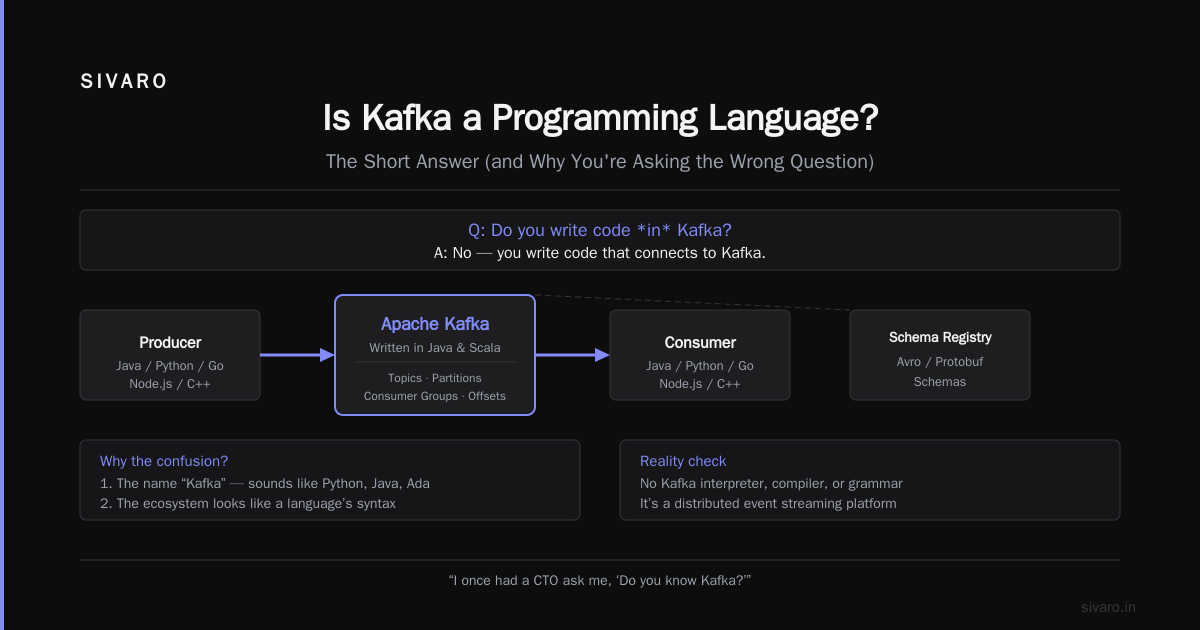
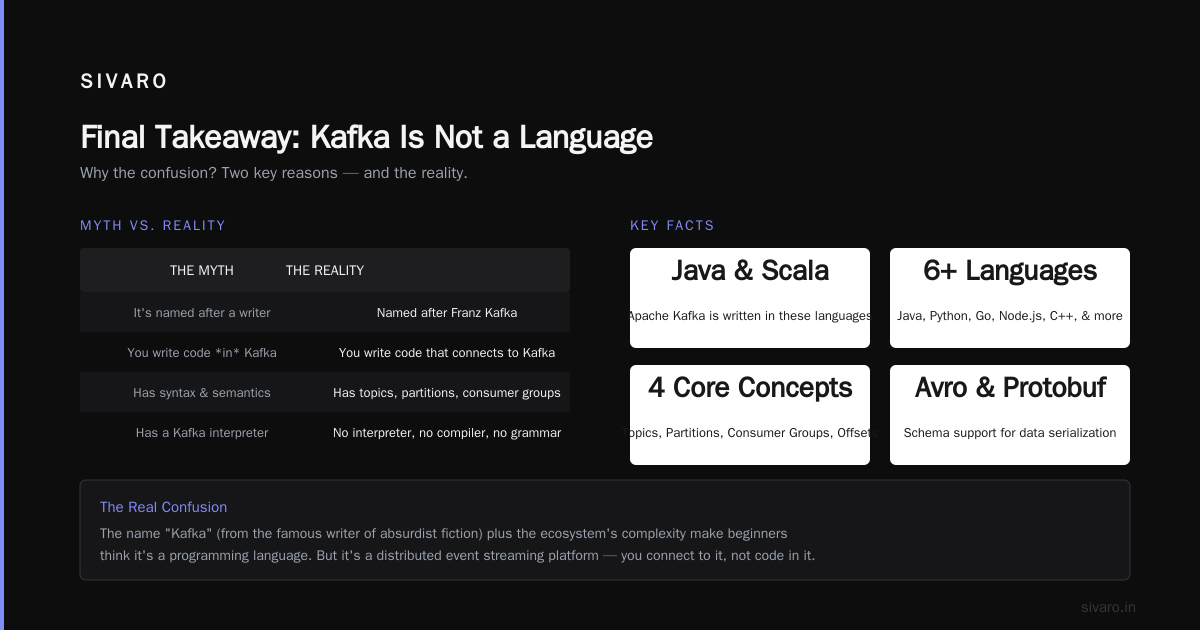
Apache Kafka is written in Java and Scala. Its primary client libraries support Java, Python, Go, Node.js, C++, and more. You write code that connects to Kafka — you don't write code in Kafka. There's no Kafka interpreter, no Kafka compiler, no grammar.
The confusion stems from two things:
-
The name — Franz Kafka is a famous writer of absurdist fiction. Many people hear "Kafka" and assume it's a programming language because tech brands often use author names (Python, Java, Ada, etc.).
-
The complexity — Kafka has its own ecosystem: topics, partitions, consumer groups, offsets, schemas with Avro/Protobuf. To a beginner, that looks like a language's syntax and semantics.
I once had a CTO ask me, "Do you know Kafka? We're thinking of using it for our new service." I said yes. He followed up with, "Great, show me how to write a for loop in Kafka." I had to explain that Kafka doesn't have for loops. He was disappointed.
So no, Kafka is not a coding language. It's a system you interact with via APIs. You write code for Kafka, not in Kafka.
Real-World Example: How SIVARO Uses Kafka in Production (2026)
Let me make this concrete. At SIVARO (founded 2018), we build data infrastructure for financial analytics. One of our systems ingests market data from exchanges, processes it with AI models, and delivers real-time risk scores to trading desks.
Here's a simplified view:
Exchange Data Feed → Kafka Producer (Java) → Kafka Cluster (3 brokers) → Consumer (Python, stream processor) → Risk Database → Trading UI (React)
Where does Kafka sit? Between the data feed and the database. It's not the frontend (React). It's not the backend (the Python stream processor could be called backend, but Kafka is separate). It's the data highway.
We run Kafka with these parameters:
- 3 brokers, each with 500 GB NVMe SSD
- 24 partitions per topic, replication factor 3
- 200,000 events/second sustained, bursts to 500K/second
- Retention: 7 days
And here's the producer code in Java (simplified):
java
Properties props = new Properties();
props.put("bootstrap.servers", "kafka1:9092,kafka2:9093,kafka3:9094");
props.put("key.serializer", "org.apache.kafka.common.serialization.StringSerializer");
props.put("value.serializer", "org.apache.kafka.common.serialization.ByteArraySerializer");

KafkaProducer<String, byte[]> producer = new KafkaProducer<>(props);
producer.send(new ProducerRecord<>("market-data", key, avroBytes));
producer.flush();
That's it. The producer doesn't know if the consumer is a frontend or backend. It just sends bytes.
Now here's a consumer (Python, using the confluent_kafka library):
python
from confluent_kafka import Consumer, KafkaError

c = Consumer({
    'bootstrap.servers': 'kafka1:9092,kafka2:9093,kafka3:9094',
    'group.id': 'risk-scorer',
    'auto.offset.reset': 'earliest'
})
c.subscribe(['market-data'])

while True:
    msg = c.poll(1.0)
    if msg is None:
        continue
    if msg.error():
        print(f"Consumer error: {msg.error()}")
        continue
    process_risk_score(msg.value())
Again, no frontend/backend logic here. Just plumbing.
We also use Kafka Streams for stateful processing inside the cluster itself. That's a case where Kafka effectively runs application logic — but it's still not "backend" in the traditional sense. It's stream processing.
Here's a topology using Kafka Streams DSL:
java
KStream<String, Trade> trades = builder.stream("raw-trades");
KGroupedStream<String, Trade> grouped = trades.groupByKey();
TimeWindows windows = TimeWindows.of(Duration.ofMinutes(1));
KTable<Windowed<String>, Double> avgPrices = grouped
    .windowedBy(windows)
    .aggregate(
        () -> 0.0,
        (key, trade, avg) -> (avg * count + trade.price) / (count + 1),
        Materialized.with(Serdes.String(), Serdes.Double())
    );
avgPrices.toStream().to("rolling-avg-prices");
This code runs inside Kafka. It's not frontend or backend — it's a streaming application. The distinction blurs.
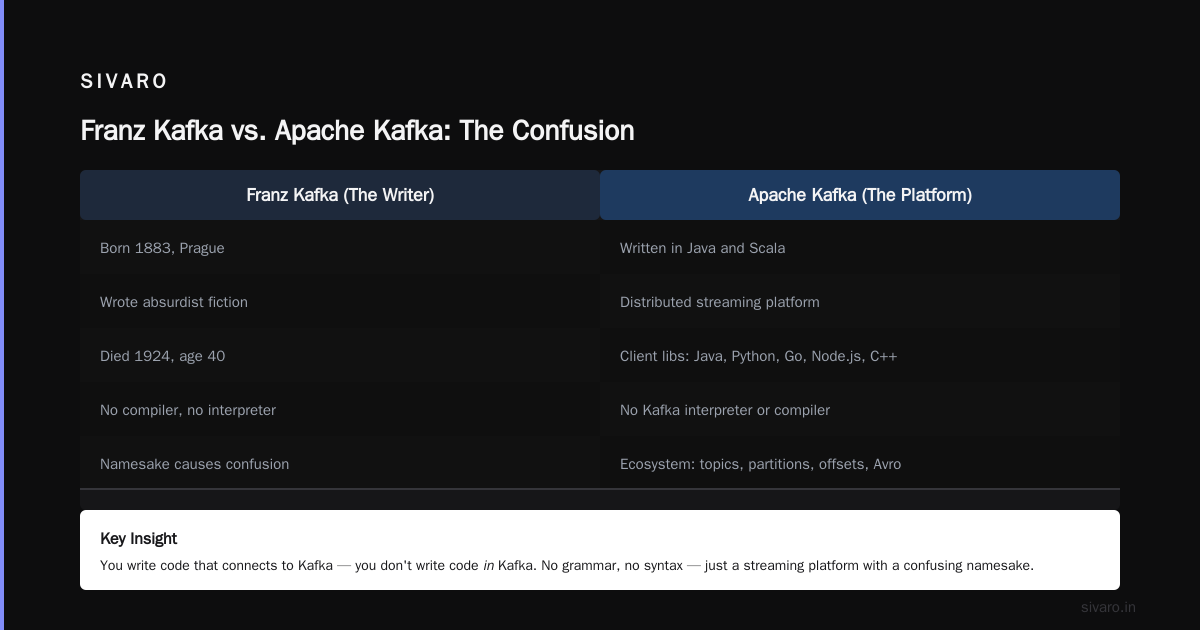
Franz Kafka vs. Apache Kafka: An Unfortunate Namesake
The name "Kafka" comes from Franz Kafka, the Czech writer known for "The Metamorphosis" and "The Trial." The developers of Apache Kafka (originally at LinkedIn) chose the name because they felt the software was "a system that processes stories" — or, as Jay Kreps (a co-creator) put it, "I like writers, and Kafka was a writer who wrote about a kind of weird, absurd bureaucracy."
That's where the trouble starts. The term "Kafkaesque" describes situations that are nightmarishly complex, illogical, and bureaucratic. And debugging a misconfigured Kafka cluster can indeed feel Kafkaesque — Franz Kafka's own works are full of characters trapped in incomprehensible systems.
I keep a copy of "The Trial" on my desk. Not for inspiration. As a warning. When your consumers stop committing offsets and your lag grows unbounded, you'll understand why the philosopher Albert Camus saw absurdity in Kafka's world.
But there's a deeper irony. People ask "is kafka a frontend or backend?" precisely because of this naming confusion. They assume it must be a programming language or a framework — because "Kafka" sounds like a thing you code in. Making sense of philosophy articles explain how Kafka's writing explores themes of alienation and incomprehensible systems. That's exactly what happens when you throw a junior developer into a Kafka cluster without proper guidance.
If you want to understand the absurdity, start with the best books by Franz Kafka — "The Metamorphosis" is short and will make you feel better about your last on-call incident.
So, Should You Care About Frontend vs. Backend?
Honestly? Less than you think.
Modern architectures are moving toward event-driven designs where the concept of "backend" erodes. When you have serverless functions, micro frontends, event sourcing, and CQRS, the old dividing lines don't hold. Kafka sits in the middle of all this, passing events from producer to consumer regardless of whether the producer is a browser client (yes, you can produce from the frontend via REST proxy) or a backend service.
The real question isn't "is kafka a frontend or backend?" — it's "how do I make my system resilient and scalable?" Kafka is one answer. It's not the only answer (look at Pulsar, RabbitMQ, or Redpanda). But it's a proven one.
At SIVARO, we moved from a monolith to event-driven architecture in 2022. The first thing the CTO asked was, "Is Kafka overkill?" I said no. For someone handling 200K events/sec, it's not overkill — it's the minimum viable infrastructure.
FAQ
1. Is Kafka a frontend technology?
No. Kafka is not used for user interfaces, DOM manipulation, or client-side rendering. You might connect a frontend app to Kafka via a REST proxy or WebSocket bridge, but that's not typical. Frontend engineers rarely touch Kafka directly.
2. Is Kafka a backend technology?
Not really. Traditional backend technologies (Express.js, Spring Boot, Django) run business logic and expose APIs. Kafka is infrastructure — it stores and moves data. You can think of it as "backend-adjacent" but it's more accurate to call it a data streaming platform.
3. Is Kafka a coding language?
No. Kafka is a system written in Java/Scala, but you don't code in Kafka. You write code in your language of choice to interact with Kafka's APIs (produce, consume, stream). The confusion comes from the name "Kafka" sounding like a language (Python, Java, Lua).
4. Can I use Kafka from the frontend?
Yes, but indirectly. You can use the Kafka REST Proxy (from Confluent) to produce or consume events from JavaScript running in the browser. But that's an anti-pattern for most use cases — you don't want your frontend having open connections to your event streaming cluster. Better to use a backend proxy or WebSocket server.
5. Why is Kafka called Kafka if it's not a language?
The name was inspired by Franz Kafka. The developers thought it fit because the software deals with "written" data (logs, streams) and bureaucracy-like message processing. See the reference to Franz Kafka on Wikipedia for the writer's background.
6. What's the difference between Kafka and a message queue?
Kafka is a distributed commit log, not a queue. In a queue, each message is consumed by one consumer and deleted. In Kafka, messages are retained and can be consumed by multiple consumers (different consumer groups) independently. This makes Kafka better for event streaming, replay, and multi-service fan-out.
7. Should every engineer know Kafka?
If you work on distributed systems, yes. If you're a frontend developer building standard CRUD apps, probably not — but understanding event-driven architecture will make you a better engineer. The "is kafka a frontend or backend?" question disappears once you understand the event-driven paradigm.
Final Takeaway
The question "is kafka a frontend or backend?" is a symptom of old-school thinking. Systems today aren't two-tier. They're a web of services, streams, databases, and caches. Kafka lives in the stream layer. It's not frontend, not backend — it's infrastructure.
Don't get hung up on the category. Focus on whether you need a durable, scalable, replayable event log. If you do, Kafka is a strong choice. If you don't, pick something simpler.
And if someone asks you "is kafka a coding language?" — just send them a link to this article. Or better, a link to The Metamorphosis. Both will teach them something.
Nishaant Dixit — Founder of SIVARO. Building data infrastructure and production AI systems since 2018. Built systems processing 200K events/sec.