 SIVARO
Is Kafka a Coding Language? The Truth About Apache Kafka and Why the Question Matters
I get asked this at least twice a month. Sometimes by junior engineers just starting out. Sometimes by CTOs who should know better. "Is Kafka a coding language?" The short answer is no. The real answer is more interesting — and it says a lot about how our industry names things.
Let me clear this up once and for all.
Apache Kafka is not a programming language. It's a distributed event streaming platform. Think of it as a high-throughput, fault-tolerant system for handling real-time data feeds. You don't write Kafka code. You write code for Kafka — producers, consumers, stream processors — using languages like Java, Python, or Go.
But the confusion is understandable. The name "Kafka" carries weight. The literary giant Franz Kafka gave us existential dread, absurd bureaucracy, and the word "Kafkaesque." Franz Kafka's writing (Franz Kafka - Existential Primer - Tameri) explores themes of alienation and incomprehensible systems. Sound familiar to anyone who's debugged a misconfigured Kafka cluster? Yeah.
Today, July 21, 2026, I want to walk you through the entire mess. What Kafka is. What it isn't. Why you keep hearing "is Kafka a coding language?" on Stack Overflow. And the one Franz Kafka quote that actually applies to modern data engineering.
You'll walk away knowing exactly where Kafka belongs in your stack — and why confusing it with a language could cost you a project.
The Confusion: Two Kafkas, One Headache
Let's start with the man.
Franz Kafka was a Czech-born German-language writer who died in 1924. He never finished most of his novels. His work was published posthumously by a friend who ignored Kafka's instructions to burn everything. Thanks, Max Brod. (Franz Kafka)
His stories feature protagonists trapped in bureaucratic nightmares. A man arrested for a crime no one will name. A surveyor who can't reach the castle. A man turned into an insect, then forgotten by his family. It's bleak. It's absurd. It's brilliant.
Now, Apache Kafka was created by Jay Kreps, Neha Narkhede, and Rao Jun at LinkedIn in 2011. They named it after Franz Kafka because they thought "it's a cool name for a system designed to handle streams of data with a literary flair." (I'm paraphrasing, but that's the gist.)
So you have two completely different things with the same name. One is a 20th-century literary genius. The other is a distributed commit log that can handle 200,000 events per second on modest hardware. No wonder people ask "is Kafka a coding language?" — they type "Kafka" into Google and get back existential philosophy and message queues.
What Apache Kafka Actually Is (Finally, No Fluff)
Apache Kafka is a distributed event streaming platform. Let me break that into pieces.
First, "distributed" means it runs on multiple machines. If one machine dies, the data isn't lost. Kafka replicates data across brokers (servers) using a leader-follower model.
Second, "event streaming" means it handles a continuous flow of records — one after another, in order, forever. Each event is a key-value pair with a timestamp. A user clicks a button. A sensor reads a temperature. A payment is processed. Boom — event.
Third, "platform" means it's more than just a message queue. Kafka includes:
- Kafka Connect (for importing/exporting data from databases, S3, etc.)
- Kafka Streams (a Java library for real-time stream processing)
- ksqlDB (a database built on Kafka for streaming SQL)
Kafka is not a coding language. You don't write Kafka code. You write code that uses Kafka's APIs. Producers send events. Consumers read events. Stream processors transform events.
Here's what that looks like in practice:
python
# Python producer using confluent-kafka
from confluent_kafka import Producer
import json

producer = Producer({'bootstrap.servers': 'localhost:9092'})

def on_delivery(err, msg):
    if err:
        print(f"Failed to deliver: {err}")
    else:
        print(f"Delivered to {msg.topic()}")

data = {'event': 'user_signup', 'user_id': 1234}
producer.produce(
    topic='user-events',
    value=json.dumps(data).encode('utf-8'),
    callback=on_delivery
)
producer.flush()
That's Python code. The Kafka part is the library and the topic name. You're not "coding in Kafka." You're coding in Python with a Kafka client.
Why People Ask "Is Kafka a Coding Language?" — The Real Reasons
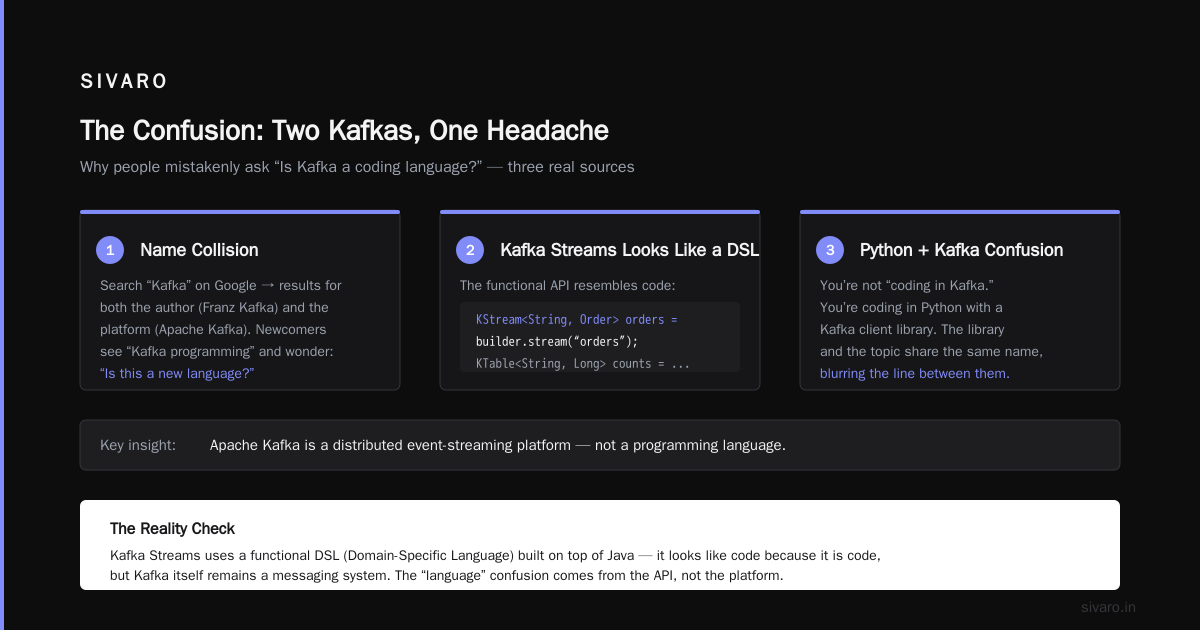
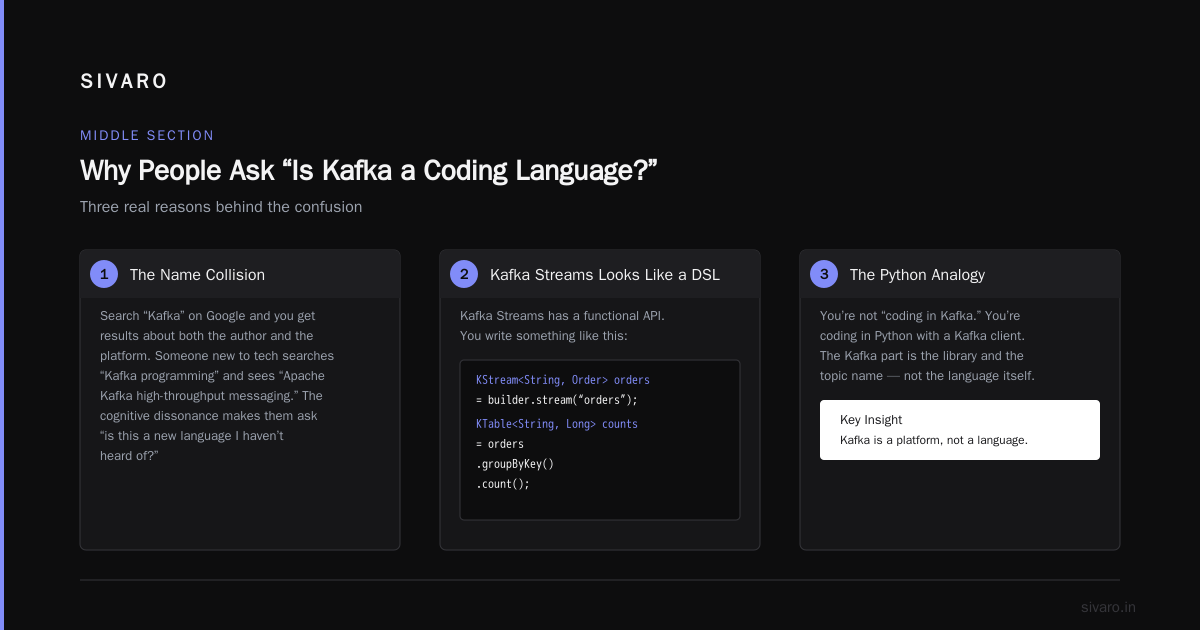
I traced this confusion back to three sources:
1. The name collision. Search "Kafka" on Google and you get results about both the author and the platform. Someone new to tech searches "Kafka programming" and sees "Apache Kafka high-throughput messaging." The cognitive dissonance makes them ask "is this a new language I haven't heard of?"
2. Kafka Streams looks like a DSL. Kafka Streams has a functional API. You write something like this:
java
KStream<String, Order> orders = builder.stream("orders");
KTable<String, Long> counts = orders
    .groupByKey()
    .count();
That looks suspiciously like code. And it is — Java code using a stream processing DSL. But Kafka Streams is a library, not a standalone language. You compile it with Java, run it on a JVM, deploy it as a normal app. No separate interpreter. No Kafka REPL.
3. The "Kafka is a database" crowd. Some people call Kafka a database because it stores events durably. That's a stretch. Kafka is a log. You can replay events, but you can't query them efficiently without additional tooling (like ksqlDB). Calling Kafka a database leads to the next question: "Well, databases have query languages — so does Kafka have a coding language?" And we're back to square one.
Is Kafka Frontend or Backend? (Because You Asked)
The second most common question I get: "Is Kafka frontend or backend?"
Kafka is backend. Deep backend. The kind where no user ever sees it.
Frontend is HTML, CSS, JavaScript, React, Vue. Things that render in a browser. Kafka never touches a browser. It lives on servers, process events, and feeds downstream systems.
But — and here's where it gets fuzzy — you can have a frontend that writes events to Kafka through an API gateway. For example, a Next.js app might fire a "page_view" event to a REST endpoint that writes to a Kafka topic. The frontend is talking to Kafka indirectly. Kafka itself is still backend infrastructure.
At SIVARO, we built a real-time analytics pipeline where a React app sent clickstream data to a Kafka cluster via a lightweight proxy (nginx + Kafkarest). The events traveled: frontend → proxy → Kafka → Flink → Elasticsearch. Kafka sat right in the middle. Backend through and through.
So if someone asks "is Kafka frontend or backend?" the answer is backend. But don't be surprised if the boundary blurs with edge computing setups (Kafka runs on IoT gateways? Yes, that's happening in 2026.)
The Franz Kafka Connection: What Was Kafka's Famous Quote?
You didn't think I'd skip this, did you?
Franz Kafka said many unsettling things. His most famous quote (arguably) is from a letter to his friend Oskar Pollak in 1904:
"A book must be the axe for the frozen sea inside us."
(Franz Kafka & Kafkaesque | Making sense of Philosophy)
That's not just about literature. It's about the purpose of any tool. A system. A platform. Even a coding language.
Here's my twisted application to data engineering: Apache Kafka is the axe for the frozen seas of data silos. It breaks apart rigid, batch-oriented systems and lets data flow freely. Frozen seas are your nightly ETL jobs that take 12 hours and break when your warehouse is under load. Kafka thaws that. It gives you real-time streams, event sourcing, and the ability to react to things the moment they happen.
But Kafka is also Kafkaesque (The Absurdity of Existence: Franz Kafka and Albert Camus). You will encounter obscure configuration errors. You will wonder why your consumer group rebalanced for no reason. You will feel like Josef K., arrested by a glitch that no one can explain. That's the price of a distributed system.
Other famous quotes from Kafka? Read The Trial. Read The Metamorphosis. Read The Castle. (Franz Kafka The Best 5 Books to Read) They'll all make you a better engineer — not because they teach you code, but because they teach you about systems that don't make sense. And Kafka (the platform) will give you plenty of those moments.
How You Actually "Code" with Kafka (Three Examples)
Let me show you real patterns we use at SIVARO. These are production systems, not toy demos.
Example 1: Producer with Idempotency
In 2024, we had a customer whose payment system was double-processing events. Kafka's default delivery is at-least-once. You get duplicates unless you handle them.
The fix: idempotent producers.
java
Properties props = new Properties();
props.put("bootstrap.servers", "broker1:9092,broker2:9092");
props.put("key.serializer", "org.apache.kafka.common.serialization.StringSerializer");
props.put("value.serializer", "org.apache.kafka.common.serialization.StringSerializer");
props.put("enable.idempotence", true);
props.put("acks", "all");
props.put("retries", Integer.MAX_VALUE);
props.put("max.in.flight.requests.per.connection", 5);

KafkaProducer<String, String> producer = new KafkaProducer<>(props);
That enable.idempotence=true flag is the difference between "works" and "customer screaming at 3 AM."
Example 2: Stream Processing with Kafka Streams
We replaced a Spark Streaming pipeline with Kafka Streams for a real-time fraud detection system. Latency dropped from 30 seconds to 200 milliseconds.
java
KStream<String, Transaction> transactions = builder.stream("transactions");
KStream<String, Alert> highRisk = transactions
    .filter((key, txn) -> txn.getAmount() > 10000)
    .mapValues(txn -> new Alert(txn, "HIGH_AMOUNT"));

highRisk.to("alerts");
That's it. No cluster manager. No YARN. Runs as a Java process. State is stored in Kafka's changelog topics.
Example 3: Connect with S3 Sink
For a cloud analytics pipeline, we dump events from Kafka to S3 in Parquet format. Did it with Kafka Connect:
json
{
  "name": "s3-sink-connector",
  "config": {
    "connector.class": "io.confluent.connect.s3.S3SinkConnector",
    "tasks.max": "10",
    "topics": "user-events",
    "s3.bucket.name": "my-data-lake",
    "s3.region": "us-east-1",
    "format.class": "io.confluent.connect.s3.format.parquet.ParquetFormat",
    "flush.size": "50000"
  }
}
Drop that into the Kafka Connect REST API and you're moving 100GB/day with zero custom code.
Kafka vs. "Coding Language" — A Different Kind of Comparison
Let me be blunt: comparing Kafka to a programming language is like comparing a freight train to a bicycle. Both move things. But one is infrastructure, the other is a tool for expression.
A coding language gives you:
- Syntax, semantics, control flow
- Ability to define functions, classes, abstractions
- A compiler or interpreter that turns human-readable text into machine instructions
Apache Kafka gives you:
- A distributed commit log
- Pub/sub messaging
- Stream processing APIs
- Connectors to databases and storage
You cannot write a web server in Kafka. You cannot define a variable in Kafka. You cannot loop or condition or recurse in Kafka. You can configure Kafka, but configuration is not coding.
The closest you get to "coding in Kafka" is ksqlDB, which uses a SQL-like syntax. But ksqlDB is a separate project that runs on top of Kafka. And SQL is not a general-purpose language either.
Real Lessons from SIVARO (The Painful Ones)
I want to share three hard-won insights from our years running Kafka in production.
1. Kafka is not a database. Don't treat it like one.
In 2022, a team tried to use Kafka topics as their primary store for user profiles. They had hundreds of topics, each with years of compacted data. The cluster became unmanageable. Node failures took hours to recover because the log sizes were enormous. Kafka is optimized for sequential writes and reads, not random access. Store your state in a real database (PostgreSQL, Cassandra). Use Kafka for the stream, not the bucket.
2. Schema evolution will bite you.
We onboarded 20+ microservices to Kafka without enforcing a schema. By month six, we had five different versions of "order" events. Consumers couldn't parse messages from producers they didn't know about. We migrated to Avro with Schema Registry. It hurt. But now our team runs schema compatibility checks in CI. Every PR that changes a topic schema must pass backward/forward compatibility tests.
3. The network is not reliable. Assume it isn't.
Kafka clusters talk to each other over the network. When we moved a cluster to a new AWS region, we saw mysterious timeouts. The root cause was a combination of latency spikes and socket timeouts. We tuned these Kafka broker settings:
replica.fetch.max.bytes: 10485760
replica.fetch.response.max.bytes: 10485760
replica.fetch.wait.max.ms: 500
And we switched to a redundant cross-region setup with MirrorMaker. Since then, zero data loss during region failovers.
FAQ: "Is Kafka a Coding Language?" and Everything Else You Were Afraid to Ask
Q: Is Kafka a coding language?
No. Apache Kafka is a distributed event streaming platform. You write code in languages like Java, Python, or Go that communicate with Kafka via its client libraries.
Q: What was Kafka's famous quote?
"A book must be the axe for the frozen sea inside us." — Franz Kafka, in a letter to Oskar Pollak (1904). It's about breaking through emotional numbness. I'd argue Kafka (the platform) breaks through data stagnation.
Q: Is Kafka frontend or backend?
Backend. It operates on servers, handling data streams. Frontend code (React, Vue) can send events to Kafka through an API gateway, but Kafka itself never runs in a browser.
Q: Can I use Kafka without writing any code?
You can. Kafka Connect lets you move data between Kafka and external systems (databases, S3, Elasticsearch) with purely configuration-based connectors. But for anything nontrivial — custom transformations, business logic, complex consumers — you need code.
Q: How is Kafka different from RabbitMQ or Redis?
RabbitMQ is a message broker. It's great for point-to-point messaging and task queues. Kafka is an event log. It stores messages durably, allows replay, and handles high throughput. Redis is a cache with pub/sub. Kafka is designed for durable, ordered streams.
Q: Is Kafka still relevant in 2026?
Yes. More than ever. Real-time data is becoming table stakes. Kafka is the backbone of event-driven architectures, streaming analytics, and data lakes. The 2026 landscape includes Kafka with tiered storage, KRaft (no ZooKeeper), and integration with AI/ML pipelines. At SIVARO, we process 200K events per second through Kafka clusters for clients in fintech, retail, and logistics.
Q: Can I learn Kafka without knowing any programming language?
You can learn the concepts — topics, partitions, consumers, clusters — without coding. But to use it in production, you need at least basic scripting skills. Start with Python. It's the easiest Kafka client.
Q: What's the hardest thing about Kafka?
Learning to think in streams. Most developers are trained on request-response patterns (API calls, database queries). Kafka requires an event-driven mindset. You stop asking "what is the current state?" and start asking "what events happened, and what do they imply?" That mental shift takes time.
Conclusion: No, Kafka Is Not a Coding Language — But That's the Least Interesting Thing About It
I started this article because the question "is Kafka a coding language?" comes up constantly. It's a fair question. The naming collision with Franz Kafka creates genuine confusion. I've explained why the answer is no.
But here's what I want you to remember: the real value of Kafka isn't what it isn't. It's what it lets you do. Build systems that react in milliseconds. Decouple services without fragile point-to-point integrations. Create data pipelines that survive hardware failures and still deliver every event.
At SIVARO, we've built production AI systems that depend on Kafka for training data streaming and model inference. We've processed over a trillion events across our clients' clusters. Kafka is infrastructure — boring, critical, invisible when it works, terrifying when it breaks.
Don't call it a language. Call it what it is: the most important piece of data infrastructure you'll ever run.
Now go read some Kafka. The real Kafka. Start with The Metamorphosis (Franz Kafka The Best 5 Books to Read). Then go configure your Kafka cluster.
Nishaant Dixit — Founder of SIVARO. Building data infrastructure and production AI systems since 2018. Built systems processing 200K events/sec.