 SIVARO
Is GCP the Same as Google Cloud? The Answer Will Surprise You
I was on a call last week with a CTO from a Series B fintech company. He'd been told by his VP of Engineering that they should "migrate everything to GCP." When I asked him what he thought GCP stood for, he hesitated. "Google Cloud... Platform, right?"
He wasn't wrong. But he wasn't entirely right either.
is gcp the same as google cloud? The short answer: no. GCP is a part of Google Cloud, but it's not the whole thing. And confusing the two has cost teams real money, delayed projects, and triggered some genuinely painful architectural rethinks.
Let me explain — because this distinction matters more in 2026 than it did in 2020.
The Naming Mess Google Created
Google has a branding problem. I've seen it burn people at SIVARO more than once.
When Google first entered the public cloud space, they called it Google Cloud Platform (GCP). That was the IaaS/PaaS layer — Compute Engine, Cloud Storage, BigQuery, all the infrastructure pieces. Developers knew it. Terraform modules referenced it. The CLI was gcloud, the console was console.cloud.google.com. Everything said GCP.
Then Google started buying and building adjacent products. Google Workspace (formerly G Suite). Apigee. Looker. Google Maps Platform. Android Enterprise. Chrome OS management. All of these live under the broader Google Cloud banner, but none of them are "GCP."
Here's the cleanest way I can put it:
Google Cloud = GCP + Workspace + Enterprise APIs + Apigee + Looker + Industry Solutions + Partner Ecosystem
GCP = Compute + Storage + Networking + Database + Data & Analytics + AI/ML Infrastructure + Security & Identity
At first I thought this was a branding problem — turns out it was pricing. Because Google Cloud Enterprise Agreements often bundle Workspace seats with GCP credits. And when you're negotiating, you need to know exactly which bucket your spend falls into.
What Actually Lives Where
Let's get specific. Because "Google Cloud" in a contract means something different than "GCP" in your Terraform code.
Google Cloud (the umbrella) includes:
- Google Cloud Platform (compute, storage, databases, networking, data/analytics, ML)
- Google Workspace (Gmail, Docs, Drive, Meet, Chat, Calendar)
- Apigee (API management — acquired in 2016)
- Looker (BI and analytics — acquired in 2019)
- Google Maps Platform (Maps, Routes, Places APIs)
- Mandiant (cybersecurity — acquired in 2022)
- Vertex AI (yes, this sits on GCP infrastructure but is sold as a separate SKU)
- Industry-specific solutions (Retail AI, Healthcare API, Financial Services)
GCP (the infrastructure layer) includes:
- Compute Engine (VMs)
- Google Kubernetes Engine (GKE)
- Cloud Storage (object storage)
- Cloud SQL / Spanner / Bigtable / Firestore
- BigQuery
- Cloud Run / App Engine
- VPC networking, Cloud CDN, Cloud Load Balancing
- IAM, Cloud KMS, Security Command Center
- Cloud Functions
- Dataflow, Dataproc, Pub/Sub
The confusion deepens when you start reading Google's own documentation. Microsoft's Azure to Google Cloud mapping guide explicitly maps "Google Cloud Platform services" as the equivalent of Azure's infrastructure — because that's what Microsoft sees as GCP. But Google's marketing documents often call the entire portfolio "Google Cloud."
I've had procurement teams ask me: "Is BigQuery part of GCP or Google Cloud?" It's both. But if you're buying it through a Workspace agreement, the pricing model changes.
Why This Matters for Your Architecture
You're reading this because you're not a procurement person. You're an engineer, a data lead, or a founder trying to build something real. So let's talk about what breaks when you confuse GCP with Google Cloud.
Case 1: Service Quotas and API Boundaries
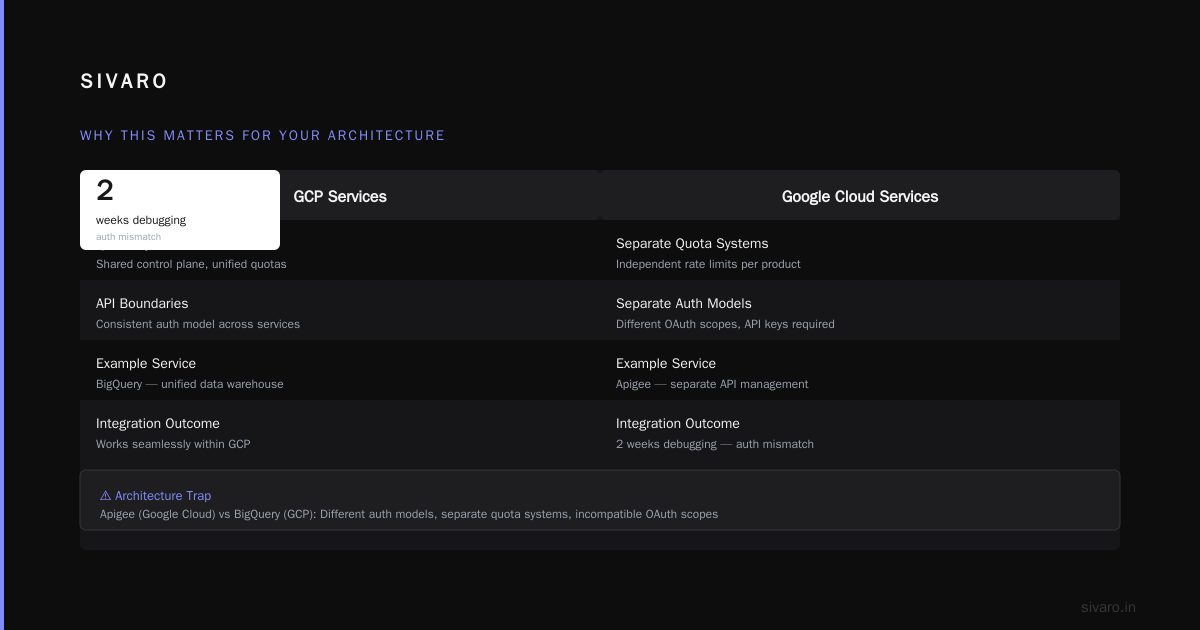
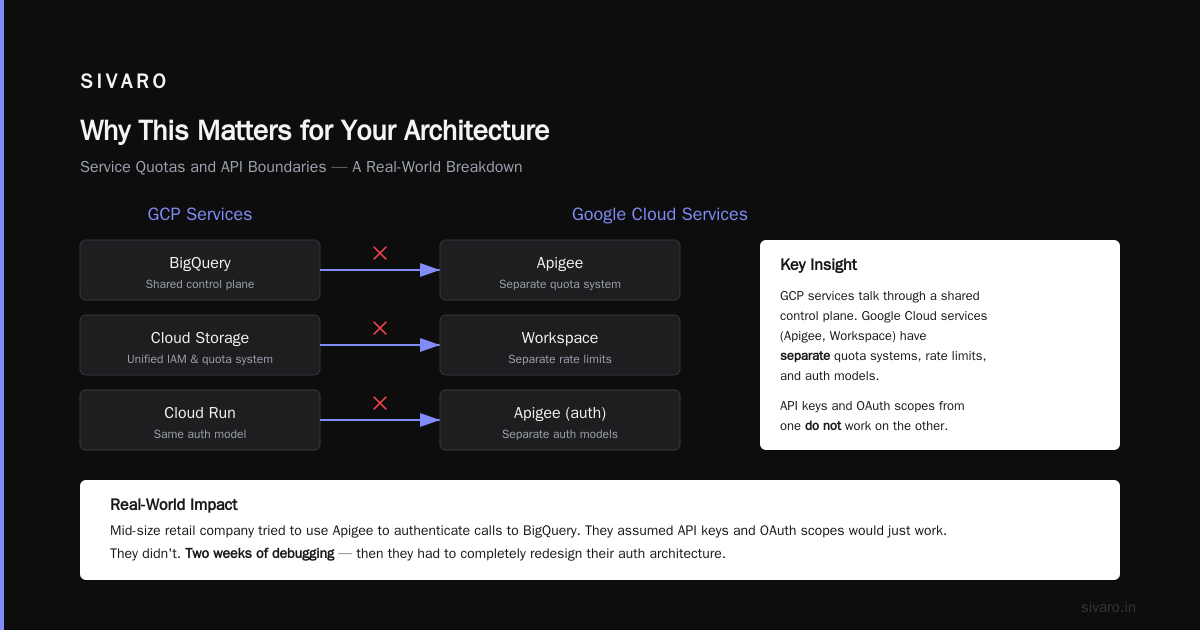
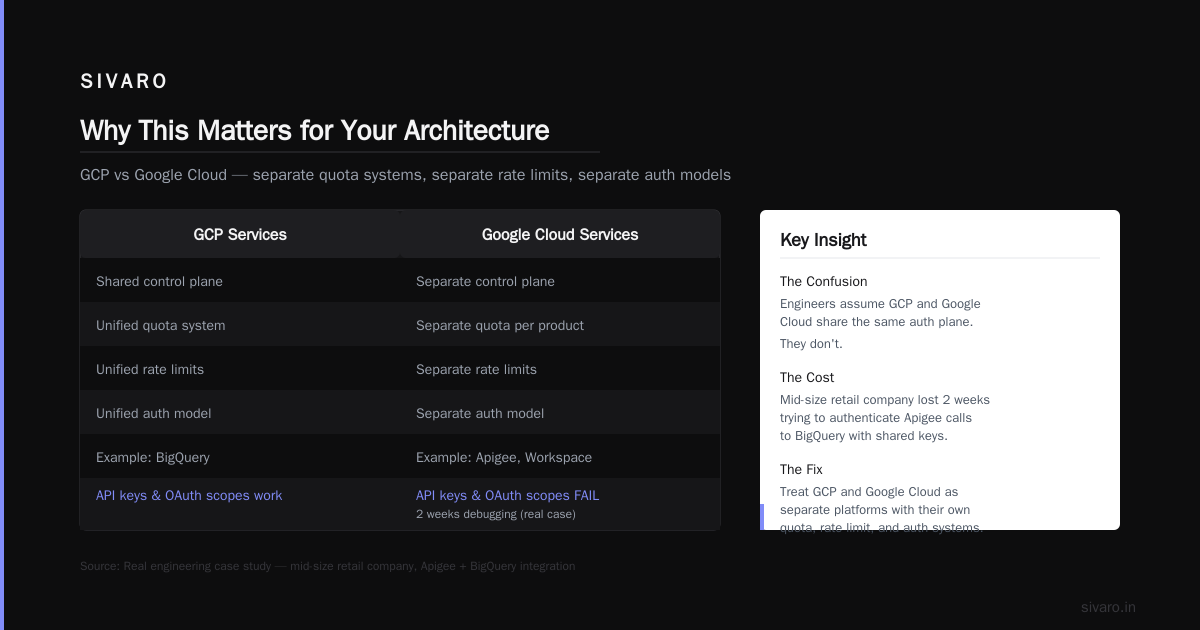
GCP services talk to each other through a shared control plane. But Google Cloud services like Apigee or Workspace have separate quota systems, separate rate limits, and separate auth models.
I watched a team at a mid-size retail company try to use Apigee (a Google Cloud product) to authenticate calls to BigQuery (a GCP service). They assumed the API keys and OAuth scopes would just work. They didn't. Two weeks of debugging later, they realized Apigee had its own IAM context that didn't inherit GCP IAM roles automatically.
The fix: Service account impersonation with domain-wide delegation. Not documented well. Cost them 40 engineering hours.
Case 2: Billing and Commitments
Google Cloud offers committed use discounts (CUDs) for GCP services — you commit to spending $X/month for 1 or 3 years, you get 30-57% off. But those commitments don't apply to Workspace, Apigee, or Looker. They're separate contracts.
A startup I advised signed a 3-year GCP CUD for $500K/year, assuming it covered their Looker instance. It didn't. Their Looker bill was separate. And because Looker is priced per user (not infrastructure), they couldn't burn down their commitment with it.
Lesson learned: Audit your spend by product category, not just "Google Cloud total."
Case 3: Support SLAs
GCP support is per-project or per-organization, based on your support tier (Basic, Standard, Enhanced, Premium). But Google Cloud support for Workspace is a different SLA with different response times. If your BigQuery cluster goes down at 2 AM, don't call Workspace support. They can't help you.
The Data Engineering Angle: GCP vs AWS
If you're reading this and thinking about gcp vs aws for data engineering, the "is gcp the same as google cloud?" confusion actually matters more there than anywhere else.
Here's why: when teams evaluate GCP vs AWS for data workloads, they often compare:
- BigQuery (GCP) vs Redshift (AWS)
- Dataflow (GCP) vs Glue (AWS)
- Vertex AI (GCP) vs SageMaker (AWS)
But they miss the Google Cloud-specific data tools that don't have direct equivalents:
- Looker (no direct AWS equivalent — AWS has QuickSight, which is weaker)
- Apigee for data API management (AWS has API Gateway, but it's less mature for enterprise data exposure)
- Google Workspace integrations (Docs, Sheets, Drive — these can feed data into BigQuery natively)
A Coursera comparison of AWS vs Azure vs Google Cloud notes that Google's data advantage comes from its "unified data cloud" — but that's Google Cloud, not just GCP. The integration between BigQuery and Looker, for example, is tighter than any third-party BI tool on AWS.
I've seen teams choose GCP for data engineering and then discover they need Looker for reporting, or Apigee for data APIs. Those decisions should happen before you commit to a cloud provider. Because migrating from GCP + Looker to AWS + Looker means re-architecting your data pipelines, not just moving compute.
The 2026 Reality Check
Let me be honest with you about where things stand today.
Google Cloud (the umbrella) is profitable. After years of losses, Google Cloud turned profitable in 2023 and has been growing since. As of mid-2026, it's the third-largest cloud provider behind AWS and Azure, but it's gaining share in specific verticals:
- Healthcare (healthcare API, HIPAA compliance)
- Retail (Recommendations AI, Vision API Product Search)
- Financial services (Anti-Money Laundering AI, Confidential Computing)
But the "GCP" infrastructure layer is still the core. Most third-party tools, monitoring agents, and CI/CD pipelines use GCP-specific APIs. If you're building on Google Cloud, you're building on GCP 90% of the time.
is aws still owned by amazon? Yes. But unlike Amazon, which keeps AWS as a separate reporting segment, Google buries GCP inside "Google Cloud" on earnings calls. That makes it harder to parse real infrastructure revenue from Workspace seat revenue.
A Practical Decision Framework
When you're evaluating cloud providers, use this checklist to separate GCP from Google Cloud:
- What compute will you run? → This is GCP: Compute Engine, GKE, Cloud Run
- What databases? → This is GCP: Cloud SQL, Spanner, Bigtable, BigQuery
- What identity and security? → This is GCP: IAM, Cloud KMS, VPC Service Controls
- Do you need API management? → This is Google Cloud: Apigee
- Do you need BI? → This is Google Cloud: Looker
- Do you need email/collaboration? → This is Google Cloud: Workspace
- Do you need vertical-specific AI? → This could be either: Healthcare API is Google Cloud, Vertex AI is GCP
The AWS vs Azure vs GCP 2026 comparison from TECHSY shows that GCP's infrastructure pricing is often 15-25% cheaper than AWS for equivalent compute. But once you add Looker and Workspace, the total Google Cloud bill can exceed AWS.
My rule of thumb: If you're a startup or mid-market company, GCP is usually the right comparison point against AWS. If you're an enterprise, Google Cloud (with all its bundled products) is the real cost.
Code Examples: What Works Where
Let me show you three scenarios where the GCP vs Google Cloud distinction matters in practice.
Scenario 1: Authenticating a Looker API call from a GCP service
python
# This is a Google Cloud (Looker) service calling GCP (BigQuery)
# You need separate auth for each.

from google.cloud import bigquery
import looker_sdk

# GCP auth - uses service account
bq_client = bigquery.Client(project="my-data-project")

# Google Cloud (Looker) auth - uses API client ID/secret
looker = looker_sdk.init40(
    client_id="looker-client-id",
    client_secret="looker-client-secret",
    base_url="https://my-instance.cloud.looker.com"
)

# These two auth contexts are independent.
# You cannot use a GCP service account to call Looker APIs directly.
Scenario 2: Setting up a cross-service quota
yaml
# Terraform for GCP quotas
resource "google_project_service" "bigquery" {
  service = "bigquery.googleapis.com"
  disable_on_destroy = false
}

# GCP quotas are per-project, per-region
# Google Cloud quotas (e.g., Apigee) are in a different resource hierarchy
# You CANNOT manage Apigee quotas from this Terraform configuration
Scenario 3: Using Workspace data in BigQuery
sql
-- GCP service (BigQuery) querying Google Workspace data
-- Requires Workspace integration enabled in Google Cloud console

SELECT
  user.email,
  COUNT(DISTINCT doc.id) as documents_created,
  SUM(doc.size_bytes) as total_storage_used
FROM `my_project.workspace_reports.user_activity`
WHERE date >= DATE_SUB(CURRENT_DATE(), INTERVAL 30 DAY)
GROUP BY user.email
ORDER BY total_storage_used DESC
This query works because Google Cloud connects Workspace audit logs to BigQuery. But you must enable that connection in the Google Cloud Admin console, not in GCP IAM. Two different UIs. Two different auth pathways.
The Hidden Cost Trap
The OpsioCloud comparison of AWS vs Azure vs GCP mentions something most engineers miss: GCP networking costs are lower than AWS for inter-service communication. That's true.
But Google Cloud's Workspace and Looker costs are per-user, not per-usage. If your data team is 50 people, Looker at ~$1,000/user/year is $50K/year — before any infrastructure. And that's Google Cloud, not GCP.
I've seen companies budget $200K/year for "GCP data infrastructure" and then get blindsided by a $60K/year Looker bill. They didn't realize Looker was a separate line item in the Google Cloud contract.
FAQ
Is GCP the same as Google Cloud?
No. GCP (Google Cloud Platform) is the infrastructure layer under the broader Google Cloud umbrella. Google Cloud includes GCP plus Workspace, Apigee, Looker, Maps Platform, and industry-specific products.
Why does Google use two names?
Brand evolution. Google Cloud Platform was the original name for IaaS/PaaS. As Google acquired and built adjacent enterprise products, they rebranded the portfolio as "Google Cloud" but kept GCP as the infrastructure brand.
Can I use GCP without using Google Cloud?
Technically yes — you can spin up Compute Engine VMs without Workspace or Looker. But Google's enterprise agreements often bundle products, and some GCP services (like Workspace audit logs in BigQuery) require Google Cloud integrations.
Is BigQuery GCP or Google Cloud?
BigQuery is a GCP service. But it's sold as part of Google Cloud's data analytics portfolio. Your contract might call it either. Check your SKU.
Which is cheaper: GCP or Google Cloud?
GCP alone is typically cheaper than the full Google Cloud bundle. The infrastructure pricing is competitive with AWS. But add Looker and Workspace and your total cost can exceed AWS equivalents.
Are GCP and AWS comparable?
Yes, for infrastructure. is gcp the same as google cloud? for data engineering, GCP's BigQuery and Dataflow compete directly with AWS Redshift and Glue. Looker competes with QuickSight. Workspace competes with Microsoft 365. See the DSStream comparison of Azure vs Google Cloud for a thorough breakdown.
Is Google Cloud Platform being phased out?
No. GCP is still the foundation. Google has just broadened the "Google Cloud" brand to encompass everything. The GCP moniker remains in documentation, CLI tools, and APIs.
Final Thoughts
I started this article with a CTO who didn't know the difference between GCP and Google Cloud. I'll end with what I told him:
"Think of GCP as the engine and Google Cloud as the car. You can drive without a sound system (Workspace) and fancy dashboard (Looker). But the engine is what moves you."
When you're evaluating cloud providers, gcp vs aws for data engineering is a fair comparison if you're only comparing infrastructure. But the moment you add Google Cloud's ecosystem products, you're comparing a different bundle.
Be precise. Your budget — and your architecture — will thank you.
Nishaant Dixit — Founder of SIVARO. Building data infrastructure and production AI systems since 2018. Built systems processing 200K events/sec.