 SIVARO

Is Docker AWS or Azure? The Truth in 2026
I get asked this question at least once a week. "Nishaant, is Docker AWS or Azure?" First time I heard it, I laughed. Then I realized how many people genuinely think Docker is a cloud service. It's not. Docker is a container runtime. AWS and Azure are cloud providers. But the confusion runs deeper than a simple "no." The real question is: how do Docker and these cloud platforms fit together? By the end of this guide, you'll know exactly where Docker ends and the cloud begins — and you'll never confuse them again.
Let's start with the obvious: Docker is not AWS. Docker is not Azure. Docker is open-source software that packages applications into portable containers. AWS and Azure are platforms that host those containers. That's it. But the marketing noise around managed container services — Amazon ECS, Azure Container Instances, Azure Kubernetes Service — blurs the line. What is Docker? from AWS itself calls Docker "a software platform for building applications based on containers." Not a cloud. Just software.
So why do people keep asking "is Docker AWS or Azure?" Because the cloud providers have wrapped Docker so tightly into their offerings that newcomers assume it's proprietary. Let's untangle that mess.
Where the Confusion Comes From
Back in 2018, Docker Inc. launched Docker Enterprise Edition, which included orchestrators like Swarm. Then Microsoft made a big push with Docker for Azure — a set of Azure Resource Manager templates that deployed Docker Swarm clusters directly. How does Docker for Azure compare to Azure Container ... shows users struggling to differentiate between "Docker the company" and "Azure the cloud." At that time, if you ran docker swarm init, it felt like you were using a cloud-native tool. You weren't. You were just running Docker on VMs.
Fast-forward to 2026. Docker Inc. sold its enterprise business to Mirantis in 2019. Docker Desktop now costs for commercial use. And every cloud provider has its own container story. Yet the question persists. At SIVARO, I've had clients who thought Docker was part of Amazon because they'd only ever launched containers via ECS. They never ran docker build locally. They assumed the whole thing was AWS.
Here's the truth: Docker is the runtime. AWS and Azure are the infrastructure. You can run Docker on a Raspberry Pi. You can run Docker on bare metal in a Colo. You can run Docker on AWS, Azure, GCP, your laptop, or a toaster with enough RAM.
Docker Is a Tool, Not a Cloud Provider
Let me repeat that until it sticks: Docker is a tool for creating and running containers. That's it. Containers are lightweight, isolated environments that share the host OS kernel. Docker made them easy.
Here's the most basic example — running a web server:
bash
docker run -d -p 8080:80 nginx:alpine
That command pulls the nginx image from Docker Hub and runs it locally. Zero cloud involved. You could be on a plane with no internet (after pulling the image). Docker doesn't need AWS or Azure to function. It needs a Linux kernel (or a Linux VM on Windows/macOS).
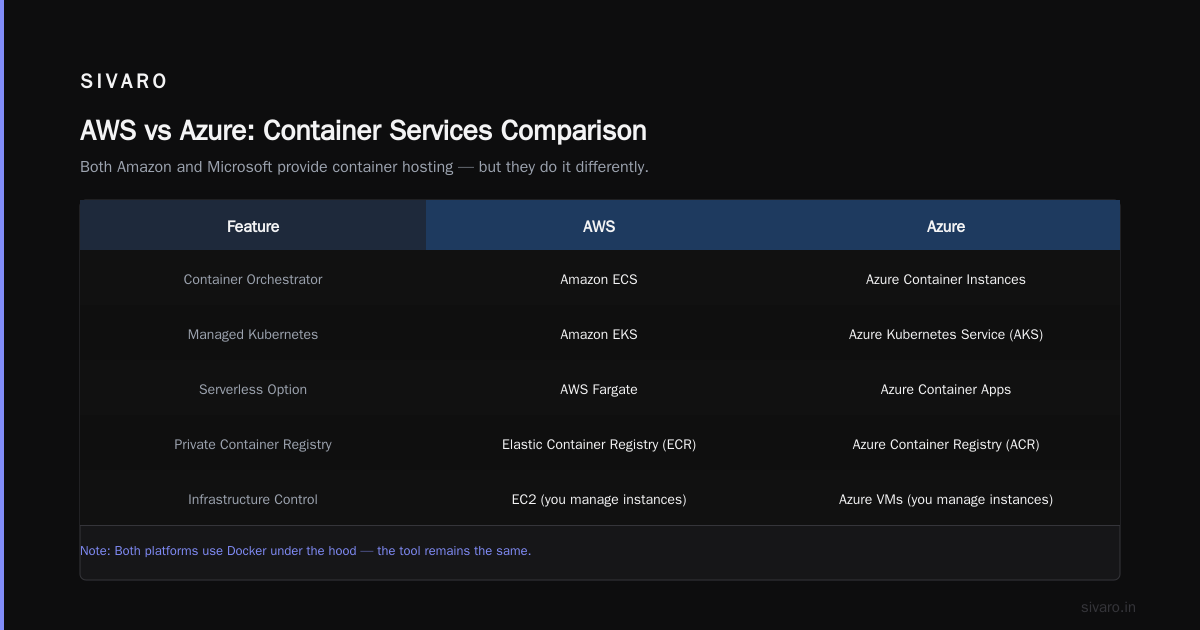
The confusion often stems from Docker Hub, the public registry. People think "I push images to Docker Hub, therefore Docker is a cloud service." No. Docker Hub is just a registry. You can push to private registries on AWS (Elastic Container Registry) or Azure (Container Registry) too. The tool remains the same.
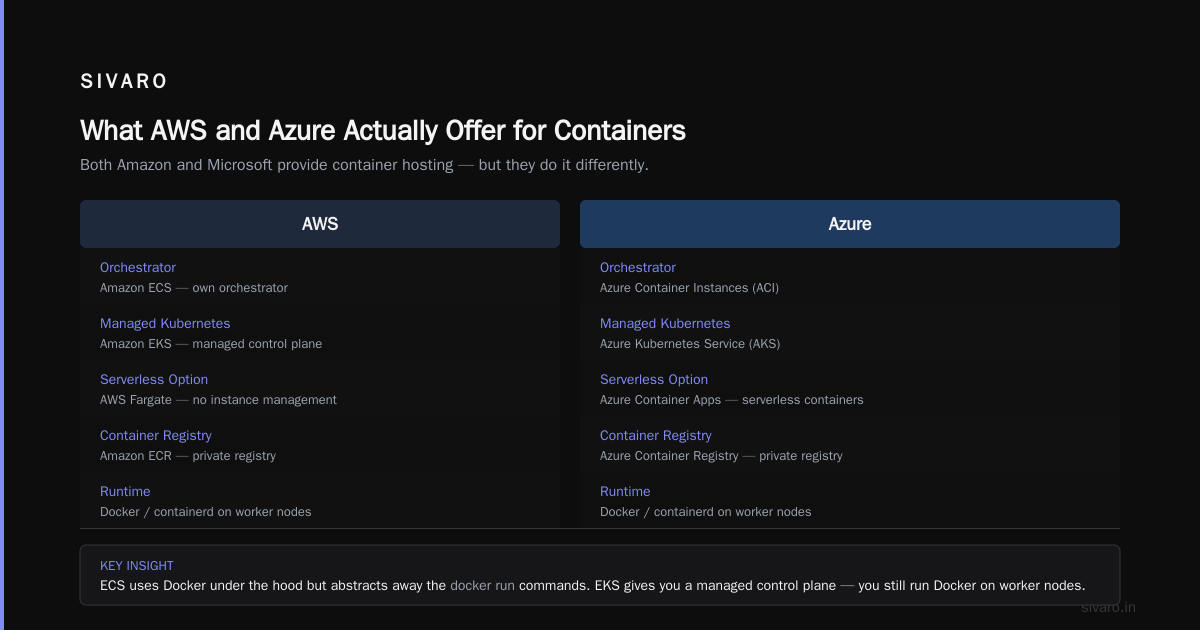
What AWS and Azure Actually Offer for Containers
Both Amazon and Microsoft provide container hosting. But they do it differently. Let's break it down.
AWS Options
- Amazon ECS (Elastic Container Service) – AWS's own orchestrator. You define tasks, services, and clusters. Supports both Fargate (serverless) and EC2 (you manage instances). ECS uses Docker under the hood, but abstracts away the
docker runcommands. - Amazon EKS (Elastic Kubernetes Service) – Managed Kubernetes. You get a control plane, and AWS manages the master nodes. You still run Docker (or containerd) on worker nodes.
- Amazon ECR (Elastic Container Registry) – Private image storage. Push/pull with
docker pushcommands. - AWS Fargate – Serverless containers. No EC2 management. Just define your task and pay per second.
Azure Options
- Azure Container Instances (ACI) – The simplest: run a container without any orchestrator. Just
az container createand it's up. Great for batch jobs or dev/test. - Azure Kubernetes Service (AKS) – Managed Kubernetes. Similar to EKS but integrated into Azure's RBAC and networking.
- Azure Container Apps – A newer service (launched 2022, matured by 2026). Based on Kubernetes but abstracts pods, services, scaling. Think of it as a managed container platform without the complexity of K8s.
- Azure Container Registry (ACR) – Private registry.
GCP Too (But We're Focusing on the Big Two)
Google Cloud Run is the simplest serverless container platform. But the question "is Docker AWS or Azure?" rarely includes GCP. So I'll stay on target.
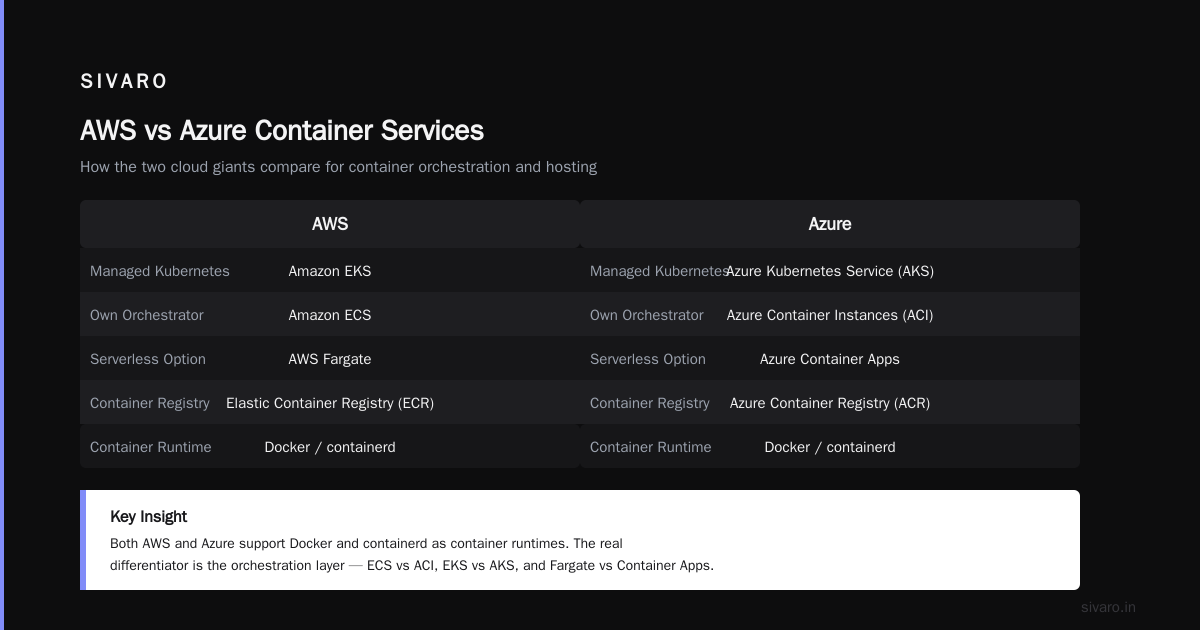
The key insight: all of these services run Docker containers. Some use containerd directly (like newer ECS optimized AMIs or Azure Container Apps), but the image format is OCI (Open Container Initiative). The container you build with docker build runs identically on any of them. Deploying containers: AWS vs. Azure from Pluralsight sums it up: "The container itself is portable. The orchestration and management are where the differentiation lies."
ECS vs AKS vs Docker Compose vs Swarm: The Real Comparison
Most people asking "is Docker AWS or Azure?" actually want to know: which container platform should I use? Let's compare the main contenders.
Docker Compose (Local / Dev)
yaml
version: '3.8'
services:
  web:
    image: nginx:latest
    ports:
      - "80:80"
  api:
    build: ./api
    environment:
      - DB_HOST=db
  db:
    image: postgres:15
    volumes:
      - postgres_data:/var/lib/postgresql/data
volumes:
  postgres_data:
Compose is great for development. You run docker compose up and you've got a multi-container app. But in production? You need orchestration — scaling, load balancing, updates. That's where ECS or AKS come in.
Amazon ECS
ECS is simple. You define tasks as JSON, and AWS schedules them. No Kubernetes complexity. At SIVARO, we used ECS for a client's microservice platform in 2024. It worked well until we needed advanced networking policies. Then we hit walls.
Example ECS task definition snippet (using aws ecs register-task-definition):
json
{
  "family": "my-app",
  "containerDefinitions": [
    {
      "name": "app",
      "image": "nginx:alpine",
      "memory": 512,
      "cpu": 256,
      "portMappings": [
        {
          "containerPort": 80,
          "hostPort": 80,
          "protocol": "tcp"
        }
      ]
    }
  ],
  "requiresCompatibilities": ["FARGATE"],
  "networkMode": "awsvpc"
}
ECS is proprietary to AWS. But the container inside that task definition is just nginx:alpine — a standard Docker image. Docker is the tool; ECS is the scheduler.
Azure Kubernetes Service (AKS)
AKS is Kubernetes. Kubernetes itself can run with Docker as the container runtime (though it's moving to containerd). The point is: Kubernetes is orchestrator-agnostic. You can run it on AWS (EKS), Azure (AKS), or on-prem with kubeadm.
Using Docker with AWS, Azure & GCP – A Complete Guide notes that "Docker is the standard container format across all cloud providers." So the question "is Docker AWS or Azure?" gets a firm neither. Docker is the substrate.
Kubernetes Changes Everything (Not Docker)
In 2026, Kubernetes has won the orchestration war. Docker Vs. AWS ECS Vs. Azure Vs. Kubernetes - CRN from 202?) predicted this. Docker Swarm is essentially dead. Docker Compose still lives for local dev, but not production.
So what does this mean for the original question? Docker is the packaging format. Kubernetes is the operating system for containers. AWS and Azure are the underlying infrastructure. If you use AKS or EKS, you're using Kubernetes on a cloud. The Docker part is just how you build and ship your app.
Here's where it gets tricky: many people think "I use K8s, therefore I don't need Docker." Wrong. Even with containerd, the images are still Docker images. The Docker CLI is still the most common way to build them. You can use kaniko or buildah, but the ecosystem revolves around Dockerfile syntax.
When You Should Use Docker Alone vs Managed Services
Plain Docker is fine for single-host scenarios. Small teams. Dev environments. But as soon as you need high availability, auto-scaling, or a multi-region deployment, you need a cloud provider's container service — or Kubernetes on top of a cloud.
Question: Should you run Docker directly on EC2 or Azure VMs?
Answer: Only if you love operational pain. We did that in 2022 at SIVARO for a client who insisted on "full control." We ran Docker on EC2, set up our own Swarm, managed updates ourselves. It worked until a kernel update broke our cluster. Then we migrated to ECS inside a week. Never again.
Use managed services. They abstract Docker's complexity. You still use Docker locally to build and test. You push images to ECR or ACR. Then the cloud orchestrator runs them.
Pricing Gotchas We Found the Hard Way
At first I thought the "is Docker AWS or Azure?" confusion was a branding problem. Turns out it was pricing. People think "I run Docker, so I just pay AWS for compute." Not quite.
AWS ECS with Fargate charges per second of CPU and memory. Azure Container Instances charges by duration. Both can surprise you if you have long-running tasks.
Example: we ran a batch job that took 6 hours on ACI. Cost: around $2. That's fine. But we had a dev environment with 10 services constantly running. That got expensive fast — $15/day for no reason. With ECS on EC2, you can use spot instances and save 70%. But then you need to handle interruptions.
Docker Vs. AWS ECS Vs. Azure Vs. Kubernetes - CRN compared costs and found ECS with EC2 spot cheapest, but with higher ops overhead. Azure Container Apps offers auto-scaling to zero — great for dev.
For production AI workloads (what SIVARO does), we've settled on AKS with node autoscaler. We build images with Docker, push to ACR, deploy via Helm. The Docker part is just the packaging. The cloud part is everything else.
So, Is Docker AWS or Azure? Final Answer
No. Docker is open-source software. AWS and Azure are cloud platforms that run Docker containers. The question itself reveals a misunderstanding of the stack.
But here's the productive follow-up: "Should I run containers on AWS or Azure?" That depends on your existing investment. If you're already in AWS, use ECS or EKS. If you're in Azure, use AKS or Container Apps. If you're starting fresh today, I'd pick Azure Container Apps for simplicity, or EKS for portability.
Docker remains the common language. You build once, run anywhere. The cloud providers compete on orchestration, not the container runtime.
So next time someone asks you "is Docker AWS or Azure?" — smile and say "Neither. It's the container that runs on both. Want to know how to pick which cloud?" Then send them this article.
FAQ: Docker, AWS, and Azure
Q: Can I use Docker with AWS without using ECS or EKS?
Yes. You can install Docker on an EC2 instance and run containers manually. Bad idea for production, but fine for testing.
Q: Does Azure have a service equivalent to Docker Swarm?
No. Azure deprecated Docker for Azure in 2019. Use AKS or Container Instances today.
Q: Is Docker Desktop free in 2026?
Docker Desktop is free for personal use, but requires a paid subscription for larger companies. Alternatives: Rancher Desktop, Podman, or colima.
Q: Can I run Docker containers on Azure Container Instances without Docker installed on my machine?
Yes. You can use the Azure CLI to create containers directly from images in ACR or Docker Hub.
Q: Is Kubernetes a replacement for Docker?
No. Kubernetes orchestrates containers. Docker builds and runs containers. They work together.
Q: Which cloud provider has the best Docker support?
Both have excellent support. The difference is in pricing and additional services. AWS has more mature tooling; Azure integrates better with Microsoft environments.
Q: Can I move my Docker containers from AWS to Azure without changes?
If your containers don't rely on AWS-specific services (like S3 or Secrets Manager), they'll run fine on Azure. The Docker image is portable. The environment variables and networking may need adjustment.
Q: What's the easiest way to get started with containers on cloud in 2026?
Install Docker Desktop locally. Write a Dockerfile. Test with docker compose. Then deploy to Azure Container Instances with az container create or to AWS Fargate with aws ecs run-task. Start small.
Nishaant Dixit — Founder of SIVARO. Building data infrastructure and production AI systems since 2018. Built systems processing 200K events/sec.