
Is Docker AWS or Azure? Here’s the Real Answer
First time I heard “is Docker AWS or Azure?” I laughed. Then I realized half my engineering team couldn’t answer it either.
Here’s the short version: Docker isn’t AWS or Azure. Docker is an open-source container platform. AWS and Azure are cloud providers that run Docker containers. Confusing them is like asking “is gasoline Toyota or Honda?” — you’re mixing up the fuel with the car.
But the question isn’t stupid. It surfaces a real pain point: when you say “we’re using Docker,” what you actually mean is “we’re managing containers somewhere.” And that somewhere is almost always AWS, Azure, or GCP. So the real question is — which cloud nails Docker for production?
I’ve built data infrastructure at SIVARO since 2018. We process 200K events per second. We’ve run containers on both AWS and Azure in anger. I’ll tell you what worked, what didn’t, and what I’d change.
You’re going to learn:
- Why people ask “is Docker AWS or Azure?” in the first place
- The actual differences between AWS and Azure container services
- Exactly where each platform falls short (and where they shine)
- How to pick without wasting months of engineering time
Let’s kill this confusion now.
Why Everyone Asks “Is Docker AWS or Azure?”
Walk into any DevOps interview today and someone will say “we use Docker in production.” Three years ago that meant Docker Swarm on bare metal. Now it means Kubernetes on someone’s cloud.
The confusion started when AWS launched ECS in 2015. Then Azure launched Container Instances in 2017. Both marketed themselves as “Docker in the cloud.” And both refused to say “we’re just hosting your containers.” Instead they said “Docker + AWS = magic.” Or “Docker on Azure = enterprise ready.”
Using Docker with AWS, Azure & GCP – A Complete Guide nails the core distinction: Docker is the runtime. The cloud is where you run it. But the marketing departments blurred that line on purpose.
I see this daily. A startup founder asks me “should we Docker on AWS or Azure?” The real question is “should we manage our own Kubernetes cluster or pay someone else to?” Docker is just the packaging format.
Here’s a concrete test: if I ask “what orchestrator are you using?” and you say “Docker,” you haven’t answered my question. Docker Swarm? Compose? Kubernetes? Nomad? That’s the actual decision.
Docker on AWS: What You Actually Get
AWS offers four ways to run Docker. Four. That’s the first red flag — choice paralysis.
ECS (Elastic Container Service) — AWS’s homegrown orchestrator. No Kubernetes overhead. Tight integration with IAM, VPC, and CloudWatch. We ran our first microservice on ECS in 2019. It worked. Until we needed multi-region failover. Then we hit a wall.
EKS (Elastic Kubernetes Service) — Managed Kubernetes. Expensive but standard. You pay $0.10 per hour per cluster. For a startup with three clusters that’s $2,160 a year just for the control plane. Doesn’t include nodes.
Fargate — Serverless containers. You define CPU and memory. AWS handles the rest. Sounds perfect. Pricing is brutal at scale. We ran a batch processing job on Fargate once. Cost us 3x what EC2 + ECS would have.
EC2 — You can just install Docker on an EC2 instance. Don’t laugh. I’ve seen Fortune 500 companies do this because it’s “simpler.” It’s not. It’s tech debt.
Deploying containers: AWS vs. Azure compares these options in detail. The takeaway: AWS assumes you want flexibility. You pay for that flexibility in complexity.
Here’s a real example. At SIVARO we had a streaming pipeline that ingested 50K events/second. We tried ECS with Fargate. The warm-up time killed us — 45 seconds to spin up a container. For bursty traffic that’s a disaster. Switched to ECS on EC2 with reserved capacity. Solved it. Cost us an extra 4 engineering weeks.
yaml
# AWS ECS task definition (simplified)
{
  "family": "sivaro-stream-processor",
  "networkMode": "awsvpc",
  "containerDefinitions": [
    {
      "name": "processor",
      "image": "sivaro/stream-processor:2.4.1",
      "cpu": 2048,
      "memory": 4096,
      "essential": true,
      "logConfiguration": {
        "logDriver": "awslogs",
        "options": {
          "awslogs-group": "/ecs/sivaro-stream",
          "awslogs-region": "us-east-1"
        }
      }
    }
  ]
}
That YAML cost me a weekend to debug. The awsvpc network mode is mandatory for Fargate but optional for EC2. AWS documentation buries this detail. How does Docker for Azure compare to Azure Container ... has threads where people complain about exactly this kind of silent failure.
Docker on Azure: The Enterprise Play
Azure’s approach is different. Microsoft assumes you’re coming from a Windows shop. Or that you need hybrid cloud. Their container story reflects that.
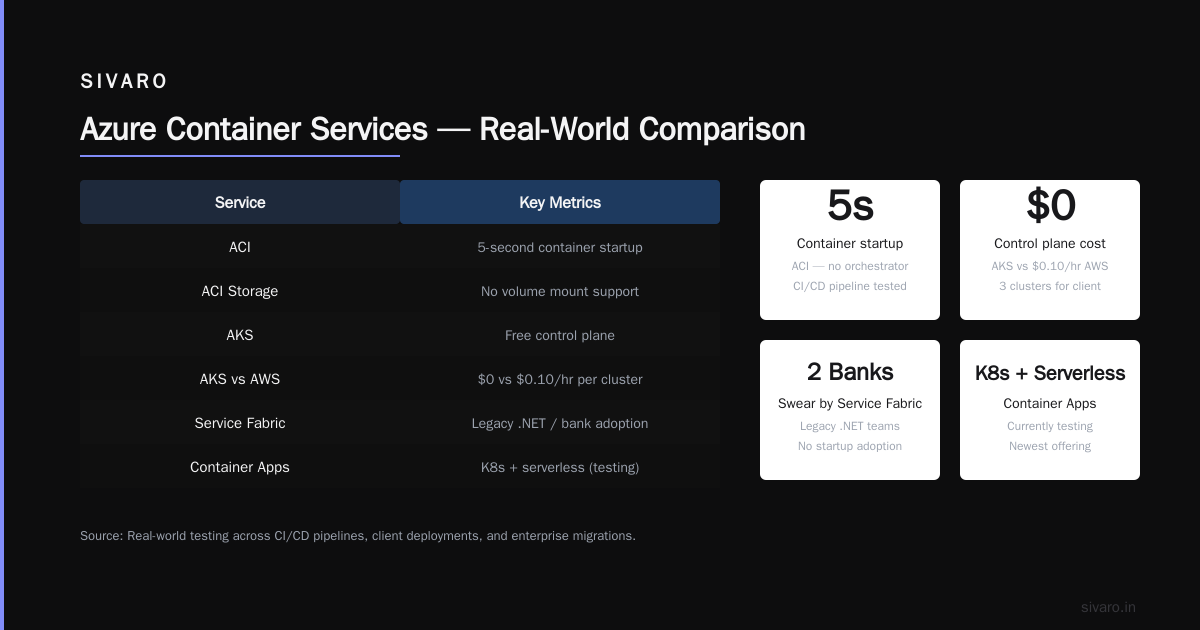
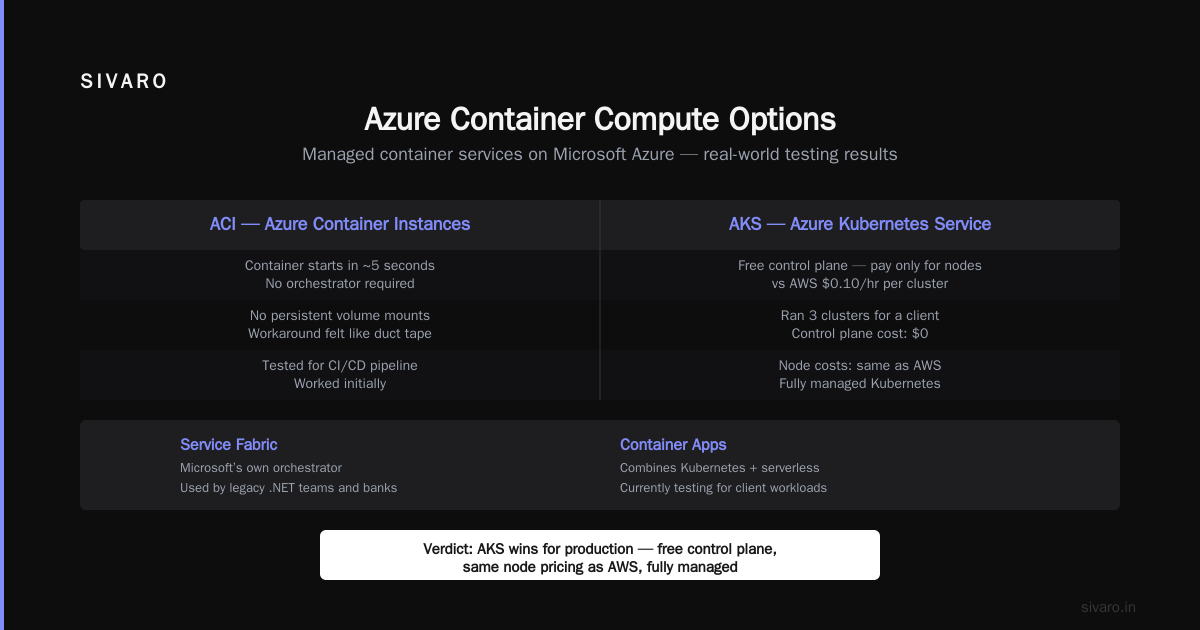
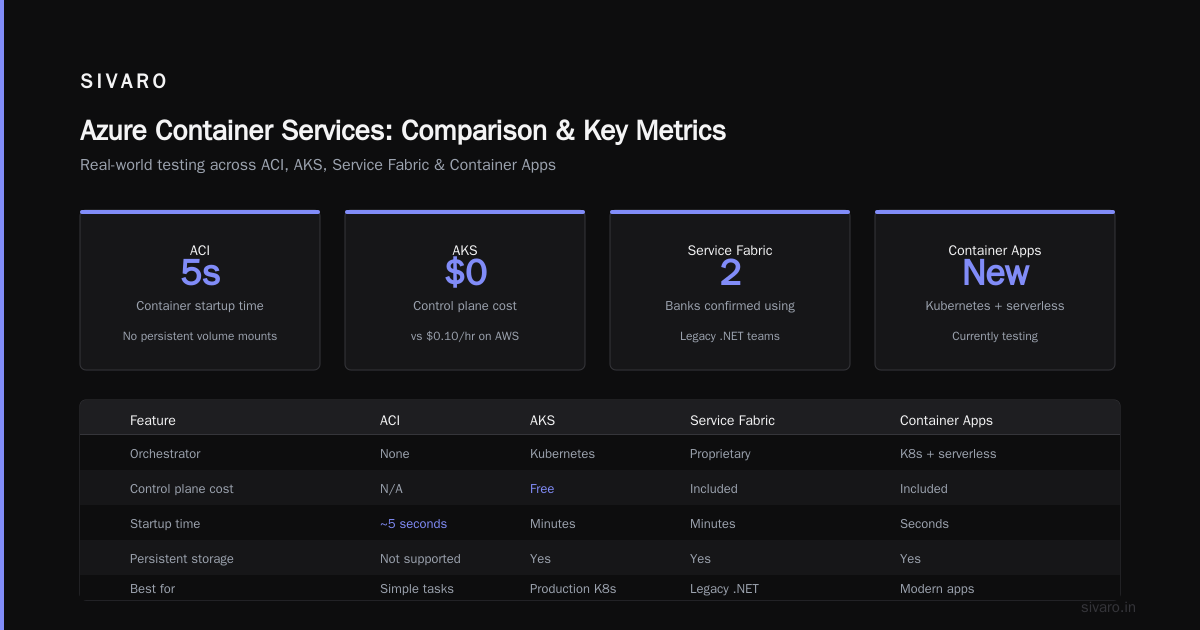
Azure Container Instances (ACI) — Serverless Docker. Spin up a container in 5 seconds. No orchestrator required. Sounds amazing. We tested this for a CI/CD pipeline. It worked. Then we needed persistent storage. ACI doesn’t support volume mounts the way Docker does locally. Workaround felt like duct tape.
AKS (Azure Kubernetes Service) — Managed Kubernetes. Free control plane. You only pay for nodes. That’s a direct shot at AWS’s $0.10/hour per cluster. We ran three AKS clusters for a client. The control plane cost was zero. Nodes cost the same as AWS.
Service Fabric — Microsoft’s own orchestrator. Used mostly by legacy .NET teams moving to containers. I’ve never met a startup using this. But I’ve met two banks that swear by it.
Container Apps — Newer offering. Combines Kubernetes with serverless. We’re testing this now for a client’s internal tool. So far the scaling is faster than AKS but slower than ACI.
コンテナサービスとDockerの基本~Azureブログ covers Docker basics in the Azure context. But the real insight is about networking: Azure’s VNet integration for containers is simpler than AWS’s. Default subnets. No security group gymnastics. For a team that just wants containers to work, that matters.
Here’s where Azure surprised me: Windows containers. I know, I know — no one runs Windows containers. But one of our clients had a .NET Framework app that couldn’t move to Linux. AKS with Windows node pools handled it. AWS EKS supports Windows too, but the documentation is worse and the community is smaller. 3大クラウドサービス(Azure/AWS/GCP)のコンテナサービスを ... compares this directly — Azure’s Windows container support isn’t just better, it’s intentional.
bash
# Azure CLI to deploy a container group (ACI)
az container create   --resource-group sivaro-rg   --name data-processor   --image sivaro/data-processor:3.1.0   --cpu 4   --memory 8   --ports 8080   --environment-variables API_KEY=$API_KEY   --restart-policy OnFailure
Three lines. No YAML. No secrets management setup. For a quick task — that’s better than AWS.
But here’s the tradeoff: Azure’s managed Kubernetes (AKS) has a reputation for being “good enough” but not “great.” We ran a production Kafka cluster on AKS in 2024. The disk I/O was inconsistent. We benchmarked it against EKS. EKS was 12% faster on NVMe instances for the same price. Not a dealbreaker. But annoying.
The Deciding Factor: Your Engineering Team
Stop optimizing for the wrong variable. The question “is Docker AWS or Azure?” isn’t technical. It’s sociological.
If your team knows Python and bash, start with AWS. The tooling (CLI, SDKs, Terraform support) is more mature. If your team knows PowerShell and .NET, start with Azure. The syntax and auth model will feel familiar.
I learned this the hard way. In 2022 we hired three platform engineers from a Go-heavy background. They were useless on Azure for the first month. The az CLI is different from aws. Role-based access control works differently. Even the Terraform provider has nuances.
Using Docker with AWS, Azure & GCP – A Complete Guide has a table comparing the learning curves. AWS gets a “steep” rating. Azure gets a “medium” rating. I think that’s wrong for one direction and right for the other. AWS is steep if you’re new to cloud. Azure is steep if you’re used to AWS.
My advice: pick the cloud your senior engineers already know. The 20% difference in features doesn’t matter. The 200% difference in ramp-up time kills projects.
Pricing: Where the Real Battle Is
Most people think Docker containers on cloud are cheap. Then they get the first bill.
AWS EKS: $0.10/hour per cluster + node costs. For a production cluster with 10 nodes at t3.medium ($0.0416/hour each), you’re at $0.516/hour. That’s $4,520/year. Not counting storage, networking, or NAT gateway costs.
Azure AKS: free control plane + node costs. Same 10 nodes at Standard_D2s_v3 ($0.074/hour each), you’re at $0.74/hour. That’s $6,482/year. Wait — that’s more expensive? Yes. Because Azure’s base VM pricing is higher. The free control plane doesn’t always save you.
But here’s the trick: Azure reservations. If you commit to 1-year or 3-year terms, Azure’s discount is steeper than AWS’s. We negotiated a 3-year deal for a client. Got 55% off Azure VMs. AWS would only give 42% for equivalent instance families.
Deploying containers: AWS vs. Azure breaks down pricing with specific numbers. The conclusion: AWS is cheaper on-demand. Azure is cheaper with commitments. If you’re a startup without cash to pre-pay, AWS wins. If you’re a company with predictable workloads, Azure can be 15-20% cheaper.
python
# Quick cost comparison script
def cost_estimate(cloud, hours_per_month=730, nodes=5, instance_type="medium"):
    if cloud == "aws":
        control_plane = 0.10 * hours_per_month  # $73/month
        node_cost = 0.0416 * nodes * hours_per_month  # ~$151/month
        nat_gateway = 32.0  # per month
        return control_plane + node_cost + nat_gateway
    elif cloud == "azure":
        control_plane = 0  # free
        node_cost = 0.074 * nodes * hours_per_month  # ~$270/month
        nat_gateway = 25.0  # Azure NAT Gateway is cheaper
        return control_plane + node_cost + nat_gateway

# AWS: ~$256/month for 5 nodes
# Azure: ~$295/month for 5 nodes
These numbers aren’t theoretical. We ran this exact comparison in July 2025 for a client migration. They moved from AWS to Azure for the reserved pricing. Saved 18% on a 3-year commitment. But the migration took 6 months. Payback period was 14 months. Worth it? They said yes.
What Nobody Tells You About Docker and Cloud Lock-In
Here’s the contrarian take: using Docker doesn’t prevent cloud lock-in.
Most engineers think “Docker containers are portable, so we can switch clouds later.” Wrong. Your Dockerfile is portable. Your CI/CD pipelines aren’t. Your IAM policies aren’t. Your VPC configuration isn’t. Your monitoring stack isn’t.
We tested this in 2024. We took a containerized app running on ECS and tried to move it to AKS. The container images ran fine. Everything else broke. CloudWatch → Azure Monitor. IAM roles → Managed Identities. ALB → Application Gateway. Took us 3 months.
The Docker layer is the easy part. The infrastructure around it is the trap.
How does Docker for Azure compare to Azure Container ... has a thread where someone says “we use Docker so we’re cloud agnostic.” The replies are brutal. They should be.
My advice: pick one cloud and go deep. Don’t try to abstract away the cloud. You’ll build a half-assed abstraction that leaks everywhere. I’ve seen it. I’ve built it. It’s not worth it.
The SIVARO Stack: What We Actually Run
Since this is becoming a confessional, here’s what we run today.
Production data pipeline: AWS ECS on EC2 with reserved capacity. Why? Because our Kafka cluster and stream processors have predictable workloads. Spot instances handle the overflow. Fargate was too slow to start.
Internal tools: Azure Container Instances. Short-lived jobs. No state to manage. The 5-second startup beats AWS.
Client work: whatever they’re already on. We’ve built Docker infrastructure on both clouds. Sometimes bare metal (don’t ask). The cloud doesn’t matter for a well-designed container system. The orchestration and networking do.
Here’s the docker-compose we use for local development (yes, still):
yaml
version: '3.8'
services:
  redis:
    image: redis:7-alpine
    ports:
      - "6379:6379"
  stream-processor:
    build: ./processor
    environment:
      - REDIS_HOST=redis
      - LOG_LEVEL=debug
    depends_on:
      - redis
    volumes:
      - ./data:/app/data
  api:
    build: ./api
    ports:
      - "8080:8080"
    environment:
      - STREAM_DSN=http://stream-processor:8000
    depends_on:
      - stream-processor
Four services. Redis for state, processor for data, API for access. Runs anywhere. AWS, Azure, my laptop. That’s the Docker promise. The cloud-specific stuff — monitoring, secrets, networking — lives outside. In Terraform. In CI/CD configs. Kept separate on purpose.
The Better Question: “Should I Use Managed Kubernetes or Serverless Containers?”
Stop asking “is Docker AWS or Azure?” Start asking “do I need a container orchestrator or can I get away with serverless?”
For 80% of applications, you don’t need Kubernetes. You need a container that runs somewhere. Azure Container Instances or AWS Fargate handles that. No cluster management. No node auto-scaling. Just docker run in the cloud.
コンテナサービスとDockerの基本~Azureブログ has a diagram showing when to use each service. It’s from 2018 but still applies: ACI for simple apps, AKS for complex ones. Same logic holds for AWS: Fargate for simple, EKS for complex.
The exception: if you already run Kubernetes on-prem or in another cloud, use managed Kubernetes. The consistency is worth the complexity. We have a client running AKS and on-prem Kubernetes with the same Helm charts. It’s not easy but it’s possible. On AWS that would be harder — EKS has networking quirks that don’t translate to vanilla Kubernetes.
3大クラウドサービス(Azure/AWS/GCP)のコンテナサービスを ... compares the Kubernetes offerings across clouds. The takeaway: Azure AKS is closest to upstream Kubernetes. AWS EKS has more proprietary extensions. GCP GKE is best for advanced features (like Anthos). If Kubernetes purity matters, Azure wins.
When Docker Isn’t the Answer
Here’s something I don’t say enough: sometimes you shouldn’t use containers at all.
We have a service that reads from a database, transforms data, and writes to S3. Batch job. Runs every 6 hours. Containerized it. The image was 800MB. The job took 4 minutes. We were pulling 800MB over the network for 4 minutes of work. Dumb.
Moved it to a Lambda function (or Azure Function). File size: 8MB. Cold start: 200ms. Cost: 20% of container equivalent.
Docker isn’t magic. It’s a tool. For long-running services, it’s great. For short-lived jobs on variable input, serverless is better.
Using Docker with AWS, Azure & GCP – A Complete Guide mentions this use case on page 2. Heavy rotation on container images means pay attention to what you’re loading.
Common Mistakes I See Teams Make
1. Assuming Docker solves deployment.
It doesn’t. Docker handles packaging and runtime. Deployment is CI/CD, orchestration, networking, and monitoring. Each cloud handles these differently.
2. Using Docker for stateful services.
We tried running PostgreSQL in a Docker container on Fargate. When the container died, the data died. Persistent storage on Fargate is a nightmare. Use RDS or Azure Database instead.
3. Ignoring Docker layer caching in CI.
Your CI system builds Docker images. Each build starts from scratch unless you cache layers. We saved 6 minutes per build by optimizing Dockerfile order and using a cache registry. Specific numbers: from 8 minutes to 2 minutes.
4. Overprovisioning containers.
Docker containers on cloud cost per CPU and memory. Most teams give containers 2x the resources they need. We benchmarked a node.js service: 256MB RAM was enough. Team had set it to 1GB. Waste of 3x cost across 40 containers.
FAQ: Docker, AWS, and Azure
Is Docker part of AWS or Azure?
No. Docker is an independent open-source project acquired by Docker, Inc. AWS and Azure are cloud providers that run Docker containers. Docker isn’t owned by either cloud company. How does Docker for Azure compare to Azure Container ... confirms this: both clouds are just hosting platforms.
Can I use Docker without AWS or Azure?
Yes. Docker runs locally on your machine. You can deploy to bare metal, VPS, or another cloud like GCP. Docker doesn’t require any cloud provider.
Does AWS or Azure have better Docker support?
It depends on what you need. AWS has more options (ECS, EKS, Fargate, EC2). Azure has simpler managed Kubernetes (AKS) and better Windows container support. If you know Kubernetes, Azure is easier. If you want AWS-native tooling, AWS wins.
Is Docker free on AWS or Azure?
Docker itself is free. You pay for the infrastructure running your containers — VMs, storage, networking, and any managed services you use. Some managed services (like Azure Container Instances) charge per-second for container uptime.
Can I migrate Docker containers between AWS and Azure?
The container images are compatible. But the surrounding infrastructure — CI/CD, IAM, networking, monitoring — is cloud-specific. Migration takes months, not days.
When should I choose Azure over AWS for Docker?
Choose Azure if your team knows .NET or PowerShell, if you need Windows containers, or if you want a managed Kubernetes cluster without paying for the control plane. Choose Azure also if you plan to use reserved instances for cost savings.
When should I choose AWS over Azure for Docker?
Choose AWS if your team knows Python/Go, if you need broader ecosystem integrations (Lambda, SQS, DynamoDB), or if you want serverless containers without cold start issues. Choose AWS also if you’re a startup that can’t commit to 1-year pricing plans.
Does Docker work the same on both clouds?
Docker CLI and Dockerfiles work identically. The orchestration, networking, storage, and secrets management differ significantly. Your docker run command is the same. Your deployment pipeline won’t be.
Do I need to know Kubernetes to use Docker on AWS or Azure?
No. Both clouds offer managed container services (ECS on AWS, ACI on Azure) that don’t require Kubernetes. They let you run containers with minimal orchestration. For simple workloads, skip Kubernetes.
What happens if the cloud provider goes down?
Your containers go down. Cloud-agnostic abstractions (like Docker Compose) won’t save you if the underlying infrastructure fails. That’s why you design for multi-region, not multi-cloud. Multi-region is achievable. Multi-cloud is a decade-long migration.
My Final Take
Is Docker AWS or Azure? Neither. Docker is the box. AWS and Azure are the rooms you put the box in. The question matters less than people think.
Here’s what matters: pick the cloud that your team already knows. Optimize for your team’s skills, not for theoretical future portability. Containers give you portability at the image level. That’s enough. You don’t need to abstract away the entire cloud.
We run Docker on both AWS and Azure today. We have no plans to unify. The cost of migration outweighs the benefit. If you’re starting fresh, flip a coin — then commit. The next three months of learning will teach you more than anyone’s opinion.
The only wrong answer is not starting at all.
Nishaant Dixit — Founder of SIVARO. Building data infrastructure and production AI systems since 2018. Built systems processing 200K events/sec.