 SIVARO
Is Distributed Systems a Hard Class?
I remember sitting in my first distributed systems lecture in 2013. The professor wrote Lamport clocks on the board and said, "This is the foundation of all ordering in distributed systems." I nodded along. Then I went home and tried to implement a simple distributed key-value store. It didn't work. It never worked. For three weeks, I couldn't get two nodes to agree on a single value without corrupting data.
I dropped the class.
Fast-forward to 2018. I'm at a startup building a distributed data pipeline. We're processing 200K events per second across six nodes. Everything I failed at in that class was now my daily reality. Only now, the textbook was wrong. The two-phase commit protocol they taught? We threw it out. The Paxos they worshipped? We built Raft instead.
So let me answer the question directly: is distributed systems a hard class? Yes. But not for the reasons you think. It's not hard because distributed systems are inherently complex (though they are). It's hard because most classes teach it wrong.
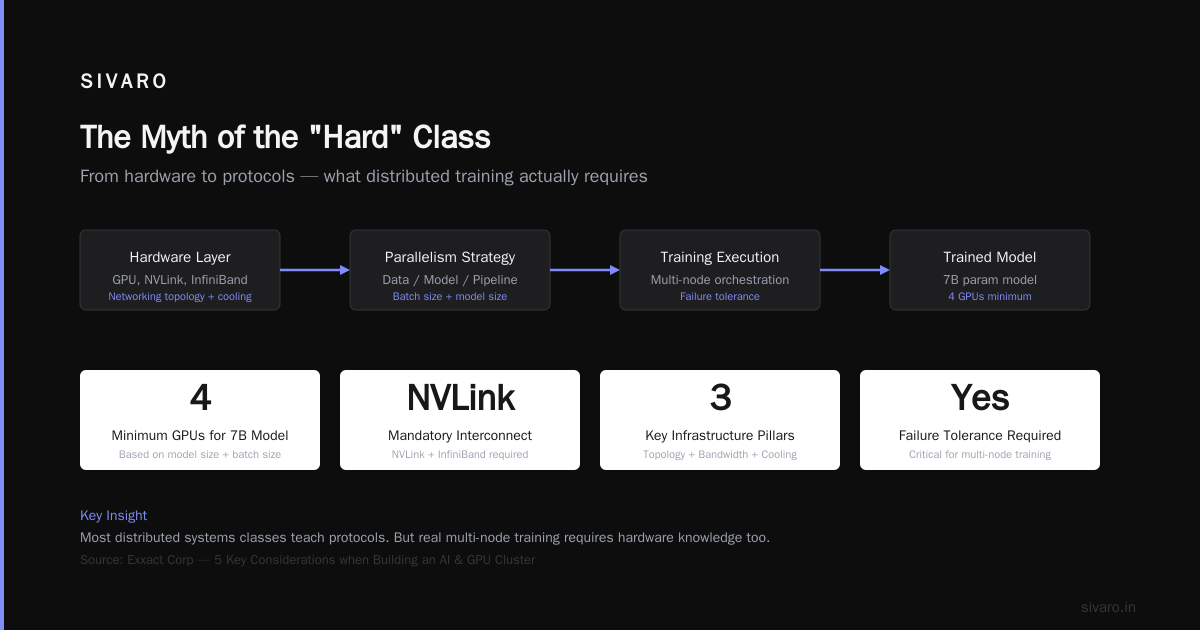
The Myth of the "Hard" Class
Most people think distributed systems is hard because of the math — consensus protocols, vector clocks, Byzantine fault tolerance. They're wrong.
I've interviewed 200+ engineers over the past four years. The ones who aced the distributed systems class usually couldn't build a reliable service that survives a single node failure. The ones who struggled in class but built stuff in their garage? Those engineers shipped production systems that handle 50K requests per second with 99.99% uptime.
The real difficulty isn't the theory. It's the gap between theory and practice.
When you take a distributed systems class, you study algorithms that assume perfect network conditions, zero clock skew, and infinite memory. In reality, networks drop packets. Clocks drift by milliseconds. Memory gets corrupted. The class teaches you the idealized version. The real world teaches you that failure is the default, not the exception.
Why Distributed Systems Feels Like a Different Language
The first concept that breaks most students is partial failure. In a single-machine system, when something fails, everything fails — you get a clear error. In distributed systems, a node can be dead, slow, or just ignoring you. You can't tell the difference. Your code has to handle all three cases, and the only way to detect failure is through timeouts. But timeouts are guesses. Too short and you get false positives. Too long and your system stalls.
This isn't intuitive. It violates everything you learned in your intro programming class, where if (x == null) was sufficient. Distributed systems asks you to write code that works when one node returns garbage, another doesn't respond, and a third sends you a message from last week.
Then there's the CAP theorem. Most classes teach it as "choose two out of three." That's a simplification. In practice, you don't choose — you trade off in nuanced ways depending on your use case. For example, when we built SIVARO's real-time analytics pipeline in 2021, we chose availability and partition tolerance. That meant eventual consistency. Our customers needed to see data within 500ms. They could tolerate a few seconds of stale data. But we had to explain that trade-off to every stakeholder. That's harder than any algorithm.
What Does "Hard" Mean for Practitioners?
I'm writing this on July 22, 2026. The AI industry is obsessed with GPU clusters. Every week I get asked: "what size gpu cluster do i need for ai agents?" and "how many gpus do you need for llm training?"
These questions are distributed systems problems in disguise.
Training a large language model isn't just about buying GPUs. It's about connecting them in a distributed network with low-latency interconnects. It's about checkpointing across hundreds of nodes without corrupting state. It's about handling node failures during a 30-day training run where a single node failure at day 28 can wipe out the entire job.
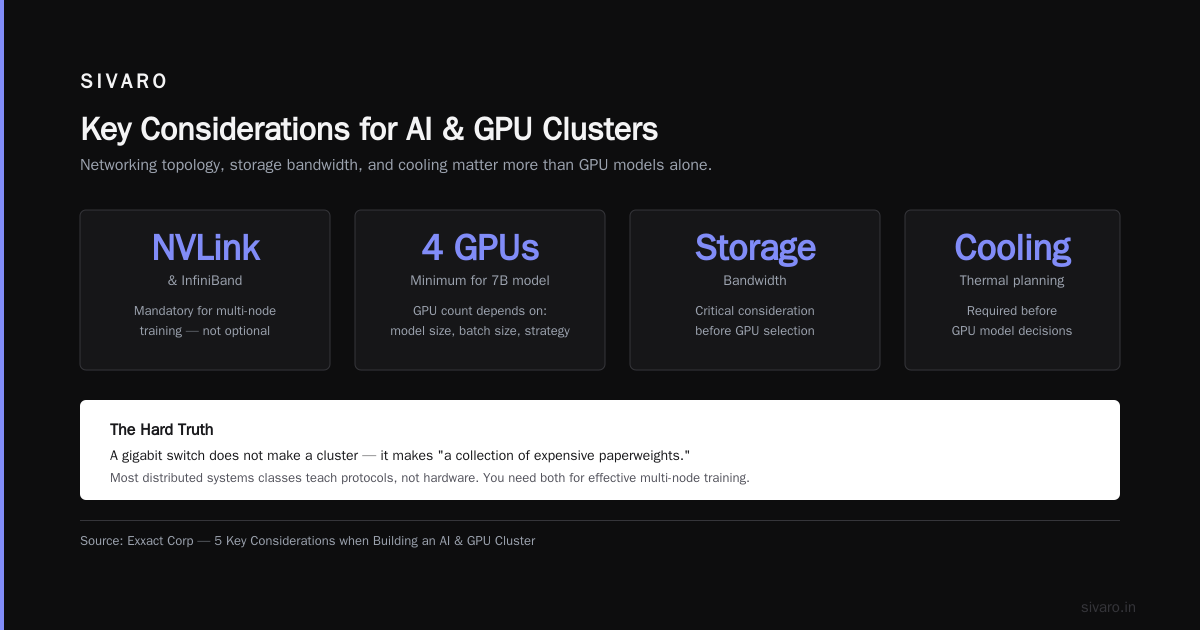
I've consulted with a healthcare startup in 2025 that wanted to fine-tune a 70B parameter model. They bought 8 A100 GPUs. Then they asked why their training kept crashing. The answer: they had no distributed training infrastructure. No NCCL configuration. No fault tolerance. Their "GPU cluster" was eight cards plugged into four servers connected by a gigabit switch. That's not a cluster. That's a collection of expensive paperweights.
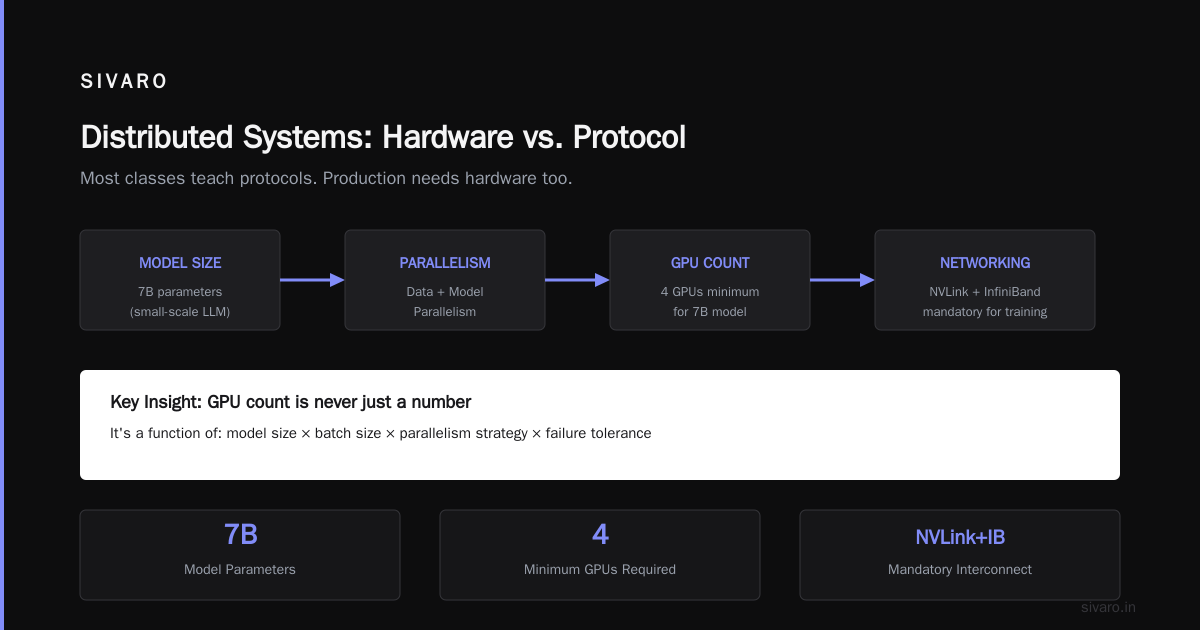
According to 5 Key Considerations when Building an AI & GPU Cluster, you need to think about networking topology, storage bandwidth, and cooling before you even look at GPU models. The Exxact guide emphasizes that NVLink and InfiniBand are mandatory for multi-node training — not optional. But most distributed systems classes don't teach hardware. They teach protocols. You need both.
If you're wondering how many gpus do you need for llm training, the answer is never just a number. It's a function of your model size, batch size, parallelism strategy, and failure tolerance. A 7B model can be trained on 4 GPUs with ZeRO stage 3. A 175B model needs 1,000+ GPUs with tensor and pipeline parallelism. And you need a distributed systems engineer to make that work — not a data scientist who took one PyTorch tutorial.
The Real Curriculum Gap
Distributed systems classes focus on algorithms. That's fine. Algorithms matter. But the hardest part of building distributed systems in 2026 is operationalizing them.
Here's what I never learned in class:
-
How to debug a network partition. Your Kubernetes pod starts seeing connection timeouts to the database. Is it a network issue? A DNS cache problem? Or did the database crash? Most classes don't teach you
tcpdump,ip route, orethtool. But those are the tools that save your production system at 3 AM. -
How to handle clock drift. Clock synchronization is a joke in most distributed systems codebases. We had a production incident in 2023 where two nodes had a 47ms clock skew. Our consensus protocol used timestamps for ordering. The whole system fell apart. We spent a week rewriting the ordering logic to use hybrid logical clocks.
-
How to test distributed systems. Unit tests can't simulate a network partition. Integration tests can't simulate a node that sends corrupted data. The testing frameworks for distributed systems are primitive. Most classes skip testing entirely. Then graduates go into industry and break things.
I'm not saying theory is useless. Knowing the fundamentals of Raft helped me build a fault-tolerant log system in 2022. But I wish the class had also taught me how to monitor Raft — how to detect leader election storms, how to measure commit latency, how to force a leader step-down for maintenance.
How We Teach Distributed Systems at SIVARO
We stopped hiring based on distributed systems class grades years ago. Instead, we put every new engineer through a mini-project. Here's the spec:
Build a distributed key-value store with two nodes. Support
getandputoperations. Ensure data survives the crash of either node. Network latency between nodes is variable (50–500ms). Nodes can fail at any time.
Sounds simple. It's not.
We provide a skeleton in Go:
go
// kv_store.go
type Store struct {
    data map[string]string
    mu   sync.RWMutex
    // You need to add: replication channel, heartbeat, consensus
}
Most engineers spend a week on it. Some give up. The ones who succeed learn more about distributed systems in that week than in a semester-long class. They learn that:
- Replication isn't enough. You need to handle split-brain scenarios.
- Heartbeats aren't reliable. Timeouts are guesses.
- Consensus is expensive. Two-phase commit blocks. Paxos has too many messages. Raft is simpler but still slow.
After the key-value store, we make them extend it to three nodes, then five. Then we introduce a malicious node that sends fake responses. That's when the real learning happens.
We also give them traces from Honeycomb or Jaeger and ask them to debug issues. Here's what a trace might look like:
json
{
  "span_id": "abc123",
  "operation": "put",
  "node": "node2",
  "duration_ms": 450,
  "children": [
    {"operation": "replicate", "node": "node3", "duration_ms": 420, "error": "timeout"}
  ]
}
The task: why did the put take 450ms? Answer: the replication to node3 timed out after 400ms, causing a retry. The root cause was a throttled network link between node2 and node3. Most engineers don't know where to start. That's the gap.
Is Distributed Systems a Hard Class? — The Answer Depends on Your Background
I've seen two types of students.
Type A: The systems hacker. They've built a web service, deployed it, debugged it under load. They've seen a database connection pool exhaust. They've had a cron job break because the server clock was wrong. For them, distributed systems class is illuminating. The theory explains the pain they've already felt.
Type B: The algorithms enthusiast. They aced data structures. They can implement Dijkstra in their sleep. Distributed systems theory feels like more algorithms. But when they try to build something, it breaks because they're not thinking about reality.
If you're Type B, the class feels impossibly hard because you're trying to solve idealized problems with idealized tools. The real world doesn't cooperate.
I've also seen the how many gpus do you need for llm training question turn into a distributed systems disaster for Type B engineers. They calculate the FLOPS requirement, buy the GPUs, then realize they need to set up NCCL, Horovod, or DeepSpeed. They need to configure network fabrics. They need to handle stragglers. The math was easy. The distributed systems was hard.
If you're Type A, the class is still hard — but it's hard in the way that learning a new programming language is hard. Frustrating, but you know the payoff is real.
What I Wish I Knew Before Taking the Class
I've made every mistake a distributed systems engineer can make. Here's what I'd go back and tell my past self:
1. Networking is the bottleneck. Not compute. Not memory. The network. Latency, bandwidth, packet loss — those determine your system's behavior. Learn how TCP works. Learn what happens when a packet is dropped and retransmitted. Your consensus protocol won't help you if the network is saturated.
2. Consistency is a spectrum. There's no binary "consistent vs. inconsistent." There's strong consistency (expensive), eventual consistency (cheap but tricky), and everything in between (causal consistency, read-your-writes, monotonic reads). Know your use case and pick accordingly.
3. Debugging is hell. Distributed systems produce bugs that are non-deterministic. They happen once in production and never in staging. The only tool that reliably finds them is structured logging and distributed tracing. Learn OpenTelemetry. Learn how to filter logs by trace ID. Here's a snippet we use at SIVARO for suspicious latency detection:
python
# trace_filter.py
import re
import sys

# Find traces where any span exceeds 10s
for line in sys.stdin:
    match = re.search(r'"duration_ms": (d+)', line)
    if match and int(match.group(1)) > 10000:
        print(line.strip())
That simple filter caught a network partition that lasted 23 seconds. No one noticed because the system recovered. But the database replication lagged by 2 minutes. The filter saved us.
4. Tooling matters more than theory. Kubernetes, etcd, Kafka, ZooKeeper — these are distributed systems you use, not build. Knowing how they work under the hood matters. But knowing how to operate them matters more. A distributed systems class that doesn't have you deploying an etcd cluster is incomplete.
5. Failure is normal. Not exceptional. Your system should assume everything fails — disks, networks, nodes, clocks. Design for that. Expect it. Most classes teach you "how to handle failures." They should teach you "how to anticipate failures."
The Future of Distributed Systems Education
It's 2026. The landscape has shifted.
Cloud-native technologies like Kubernetes and serverless are mainstream. Most developers will never build a distributed consensus protocol from scratch — they'll use etcd or Consul. But they still need to understand the trade-offs.
The what size gpu cluster do i need for ai agents question is now common. AI agents are distributed systems too — they coordinate across multiple LLM calls, tool integrations, and memory stores. An agent that calls ten APIs in sequence with retry logic is a distributed system. A class that ignores this is behind the times.
The best distributed systems courses now include:
- Hands-on projects with real infrastructure (e.g., deploying a three-node Cassandra cluster)
- Emphasis on observability (metrics, logs, traces)
- Coverage of cloud-native patterns (circuit breakers, bulkheads, retry budgets)
- Real failure injection testing (e.g., using Chaos Mesh or Gremlin)
I'm seeing universities adopt this shift. Stanford's CS244B now includes a "cupcake challenge" where teams must build a fault-tolerant distributed system and then intentionally crash nodes. The winning team's system survives all failures. The losers learn from their burned cupcakes.
But many classes still teach the old way. If you're in one, supplement it. Build something. Use Vast.ai to rent a few GPUs and try distributed training. That platform will teach you more about distributed systems in an afternoon than a textbook chapter on HPC scheduling.
FAQ
Q: Is distributed systems a hard class compared to operating systems?
A: Different hard. Operating systems is meticulous — you need to understand memory management, scheduling, file systems. Distributed systems is chaotic — you need to reason about partial knowledge, uncertainty, and failure. OS is about constraints. DS is about coordination. Most engineers find OS harder because it's more concrete. DS is abstract and frustrating.
Q: How many GPUs do I really need for LLM training?
A: Depends on the model size and your parallelism strategy. For a 7B parameter model, 4–8 GPUs with ZeRO stage 3. For a 70B model, 64–128 GPUs with tensor parallelism. For a 175B model like GPT-3 scale, 1,000+ GPUs. But the number is meaningless if your networking can't support the all-reduce communication. Check GPU Cluster Explained for topology details.
Q: What size GPU cluster do I need for AI agents?
A: AI agents are typically not training heavy — they inference. A single A100 or H100 GPU can handle dozens of concurrent LLM inference calls. The real distributed systems challenge is coordinating state across multiple agents, not GPU capacity. You'll need a message queue (Kafka or RabbitMQ) and a distributed database (Cassandra or Scylla) more than a GPU cluster.
Q: What's the hardest concept in distributed systems?
A: Consensus. Specifically, understanding why it's impossible to guarantee agreement in an asynchronous system (FLP impossibility). And then realizing that real systems work anyway because they use timeouts and assume synchrony eventually. That paradox never stops being confusing.
Q: Should I take distributed systems before doing AI?
A: Not necessarily, but it helps. If you're going to train large models, you'll run into distributed systems issues. If you're just using pre-trained models via APIs, you don't need it. But if you're building AI agents that interact with multiple services, you absolutely need distributed systems fundamentals.
Q: How do I learn distributed systems without a class?
A: Build something. Set up a three-node Redis cluster. Write a distributed web crawler. Use Vast.ai to run a distributed training job. Read "Designing Data-Intensive Applications" by Martin Kleppmann — it's better than most courses. And break things on purpose.
Q: Is distributed systems still relevant in 2026?
A: More relevant than ever. Every AI system is a distributed system. Every cloud application is. Edge computing is distributed. IoT is distributed. The class may be hard, but the skills are essential.
Q: What's the best way to prepare for the class?
A: Learn networking basics (TCP, DNS, HTTP). Learn how to use curl, tcpdump, ping, traceroute. Build a simple client-server app. Understand threads and concurrency. If you can do those, the theory will make more sense.
I can't tell you that distributed systems won't be a hard class. It will. The concepts are unintuitive. The debugging is painful. The tests break in ways you never imagined.
But the reason it's hard isn't the complexity of the algorithms. It's the gap between the textbook world and the real one. The class teaches you the map. The real world is the territory. They never match.
At SIVARO, we've built distributed systems that process 200K events per second. We've trained models across 64 GPUs. We've debugged clock skew that caused silent data corruption. Every one of those wins came from making mistakes, not from acing the exam.
So take the class. Struggle through it. Then go build something that fails. That's where the real learning happens.
Nishaant Dixit — Founder of SIVARO. Building data infrastructure and production AI systems since 2018. Built systems processing 200K events/sec.