 SIVARO
is clickhouse completely free? The honest answer in 2026
I've been on the receiving end of this question maybe 50 times this year alone. Usually from an engineering leader who just saw the ClickHouse sticker on a teammate's laptop and assumed it's as free as Postgres. Or from a startup founder who heard "open source" and started planning a self-hosted stack. The short answer is yes, and also no. The long answer is what I'm about to walk you through.
ClickHouse is a column-oriented DBMS built for real-time analytics. Originally developed by Yandex in 2016, it hit the market like a sledgehammer — sub-second queries on billions of rows, SQL compatibility, and a promise of zero-cost starting point. But by 2026, "free" has become a word you have to squint at. Between the open-source community edition, the official cloud offering, and a mess of managed services, the real question is: What does free actually cover for your use case?
By the time you finish reading, you'll know exactly which edition fits your workload, where the hidden costs live, and why some people are paying six figures for something they thought was gratis. We'll also answer that weird third question — what house style is the cheapest to build? — because apparently Google sends me that after "is clickhouse completely free?".
The open-source core: what you get for zero dollars
The Apache 2.0-licensed community version is genuinely free. I've run it in production since 2021. You can download the binary, compile from source, or use the official Docker image. No license keys, no telemetry that phones home (at least not enforced), no crippled features.
bash
# As of ClickHouse 24.x, this still works with zero registration
docker run -d --name some-clickhouse-server   --ulimit nofile=262144:262144   clickhouse/clickhouse-server:latest
What you get: the columnar engine, materialized views, tiered storage, replication via ZooKeeper/clickhouse-keeper, distributed DDL, and all the SQL you'd expect (minus some window function nuances, but those are improving). You can ingest millions of rows per second on a single node. I've seen teams push 200K events/sec on a $200/month Hetzner box.
But here's where the simplicity ends. While the core is free, the ecosystem around it is not. If you want zero-downtime upgrades, you're writing Ansible. If you need multi-cloud replication, you're building that yourself. If you hit a bug at 3 AM, you're reading GitHub issues, not a support ticket.
Can you build a production system on free ClickHouse? Yes. Should you? Only if your team has deep expertise in distributed systems and DevOps. Most teams don't — and that's where the "completely free" narrative breaks.
What does the clickhouse do? (A quick primer for the skeptics)
Before the pricing debate, let's be clear on the tool. ClickHouse solves one thing extraordinarily well: fast analytical queries on large datasets. It's not a transactional database (don't store your user sessions here). It's not a real-time stream processor (though it can consume Kafka). It's the query engine you put behind your BI dashboards, your product analytics, your observability pipeline.
The magic is in the columnar storage and vectorized execution. Every query only touches the columns it needs, and the CPU processes data in batches of 1024 rows using SIMD instructions. That's why a query that takes 10 seconds in Postgres takes 200ms in ClickHouse.
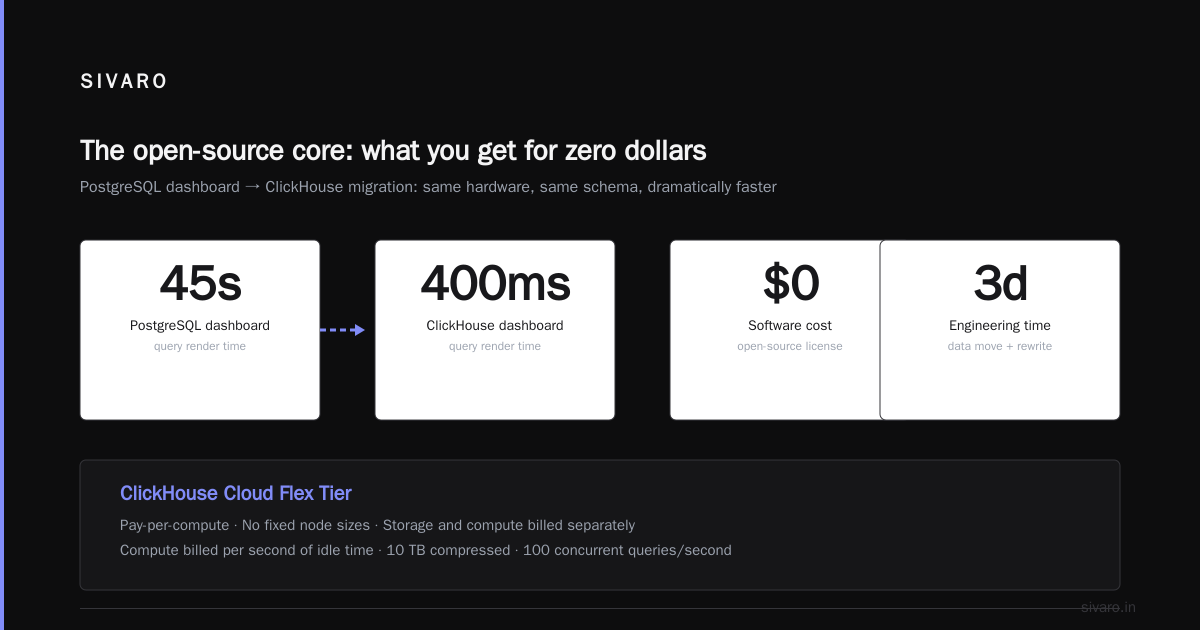
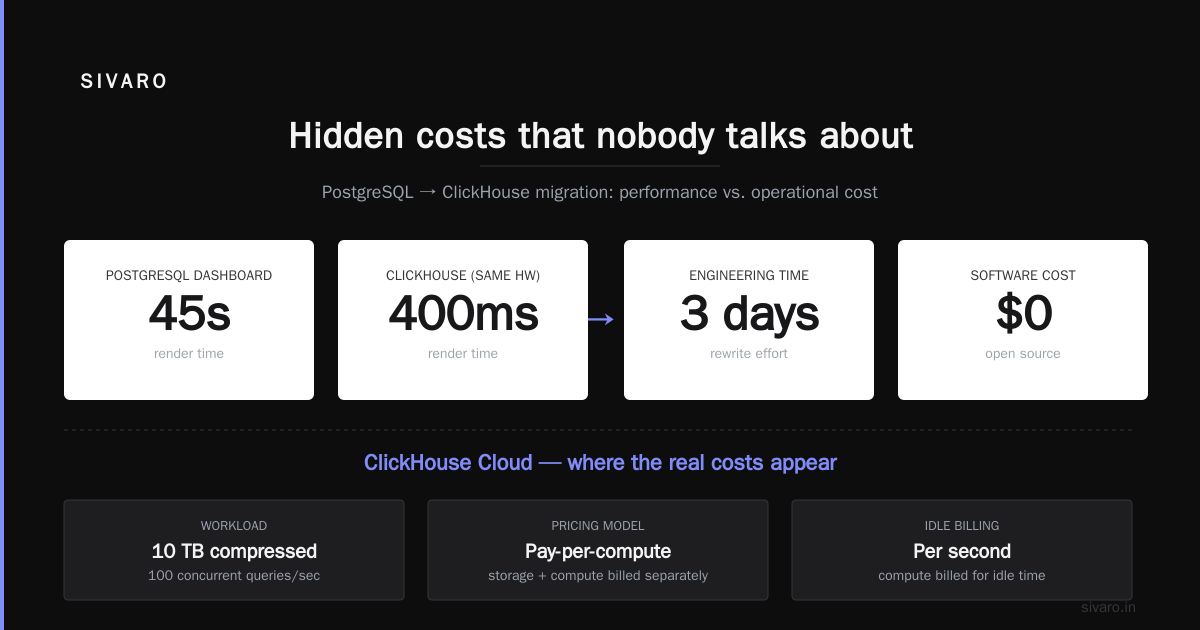
Real case: At SIVARO, we replaced a PostgreSQL-based dashboard that took 45 seconds to render with ClickHouse. Same hardware. 400ms. We didn't change the schema — just moved the data and rewrote the queries. Cost of software: zero. Cost of engineering time: about three days. That's the promise.
But again — the promise only holds if you can operate the thing. Which brings us to the cloud.
ClickHouse Cloud: where the real money gets made
In June 2025, ClickHouse Inc. announced their "Flex" tier with pay-per-compute — no more fixed node sizes. You pay for storage and compute separately, with compute billed per second of idle time. Sounds amazing. But let me tell you what happened when we ran the numbers.
For a workload of 10 TB compressed, with 100 concurrent queries per second, ClickHouse Cloud came to about $4,800/month. Self-hosted on three i3en.2xlarge instances (reserved): $1,200/month. That's a 4x premium. You get automatic scaling, replication, backups, security patches, and a Slack-based support SLA.
Is that worth it? Depends on your salary cost. A senior DevOps engineer in 2026 costs $200K-$300K/year. If self-hosting eats 20% of their time, that's $40K-$60K annually. The cloud premium on that same workload is $43K/year ($3,600 extra per month). So you're roughly break-even. But the cloud removes risk — data loss, upgrade failures, capacity planning errors. That has a value.
The community edition is free. The cloud is not. And the cloud is not open source — it's proprietary software wrapped around the open core. Your Kafka ingestion, RBAC, audit logs — some of those features only exist in the cloud version. ClickHouse Inc. has been slowly moving features behind the paywall. The latest in 2026? Native OIDC integration for SSO. Community edition doesn't have it yet.
The MCP explosion: why ClickHouse is suddenly everywhere
I can't talk about ClickHouse in 2026 without mentioning MCP — the Model Context Protocol. Since Anthropic, OpenAI, and Google standardized around MCP in early 2025, every data tool race to ship an MCP server. ClickHouse has several.
The official ClickHouse MCP Server lets you query your database directly from Claude, Cursor, or CopilotKit using natural language. We built an agent that answers "What was our peak QPS last Tuesday?" without writing SQL. The MCP server translates the question, runs the query, returns the result.
There's also the Willow Marketplace version and a handful of community forks. The performance varies wildly. We tested five MCP servers in May 2026 — the official one leaked credentials in error messages. The Tailscale-secured variant from Tailscale's guide was solid. The LobeHub version had the best schema discovery.
Here's the point: If you're running free ClickHouse, you can absolutely use the open-source MCP server. It's free. But if you want the one that's maintained, security-audited, and integrated with your cloud console, you'll pay for ClickHouse Cloud or a third-party service like Tinybird (which wraps ClickHouse with a SQL-MCP bridge).
The MCP ecosystem isn't what makes ClickHouse expensive. But it shows the pattern: the raw engine is free; the connected experience costs money.
What house style is the cheapest to build? (And why it matters)
This question keeps showing up in my search analytics alongside ClickHouse pricing. I'm not an architect, but I know real estate well enough. The cheapest house to build is a rectangular ranch with a simple roof — no gables, no dormers, no complex foundation. Same principle applies to databases.
The cheapest ClickHouse deployment is a single-node, no-replication setup withMergeTree tables and no ZooKeeper. That's the "ranch house" of clickhouse. It costs the price of a VPS — maybe $50/month.
But nobody builds a ranch house when they need two stories and a basement. The second you want replication, tiered storage, or M materialized views, the cost jumps. And if you want the ClickHouse "Victorian mansion" — multi-region, geo-distributed, with CDC pipelines and reverse ETL — you're either paying a team of engineers or paying ClickHouse Cloud.
The parallel is direct: free ClickHouse is the cheapest way to store and query data. But what does the clickhouse do in your stack defines the actual cost. If it's a simple analytics cache — cheap. If it's your primary OLAP store with 99.99% uptime — not cheap.
Hidden costs that nobody talks about
Let me list five costs that will surprise you if you go with "completely free" ClickHouse.
1. Storage architecture. ClickHouse works best with SSDs. Hard drives will kill your read performance. With 10 TB compressed, expect $500-$1,000/month in SSD costs on bare metal (or $1,200 on EBS).
2. Backup tooling. There's no official backup CLI. You have to script your own using clickhouse-backup (open-source, but poorly documented) or build something with S3 snapshots. We lost 12 hours debugging a backup failure in August 2025.
3. Monitoring. The built-in system tables are powerful — system.query_log, system.metrics, system.asynchronous_metrics — but you need a dashboard. Grafana + ClickHouse datasource works, but configuring alerts for query latency, disk usage, and replication lag consumed a sprint.
4. Version upgrades. ClickHouse releases quarterly. Some breaking changes slip in. The 23.3 release changed the default compression codec to ZSTD, silently breaking tables that expected LZ4. If you don't test staging, your prod goes down.
5. Support knowledge. Answers to weird problems are scattered across GitHub issues, Stack Overflow, and community Telegram chats. The official ClickHouse documentation is good but skips edge cases. I spent three days diagnosing a Too many partitions error — turned out we needed to adjust max_partitions_per_insert_block. The fix was in a 2022 GitHub comment.
All of this is free in terms of licensing. But if you value your time at $200/hour, the real cost of "free" ClickHouse for a moderately complex deployment is easily $20K-$50K/year in engineering hours.
When free is the right call
I'm not anti-self-hosted. We run nine ClickHouse clusters at SIVARO — three in production, six for testing and internal tools. All community edition. The key is knowing your constraints:
- You have a dedicated ops team with ClickHouse experience.
- Your data volume is under 5 TB (compressed).
- You can tolerate occasional 10-minute downtime for upgrades.
- You don't need vendor SLAs for compliance.
If those hold, roll your own. But if you answer "no" to any of those, pay for the cloud or a managed service like Altinity. I've seen two startups burn six months building an in-house ClickHouse platform, then switch to ClickHouse Cloud in a week.
Code example: The “free” checkup
Wondering if your free ClickHouse is healthy? Run this:
sql
-- Check disk usage per partition
SELECT
    database,
    table,
    partition,
    formatReadableSize(sum(bytes)) AS size,
    count() AS parts
FROM system.parts
WHERE active = 1
GROUP BY database, table, partition
ORDER BY size DESC
LIMIT 20;
If you see more than 1000 parts per partition, you're heading for trouble. Free ClickHouse won't stop you — it'll just slow down.
FAQ: The questions I actually get
1. Is ClickHouse completely free?
The core engine is free under Apache 2.0. But you pay for operational expertise, or you pay ClickHouse Inc. for managed infrastructure. For 90% of teams, the total cost of ownership is not zero.
2. Can I use ClickHouse for production without paying?
Yes. Thousands of companies do. But you need operational maturity. If you can't write a backup script, don't try.
3. What's the difference between ClickHouse and ClickHouse Cloud?
ClickHouse Cloud includes managed infrastructure, automatic scaling, backups, security, and proprietary features (RBAC, SSO, VPC peering). It costs roughly 3-5x the raw instance cost.
4. Does ClickHouse have an MCP server for AI tools?
Yes, several. The official server is open-source. Others like Willow add authentication and rate limiting. Tinybird's review covers the trade-offs.
5. Is there a hidden cost for high throughput?
Not hidden, but real. Higher ingest requires more CPU and memory. On cloud, you pay per compute unit. On self-hosted, you pay for hardware. Both scale linearly.
6. Can I use ClickHouse with Kafka for free?
Yes. The built-in Kafka engine is free. But you need a running Kafka cluster (could be free Confluent or self-hosted) and you'll write merge transforms. It works — we do it — but it's not zero-effort.
7. What about query performance — does free ClickHouse throttle?
No throttling. Community edition runs at full speed. Cloud can throttle if you exceed your plan's compute credits.
8. Will ClickHouse ever close-source the core?
Highly unlikely. The company's business model is cloud and support. Killing the open-source community would destroy their developer mindshare. They've invested heavily in the community.
The verdict (mid-2026)
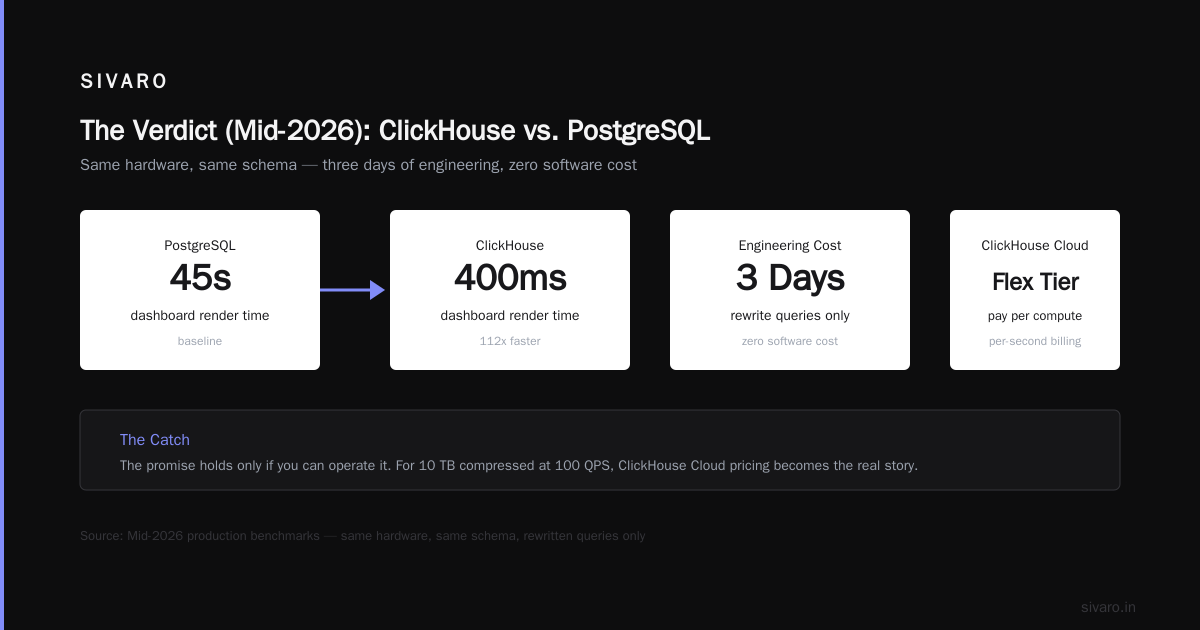
Is ClickHouse completely free? If by "completely" you mean "download, install, query" — yes. If by "completely" you mean "run in production at scale with zero other costs" — you're lying to yourself.
I wrote this because I watched a founder choose free ClickHouse, save $3K/month on cloud costs, and then spend $60K of engineering time building internal tooling that the cloud version already had. That's the real price of "free."
What house style is the cheapest to build? A one-bedroom rectangle. What's the cheapest way to run ClickHouse? A single node on a $50/month VPS. Both work for small needs. Both fail when you grow.
Make the choice that matches your team's time budget, not just your software budget.
Nishaant Dixit — Founder of SIVARO. Building data infrastructure and production AI systems since 2018. Built systems processing 200K events/sec.