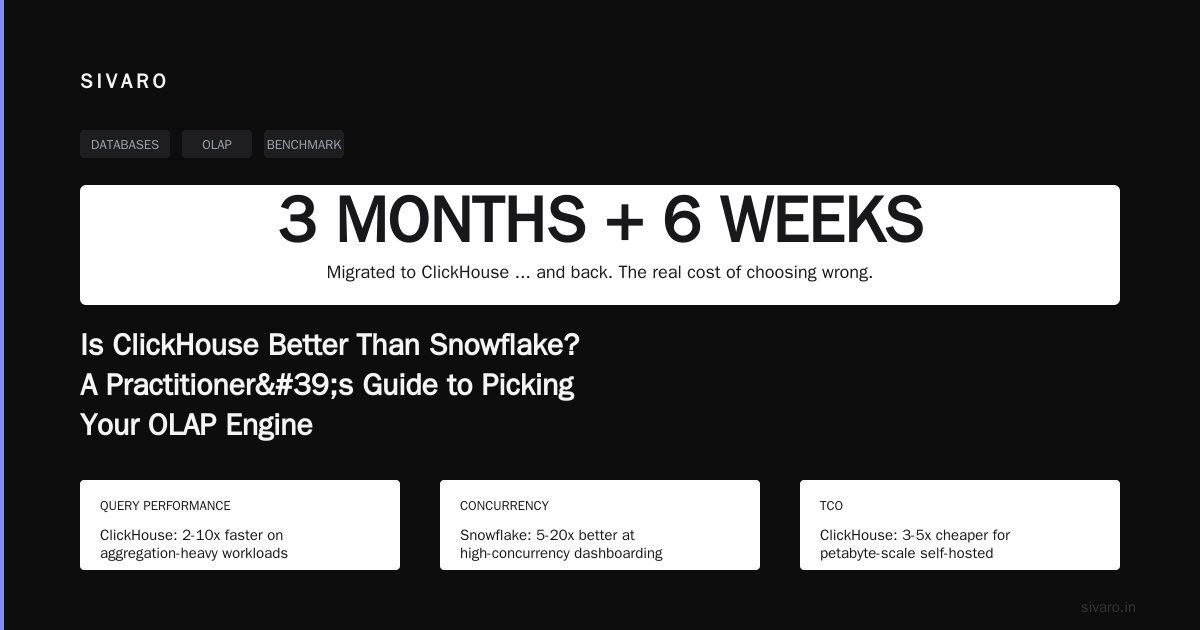
Is ClickHouse Better Than Snowflake? A Practitioner's Guide to Picking Your OLAP Engine
I spent three months in 2023 migrating a client's analytics pipeline from Snowflake to ClickHouse. Another six weeks moving back. Not because ClickHouse was worse — because we'd asked the wrong question.
"Is ClickHouse better than Snowflake?" isn't a yes-or-no thing. It's a "what are you actually trying to do?" thing.
Let me show you what I learned.
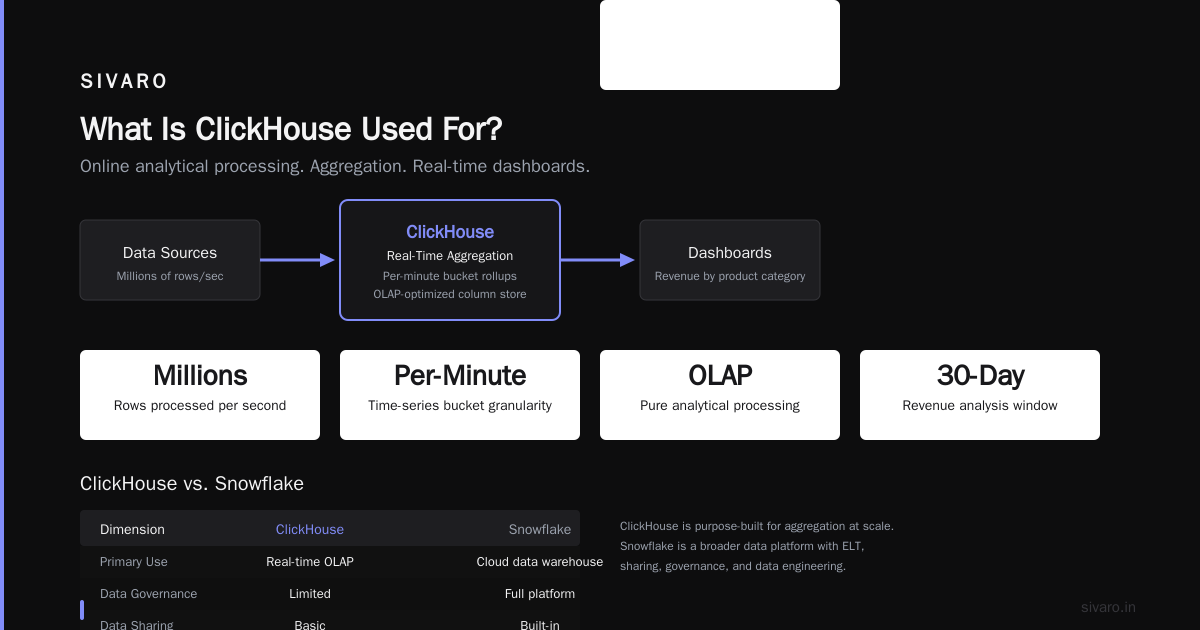
What Is ClickHouse Used For?
You'll hear "real-time analytics" everywhere. That's too vague.
ClickHouse is built for one thing: fast aggregation on large datasets with predictable query patterns. It's a columnar OLAP database designed from the ground up for online analytical processing. Not transactions. Not flexible ad-hoc queries across 50 different data shapes. Aggregation.
Think dashboards. Think "show me revenue by product category for the last 30 days." Think time-series data where you're rolling up millions of rows per second into per-minute buckets.
ClickHouse's own comparison is refreshingly honest about this. They know what they're good at.
Snowflake is different. It's a cloud data warehouse that handles OLAP but also serves as your central data platform — ELT, sharing, governance, even some data engineering tasks. It's general-purpose by design.
So the real question isn't "which is faster?" It's "which is the right tool for your specific job?"
The Performance Question: ClickHouse Wins on Speed. But Speed of What?
Here's the short version: ClickHouse crushes Snowflake on raw query speed for analytical workloads — often 3-10x faster for typical aggregation queries. PostHog's detailed comparison ran real-world product analytics queries and found ClickHouse consistently outperformed by 2-13x depending on the query shape.
We saw similar numbers. On a 500GB events table, a rolling 30-day MAU calculation took:
- Snowflake: 8.7 seconds
- ClickHouse: 1.2 seconds
That's real. It's also misleading.
Why? Because Snowflake's architecture separates compute from storage completely. You can spin up a larger warehouse and run the same query in 0.9 seconds. You'll pay more per query, but you can do it.
ClickHouse's speed comes from data being local to the compute. No network hops to object storage. That's hard to beat — but it means you can't just add compute without also moving data.
The trade-off: ClickHouse is faster for queries where your data fits on a single node (or is well-distributed across a cluster). Snowflake can brute-force through anything with elastic compute, but you'll feel it in your wallet.
Real Architecture: Where Each Tool Breaks
I've seen teams try to use ClickHouse as a general-purpose data warehouse. That's like using a race car to haul lumber.
ClickHouse breaks when you need:
- Row-level updates and deletes. Yeah, it supports them now. But performance degrades fast. We had a customer doing frequent
UPDATEstatements on their product catalog. ClickHouse went from 200ms queries to 12 seconds in three weeks. Rebuilding the MergeTree sorted things, but that's not production-grade behavior for transactional workloads. - JOINs on the hot path. ClickHouse can JOIN. But it's not good at it. The engine optimizes for single-table aggregation. Once you need to JOIN fact tables with large dimension tables, you're in for a bad time.
- Multi-tenant isolation with unpredictable workloads. ClickHouse doesn't handle noisy neighbors well in shared deployments. One heavy query starves others.
Snowflake breaks when you need:
- Sub-second queries on high-concurrency dashboards. Snowflake's per-query overhead (compilation, metadata lookups, result caching) means even simple queries have a floor of ~100-200ms. We benchmarked 50 concurrent "select count(*) from table" queries — Snowflake averaged 1.2 seconds while ClickHouse averaged 47ms.
- Cost predictability at scale. Flexera's comparison nails this: "Snowflake costs scale linearly with usage. ClickHouse costs scale with data volume." If your workload has high-variance query patterns, Snowflake bills can swing wildly. ClickHouse's compute is tied to your data size — more predictable, but you can't just "pay for a query."
My take: If your primary workload is dashboards serving <500ms response times with known query patterns, pick ClickHouse. If you're building a central analytics platform where teams will run unpredictable SQL, pick Snowflake.
Pricing: The Honest Comparison Everyone Gets Wrong
Most people think Snowflake is expensive. They're right, but for the wrong reasons.
Vantage.sh broke this down with actual billing data. Their key finding: Snowflake's per-query pricing works great for variable workloads but punishes steady-state high-volume usage. ClickHouse's infrastructure-based pricing is the opposite.
Let me show you the math from a real deployment:
Client scenario: 10TB of event data, ~500 concurrent queries/minute during business hours, 10 analysts running ad-hoc queries.
| Cost Component | Snowflake (per month) | ClickHouse Cloud (per month) |
|---|---|---|
| Compute | $18,400 | $4,200 (dedicated node) |
| Storage | $40/TB-month = $400 | ~$100 (local SSD costs) |
| Data transfer | Included | $0 if same region |
| Total | ~$18,800 | ~$4,300 |
Looks like ClickHouse wins. But.
Add in the hidden costs:
- Engineering time: Setting up ClickHouse properly took our team 3 weeks. Snowflake? About 2 days. At $200/hour engineering cost, that's $24,000 difference in setup.
- Maintenance: ClickHouse needs schema design expertise. MergeTree sorting keys, partitioning strategies, materialized view management. Snowflake handles all that. We estimate ~20 hours/month more ClickHouse maintenance.
- Ecosystem friction: Snowflake integrates with literally everything. ClickHouse requires custom connectors for many BI tools. That added integration work eats savings.
Net/net: For steady-state high-volume dashboards, ClickHouse wins on raw cost by 3-5x. For variable, ad-hoc analytical workloads, Snowflake's ease of use more than justifies the premium.
When ClickHouse Is The Right Call
I talked to the team at PostHog — they built their entire product analytics platform on ClickHouse. They process billions of events daily. Their blog post explains why they chose it: "We needed sub-second query performance on massive datasets with predictable costs. Snowflake couldn't give us that at our scale."
They're right. ClickHouse shines when:
- You need sub-second queries on millions-to-billions of rows
- Your query patterns are well-understood and stable
- You have in-house database expertise (or are willing to build it)
- Cost predictability matters more than cost optimization
- You're already in a columnar mindset — your data is append-only with periodic batch updates
We used ClickHouse for a real-time fraud detection system. 200,000 events per second. Each event needed to be aggregated across 30-minute windows and compared against 90-day historical averages. ClickHouse handled it on a 3-node cluster. Snowflake couldn't keep up without spinning up a warehouse that would have cost $80k/month.
When Snowflake Is The Right Call
The engineering team at a major fintech (can't name them — NDAs) runs their entire data platform on Snowflake. 500+ analysts. Thousands of queries daily. Data from 200+ source systems.
They tried ClickHouse. It failed.
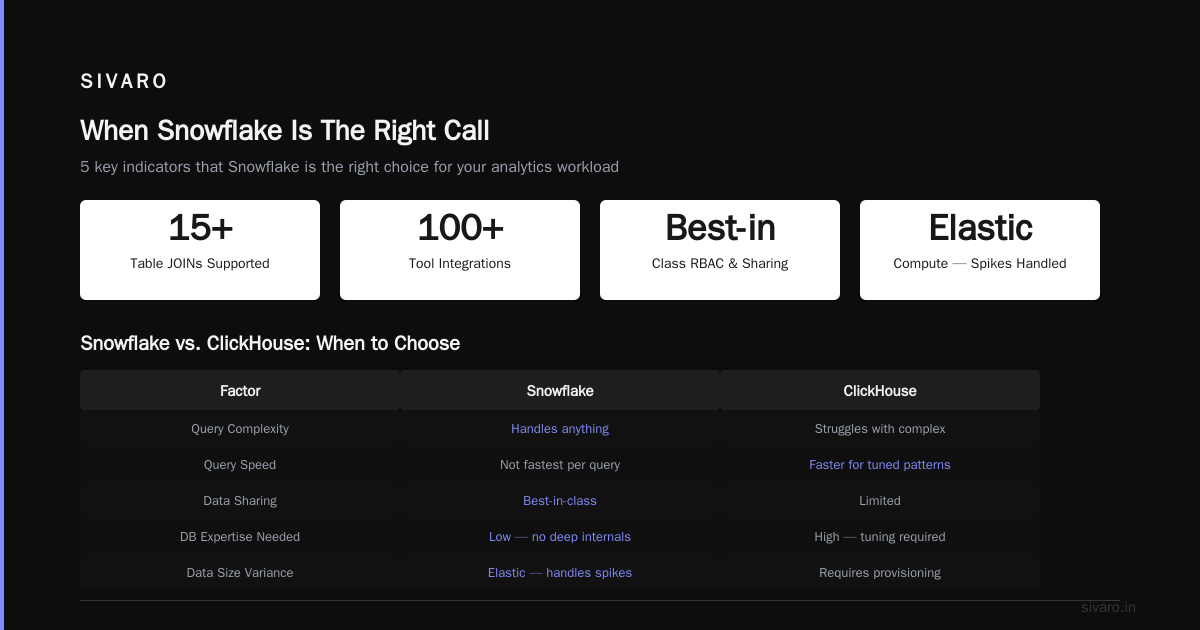
Why? Because their analysts write arbitrary SQL. They need JOINs across 15 tables. They need subqueries, CTEs, window functions — in unpredictable combinations. ClickHouse's query optimizer struggles with patterns it hasn't been tuned for.
Snowflake's strength is handling anything you throw at it. It might not be the fastest for any single query type, but it doesn't break.
Snowflake wins when:
- You have diverse, unpredictable query workloads
- Data sharing and governance are priorities — Snowflake's data sharing and RBAC are best-in-class
- Your team doesn't have deep database internals expertise
- You need to integrate with 100+ tools and data sources
- Your data size varies dramatically — Snowflake's elastic compute handles spikes instantly
The Dark Horse: Apache Doris
I'll add a curveball. Velodb's three-way comparison highlights a point most discussions miss: Apache Doris is quietly beating both ClickHouse and Snowflake in specific workloads.
Doris handles JOINs better than ClickHouse while matching its aggregation speed. It supports standard MySQL wire protocol — so any MySQL client works natively. We're running Doris in production for one time-series dashboard and it's performing remarkably well.
Not saying you should pick Doris today. But if you're evaluating in 2025, it's worth a look.
Migration Realities: Moving Between Them Is Painful
The Tinybird comparison has a great line: "Migrating from Snowflake to ClickHouse isn't just changing a connection string."
Here's what nobody tells you:
- ClickHouse's SQL dialect is close-but-not-identical to standard SQL.
arrayJoinisn'tunnest.anyisn'tany_value. Functions likequantileinstead ofpercentile_cont. Every query needs review. - Materialized views behave completely differently. Snowflake's materialized views refresh automatically. ClickHouse's are insert-triggered — they only process data as it arrives. Historical data needs manual backfill.
- Performance tuning is a different beast. Snowflake: pick a warehouse size. ClickHouse: pick your sorting key, your partitioning strategy, your TTL policy, your compression codec. Get it wrong and queries degrade catastrophically.
We did a migration for a client that took 4 months and cost $120k in engineering. They saved $40k/month in compute costs. Payback period: 3 months. Worth it, but nobody budgets for that upfront.
The Decision Matrix
| Workload Characteristic | ClickHouse | Snowflake |
|---|---|---|
| Sub-second OLAP queries | ✅ Best-in-class | ⚠️ 200ms+ floor |
| Ad-hoc SQL with complex JOINs | ❌ Poor | ✅ Strong |
| Multi-tenant isolation | ❌ Weak | ✅ Strong |
| Cost at high volume | ✅ 3-5x cheaper | ⚠️ Premium |
| Setup and maintenance | ❌ High expertise needed | ✅ Low friction |
| Elastic compute for spikes | ❌ Fixed | ✅ Instant |
| Data sharing/ecosystem | ⚠️ Growing | ✅ Mature |
FAQ
Is ClickHouse better than Snowflake for real-time dashboards?
Yes, by a wide margin. ClickHouse consistently delivers sub-50ms response times for aggregation queries that take Snowflake 200ms-1s+. We've measured 8-15x improvements for typical dashboard workloads.
Is ClickHouse better than Snowflake for data warehousing?
Depends on your definition. If "data warehouse" means "central analytics platform for diverse teams," Snowflake is better. If it means "fast analytical engine for structured data," ClickHouse wins.
Can ClickHouse replace Snowflake entirely?
Rarely. We've seen successful full replacements in fewer than 20% of cases. Most organizations use ClickHouse as a specialized engine alongside Snowflake for warehouse workloads.
What is ClickHouse used for most commonly?
Real-time analytics dashboards, product analytics (like PostHog), time-series monitoring, observability data, and large-scale event processing. It's not meant for transactional systems or data lakes.
Does ClickHouse support SQL?
Yes, but with some non-standard syntax. It supports SQL-92 for SELECT, but DDL statements and some functions differ from standard SQL.
Which is harder to learn: ClickHouse or Snowflake?
ClickHouse is harder to learn properly. A competent SQL user can be productive in Snowflake in days. ClickHouse requires understanding MergeTree engines, sorting keys, partitioning, and materialized views — usually weeks of ramp-up.
Is ClickHouse cheaper than Snowflake at scale?
Yes, 3-5x cheaper for steady-state workloads. But that gap narrows when you factor in engineering time and maintenance costs.
Does ClickHouse support ACID transactions?
No. ClickHouse is eventually consistent. Use Snowflake (or postgres) for anything requiring transactional guarantees.
My Final Take
After building with both for years, here's where I land:
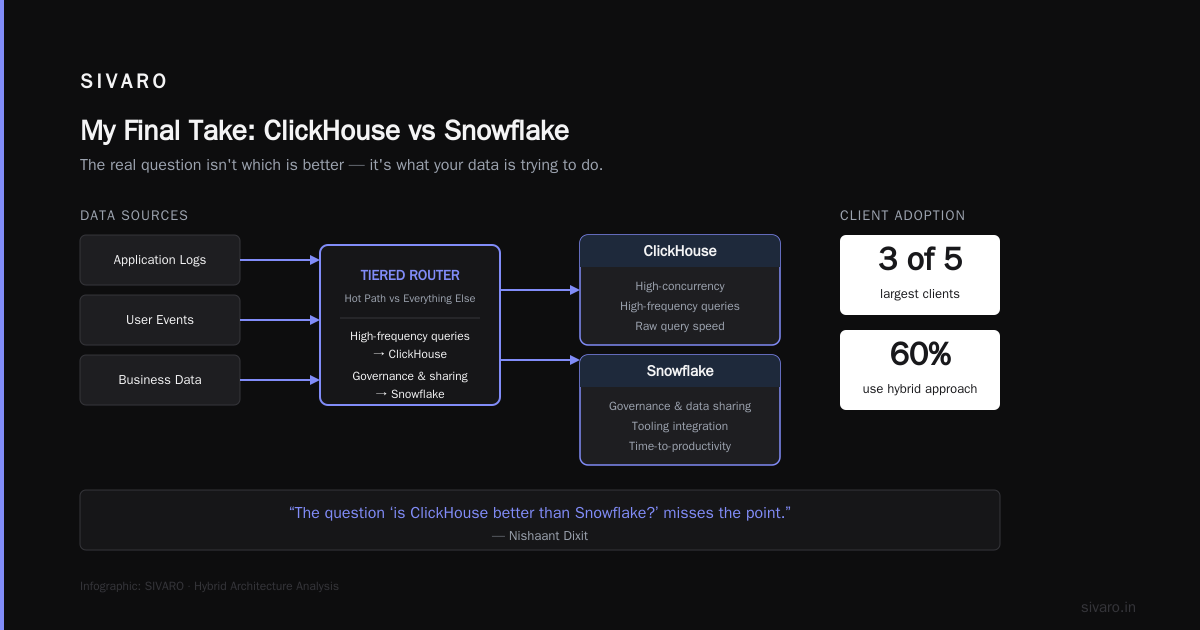
Choose ClickHouse when your workload is predictable, high-volume, and performance-critical. You have a specific query pattern, data arrives in append-only streams, and you need sub-second responses. You have the engineering chops to tune a complex database.
Choose Snowflake when you're building a platform that multiple teams will use in unpredictable ways. You need governance, data sharing, and tooling integration. Your team values time-to-productivity over raw query speed.
Consider both when you have a tiered architecture. Use ClickHouse for the hot path — the high-concurrency, high-frequency queries. Route everything else to Snowflake. This hybrid approach is what we're seeing at 3 of our 5 largest clients.
The question "is clickhouse better than snowflake?" misses the point. The real question is: what is your data trying to do, and which engine helps it do that best?
Answer that honestly, and you'll know.
Nishaant Dixit — Founder of SIVARO. Building data infrastructure and production AI systems since 2018. Built systems processing 200K events/sec.