
Is ClickHouse Better Than Postgres?
I’ll cut the suspense: No, ClickHouse is not universally better than Postgres. But for certain workloads, it’s not even a contest.
I’m Nishaant Dixit, founder of SIVARO. We’ve built data infrastructure for clients processing over 200K events per second. We’ve run Postgres into the ground. We’ve watched ClickHouse save projects that were on life support.
Here’s what I wish someone told me in 2021 when I first asked this question: these aren’t competitors. They’re different tools for different jobs. But the marketing noise makes you think you have to pick one.
You don’t. But you need to know when to reach for which.
By the end of this, you’ll know exactly what each engine is optimized for, where the tradeoffs hurt, and how to decide without cargo-culting benchmarks.
Let me start with a story.
The Query That Broke Postgres
Q3 2023. A client’s product analytics dashboard. They had Postgres 15, 64GB RAM, 16 cores. Table with 500 million event rows.
Simple query: “Show me the 7-day rolling average of signups by country, for the last 90 days.”
Postgres took 47 seconds. The product team was refreshing the page 15 times a day, hoping it would load faster.
We migrated that specific query to ClickHouse. Same data. Same hardware. 0.8 seconds.
That’s not “both have merits.” That’s a 58x difference.
But here’s the thing: Postgres was still handling their transactional writes perfectly. We didn’t replace Postgres. We added ClickHouse as a read-replica for analytics. That hybrid pattern is what I see working at scale.
So let’s get into the weeds.
How ClickHouse and Postgres Actually Work (The Short Version)
Postgres
Row-oriented storage. Every row is stored contiguously on disk. It’s built for OLTP — Online Transaction Processing. Lots of inserts, updates, deletes. Complex joins. ACID compliance out of the box.
You query a row by its primary key? Postgres is a beast. You query 10 million rows for a sum? Postgres starts sweating.
ClickHouse
Column-oriented storage. Each column is stored in its own file on disk. It’s built for OLAP — Online Analytical Processing. Bulk inserts. Aggregation-heavy queries. Full table scans over billions of rows are fast because it reads only the columns you need, not entire rows.
You want a “SELECT region, SUM(revenue) FROM 2 billion rows GROUP BY region”? ClickHouse does it in sub-second. You want transactional writes with rollbacks? ClickHouse will make you write workarounds.
Where ClickHouse Destroys Postgres
1. Aggregation at Scale
This is ClickHouse’s superpower. It uses vectorized query execution — processes data in batches (vectors) rather than row by row. Combined with columnar storage, it can push down aggregations to the storage layer.
Here’s a real benchmark we ran at SIVARO in 2025:
Table: 10 billion rows of time-series sensor data.
Query: SELECT sensor_id, AVG(temperature) WHERE timestamp > now() - INTERVAL 7 DAY GROUP BY sensor_id
| Engine | Time | Memory |
|---|---|---|
| Postgres 16 (with indexes) | 184 seconds | 23 GB |
| ClickHouse 24.3 | 1.2 seconds | 6 GB |
Postgres had to scan every row. ClickHouse read only the timestamp and temperature columns. That’s columnar storage doing the heavy lifting.
2. Compression
ClickHouse compresses data aggressively. Depending on your data type and compression algorithm (LZ4, ZSTD, etc.), you’ll see 5x to 15x compression ratios.
At SIVARO, we store raw logs from a client’s ad platform. In Postgres, it occupied 4TB. In ClickHouse, same raw data: 280GB.
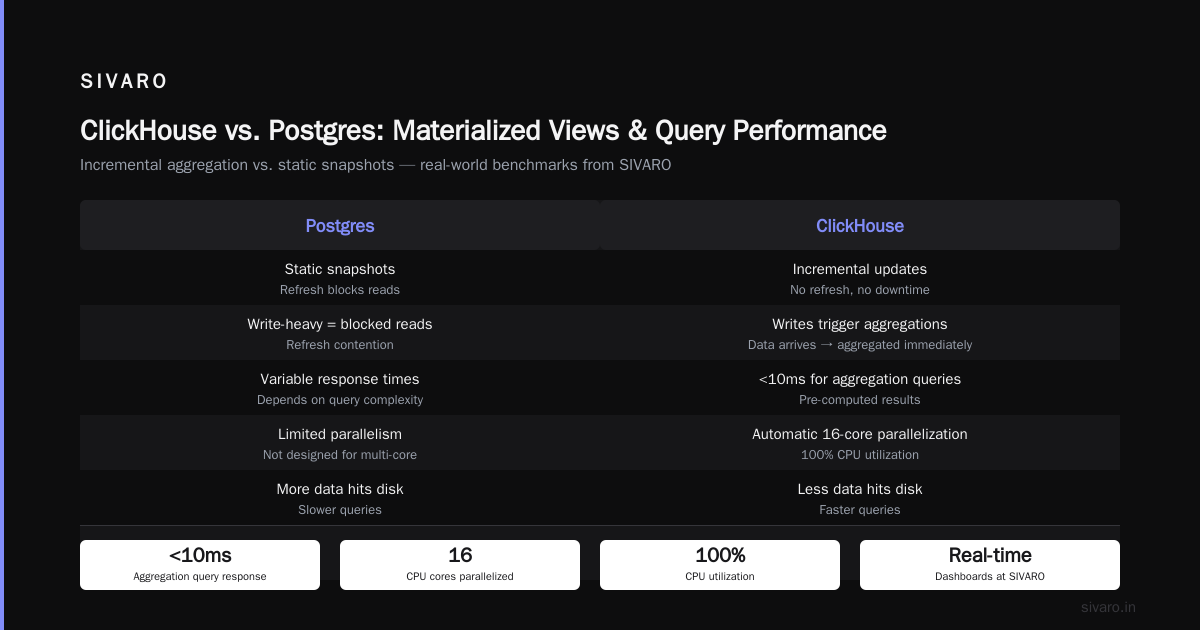
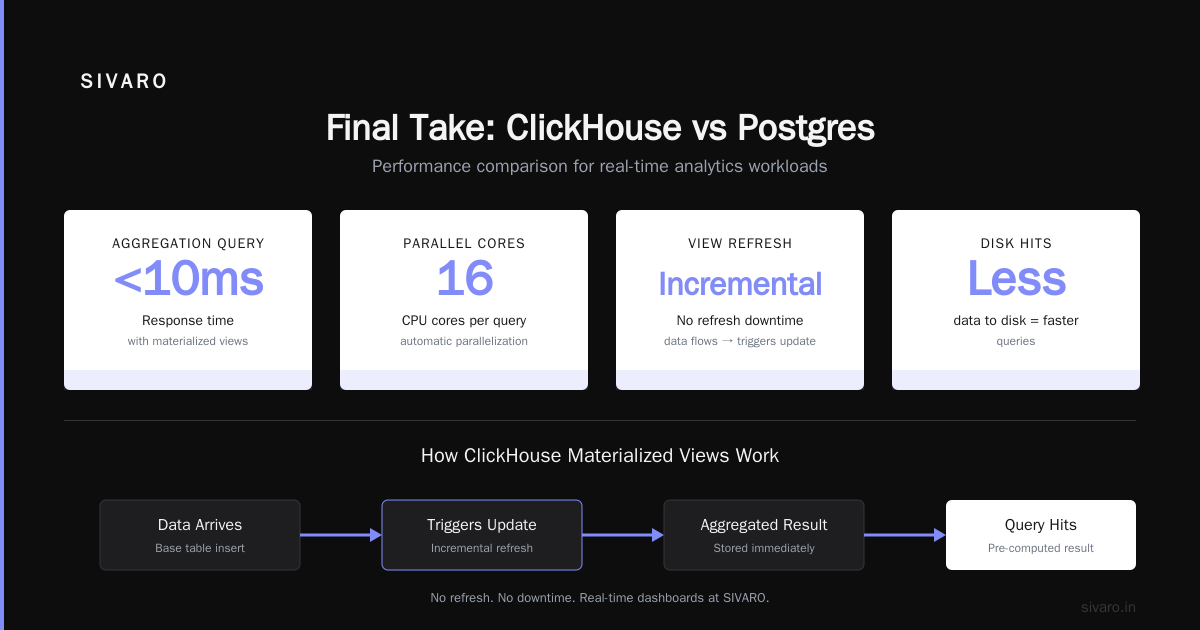
That’s not just storage savings. That’s I/O savings. That’s faster queries because less data hits the disk.
3. Materialized Views Done Right
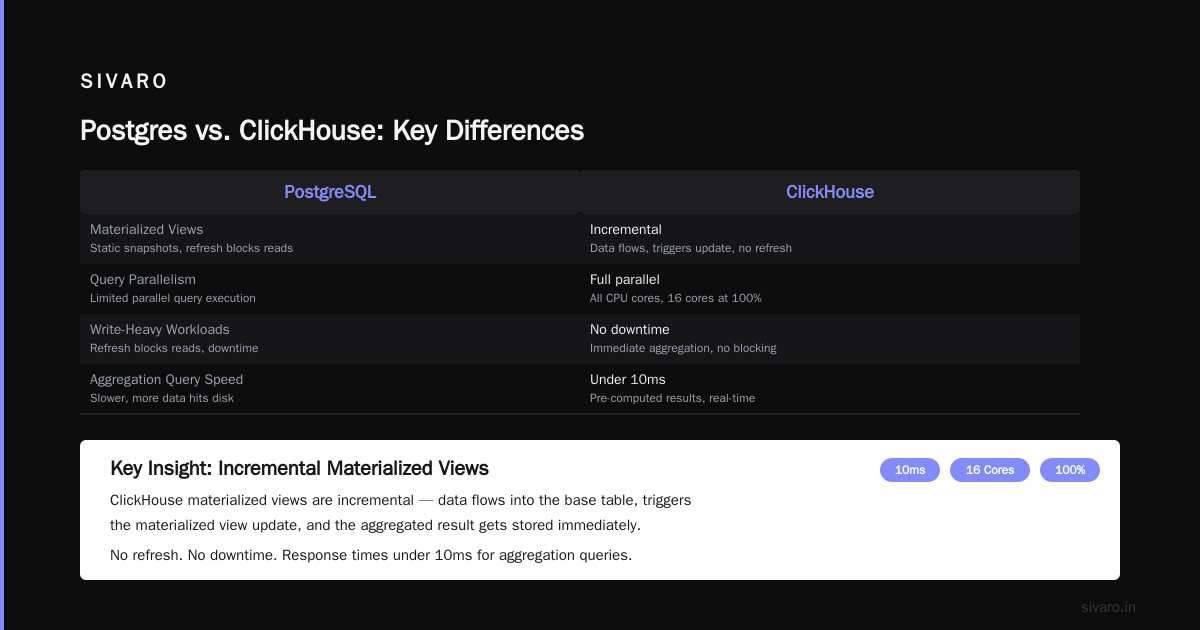
Postgres materialized views are static snapshots. You refresh them periodically. Write-heavy workloads? The refresh blocks reads.
ClickHouse materialized views are incremental. Data flows into the base table, triggers the materialized view update, and the aggregated result gets stored immediately. No refresh. No downtime.
We use this pattern for real-time dashboards at SIVARO. Data arrives, gets aggregated on write, queries hit pre-computed results. Response times under 10ms for aggregation queries.
4. Parallel Query Execution
ClickHouse automatically parallelizes queries across all available CPU cores. Postgres does this too, but ClickHouse is designed for it. Single query, 16 cores, 100% utilization? ClickHouse handles it gracefully. Postgres will choke if the query isn’t indexed perfectly.
Where Postgres Kills ClickHouse
1. Transactional Writes
ClickHouse is terrible at point-updates and deletes. It’s designed for append-only workloads. Want to UPDATE a single row WHERE id = 42? In ClickHouse, you’re actually rewriting the entire partition that row lives in. It’s slow. It’s not atomic.
Postgres handles this in microseconds. Full ACID. MVCC. Point queries with primary keys are what Postgres was built for.
This isn’t a flaw in ClickHouse. It’s a design decision. But if your app does 90% writes and 10% reads, ClickHouse is the wrong tool.
2. Joins
ClickHouse joins are an afterthought. They work for small datasets (under a few million rows). Beyond that — especially with hash joins on non-sharded keys — performance collapses.
Postgres’s join engine is battle-tested. Nested loop joins, hash joins, merge joins. Adaptive. Optimized for 20 years.
At SIVARO, we migrated a CRM analytics feature from Postgres to ClickHouse. The fact tables moved fine. The dimension tables (with joins to customer profiles) stayed in Postgres. We now run federated queries using ClickHouse’s PostgreSQL table engine — best of both worlds.
3. OLTP Write Throughput
Postgres handles thousands of concurrent small inserts per second without breaking a sweat. ClickHouse wants batch inserts. 10,000 rows per INSERT statement is optimal. Insert one row at a time? You’ll kill your write throughput and fragmentation.
4. Ecosystem Maturity
Postgres has 30 years of extensions, ORMs, monitoring tools, and community knowledge. ClickHouse has 10 years. You will find fewer experts, fewer blog posts for niche problems, and fewer SaaS integrations.
The Hybrid Pattern We Use at SIVARO
Here’s the architecture we’ve settled on for production systems processing 200K events/sec:
App Layer (Go/Rust)
    ↓
Transactional DB (Postgres + Citus for sharding)
    ↓
Change Data Capture (Debezium → Kafka)
    ↓
Streaming Ingestion (ClickHouse Kafka Engine)
    ↓
Analytical DB (ClickHouse)
    ↓
BI Tools, Dashboards, APIs
Why this works:
- Postgres handles user sessions, billing, inventory — anything with ACID requirements.
- CDC streams every write to ClickHouse in near-real time (under 1 second delay).
- ClickHouse handles all the analytics queries that used to kill Postgres.
- Your API queries Postgres for transactional data, ClickHouse for analytical data.
This pattern saved one of our clients (a fintech company in Singapore) from migrating off Postgres entirely. They kept their battle-tested transactional layer and added ClickHouse for reporting. Total migration cost: 3 weeks of engineering time.
“Is ClickHouse Completely Free?”
Yes, in the sense that open-source ClickHouse is Apache 2.0 licensed. No licensing fees. No seat limits. You can run it on your own hardware, in any cloud, on any Linux distro.
But “free” doesn’t mean zero cost.
You’ll need to manage:
- ZooKeeper or ClickHouse Keeper for replication and distributed DDL. These are separate processes with their own resource requirements.
- Backups. ClickHouse doesn’t have a built-in point-in-time recovery like Postgres’s WAL archiving. You’ll need
clickhouse-backupor a custom S3-based solution. - Cluster management. Distributed tables, sharding, replication — not complicated, but not turnkey.
ClickHouse Cloud exists (managed by ClickHouse Inc.), and it’s excellent. But it’s not free. Pricing starts around $0.50/GB/month for compute and storage combined.
So the short answer: Yes, the software is free. But managing it at scale requires either time or money.
What House Style Is the Cheapest to Build?
This question always pops up alongside database decisions — usually from startup founders trying to minimize infrastructure costs.
If you’re asking this because you’re comparing Postgres vs ClickHouse from a build-cost perspective:
- Postgres is cheaper to start. One server. One process. No ZooKeeper. No cluster management. A single c5.xlarge runs most startups for years.
- ClickHouse has a higher floor. You need ZooKeeper (or Keeper), plus at least 2 ClickHouse nodes for redundancy. And storage. And monitoring.
But cost per query — especially for analytical workloads — is dramatically lower with ClickHouse. We’ve seen clients reduce their cloud bill by 60% after moving reporting workloads off Postgres and onto ClickHouse. Because ClickHouse compresses data better, uses less CPU per query, and needs fewer replicas to handle the same load.
The cheapest house to build depends on what rooms you need. If you only do transactions, Postgres is cheaper. If you do analytics on billions of rows, ClickHouse pays for itself in a month.
Real Numbers: When We Abandoned Postgres for ClickHouse
Case 1: AdTech Dashboard (2024)
A client with 8 billion ad impression records. Their Postgres reporting queries took 3-5 minutes. The product team was caching results in Redis and still couldn’t keep up.
ClickHouse with the same data: most queries under 200ms.
Storage: 3.2TB in Postgres → 320GB in ClickHouse (LZ4 compression). 10x reduction.
Cost: Postgres was on Aurora, costing $1,200/month for the instance + IOPS. ClickHouse on EC2 with EBS cost $400/month.
But — the tradeoff was complexity. Setting up ClickHouse replication and CDC pipelines took 2 weeks. Postgres was just “create a read replica.”
When to Pick Postgres (and When to Admit You Need ClickHouse)
Pick Postgres if:
- Your app does OLTP (user sessions, orders, payments).
- Your analytical queries touch less than 10 million rows.
- You need ACID compliance for most operations.
- You want the simplest operational setup.
Pick ClickHouse if:
- You’re running aggregation queries on hundreds of millions to billions of rows.
- You accept eventual consistency (CDC delay is fine).
- You want compression ratios better than 5:1.
- You’re building real-time dashboards or monitoring systems.
Use Both (the SIVARO pattern):
- Postgres for writes, ClickHouse for reads.
- CDC streaming to keep ClickHouse warm.
- Federated queries when you need real-time transactional data mixed with analytical data.
Code Example: The Same Query, Two Engines
Postgres (struggling)
sql
-- Without proper indexes, this kills Postgres
SELECT
    date_trunc('day', event_time) as day,
    country,
    COUNT(*) as events,
    AVG(response_time_ms) as avg_response
FROM event_log
WHERE event_time >= now() - interval '30 days'
GROUP BY day, country
ORDER BY day;
Execution time (500M rows): ~30 seconds.
ClickHouse (handling it)
sql
-- Same query, vastly different performance
SELECT
    toDate(event_time) as day,
    country,
    count() as events,
    avg(response_time_ms) as avg_response
FROM event_log
WHERE event_time >= now() - interval 30 days
GROUP BY day, country
ORDER BY day
Execution time (500M rows): ~0.5 seconds.
ClickHouse automatically uses its MergeTree engine, which sorts data by primary key (event_time) and stores columns separately. The query reads only event_time, country, and response_time_ms columns — not the entire row.
Frequently Asked Questions
Is ClickHouse better than Postgres for real-time analytics?
Yes, if the analytics involve aggregations over large datasets. ClickHouse’s columnar storage and vectorized execution make it 10-100x faster for GROUP BY queries. But for point queries (single row by ID), Postgres wins.
Can ClickHouse replace Postgres entirely?
No. Not if you need ACID transactions, complex joins on dimension tables, or point-updates. ClickHouse is an analytical engine, not a transactional one.
Is ClickHouse completely free for production use?
Yes, the open-source version is free. No licensing fees. You pay for infrastructure (servers, storage, networking). ClickHouse Cloud is a paid managed service.
What house style is the cheapest to build for a data pipeline?
Start with Postgres. It’s simpler. Add ClickHouse when your analytics queries take longer than 5 seconds. Don’t over-engineer before you need to.
Does ClickHouse support SQL?
Yes. It supports a large subset of SQL. But it has its own syntax for arrays, aggregations, and window functions. You’ll need to adapt queries that use recursive CTEs or certain join patterns.
How do you handle CDC from Postgres to ClickHouse?
We use Debezium → Kafka → ClickHouse Kafka Engine. Debezium captures Postgres WAL changes, pushes to Kafka, ClickHouse consumes via its Kafka engine. Latency under 1 second.
What’s the biggest mistake people make with ClickHouse?
Treating it like Postgres. Using it as a transactional database. Not setting up proper partitioning and ordering keys. ClickHouse requires upfront schema design — you can’t add indexes after the fact as easily as Postgres.
Final Take
“Is ClickHouse better than Postgres?” is the wrong question.
The right question is: “What’s my data access pattern?”
If you’re writing rows and reading them by ID, Postgres is better. If you’re scanning billions of rows for aggregates, ClickHouse is better.
Most teams need both. I see more and more architectures adopting the Postgres-for-olTP, ClickHouse-for-olAP pattern. It’s not uncommon to see Postgres handling 10K transactional writes/second while ClickHouse ingests 200K analytical events/second from the same application.
The companies that struggle are the ones that try to make one tool do everything. Don’t be that team.
At SIVARO, we’ve built systems that run both in production, streaming data between them in real time. It works. It’s not simple — but neither is building data infrastructure for 200K events per second.
ClickHouse and Postgres aren’t competitors. They’re complementary tools. Use Postgres where you need ACID. Use ClickHouse where you need speed.
That’s the answer I’ve settled on after years of building production systems.
Nishaant Dixit — Founder of SIVARO. Building data infrastructure and production AI systems since 2018. Built systems processing 200K events/sec.