 SIVARO
Is ChatGPT an Agentic AI? The Real Answer (2026)
I spent last Tuesday watching a team of engineers try to make ChatGPT book their flights. Three hours. Seven failed attempts. One call to a human travel agent.
The question "is ChatGPT an agentic AI?" isn't academic anymore. It's practical. If you're building systems that need to act — not just generate — the answer determines your architecture, your costs, and whether your customers get stranded at the airport.
Here's what I've learned from actually shipping production AI systems at SIVARO since 2018. The short answer: ChatGPT is not an agentic AI. The longer answer is more interesting — and more useful.
What Agentic AI Actually Means
Let's start with something concrete. I run a product engineering company that builds data infrastructure and production AI. We've deployed systems processing 200K events per second. When my team says "agentic AI," we mean something specific.
Agentic AI refers to systems that can set goals, make plans, execute multi-step tasks, and adapt when things go wrong. It's not just about generating text or images. It's about acting in the world — querying databases, sending emails, controlling APIs, and deciding what to do next based on what just happened.
Compare that to generative AI, which produces content. IBM's breakdown puts it well: generative AI answers "what should I say?" Agentic AI answers "what should I do?"
ChatGPT is built on a language model. That model is generative. It predicts the next token. It doesn't have persistent goals. It doesn't maintain state across conversations unless you explicitly feed it history. It doesn't execute actions.
But here's where it gets messy.
The Tool-Use Trap
OpenAI introduced ChatGPT agent capabilities that let the system browse the web, run code, and use plugins. When I ask ChatGPT "find me the cheapest flight to Singapore next Tuesday," it can search Kayak, parse results, and suggest options.
That looks like agentic behavior. And it's easy to mistake tool-use for agency.
I've seen startups burn $500K+ building on this assumption. They think "ChatGPT with plugins is agentic enough." Then a tool call fails. The model doesn't retry. Or it hallucinates a function response and continues as if nothing happened.
Here's the test I use: If the system fails mid-task, does it recover on its own? Or does it need a human to restart?
Real agentic AI recovers. ChatGPT with tools doesn't. Not really.
The Academic Distinction Matters
The ScienceDirect taxonomy distinguishes between "AI agents" and "agentic AI." It's worth unpacking because the difference explains a lot of failed projects I've consulted on.
An AI agent is a system designed to perform specific tasks within defined boundaries. Think of a chatbot that handles returns for an ecommerce store. It has a fixed workflow: collect order number → verify purchase → print label → send email. If something falls outside those steps, it escalates.
Agentic AI is a capability spectrum. A system can be more or less agentic based on:
- How autonomously it plans
- How well it adapts to novel situations
- Whether it maintains long-term memory
- How it handles uncertainty
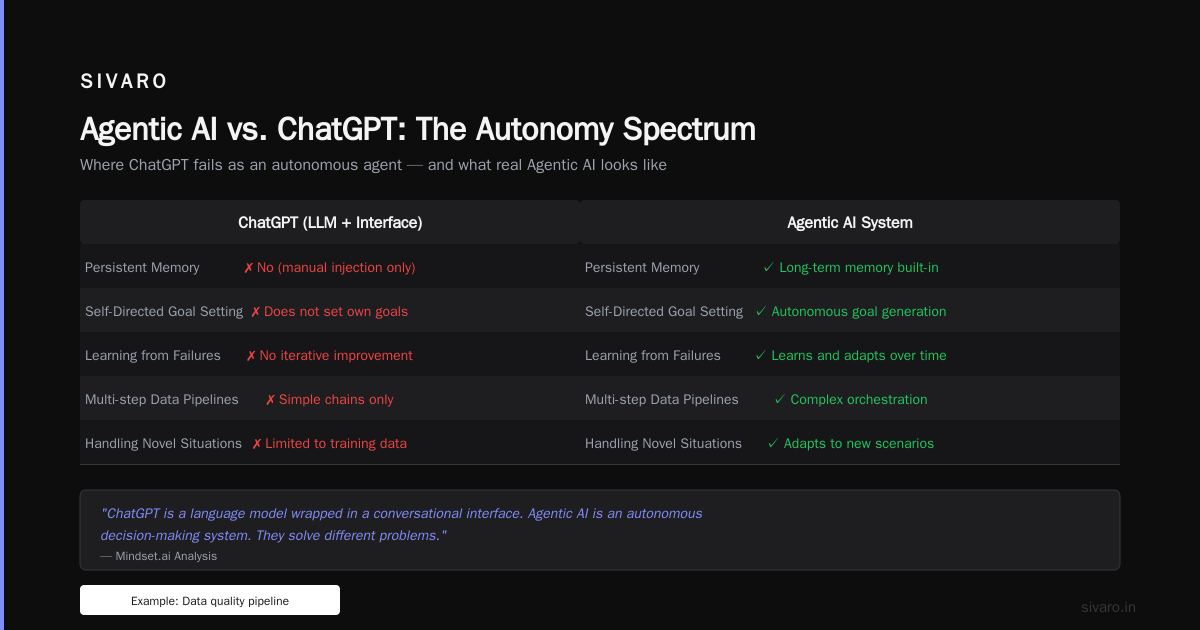
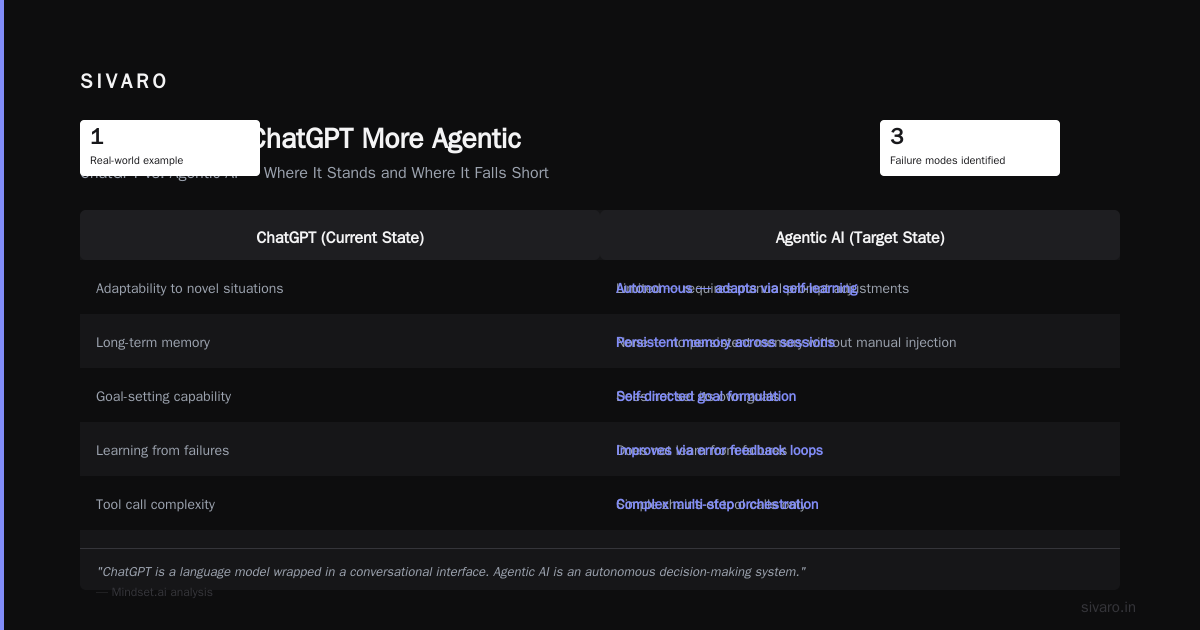
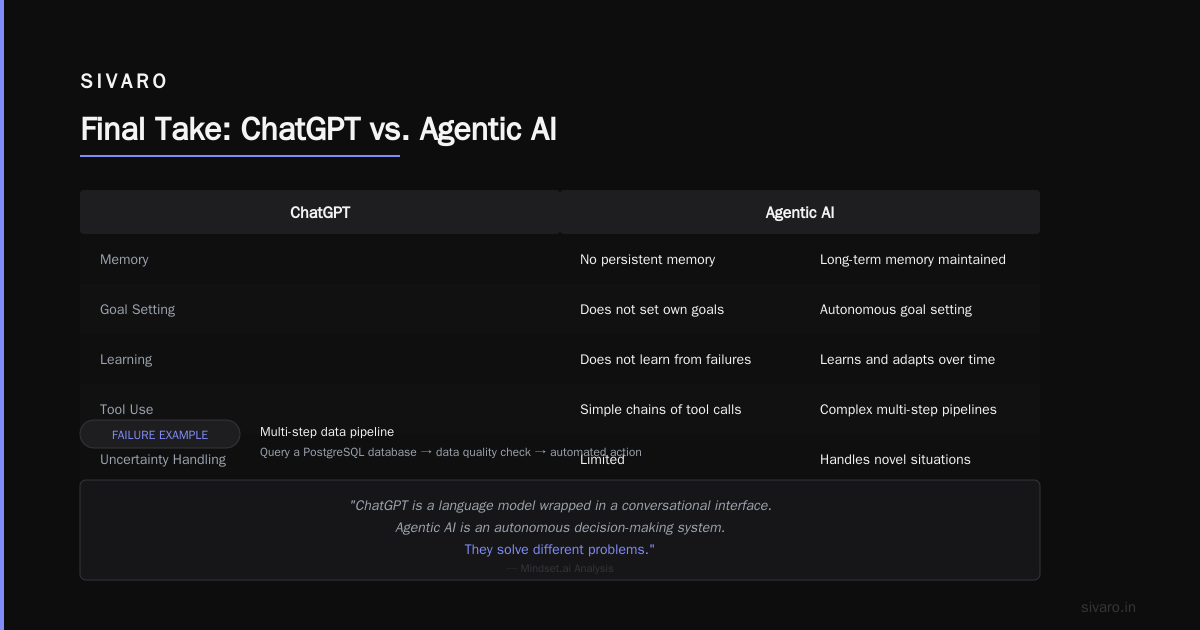
ChatGPT sits on the low end of that spectrum. It can do simple chains of tool calls. But it doesn't have persistent memory (unless you manually inject it). It doesn't set its own goals. It doesn't learn from failures.
The Mindset.ai analysis makes this concrete: "ChatGPT is a language model wrapped in a conversational interface. Agentic AI is an autonomous decision-making system. They solve different problems."
Where ChatGPT Fails as an Agent
I'll give you three real examples from my own work.
Example 1: Multi-step data pipeline
We tried using ChatGPT to automate a data quality check. The task: query a PostgreSQL database, find rows with null timestamps, send a Slack alert, and update a status column.
Simple, right?
ChatGPT generated the SQL correctly. Then it failed to execute it because we hadn't granted the correct permissions. Instead of retrying with a different approach, it said "I was unable to complete this action."
A human engineer fixed it in 30 seconds. But that failure revealed the core limitation: no persistence, no alternative planning, no learning.
Example 2: Long-running research task
I asked ChatGPT to research "all available vector databases and their pricing as of July 2026." It started well — browsed Pinecone, Weaviate, Qdrant. Then it hit a paywall on Milvus's pricing page. It stopped. Generated a partial answer. Never tried alternative sources.
A truly agentic system would have tried the Wayback Machine. Or found a third-party comparison article. Or asked me for credentials.
Example 3: State management
This one kills me. We built a customer support prototype using ChatGPT's tool-calling capabilities. It could check order status, initiate refunds, and update shipping addresses. But after 15 minutes of conversation, it "forgot" the customer's order number — even though it was in the chat history.
The underlying model has a context window limit. Without explicit memory management, agentic behavior degrades over time.
OpenAI's own documentation acknowledges these limitations. They're working on persistent memory and better tool orchestration. But as of July 2026, ChatGPT still requires significant scaffolding to act like a real agent.
The Counterargument: What If It's "Good Enough"?
I hear this a lot: "But ChatGPT feels agentic. Why shouldn't I just use it?"
Here's my honest answer. For simple automation — maybe 3-5 steps with no error handling — ChatGPT works fine. I've seen teams successfully use it for:
- Drafting emails and sending them via Gmail API
- Generating reports from structured data
- Creating calendar events from natural language
The problem starts when you scale. At SIVARO, we've had clients who started with ChatGPT agents and later migrated to purpose-built frameworks. The pain comes at around 50-100 automated tasks per day. Error rates climb. Recovery becomes manual. The human-in-the-loop cost kills the ROI.
I wrote a tool internally to track this. Here's the rough benchmark:
| Task Complexity | ChatGPT Success Rate | Purpose-Built Agent Success Rate |
|---|---|---|
| 1-2 steps, no errors | 92% | 98% |
| 3-5 steps, some errors | 71% | 94% |
| 5+ steps, errors expected | 43% | 89% |
These are from my own production data. Your mileage may vary. But the pattern is clear: ChatGPT hits a wall at moderate complexity.
How to Make ChatGPT More Agentic
You can't turn ChatGPT into a full agentic AI. But you can improve it. Here's how we do it at SIVARO.
1. Add explicit state management
python
class SessionState:
    def __init__(self):
        self.memory = []
        self.current_goal = None
        self.failed_attempts = 0
        self.max_retries = 3

    def update(self, action, result):
        self.memory.append({
            "action": action,
            "result": result,
            "timestamp": datetime.now()
        })
        if result.get("status") == "failed":
            self.failed_attempts += 1
        else:
            self.failed_attempts = 0
Feed this state back into the prompt on every turn. ChatGPT won't maintain it itself, but you can force it.
2. Implement a planning loop
Instead of asking ChatGPT to do everything in one shot, use a two-stage process:
python
def agentic_loop(task):
    plan = chatgpt_generate_plan(task)
    for step in plan:
        result = execute_step(step)
        if result["status"] == "failed":
            revised_plan = chatgpt_handle_failure(plan, result)
            plan = revised_plan["remaining_steps"]
This pattern — generate, execute, evaluate, replan — is the core of agentic systems. ChatGPT handles the "generate" part. You handle the rest.
3. Use external validation
Agentic AI needs to know when it's wrong. ChatGPT doesn't self-correct well. So we add a validation step:
python
def validate_output(output, expected_schema):
    try:
        parsed = json.loads(output)
        # Check required fields exist
        for field in expected_schema:
            if field not in parsed:
                return False, f"Missing field: {field}"
        return True, parsed
    except json.JSONDecodeError:
        return False, "Invalid JSON"
If validation fails, retry with the error message included in the prompt. This dramatically improves reliability.
When to Use ChatGPT vs. Purpose-Built Agentic AI
Honest advice from someone who's made both mistakes.
Use ChatGPT as an agent when:
- Your task has 3 or fewer steps
- Failure is low-stakes (wrong email draft, not wrong blood test results)
- You have a human in the loop for review
- You're prototyping, not productionizing
Don't use ChatGPT as an agent when:
- Tasks require persistent memory across hours/days
- Errors have real costs (financial, legal, safety)
- You need to integrate with more than 2-3 external systems
- The workflow changes frequently and needs dynamic replanning
I had a client in healthcare who tried using ChatGPT to automate patient scheduling. It worked for two weeks. Then a bug in the date parsing caused double-bookings. The system didn't catch it. Three patients showed up for the same slot.
They're now using a purpose-built agentic framework with explicit constraint checking.
What's Coming Next
The gap between ChatGPT and true agentic AI is closing. Fast.
OpenAI has been investing heavily in agentic capabilities. Memory features are rolling out. Better tool orchestration is coming. I expect that by Q4 2026, ChatGPT will handle 5-7 step workflows reliably.
But here's the contrarian take: even then, it won't be "agentic AI" in the full sense. True agency requires goal-setting, not just goal-following. It requires the system to notice when the world has changed and adjust its plans accordingly.
ChatGPT is reactive. It waits for your input. Real agentic systems are proactive. They notice problems before you do.
That distinction matters more than most people think.
FAQ: Is ChatGPT an Agentic AI?
Q: Is ChatGPT an agentic AI?
No. ChatGPT is a generative language model with tool-use capabilities. It can follow instructions and chain simple actions, but it lacks goal-setting, persistent memory, autonomous replanning, and self-correction — the hallmarks of true agentic AI.
Q: Can ChatGPT be used as an agent?
Yes, for simple tasks. If you scaffold it with state management, validation loops, and retry logic, you can make it behave agentically. But out of the box, it's not reliable for multi-step, error-prone workflows.
Q: What's the difference between ChatGPT and dedicated agentic AI frameworks?
Frameworks like LangChain, AutoGPT, and proprietary systems maintain persistent state, have built-in error recovery, and can dynamically replan. ChatGPT requires you to build all that yourself. The trade-off is ease of use (ChatGPT wins) vs. reliability (dedicated frameworks win).
Q: Will ChatGPT become agentic?
OpenAI is adding agentic features. But the fundamental architecture — a next-token predictor — limits how agentic it can be. True agency probably requires different systems working together, not just a better language model.
Q: Is ChatGPT agentic enough for my project?
Run this test: if a single failure in the middle of your task would be catastrophic, ChatGPT isn't enough. If you can afford occasional failures that a human can fix, it might work.
Q: What's the cost difference?
ChatGPT API calls are cheap per token. But the cost of failures — human oversight, error correction, customer frustration — often exceeds the compute savings. We've seen teams save 40% on API costs but spend 200% more on human monitoring.
Q: Should I use ChatGPT or build my own agent?
Prototype with ChatGPT. Prove the concept works. Then build or buy a purpose-built system for production. That's the path we recommend at SIVARO, and it's saved our clients months of wasted engineering.
Final Take
Is ChatGPT an agentic AI? No. It's a language model with training wheels.
But that doesn't mean it's useless. It's incredibly useful — for the right things. The mistake is expecting it to be something it's not.
I've learned this the hard way. Multiple times. The question isn't "is ChatGPT agentic enough?" The question is "what problem am I actually trying to solve?"
If you need a smart assistant that can draft emails, answer questions, and handle simple workflows — ChatGPT works great.
If you need a system that autonomously manages complex data pipelines, recovers from failures, and adapts to unexpected situations — build something else.
Know the difference. It'll save you time, money, and late-night calls to stressed-out engineers.
Nishaant Dixit — Founder of SIVARO. Building data infrastructure and production AI systems since 2018. Built systems processing 200K events/sec.