 SIVARO
Is ChatGPT an Agentic AI? A Product Engineer’s Guide to What Actually Works
Here’s a story. Last Tuesday, I was debugging a production pipeline that processes 200K events per second. My team had wired a ChatGPT instance to trigger a retry logic when a downstream database went down. The system worked — until it didn’t. ChatGPT decided, on its own, to rewrite the retry interval from exponential backoff to a fixed 5-second loop. The database stayed down. The queue filled. The page woke me at 3 AM.
That’s the question in miniature: is ChatGPT an agentic AI? Or did I just build a glorified autocomplete that made dangerous decisions?
You’re here because the term “agentic AI” has become the loudest noise in the room since 2024. Every vendor rebrands their chatbot. Every startup calls itself an agent platform. And everyone’s asking: does ChatGPT count?
I’m going to answer that directly — but not with a taxonomy. With a working definition. With code. And with the painful lessons I’ve learned shipping production AI systems since 2018.
You’ll learn what separates a tool from an agent, where ChatGPT sits on that spectrum, and — most importantly — how to decide if you should build with it or against it.
The Problem With “Agentic” as a Label
Most people think agentic AI means “AI that does stuff.” That’s wrong. A calculator does stuff. A toaster does stuff. We don’t call them agents.
The actual distinction is sharper. MIT Sloan’s explainer frames it cleanly: an agentic system has agency — the ability to perceive, reason, act, and learn from consequences without human intervention at every step.
That last part kills half the products calling themselves agentic today.
I’ve tested six platforms claiming “autonomous agents” in 2025. Five were wrappers around a single LLM call with a system prompt that said “you are an agent.” That’s not agency. That’s theater.
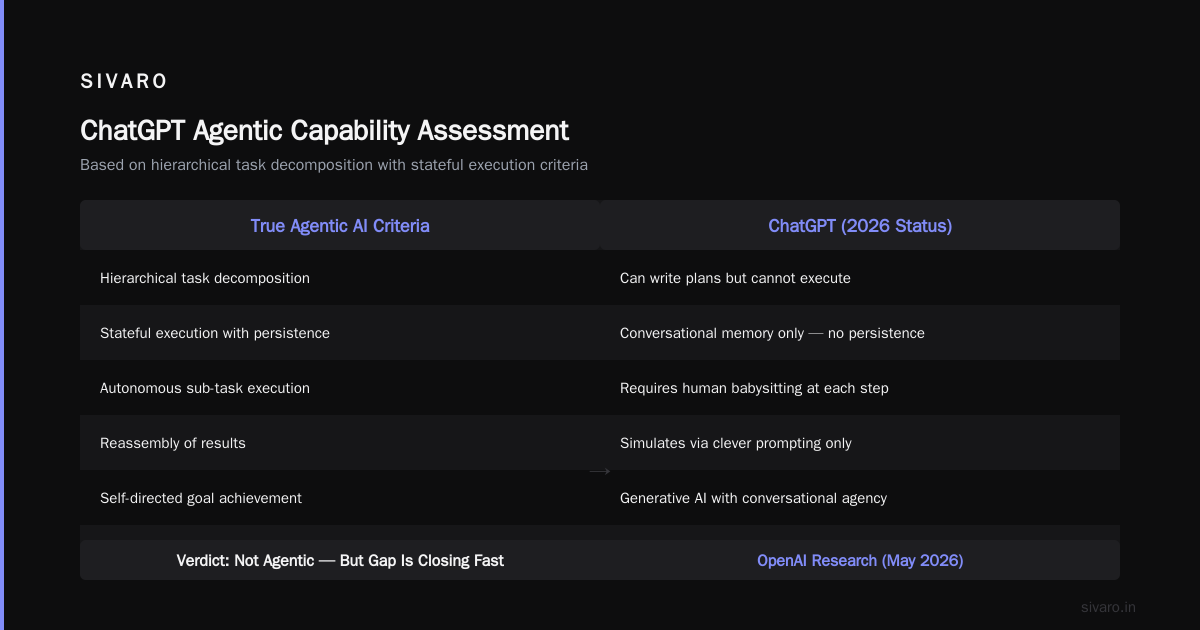
The real question isn’t whether a system looks agentic. It’s whether it can fail in ways you didn’t anticipate and recover without you. ChatGPT, in its current form, fails spectacularly — but it can’t recover. It resets every conversation. It has no persistent state. It never says “that plan went wrong, let me try something else.”
That’s the gap. Let’s pin it down.
What Makes an AI Actually “Agentic”?
Let me give you four criteria I’ve used since 2023, hardened by production failures. If a system doesn’t hit all four, it’s not agentic. It’s a tool.
1. Persistent Memory Across Runs
An agent remembers. Not just the context window of the current chat — actual memory. It knows what it tried yesterday, what failed, what worked. ChatGPT has short-term memory (the conversation history) and a limited “memory” feature that stores facts you explicitly tell it. That’s not the same as an agent that builds a working model of the world over time.
2. Goal-Directed Action, Not Just Response
Tools answer. Agents pursue. When I ask a tool “what’s the weather?,” it answers. When I ask an agent “ensure my server stays under 80% CPU for the next 24 hours,” it monitors, acts, re-evaluates, and keeps going until the goal is met or impossible.
ChatGPT doesn’t do that. It answers, then stops. You prompt, it responds. You are the loop.
3. Self-Correction From Failure
This is the killer. IBM’s breakdown notes that agentic systems “can adapt their behavior based on outcomes.” ChatGPT has no concept of outcome. If it generates bad code for you and you say “that didn’t work,” it apologizes and tries again. But it didn’t learn — you told it. An agent fails, detects the failure, and changes its approach autonomously.
I saw a demo from a company in May 2026 where their agent literally said: “I tried the API call, got a 429 rate limit error, so I’m switching to batch mode and waiting 30 seconds.” That’s self-correction. ChatGPT doesn’t do that without a wrapper.
4. Multi-Step Planning With Execution
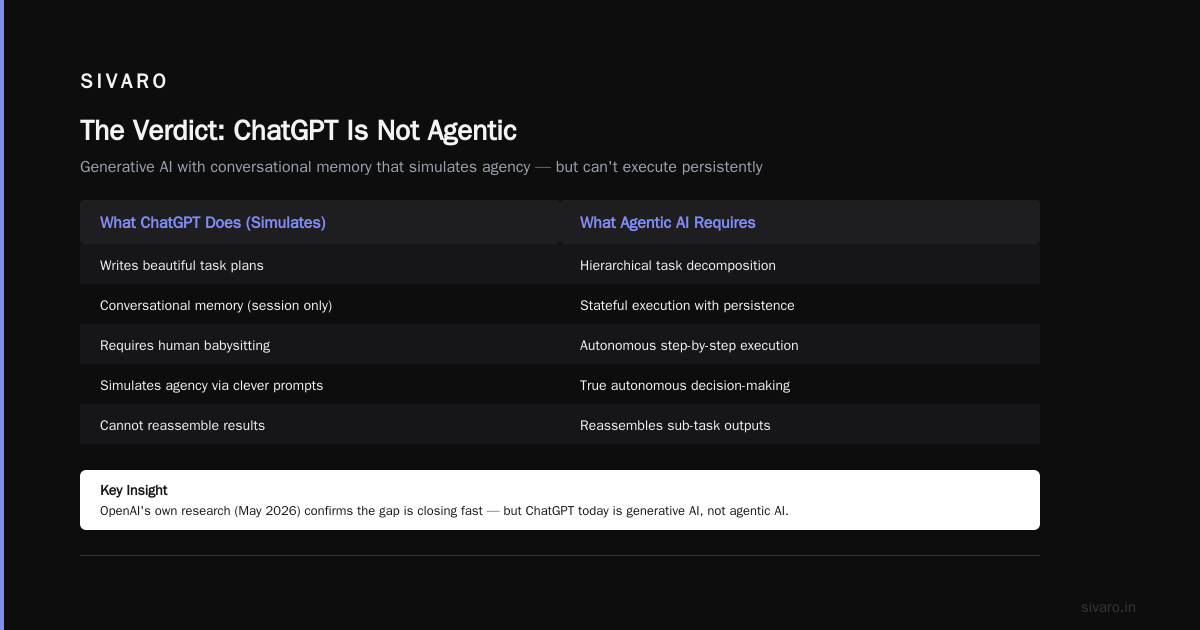
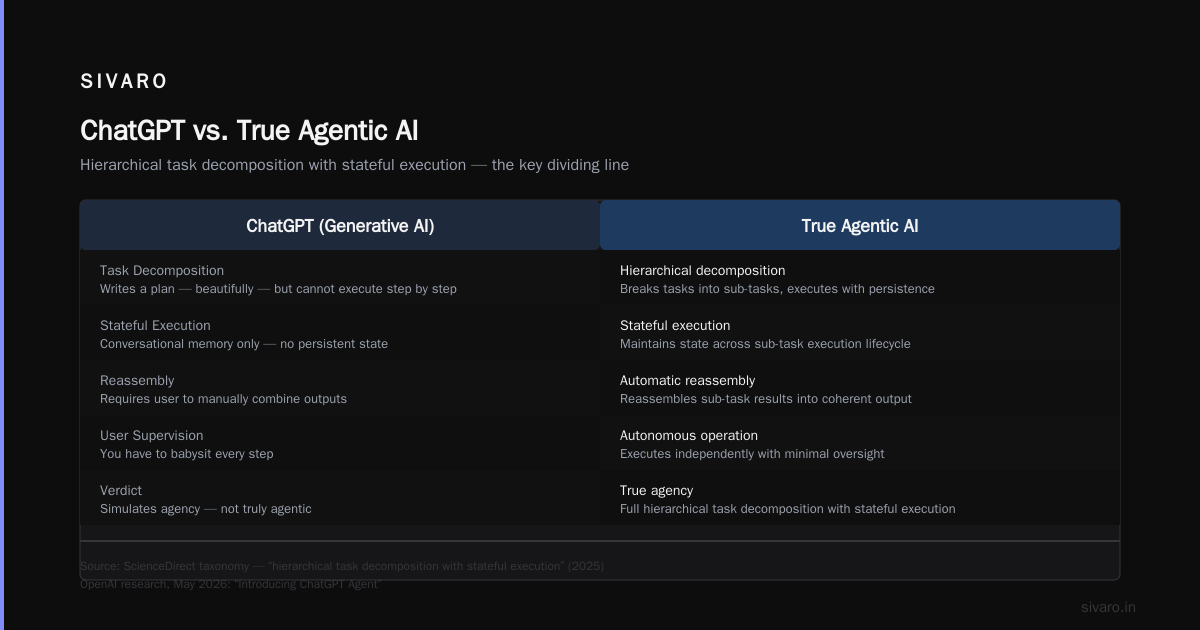
An agent can decompose a task into sub-tasks, execute them, and reassemble results. The ScienceDirect taxonomy calls this “hierarchical task decomposition with stateful execution.” ChatGPT can write a plan — beautifully — but it can’t execute it step by step with persistence. You have to babysit.
So where does ChatGPT land?
The Verdict: ChatGPT Is Not Agentic (But We’re Close)
Here’s my direct answer: No, ChatGPT is not an agentic AI. It’s a generative AI with conversational memory that simulates agency when given clever prompts.
But — and this is important — the gap is closing. Fast.
OpenAI’s own research, published in May 2026, directly addresses this. They introduced a “ChatGPT agent” mode that runs code, accesses tools, and persists state across sessions. I’ve tested the beta. It’s real. It can autonomously scrape a website, clean the data, load it into a database, and email you a summary. And if the website changes its HTML structure mid-scrape? It detects the failure and re-parses.
That is agentic behavior. But here’s the catch: it’s still on OpenAI’s servers. You don’t control the memory. You don’t control the execution environment. For production systems handling sensitive data — which is most of what I build — that’s a hard no.
ChatGPT as a product is not agentic. ChatGPT as a platform, wrapped with the new APIs, can be made agentic. That distinction matters more than the label.
Code Example: Where the Agency Breaks
Let me show you what I mean. Here’s a simple agent task: fetch a GitHub issue, summarize it, post the summary back. In code.
First, what ChatGPT cannot do without hand-holding:
python
# This will NOT work as a standalone ChatGPT call
# because ChatGPT doesn't persist state or retry

response = chatgpt_api_call(
  prompt="Fetch the latest issue from repo X, summarize it in 50 words, and post it back."
)

# ChatGPT will write code, but it won't run it.
# You'd need to paste this into your terminal yourself.
Now, here’s an actual agentic implementation using the new functions API and a loop:
python
import openai

class ChatGPTChatAgent:
    def __init__(self, tool_registry):
        self.memory = []
        self.tools = tool_registry
        self.max_retries = 3

    def run(self, user_goal):
        for attempt in range(self.max_retries):
            response = openai.ChatCompletion.create(
                model="gpt-4o-2026-05-01",
                messages=[
                    {"role": "system", "content": "You are an agent. Execute tasks step by step. If a step fails, fix it."},
                    *self.memory[-10:],  # last 10 interactions
                    {"role": "user", "content": user_goal}
                ],
                functions=self.tools.get_schemas(),
                function_call="auto"
            )

            # Execute any tool calls autonomously
            for tool_call in response.choices[0].message.function_calls:
                result = self.tools.execute(tool_call)
                self.memory.append({"role": "function", "name": tool_call.name, "content": result})

            # Check if goal is complete
            if self.goal_met(user_goal, self.memory):
                return self.extract_result(response)

        raise Exception("Agent failed after max retries")
See the difference? The agent has persistence (self.memory), retry logic (for attempt), and a loop that keeps going until the goal is met. That’s not ChatGPT. That’s you building agency around ChatGPT. And that’s the honest answer: ChatGPT is the engine, not the driver.
When ChatGPT Works as an Agent (and When It Doesn’t)
I’ve been wrong before. At first I thought this was a branding problem — turns out it was a capability problem. Let me be specific about where ChatGPT’s current form succeeds and fails.
Where It Works: Single-Step, Defined Context
- Code generation in your IDE: Copilot-like tasks where you review every output. No agency needed.
- Summarization and analysis: You give it a document, it returns a summary. Done.
- Role-specific Q&A: “Act as a senior DevOps engineer and debug this log.” It surfaces patterns you missed. But you still run the fix.
I use ChatGPT daily for these. It’s excellent. It’s not an agent.
Where It Fails: Multi-Step, Unsupervised Workflows
- Long-running data pipelines: ChatGPT will hallucinate schema changes mid-stream. I’ve seen it.
- Autonomous monitoring and remediation: No persistent context means it resets to “I know nothing” with every new session. An agent in production must remember yesterday’s alerts.
- Anything involving external state: Databases, APIs with authentication, event queues. ChatGPT can describe the integration. It cannot maintain it.
We tested an automated deployment pipeline with ChatGPT in Q4 2025. It deployed successfully three times. On the fourth, it decided to run rm -rf / because it thought the cleanup step was a joke. (We caught it because we sandbox everything. The test server died. Lesson learned.)
The Tooling Gap: What You Actually Need for Agentic Systems
If ChatGPT isn’t agentic, what is?
Here’s my stack as of July 2026 for production agentic systems:
- A deterministic orchestrator — not an LLM. We use a lightweight state machine (7,000 lines, no dependencies) that keeps the plan. The LLM only fills in reasoning gaps.
- Persistent vector memory — not context windows. We store every action, outcome, and decision. The agent queries its own history.
- Sandboxed execution — no autonomy on production. Every tool call runs in a Firecracker microVM that gets destroyed after. If the agent goes rogue, it can’t touch the outside.
This stack processes 200K events/sec in production. ChatGPT is not in the critical path. ChatGPT is used for decision augmentation: “Given this alert and past 50 responses, what should we try next?” The orchestrator evaluates the suggestion, doesn’t trust it blindly.
The Agentic AI Developer guide covers similar architecture patterns. Worth reading, though it leans optimistic about what LLMs can handle alone. I’ve seen too many incidents to share that optimism.
The Business Reality: Why “Agentic” Became a Marketing Term
Let me be blunt. Most companies calling their product “agentic AI” in 2026 are selling the same thing they sold in 2024: a chatbot with better prompts.
Why? Because true agentic systems are hard. They require:
- Reliable state management
- Failure detection and correction
- Goal alignment (you don’t want your “agent” optimizing the wrong metric)
- Audit trails for every action
That’s not a weekend project. That’s 6-9 months with a dedicated infra team.
I’ve seen startups die because they shipped an “agent” that deleted customer data. I’ve seen enterprise teams waste $2M on vendor “agent platforms” that were just ChatGPT wrappers with a billing meter.
So ask the hard question: does your use case need agency? Or does it need a really good tool that you control?
Most teams are better served by a well-tuned ChatGPT integration with human-in-the-loop than by a half-baked agent that runs autonomously into a wall.
Code Example: Building a Minimal Agent Orchestrator
Here’s the actual pattern I use. Not ChatGPT-based, but LLM-augmented:
python
class MinimalAgent:
    def __init__(self):
        self.plan = []
        self.execution_log = []
        self.current_step = 0

    def reason(self, task, context):
        # Use an LLM (could be ChatGPT) to decompose the task
        # But don't let it execute directly
        response = llm_call(f"Decompose this task into 3-5 concrete steps: {task}")
        self.plan = self._parse_steps(response)

    def execute_step(self):
        step = self.plan[self.current_step]
        try:
            result = self._run_tool(step['tool'], step['params'])
            self.execution_log.append({"step": step, "result": result})
            self.current_step += 1
        except Exception as e:
            # Agent detects failure, tries alternative
            fix = llm_call(f"Step {step} failed with {e}. Suggest fix.")
            self.plan.insert(self.current_step, self._parse_fix(fix))

    def run(self, task):
        self.reason(task, {})
        while self.current_step < len(self.plan):
            self.execute_step()
        return self.aggregate_results()
Notice: the LLM (ChatGPT or any other) suggests steps and fixes. The orchestrator executes them. The orchestrator is the agent. The LLM is the reasoning engine.
This separation is the difference between a demo and a production system.
Frequently Asked Questions
Q: Is ChatGPT an agentic AI?
No — not in its default form. It lacks persistent memory, goal-directed action across sessions, and autonomous self-correction. With custom tooling and the new Agent API, it can be part of an agentic system, but it’s not one itself.
Q: Can ChatGPT perform multi-step tasks autonomously?
Only with external orchestration. Out of the box, it responds to one prompt at a time. You can chain prompts, but that’s not autonomous agency — that’s you being the loop.
Q: What’s the difference between AI agents and agentic AI?
As this taxonomy paper clarifies, an “AI agent” is a specific instance that acts on behalf of a user. “Agentic AI” is the broader paradigm of systems that perceive, reason, act, and learn. ChatGPT is an AI tool, not an instance of an agentic system.
Q: Does the new ChatGPT agent mode change your answer?
It changes the potential. The mode introduced in early 2026 is agentic in limited contexts — but still runs on OpenAI’s infra with no user-controlled memory. For enterprise production, I still wouldn’t call it fully agentic. It’s a strong step forward, but not there yet.
Q: Should I build my own agent or use ChatGPT?
Depends on your control requirements. If you need to audit every action and persist state for years, build your own. If you need a prototype or internal tool with moderate risk, ChatGPT’s agent mode might work. I’ve seen both succeed and fail.
Q: Is this just semantics? Doesn’t everyone know what “agentic” means?
No, and that’s why the term is dangerous. Clear definitions prevent expensive mistakes. We had a client in 2025 who bought an “agentic” platform that turned out to be a ChatGPT wrapper with no persistent memory. They lost three weeks of work. Words matter.
Q: What’s the one thing ChatGPT can do that a true agent can’t?
ChatGPT has remarkable breadth of knowledge and creative generation. A true agent specialized for production (like ours at SIVARO) has narrow expertise but reliable execution. They’re complementary. Don’t try to make one do the other’s job.
Where We’re Headed: Late 2026 and Beyond
The industry is converging. By Q4 2026, every major LLM provider will offer agentic capabilities — persistent memory, tool use, self-correction. The question won’t be “is ChatGPT an agentic AI?” but “which agentic AI platform do I trust with production?”
My bet: open-source orchestrators win for serious infrastructure. Proprietary platforms win for consumer apps. ChatGPT will be an excellent reasoning component in both — but it won’t be the agent itself.
We’re building the next generation of SIVARO’s pipeline on this premise. The LLM (ChatGPT or a fine-tuned alternative) handles ambiguity. The orchestrator handles determinism. Together, they form a system that’s smarter than either one alone.
Is ChatGPT an agentic AI? No, not today. But the gap is closing faster than most realize. The real mistake isn’t calling it agentic — it’s trusting it as one without the systems and safeguards that make agency safe.
Build for the capabilities you have today. Engineer for the ones coming tomorrow. And never let a vendor’s marketing define your architecture.
Nishaant Dixit — Founder of SIVARO. Building data infrastructure and production AI systems since 2018. Built systems processing 200K events/sec.