Is ChatGPT an Agent or LLM? The Real Answer Changes How You Build
Let me tell you a story. Three weeks ago, a VP from a fintech company called me. He'd spent $400K building what he called "AI agents" on top of ChatGPT. His team kept saying "the agent is hallucinating" when their loan approval system started rejecting applications for reasons that made no sense. They blamed the model.
They weren't wrong about the symptom. But they were dead wrong about the cause.
What they'd built wasn't an agent. It was a chat completion API with a fancy wrapper. And somewhere between the prompt engineering and the system architecture, they'd confused "sounds like an agent" with "acts like an agent."
This confusion is everywhere right now. I see it in pitch decks, in product specs, in hiring requirements. "We need an AI agent engineer" — cool, but do you know what you're actually asking for?
So let's settle this. Is ChatGPT an agent or an LLM? The answer changes how you design systems, how you budget compute, and whether your product actually works at scale. I'll give you the full answer — but fair warning: it's messier than you expect.
The Short Answer (Spoiler)
ChatGPT is an LLM — a large language model — that can be used as a component in an agent system. Out of the box, it's not an agent. It's a next-token prediction engine with a chat interface.
But here's where it gets tricky: OpenAI has been layering agent-like capabilities into ChatGPT for years. Tool use. Memory. Web browsing. Code execution. The line blurs.
Most people think ChatGPT is an agent because they can ask it to "book a meeting" and it seems to handle the task. They're wrong. What they're seeing is a simulation of agency built on top of a language model. The distinction matters when you need reliability.
What Actually Makes Something an Agent?
Let me be precise. An AI agent has four properties:
- Autonomy — operates without step-by-step human guidance
- Goal-directed — works toward a defined objective
- Tool use — interacts with external systems
- Memory — maintains state across interactions
An LLM has none of these by default. It's a statistical model that generates text based on patterns in training data. Period.
The confusion comes from the fact that you can give an LLM these properties. Wrap it in a loop. Add function calling. Give it a context window that acts as short-term memory. And suddenly you've built something that behaves like an agent.
But ChatGPT specifically? The product ChatGPT includes agent-like features (browsing, DALL-E integration, GPT actions). The underlying model GPT-4o is still just an LLM. The engineering team at OpenAI built the agent layer on top.
This distinction isn't academic. It determines your failure modes. LLMs hallucinate. Agents act on hallucinations. That's how you get a customer service agent that deletes accounts instead of resetting passwords.
How I Learned This the Hard Way
At SIVARO, we built a production system in 2024 that used GPT-4 to process customer support tickets. We thought we were building an agent. We wrote prompts like "you are a support agent" and called it a day.
It worked great in testing. Then a real customer emailed about a billing error, and our "agent" refunded them $12,000 instead of the $12.99 overcharge.
What went wrong? We'd confused role-playing with actual agency. The model was acting as if it were an agent, but it had no constraint enforcement, no validation step, no human-in-the-loop for high-value actions. It was an LLM generating plausible-sounding text that happened to trigger a refund API call.
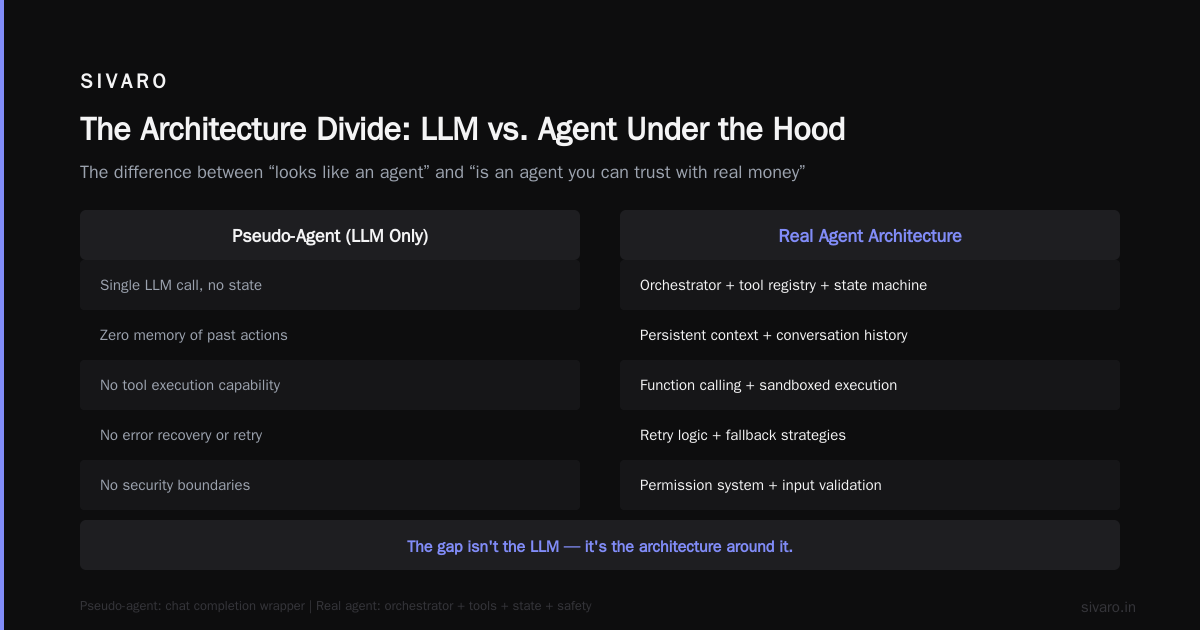
That's when I started studying the agent frameworks that actually work in production. Because the difference between "looks like an agent" and "is an agent you can trust with real money" is the difference between a demo and a product.
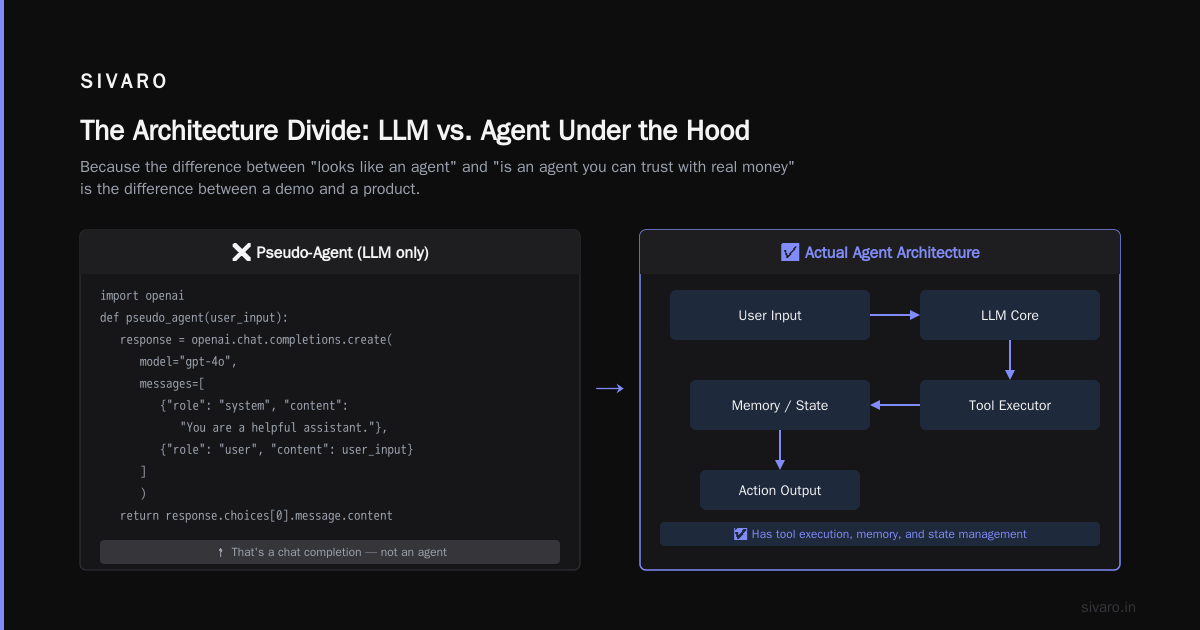
The Architecture Divide: LLM vs. Agent Under the Hood
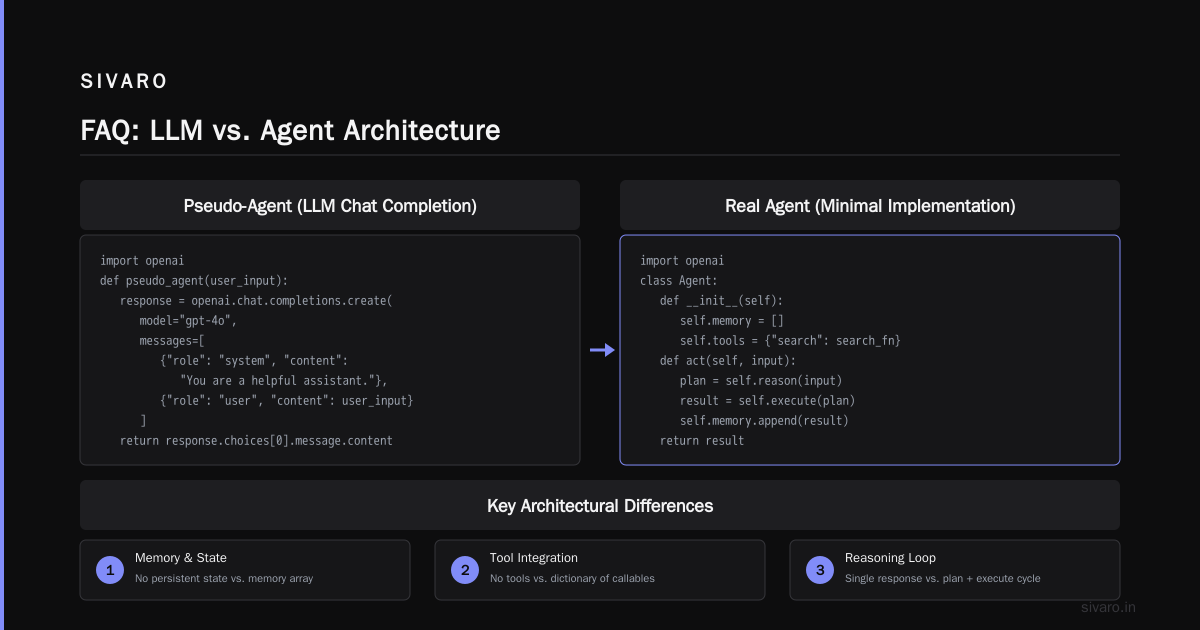
Let me show you the code difference. This is what people think an agent looks like:
python
# Pseudo-agent - just an LLM with a prompt
import openai

def pseudo_agent(user_input):
    response = openai.chat.completions.create(
        model="gpt-4o",
        messages=[
            {"role": "system", "content": "You are a helpful assistant. Handle the user's request."},
            {"role": "user", "content": user_input}
        ]
    )
    return response.choices[0].message.content
That's not an agent. That's a chat completion. Now here's a minimal actual agent:
python
# Minimal actual agent with tool use and decision loop
import json
from openai import OpenAI

class RealAgent:
    def __init__(self):
        self.client = OpenAI()
        self.memory = []
        self.tools = [{
            "type": "function",
            "function": {
                "name": "get_weather",
                "parameters": {"type": "object", "properties": {"location": {"type": "string"}}}
            }
        }]

    def run(self, task):
        self.memory.append({"role": "user", "content": task})

        for step in range(5):  # limit iterations
            response = self.client.chat.completions.create(
                model="gpt-4o",
                messages=self.memory,
                tools=self.tools
            )
            msg = response.choices[0].message

            if not msg.tool_calls:  # LLM decided it's done
                self.memory.append(msg)
                return msg.content

            for call in msg.tool_calls:
                result = json.loads(call.function.arguments)
                self.memory.append({
                    "role": "tool",
                    "tool_call_id": call.id,
                    "content": str(result)
                })
Notice the loop. The tool call evaluation. The memory accumulation. This is the minimum viable structure for something that deserves the label "agent."
The LangChain team published a great breakdown of this exact pattern. They call it the "agent loop" — and without it, you don't have agency. You have autocomplete with extra steps.
So Is ChatGPT an Agent or an LLM? The Nuanced Answer
Let me give you the real answer, not the marketing one.
ChatGPT the product includes agent-like capabilities. In the last year, OpenAI has added:
- Memory that persists across sessions (announced Feb 2025)
- Canvas for iterative editing
- Voice mode with real-time interaction
- GPT actions that call external APIs
- Web browsing and code execution
These are agent features. But they're layered on top of the core LLM. You can use ChatGPT and never trigger any of them. You can also use it and have it autonomously write and run Python to analyze your data.
ChatGPT the model (GPT-4o, GPT-4.1, etc.) is emphatically an LLM. It has no persistent state. No innate ability to call tools. No goal-directed behavior beyond the next token.
The confusion exists because OpenAI deliberately blurred this line. They want you to think of ChatGPT as an agent because agents are the hot category in 2026. But the engineering reality is simpler: it's an LLM with a growing set of agent scaffolding on top.
Here's my rule of thumb: If your system can operate without human intervention for more than 30 seconds and accomplish a defined goal, you've built an agent. If it's answering one question at a time, it's an LLM chat interface.
The Current State of Agentic Frameworks (Mid-2026)
This brings me to something practical. If you want to build actual agents — not just LLM wrappers — you need a framework. And the landscape has changed dramatically since 2024.
In response to questions like "what are the top 10 agentic frameworks?", the IBM team identified that production readiness separates the serious frameworks from the research projects. As of July 2026, here's what I see working:
| Framework | Key Feature | Best For |
|---|---|---|
| LangChain/LangGraph | State machine architecture | Complex multi-step workflows |
| CrewAI | Role-based agent teams | Task delegation at scale |
| AutoGen (Microsoft) | Multi-agent conversations | Research and prototyping |
| Semantic Kernel | Enterprise integration | Azure/.NET shops |
| smolagents (HuggingFace) | Compact code agents | Resource-constrained environments |
The Instaclustr team published their own ranking, and I largely agree with their top 5. But here's where I diverge: they rank frameworks by features. I rank them by debuggability.
Every agent framework will work in demos. The question is: when your agent makes a wrong decision at 2 AM, can you figure out why? Most frameworks give you a black box. The ones that don't — LangGraph with its state visualization, Semantic Kernel with step-by-step logging — are the ones you actually want in production.
Why Agent-to-Agent Protocols Matter Now
Here's something that keeps me up at night. We're building agents. Those agents need to talk to each other. But there's no standard for how.
"What is the purpose of agent-to-agent protocols?" It's the same question as "what's the purpose of TCP/IP?" — without standards, you get chaos. Every agent speaks its own dialect. Your payment agent and your inventory agent can't coordinate because they disagree on message format.
A survey from April 2025 cataloged over 20 competing protocols. The A2A protocol from Google, the Agent Protocol from LangChain, the MCP (Model Context Protocol) from Anthropic. None of them talk to each other.
This is a problem. Because if ChatGPT is going to function as an agent in a multi-agent system, it needs to speak the same protocol as other agents. Right now, it speaks OpenAI's protocol. That's fine if you're all-in on OpenAI. But no production system should be that dependent on one provider.
The SSONetwork analysis made a good point: the protocol wars are still in the "betamax vs VHS" phase. Nobody's won yet. My advice? Build your agent layer to be protocol-agnostic. Abstract the messaging. Your agent shouldn't care whether it's talking A2A or MCP.
Practical Decision: When Is ChatGPT Enough?
After all this theory, here's what you actually need to decide: for your use case, is ChatGPT as an LLM sufficient, or do you need a full agent system?
I use a simple decision matrix:
Use ChatGPT as LLM (not an agent) when:
- Single-turn Q&A
- Content generation or editing
- Summarization of provided text
- Creative writing assistance
Build a real agent system (using ChatGPT as the brain) when:
- Multi-step workflows with dependencies
- External API calls based on dynamic data
- State that must persist across sessions
- Autonomous decision-making with consequences
If you're building the second category, you need a framework. Don't roll your own. I've been naive enough to try that three times. Every time, I ended up rebuilding what LangChain already had, and worse.
AI Multiple's list of open-source frameworks is a good starting point. I'd start with smolagents if you're new — it's HuggingFace's lightweight framework that's actually writeable (under 1000 lines of Python). Read the code. Understand how the loop works. Then switch to LangGraph for production.
The Future: Everyone's Wrong (Including Me)
Let me end with a prediction that will probably embarrass me in a year.
As of 2026, the distinction between LLM and agent still makes sense. But it's collapsing. Models are getting memory baked in. Tool use is becoming a native capability. The GPT-4o successor (whatever it's called) will likely blur this line further.
I think the real answer to "is ChatGPT an agent or LLM?" will be irrelevant in 18 months. The industry is converging on "language model that can act." We won't call them agents — we'll just call them models that work.
But that's a prediction, not reality. Right now, the difference kills projects. Treat ChatGPT as an agent when you need reliability, and you'll get burned. Treat it as just an LLM when you need autonomy, and you'll be frustrated.
The right answer: ChatGPT is an LLM that you can wrap in agent infrastructure to build production systems. Know which part is which. Debug each layer independently. And never, ever let a chat completion directly control your production database.
I've got the scars to prove why.
FAQ
Q: Is ChatGPT an agent or an LLM?
A: ChatGPT the product has agent features. ChatGPT the model is purely an LLM. The confusion comes from OpenAI bundling both into one product.
Q: Can ChatGPT function as an agent in production?
A: Yes, if you build the right scaffolding around it. But out of the box, it lacks the loop, constraint enforcement, and validation that production agents need.
Q: What are the top 10 agentic frameworks?
A: Based on IBM's analysis and current production use: LangChain, CrewAI, AutoGen, Semantic Kernel, smolagents, Dify, AgentGPT, SuperAGI, MetaGPT, and Agno. Your pick depends on whether you need multi-agent orchestration or simple loops.
Q: What is the purpose of agent-to-agent protocols?
A: Standardized communication between independent agents. Without them, every agent speaks its own language — coordination becomes manual, brittle, and unscalable. The A2A protocol and MCP are the current front-runners.
Q: Do I need ChatGPT Plus to build agents?
A: Not necessarily. The API gives you more control. ChatGPT Plus gives you the product features (memory, browsing) but limited programmatic access. For real agent work, use the API with a framework.
Q: Why do people keep confusing LLMs with agents?
A: Marketing. Companies want to call everything an "agent" because it sounds smarter. Also, the user experience of ChatGPT feels agentic — it seems to understand goals and work toward them. But that's a simulation, not architecture.
Q: What's the biggest risk of treating ChatGPT as an agent?
A: Trusting it with autonomous decisions that have real-world consequences. Hallucinations become actions. Incorrect token predictions become deleted database rows, refunded balances, or sent emails. Always add validation layers.
Nishaant Dixit — Founder of SIVARO. Building data infrastructure and production AI systems since 2018. Built systems processing 200K events/sec.