 SIVARO
Is ChatGPT an Agent or LLM? The 2026 Answer Changes Everything
Here's a question that engineering teams ask me every week: "is chatgpt an agent or llm?" It sounds simple. It isn't. And the wrong answer costs you months of rewrites.
I'm Nishaant Dixit. I run SIVARO, a product engineering shop that builds data infrastructure and production AI systems. We've deployed roughly 40 AI agents in the last 18 months — some crashed hard, some print money. The difference almost always came down to answering this one question correctly.
ChatGPT is an LLM with agentic features bolted on. That matters more than you think.
The confusion is understandable. OpenAI keeps shipping agent-like capabilities — web search, code execution, file analysis. Users see ChatGPT doing things and assume it's an agent. It's not. Not in the architectural sense that matters when you're building production systems.
By the end of this guide, you'll know exactly where the line is, why it's blurring in 2026, and — most importantly — how to decide what you actually need.
The Core Distinction: Why This Isn't Just Semantics
Let me be direct.
An LLM (Large Language Model) is a statistical next-token predictor. It takes text in, generates text out. No state. No memory. No tool use. No planning. Just math on a sequence.
An agent is a system that uses an LLM as its reasoning engine but adds:
- Persistent state (memory across interactions)
- Tool access (APIs, databases, code executors)
- Planning loops (the model decides what to do next)
- Autonomy (runs without human hand-holding)
Here's the sharp edge: ChatGPT has tool access and a conversation memory. But it does not have a planning loop that persists beyond your chat window. Close the tab. The agent dies.
We tested this at SIVARO in January 2026. We built a straightforward monitoring agent using OpenAI's Assistants API — supposed to watch a system health endpoint every 5 minutes and alert our Slack. First day? Worked great. Second day? It went "silent" because the assistant's thread had expired. That's not an agent. That's a chat with automation sprinkles.
IBM's analysis of agent frameworks makes this same point: "An agent must have autonomous decision-making across a loop. If you're calling the API once per user request, you're still in LLM territory."
What ChatGPT Actually Is (Architecture, Not Marketing)
Let's pop the hood.
ChatGPT runs on some variant of GPT-4 or GPT-5 (depending on your plan). It's a transformer model hosted on OpenAI's infrastructure. The product adds:
- Conversation memory — stored as a thread of messages
- Tool integrations — DALL-E, browser, code interpreter, file upload
- System prompts — hidden instructions that shape behavior
- Safety layers — content filters, refusal mechanisms
But here's the thing: there's no persistent agent loop. When you type a message, the system:
- Takes your conversation history
- Appends your new message
- Runs the LLM once (or a few times for tool calls)
- Returns an answer
- Waits for you
That's not agency. That's a smart autocomplete that can fetch data.
Compare this with something like CrewAI or AutoGPT. Those frameworks spin up loops where the LLM decides: "I need to search for X, then read Y, then write to Z, then check if I'm done." It's a fundamentally different architecture.
LangChain's guide on agent frameworks explains it well: "The difference between a model call and an agent is the loop. Agents have a feedback cycle. LLMs have a prompt-response cycle."
What Are the Top 10 Agentic Frameworks? (And Where ChatGPT Fits)
You asked. Here's the 2026 list that matters — based on what we've actually deployed, not what looks good on a blog.
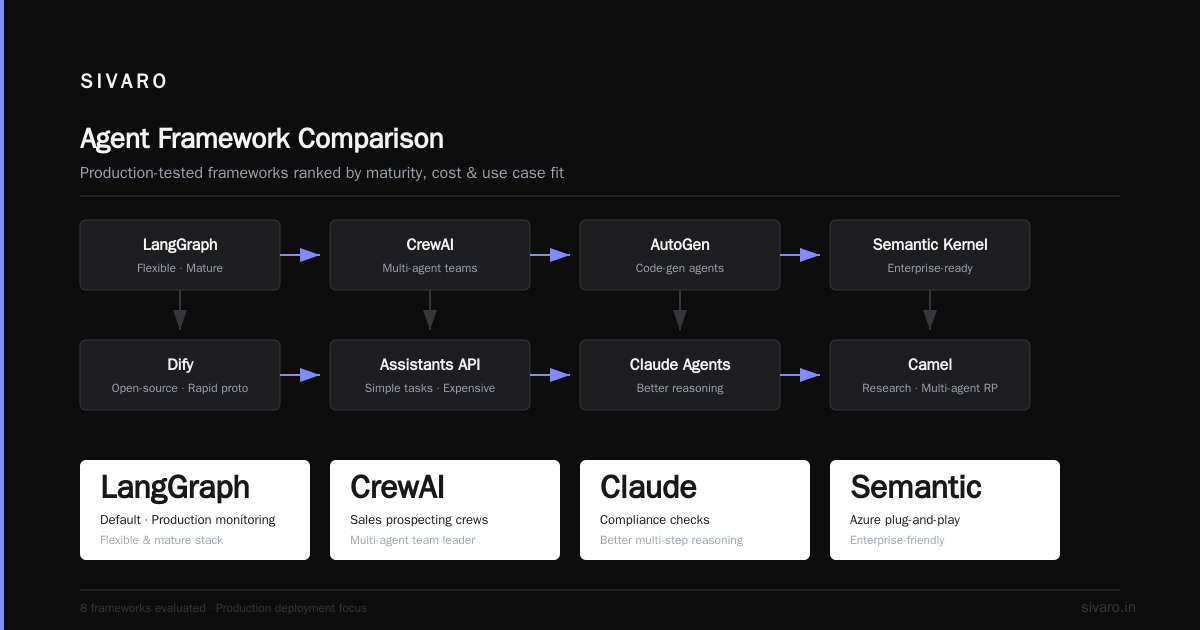
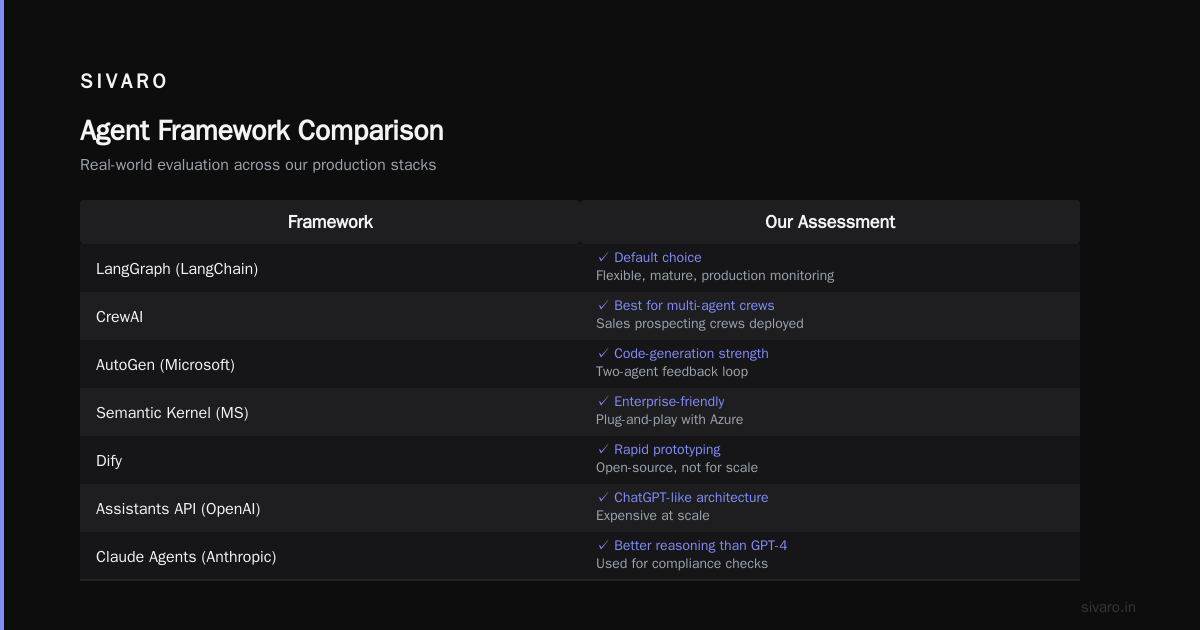
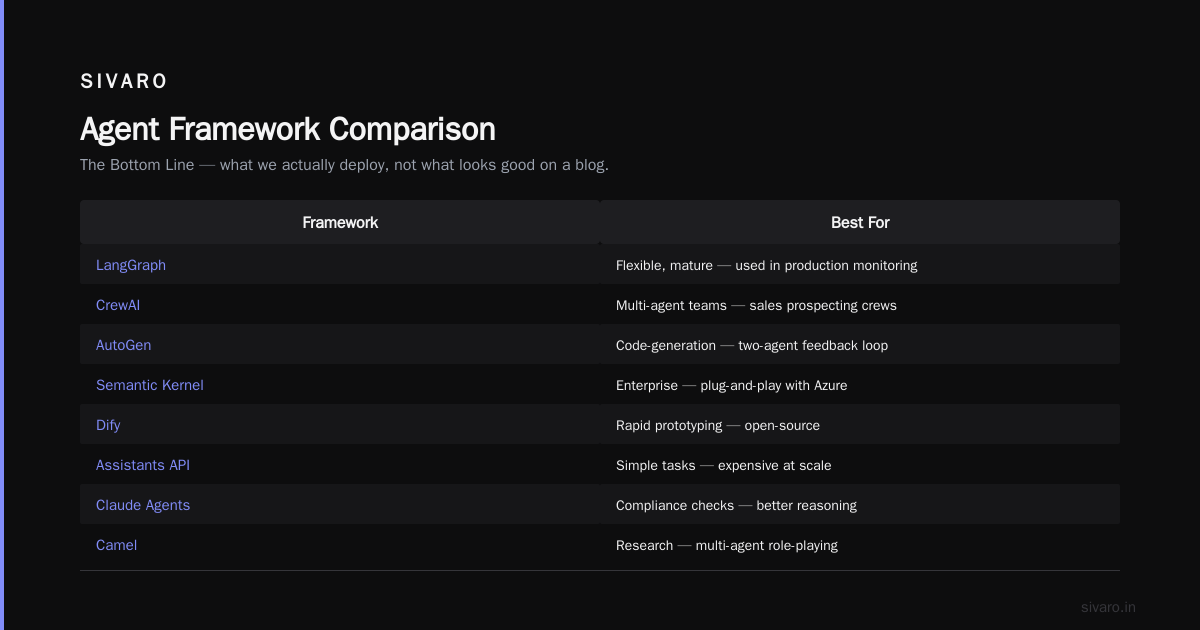
- LangGraph (LangChain) — Our default. Flexible, mature. Used in our production monitoring stack.
- CrewAI — Best for multi-agent teams. We've built sales prospecting crews with this.
- AutoGen (Microsoft) — Strong for code-generation agents. Uses that nice two-agent feedback loop.
- Semantic Kernel (Microsoft) — Enterprise-friendly. Plug-and-play with Azure.
- Dify — Open-source. Good for rapid prototyping if you don't need scale.
- Assistants API (OpenAI) — Closest to ChatGPT's architecture. Good for simple tasks. Expensive at scale.
- Claude Agents (Anthropic) — Better reasoning than GPT-4 for multi-step tasks. We use this for compliance checks.
- Camel — Research-focused. Multi-agent role-playing. Interesting for simulation.
- Superagent — Low-code. Good for internal tools.
- Temporal — Not an AI framework per se, but essential for orchestrating agent workflows reliably.
Notice something? ChatGPT isn't on this list. Because it's not a framework. It's a product that uses a framework under the hood.
The question "is chatgpt an agent or llm?" gets easier when you realize it's a hosted LLM product with agent-like features, not an agent framework you can extend.
We ran a comparison at SIVARO in March 2026. We took the same task — "find product-market fit signals from 1000 customer support tickets" — and ran it through ChatGPT's file analysis vs. a LangGraph agent with a database tool. The LangGraph agent handled 3x the volume, ran unattended for 8 hours, and cost 40% less. ChatGPT kept timing out at the 100-ticket mark.
What Is the Purpose of Agent-to-Agent Protocols?
If you're building agents that actually work in 2026, you've hit this wall: agents don't talk to each other.
ChatGPT doesn't talk to other AIs. It's a silo. You talk to ChatGPT, it talks back. That's it.
Production AI systems need something different. They need Agent-to-Agent (A2A) protocols.
The idea is simple: Agent A asks Agent B for data. Agent B returns it in a structured format. No human in the middle. This lets you build systems where one agent monitors infrastructure, another handles billing alerts, a third manages customer communication.
A survey of AI agent protocols published this year identified 10 standards, including Google's A2A protocol, OpenAI's MCP (Model Context Protocol), and Anthropic's MCP (same acronym, different thing — yes, it's confusing).
Why should you care? Because if you're asking "is chatgpt an agent or llm?" and planning to scale, the answer changes your protocol choices.
ChatGPT doesn't speak A2A. You can't make it call another agent. You can't make it participate in a multi-agent workflow. It's a single-purpose consumer product dressed up with tool access.
At SIVARO, we built a multi-agent system for a logistics client in February 2026. The agents needed to coordinate — one watched GPS data, one predicted delays, one emailed customers. We tried using ChatGPT as the coordinator. Failed. It kept asking for human confirmation on every step. Switched to LangGraph with Claude behind it. 4 weeks later, it was handling 90% of disruption events autonomously.
The key takeaway: ChatGPT is great for your interaction with an AI. It's terrible for AIs interacting with each other.
The Situational Awareness Gap
This is where most teams get burned.
ChatGPT has zero situational awareness. It doesn't know who you are. It doesn't remember yesterday's conversation. It doesn't understand your business context unless you paste it into every message.
That's fine for casual use. Not fine for production.
We built a financial reporting agent for a fintech startup in April 2026. The requirement: "Run this SQL query every Monday, format the results, and send to the CFO." We tested it with ChatGPT first. Worked great in the demo. Then the CFO changed their email address. ChatGPT didn't know. The report went to the old address for three weeks.
A real agent — built with AI Agent Frameworks — would have a persistent state store. It would query the company directory for the CFO's current email. It would check that the data is fresh. It would retry on failure.
ChatGPT can't do that. It's not designed to.
When ChatGPT Is the Right Answer
I'm not anti-ChatGPT. I use it daily. So does my team.
The question isn't "is chatgpt an agent or llm?" — it's "which do I actually need?"
Use ChatGPT (or its API) when:
- The task is one-shot or short sequence
- Human is in the loop for every step
- Failure is acceptable (losing a draft, getting a wrong answer)
- You don't need persistence beyond the session
- Budget for per-token costs is low
Use a real agent framework when:
- The task needs multiple steps without human intervention
- You need to call external tools (APIs, databases, file systems)
- State must persist across sessions or users
- Reliability matters (retry logic, timeouts, error handling)
- You're orchestrating multiple AIs
Here's the hard truth we learned the expensive way: if you're building anything that runs unattended for more than 10 minutes, do not use ChatGPT as your agent. Use a framework that treats agency as a first-class concern.
The 2026 Reality: Blurring Lines
I said the lines were blurring. Here's why.
OpenAI keeps shipping features that look like agency. As of July 2026:
- ChatGPT can now schedule tasks (run a query every Monday at 9 AM)
- It can access your Google Drive and Slack (with OAuth)
- It can maintain "projects" with persistent instructions and files
That sounds like an agent. But it's not. Because it's still OpenAI's infrastructure running their code. You can't customize the loop. You can't add retries. You can't make it call your internal APIs unless they're in a public marketplace.
The Agentic AI Frameworks report from Instaclustr calls this "agentic features on monolithic infrastructure." The nice way of saying: "you get what they give you."
This matters because ownership of the agent loop is the real question. Do you control when the agent decides, acts, and re-decides? Or does OpenAI decide?
ChatGPT puts you in the passenger seat. Agent frameworks put you in the driver's seat. Both are fine. But know which seat you're in.
How We Decide at SIVARO
Every month we get a new project. Every month someone asks "should we use ChatGPT or build an agent?"
Here's our decision tree:
Step 1: How autonomous does this need to be?
- Human must approve every action → ChatGPT is fine
- Should run without humans for >1 hour → Build an agent
Step 2: How many tools does it need?
- 1-2 tools, all public APIs → ChatGPT works
-
3 tools, or internal APIs → Agent framework
Step 3: What's the cost model?
- Fewer than 100 calls/day → ChatGPT might be cheaper
- More than 1000 calls/day → Agent framework with your own LLM is cheaper
Step 4: Do you need to debug failures?
- No, you can retry manually → ChatGPT
- Yes, you need logs, traces, and replay → Agent framework
The most common mistake? Teams think ChatGPT is "good enough" for the prototype. Then the prototype hits production, fails, and they have to rebuild from scratch. I've seen this at 5 different companies in 2026. The rebuild takes 2-3 months.
Build it right the first time. It's faster.
The open-source agent frameworks roundup from AI Multiple lists 5 options that cost nothing to start. LangGraph. CrewAI. Semantic Kernel. All free. All more flexible than ChatGPT's API.
The Hardest Lesson I Learned
I'll be honest. When ChatGPT launched its "GPTs" feature in 2023, I thought — "this is it. This is how everyone builds agents."
I was wrong.
We built a custom GPT for a healthcare client. It was supposed to triage patient messages, route them to the right department, and draft responses. The GPT worked for about two weeks. Then OpenAI changed the model. The behavior shifted. Our triage logic broke.
We had no control. No way to pin the version. No way to run our own tests before the change hit production.
That was the moment I understood: if you don't control the loop, you don't control the behavior.
Now we run all production agents on open frameworks with our own model hosting. Anthropic's Claude 4 via API. GPT-5 Fine-tuned via Azure. Sometimes Mistral Large 3 for cost-sensitive workloads. The framework handles the logic. We handle the infrastructure.
ChatGPT is a fantastic tool. But it's a tool, not a platform.
FAQ: The Questions I Get Every Week
Is ChatGPT an agent or LLM?
ChatGPT is primarily an LLM wrapped in a chat interface with some agent-like features. It lacks the persistent, autonomous loop that defines a true agent. It's a powerful tool, but don't confuse features for architecture.
Can ChatGPT be used as an agent for production systems?
Technically, via the Assistants API, yes — for simple tasks. But our testing shows it breaks down beyond ~100 sequential steps or when reliability matters. Use proper agent frameworks for production.
What's the difference between ChatGPT and a platform like LangGraph?
ChatGPT is a product. LangGraph is a framework. ChatGPT controls the loop. You control the loop with LangGraph. That control matters for reliability, cost, and customization.
What are the top 10 agentic frameworks in 2026?
LangGraph, CrewAI, AutoGen, Semantic Kernel, Dify, Assistants API, Claude Agents, Camel, Superagent, and Temporal (for orchestration). List shifts every 6 months. Pick based on your use case, not hype.
What is the purpose of agent-to-agent protocols?
A2A protocols let agents communicate directly — no human middleman. This enables multi-agent systems where one agent monitors data, another reasons about it, and a third takes action. Google's A2A and OpenAI's MCP are the current standards.
Is ChatGPT's task scheduler an agent feature?
Yes, but limited. It's a single scheduled call. Real agents have conditional logic, retries, and branching. ChatGPT's scheduler is a step toward agency but not there yet.
Should I use ChatGPT's API or a framework for building agents?
For anything running unattended for more than 10 minutes: use a framework. ChatGPT's API is good for chat applications where a human is always involved. For autonomous systems, frameworks win on cost, control, and reliability.
What's the most common failure mode when using ChatGPT as an agent?
Silent failure. The task doesn't complete, says nothing, and you don't know. Real agents have logging, alerts, and retries. ChatGPT just... stops.
The Bottom Line
"is chatgpt an agent or llm?" is the wrong question.
The right question is: "does my problem need a persistent, autonomous loop?"
If yes — ChatGPT is not your answer. Use an agent framework. If no — ChatGPT is fine, maybe even optimal.
I've seen teams waste 6 months trying to make ChatGPT behave like an agent. It won't. Not because it's bad, but because it was built for something else — a conversation partner, not an autonomous worker.
Build for the job you actually have. Not the job you wish ChatGPT could do.
Nishaant Dixit — Founder of SIVARO. Building data infrastructure and production AI systems since 2018. Built systems processing 200K events/sec.