
Is AWS an ERP System? The Real Answer for 2026
I get this question at least once a month. A CTO calls me, they're evaluating cloud infrastructure, and somewhere in the conversation they ask: "is aws an erp system?"
Usually it's because someone on their board read something about AWS and SAP, or they heard AWS now does "enterprise resource planning" from a vendor pitch. Let me kill this confusion right now.
No. AWS is not an ERP system. Never was. Never will be.
But that answer — the blunt one — misses the real story. Because in 2026, the line between what AWS provides and what an ERP system does has gotten... weird. Complicated. Interesting.
Here's what I've learned building data infrastructure for the last eight years at SIVARO, running production AI systems that process over 200K events per second. I've deployed on AWS for clients in manufacturing, logistics, and fintech. I've watched ERP vendors panic, pivot, and posture.
Let me show you what "is aws an erp system?" actually means in practice — and why asking it might mean you're asking the wrong question.
The Short Answer: AWS Is an Infrastructure Platform, Not an ERP
AWS is a cloud computing platform. It gives you compute, storage, databases, networking, machine learning, and about 200 other services. You build on it.
An ERP system — SAP S/4HANA, Oracle E-Business Suite, Microsoft Dynamics 365 — is a packaged business application suite. It handles accounting, procurement, supply chain, HR, inventory. You configure it.
These are fundamentally different things.
Think of it this way: AWS is the factory floor, the electricity, the conveyor belts. ERP is the assembly line and quality control process that runs on top of that floor.
AWS can host an ERP system. AWS can integrate with an ERP system. AWS can even extend an ERP system with AI and data infrastructure. But AWS itself is not the ERP system.
Enterprise resource planning (ERP) - AWS Marketplace lists ERP solutions you can deploy on AWS — notice it says "solutions," not "AWS is an ERP."
So why does this question keep coming up?
Why People Think AWS Might Be an ERP (And Why They're Wrong)
Three reasons. All of them matter.
Reason 1: AWS now runs major ERP workloads.
In 2024, AWS and SAP deepened their partnership significantly. Today, 5,000+ SAP customers run on AWS. That's not small. The Transforming ERP Business Process Operations with Agentic AI post from AWS shows exactly how deep this integration goes — they're talking about agentic AI orchestrating ERP workflows. When you see AWS talking about "transforming ERP," it's easy to assume AWS is part of the ERP stack now.
It's not. It's the platform under it.
Reason 2: AWS launched industry-specific "ERP-adjacent" services.
AWS Supply Chain, AWS HealthLake, AWS for Manufacturing — these look like business applications. They have UIs. They have workflows. They connect to your existing systems.
But they're not ERP replacements. They're specialized services that fill gaps ERP vendors left open. AWS Supply Chain helps you manage inventory visibility and demand forecasting. It doesn't replace your procurement module.
Reason 3: The AI blur.
When AWS Enters the AI Factory Race, Raising Stakes for Cloud-Data Sovereignty hit in late 2025, people saw "AI Factory" and assumed AWS was building ERP functionality. It's not. It's building infrastructure for ERP vendors to deploy AI.
The confusion is understandable. But wrong.
What AWS Actually Is: The ERP Infrastructure Layer
Let me be specific about what AWS provides when you're running ERP on it.
AWS gives you three things for ERP:
1. Compute and Storage
You run SAP S/4HANA on EC2 instances. You store your ERP data in EBS volumes or S3. You use RDS for any custom databases. This is the boring, essential layer.
2. Data Infrastructure
This is where AWS shines. Think about ERP data — it's transactional, structured, and lives in relational databases. But modern AI systems want unstructured data, real-time streams, feature stores.
AWS gives you:
- Amazon Redshift for data warehousing ERP data
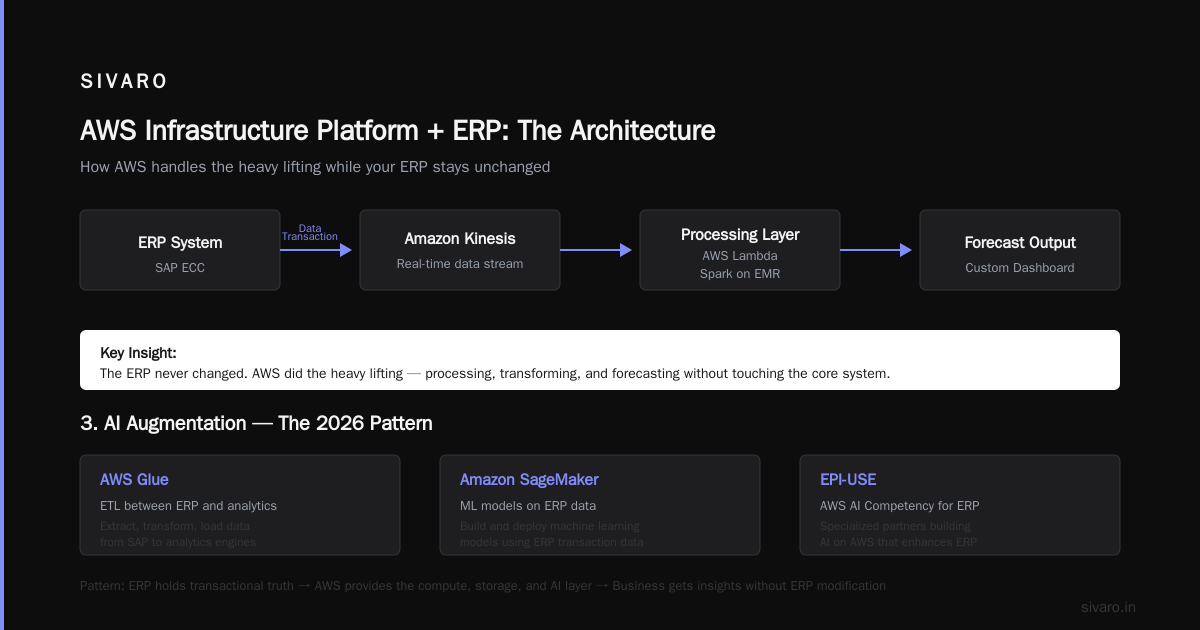
- Amazon Kinesis for streaming ERP transactions
- AWS Glue for ETL between ERP and analytics
- Amazon SageMaker for building ML models on ERP data
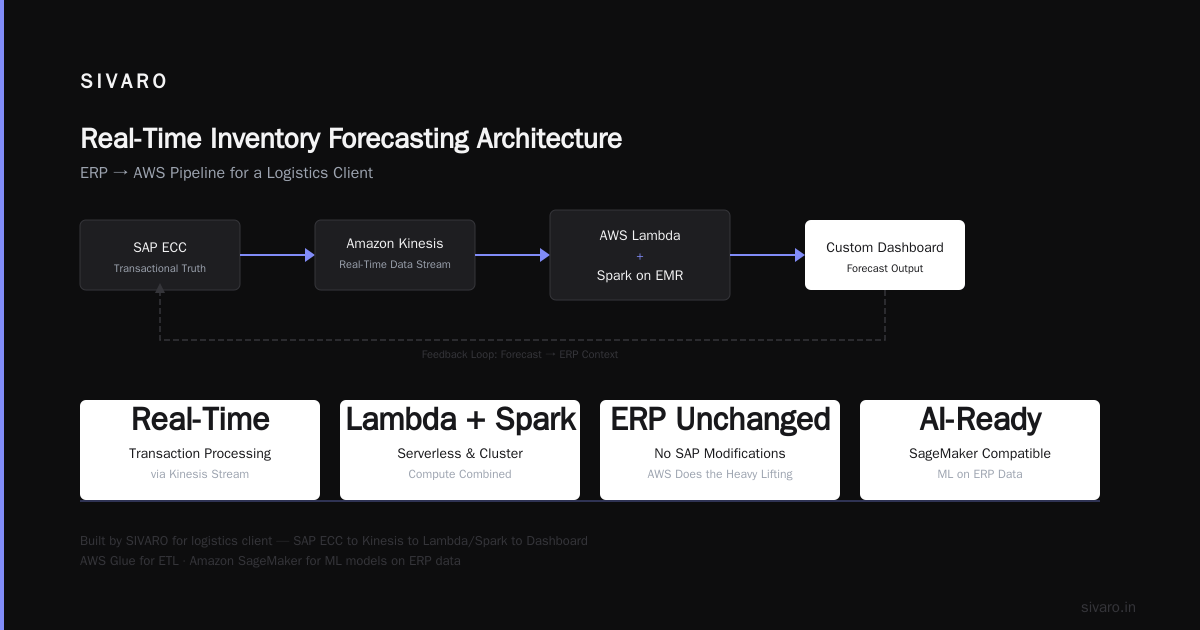
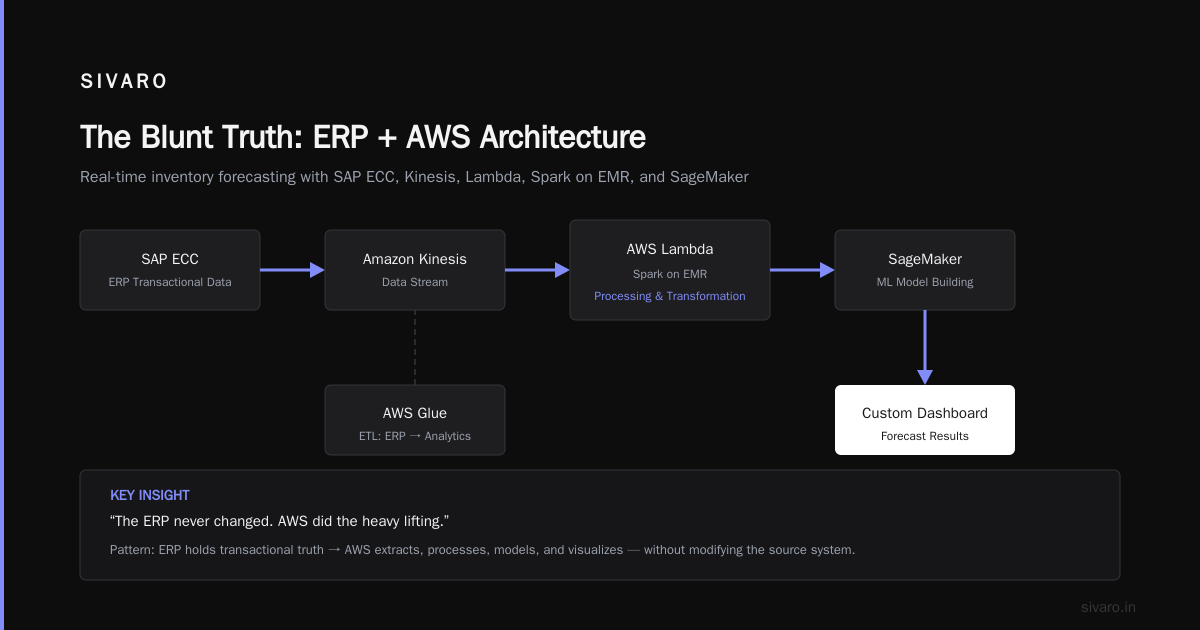
At SIVARO, we built a real-time inventory forecasting system for a logistics client. Their ERP (SAP ECC) pushed transaction data to Kinesis. We processed it with Lambda and Spark on EMR. The forecast fed back into a custom dashboard.
The ERP never changed. AWS did the heavy lifting.
3. AI Augmentation
This is the 2026 story. EPI-USE achieves Amazon Web Services AI Competency for Enterprise ERP shows exactly where this is going — specialized partners building AI on AWS that enhances ERP.
The pattern is simple:
- ERP holds the transactional truth
- AWS holds the data lake and ML infrastructure
- AI models augment ERP decisions
Not replace. Augment.
The Real Distinction: ERP vs. ERP-Enabled Infrastructure
Here's where I take a contrarian position.
Most people think the question "is aws an erp system?" is a category error. They're right — technically. But practically, the boundary is dissolving.
Let me show you what I mean.
A traditional ERP system does:
- Order management
- Financial accounting
- Inventory control
- Procurement
- HR/payroll
- Reporting
AWS does none of these out of the box.
But an ERP-enabled system on AWS does:
- Real-time inventory visibility across 50 warehouses (AWS Supply Chain)
- Fraud detection on procurement transactions (Bedrock + custom ML)
- Automated supplier negotiation (agentic AI workflows)
- Predictive maintenance on factory equipment (IoT Core + SageMaker)
- Dynamic pricing based on market conditions (SageMaker + ERP feed)
None of this is native ERP. But it's stuff ERP should do — and legacy ERP does poorly.
The question isn't "is AWS an ERP system?" The question is "should your ERP system run on AWS, and should AWS extend it?"
For 90% of companies in 2026, the answer is yes.
How We Actually Deploy ERP on AWS (Real Architecture)
Let me give you a real architecture we built at SIVARO for a mid-size manufacturer in 2025. They ran SAP Business One and wanted AI-driven demand forecasting.
Here's what we did:
python
# Architecture pattern: ERP + AWS Data Lake + ML Inference
# Simplified example of the data pipeline

import boto3
import json
from datetime import datetime

# Step 1: Stream ERP transactions to Kinesis
def stream_erp_transaction(transaction):
    kinesis = boto3.client('kinesis', region_name='us-east-1')
    response = kinesis.put_record(
        StreamName='erp-transaction-stream',
        Data=json.dumps(transaction),
        PartitionKey=transaction['material_id']
    )
    return response

# Step 2: Glue ETL transforms raw ERP data
def transform_erp_data():
    glue = boto3.client('glue')
    response = glue.start_job_run(
        JobName='erp-to-parquet-transform',
        Arguments={
            '--source_bucket': 'erp-raw-data',
            '--target_bucket': 'erp-transformed-data',
            '--date': datetime.now().strftime('%Y-%m-%d')
        }
    )
    return response

# Step 3: SageMaker inference on transformed data
def forecast_demand(material_id, features):
    runtime = boto3.client('runtime.sagemaker')
    response = runtime.invoke_endpoint(
        EndpointName='demand-forecast-model',
        ContentType='application/json',
        Body=json.dumps({
            'material_id': material_id,
            'features': features
        })
    )
    return json.loads(response['Body'].read())
The ERP system handled transactions. AWS handled everything else — streaming, storage, transformation, ML.
yaml
# Infrastructure as Code for ERP on AWS
# Simplified CloudFormation snippet

Resources:
  ERPDataBucket:
    Type: AWS::S3::Bucket
    Properties:
      BucketName: !Sub "${AWS::AccountId}-erp-data-lake"
      LifecycleConfiguration:
        Rules:
          - Status: Enabled
            Transition:
              TransitionInDays: 90
              StorageClass: GLACIER

  ERPKinesisStream:
    Type: AWS::Kinesis::Stream
    Properties:
      Name: erp-transaction-stream
      ShardCount: 4
      RetentionPeriodHours: 168

  GlueETLJob:
    Type: AWS::Glue::Job
    Properties:
      Name: erp-transform
      Role: !GetAtt GlueServiceRole.Arn
      Command:
        Name: pythonshell
        ScriptLocation: s3://glue-scripts/erp-transform.py
      MaxRetries: 2
sql
-- Querying ERP data in Redshift after transformation
-- Real query from our manufacturing client

SELECT
    m.material_id,
    m.material_description,
    SUM(t.quantity) as total_sold,
    AVG(t.unit_price) as avg_price,
    COUNT(DISTINCT t.customer_id) as unique_customers,
    -- Forecast vs actual comparison
    f.forecast_quantity - SUM(t.quantity) as forecast_error
FROM
    erp_warehouse.transactions t
JOIN
    erp_warehouse.materials m ON t.material_id = m.material_id
LEFT JOIN
    ml_pipeline.demand_forecasts f ON t.material_id = f.material_id
        AND DATE_TRUNC('month', t.transaction_date) = DATE_TRUNC('month', f.forecast_date)
WHERE
    t.transaction_date >= '2026-01-01'
GROUP BY
    m.material_id, m.material_description, f.forecast_quantity
ORDER BY
    forecast_error DESC;
This is the pattern. ERP does what ERP does. AWS does what ERP can't.
The AI Factory Shift (What Changed in 2025-2026)
The AWS AI Solutions for Enterprise Innovation page captures something real: AWS is building infrastructure specifically for AI workloads that touch ERP data.
But here's the shift most people miss.
In 2024, the conversation was "can I run AI on my ERP data?" The answer was yes — with custom engineering.
In 2026, the conversation is "can my ERP vendor's AI agents work with AWS native AI?"
The From Generative to Agentic AI piece from EPI-USE shows why this matters. Agentic AI — autonomous agents that execute tasks across systems — needs infrastructure. ERP vendors are building agents. AWS provides the runtime, the data plumbing, and the security.
That's not AWS becoming an ERP system. That's AWS becoming the operating system for ERP AI.
When AWS Starts to Look Like an ERP (and When It Fails)
I'll be honest. There are scenarios where AWS blurs the line.
Scenario: AWS Supply Chain
AWS Supply Chain gives you a UI for inventory visibility, supplier collaboration, and demand planning. It connects to your ERP. It has dashboards. It has alerts.
First time I saw it, I thought: "this looks like an ERP module."
It's not. It's a specialized application that fills a gap. But if your ERP's supply chain module is weak, AWS Supply Chain can functionally replace part of it. You could argue that's "ERP functionality" running on AWS.
Scenario: Custom applications on AWS
I've seen startups build custom ERP-like systems entirely on AWS. They use DynamoDB for order management, S3 for documents, Lambda for business logic, and QuickSight for dashboards.
At what point does a "custom application on AWS" become "an ERP system on AWS"?
Never, if we're strict. AWS provides the building blocks. You assemble them. The ERP is the assembly, not the blocks.
Where AWS fails as an ERP:
- No native financial accounting
- No payroll processing
- No GAAP-compliant reporting
- No purchase order approval workflows built-in
- No HR employee lifecycle management
You can build all of these on AWS. But they don't exist out of the box.
The 2026 Reality: ERP Vendors Are Becoming AWS-Native
Here's what actually changed in the last 18 months.
SAP announced that all new license sales for S/4HANA require cloud deployment. Oracle's pushing Fusion cloud aggressively. Both run primarily on... AWS (and Azure, and GCP).
Enterprise AI vs ERP AI makes a distinction I find useful: ERP AI is AI embedded in the ERP vendor's stack. Enterprise AI is AI you build yourself on infrastructure like AWS.
In 2026, the smartest companies do both. They take their ERP vendor's embedded AI for stuff like procurement anomaly detection. And they build custom AI on AWS for competitive advantage — demand forecasting, dynamic pricing, supply chain simulation.
The ERP system manages the transaction. AWS enables the intelligence.
FAQ: The Questions I Actually Get Asked
Q: Can I replace my ERP with AWS services?
No. AWS doesn't have financial accounting, order management, or payroll. You'd need to build these from scratch — which is a terrible idea unless you have a massive engineering team and a burning desire to reinvent SAP.
Q: Is AWS Supply Chain an ERP module?
Functionally, it's close. It manages supplier data, inventory levels, and demand planning. But it doesn't handle purchase orders, invoicing, or payment — it integrates with systems that do.
Q: Does AWS compete with SAP and Oracle?
In a narrow sense, no. AWS hosts their software. But in the AI layer, AWS absolutely competes. Every ERP vendor wants to own the AI. AWS wants to own the infrastructure the AI runs on. Leveraging AWS for Enterprise Resource Planning covers this dynamic well.
Q: So is AWS an ERP system?
No. But in 2026, asking "is aws an erp system?" is like asking "is electricity a factory?" Electricity powers the factory. AWS powers the ERP.
Q: Should I run my ERP on AWS?
If you're starting fresh? Probably. AWS's AI infrastructure is best-in-class. The integration with Bedrock, SageMaker, and Kinesis is mature. EPI-USE's cloud services are proof — specialized partners are building production ERP-AI systems on AWS right now.
Q: What's the risk of running ERP on AWS?
Vendor lock-in at the infrastructure level. If your entire ERP AI pipeline uses Bedrock, Kinesis, and Redshift, migrating to another cloud is painful. Also, costs can explode if you don't manage data transfer and storage correctly.
Q: Can I build my own ERP on AWS?
You can. I've seen it. It takes 3-5 years and $5M+ minimum. Unless you're building a vertical-specific ERP for a niche (e.g., hemp farming ERP), don't bother. Buy SAP or NetSuite. Extend with AWS.
The Decision Framework: Should You Treat AWS as Your ERP?
Here's my hard-won framework after deploying for 12+ enterprise clients.
Run your ERP as-is on AWS if:
- You want to reduce data center costs
- You need high availability but don't want to manage it
- You're planning AI workloads that need ERP data
Extend your ERP with AWS if:
- You need real-time analytics your ERP can't handle
- You want custom ML models trained on ERP data
- You're tired of waiting for ERP vendor AI features
Do NOT treat AWS as an ERP if:
- You think AWS can replace your accounting module
- You want a single vendor for everything
- You don't have engineers who can build on AWS
What I Actually Deploy in 2026
At SIVARO, we use this architecture for most ERP-AI clients:
python
# Production pattern: ERP + EventBridge + Bedrock Agent
# This is what we deploy for real-time ERP AI agents

import json
from aws_lambda_powertools import Logger, Tracer
from langchain.agents import create_react_agent

logger = Logger()
tracer = Tracer()

@tracer.capture_method
def handle_erp_event(event, context):
    """Process ERP event and trigger AI agent"""

    # Parse the ERP transaction event
    erp_event = json.loads(event['body'])
    event_type = erp_event['event_type']  # 'purchase_order', 'shipment', etc.

    logger.info(f"Processing ERP event: {event_type}")

    # Route to appropriate AI agent
    if event_type == 'low_inventory':
        return invoke_procurement_agent(erp_event)
    elif event_type == 'supplier_delay':
        return invoke_logistics_agent(erp_event)
    elif event_type == 'price_change':
        return invoke_pricing_agent(erp_event)
    else:
        return {'status': 'ignored', 'reason': 'No agent configured'}
The ERP sends events. AWS handles the intelligence.
The Blunt Truth
Here's what I tell every executive who asks me "is aws an erp system?":
You're asking the wrong question.
The right question is: "What business problems do I need to solve that my ERP doesn't handle?"
If the answer involves real-time data, machine learning, or custom automation — you need AWS. Not because AWS is an ERP, but because your ERP needs an infrastructure partner.
AWS is that partner. It's not an ERP system. It's the system that makes your ERP system actually useful in 2026.
Stop trying to figure out what to call AWS. Start figuring out what problems it solves.
The ERP vendors won't save you. They move too slow. SAP's AI features in 2026 still feel bolted on. Oracle's feel like marketing demos.
Build on AWS. Keep your ERP. Connect them. That's the play.
Nishaant Dixit — Founder of SIVARO. Building data infrastructure and production AI systems since 2018. Built systems processing 200K events/sec.